Your Warehouse Data Is Stuck — Reverse ETL Fixes That
Millions of user records sitting in your data warehouse while the marketing team manually exports CSVs into Salesforce. Sound familiar? That’s the exact problem Reverse ETL solves.
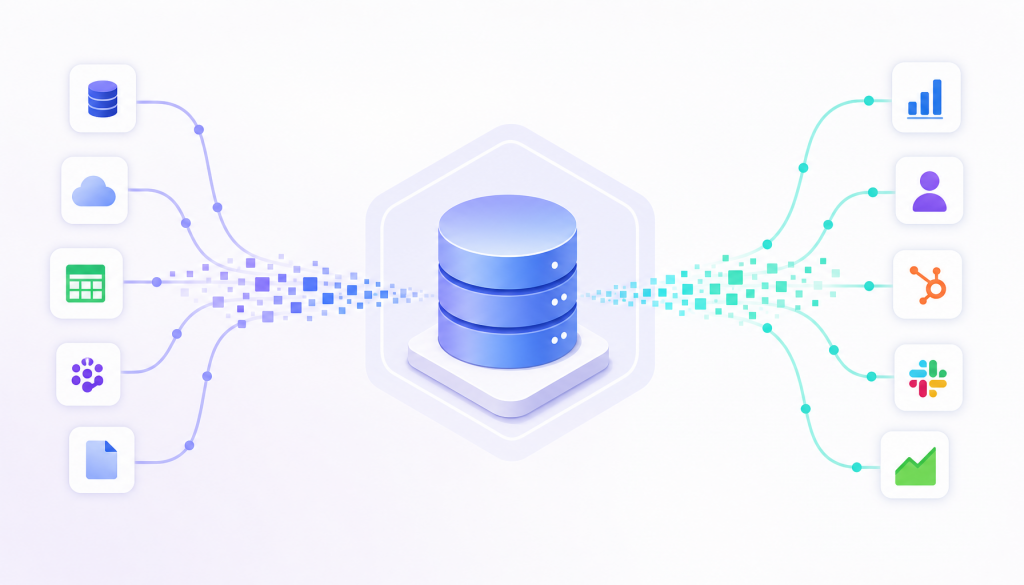
Traditional ETL pulls data from business systems into a warehouse. Reverse ETL does the opposite — it pushes clean, modeled data from your warehouse back into operational tools. The market has crossed $500 million and keeps growing. Hightouch and Census are the two dominant players, with feature overlap north of 80%. Picking between them feels like choosing Coke or Pepsi.
But there are real differences. After digging into both platforms extensively, here’s my breakdown of where each one wins and where it falls short.
Hightouch: Built for Marketing Teams
Hightouch came out of Y Combinator in 2019. The founding team came from Segment, and it shows — they understand what marketers need from data infrastructure.
Customer Studio is their flagship differentiator. It’s a visual audience builder that lets non-technical marketers create segments without writing SQL. “Users who visited the pricing page last week but didn’t convert” — a few clicks, done. This feature positions Hightouch as a composable CDP, not just a sync tool.
Match Booster solves a specific paid media problem. Your warehouse has user IDs, but Facebook only matches on emails and phone numbers. Match Booster uses identity graphs to enrich your records, boosting ad match rates by 20-30%. If you spend heavily on paid acquisition, that’s real money.
Integration breadth is another strength. Over 200 destination connectors covering CRMs, ad platforms, email tools, analytics, and even tools like Notion and Airtable. Source support includes Snowflake, BigQuery, Redshift, and Databricks — all the major warehouses.
Pricing is destination-based. The Growth plan starts at $1,000/month. According to Vendr data, destination fees range from $500 to $2,000+/month depending on tier and contract. Customer Studio and Match Booster cost extra. Enterprise deals average around $20K/year for SMB and can reach $130K+ for large deployments. There’s a free tier for testing, limited to 1 destination.
Best for: Teams where marketing drives the data activation roadmap. Philips, Samsung, and 7-Eleven are among their customers.
Census: Engineer-First, Now Part of Fivetran
Census also launched in 2019 but positioned itself squarely for data engineering teams. In February 2026, Fivetran acquired Census and rebranded it as “Fivetran Activations” — though the Census brand still exists for now.
dbt integration is their biggest differentiator. Census reads your dbt project metadata directly. Models defined in dbt appear automatically in Census. You control which models are syncable via tags, and version control follows your git workflow. For teams that live in dbt, this removes an entire layer of configuration friction.
Live Syncs offer near-real-time data activation. Instead of batch-only scheduling, Census supports change data capture (CDC). When a row changes in your warehouse, it can reach downstream systems within minutes. Use cases like fraud detection and inventory alerts benefit here, where batch latency isn’t acceptable.
Census Embedded is a white-label offering. If you build SaaS products and want to let customers sync data to their own CRMs, you can embed Census without building the integration layer yourself. Niche market, but high-margin.
Integration depth over breadth. Around 150+ destinations — fewer than Hightouch, but the core connectors (Salesforce, HubSpot, Google Ads) get deeper optimization. Salesforce support includes upsert, delete, and contact association out of the box.
Pricing shifted to MAR (Monthly Active Rows) after the Fivetran acquisition. It’s consumption-based — you pay for inserted and updated rows, including deletes. Each activation runs on its own consumption curve. Fivetran offers a free plan with 3,500 MAR for Activations to get started. Real-world costs depend heavily on sync volume and frequency.
Best for: Data teams running dbt, organizations already on Fivetran, and scenarios requiring near-real-time sync.
Head-to-Head: Where the Differences Actually Matter
Connector Ecosystem
Hightouch wins on quantity (200+ vs 150+), but many of those extra connectors are long-tail tools. The top 50 destinations that most companies actually use? Both platforms cover them well.
Census wins on connector depth. Their Salesforce connector, for example, handles more complex operations natively. If your primary destinations are Salesforce, HubSpot, or Google Ads and you need advanced sync modes, Census tends to offer more granular control.
On the source side, it’s nearly a tie. Both support Snowflake, BigQuery, Redshift, and Databricks. Census adds Postgres and MySQL as sources, which matters for teams that haven’t fully migrated to a cloud warehouse.
Sync Capabilities: Batch vs Real-Time
Hightouch defaults to scheduled batch syncs with a minimum interval of 15 minutes. That works for most marketing automation. Enterprise plans support near-real-time, but it’s not the primary selling point.
Census’s Live Syncs are genuinely near-real-time via CDC. Latency stays under 5 minutes. The trade-off: your warehouse needs specific configuration (Snowflake Streams, BigQuery Change History), and real-time syncs are billed at a higher rate on the MAR consumption curve.
Both platforms handle retries, error logging, and webhook notifications reliably. Census adds pre-sync field validation rules — rows that don’t pass get skipped and flagged rather than synced with bad data.
User Experience
Hightouch is more approachable. Customer Studio’s drag-and-drop audience builder, wizard-style sync configuration, and field mapping previews reduce the learning curve significantly. Marketers can self-serve without filing tickets.
Census is more technical. The interface surfaces SQL directly, shows dbt models as first-class objects, and uses table-style field mapping suited for bulk configuration. The learning curve is steeper, but power users move faster.
On the CLI front, Census is stronger. You can export sync configurations as YAML and manage them in git — true infrastructure-as-code for your data activation layer. Hightouch’s CLI only triggers syncs; it can’t manage configurations.
Pricing Models Compared
Hightouch charges per destination with row-based overages. What counts as a row? An upsert is one row. A delete is one row. Sync 1 million users daily and you’re burning 30 million rows per month. Overages stack up fast if you’re not watching.
Census (Fivetran Activations) uses MAR-based consumption pricing. Each activation has its own consumption curve. The free tier includes 3,500 MAR. Beyond that, costs scale with usage. One advantage for existing Fivetran customers: Activations appear on the same bill, simplifying procurement.
Which is cheaper? It depends entirely on your pattern:
– Few users, many fields, high sync frequency → Census MAR model tends to be more predictable
– Many users, low update frequency → Hightouch’s per-destination model can work out cheaper
– Already a Fivetran customer → Census bundles save on overhead
A rough benchmark: 1 million users, daily syncs, 5 destinations. Expect $3,000-4,000/month on either platform. But your mileage will vary significantly based on contract negotiation and actual usage patterns.
Enterprise Features
Access control: Both offer RBAC. Hightouch uses a Workspace model for team isolation. Census uses Permission Groups with finer granularity — you can restrict access down to individual syncs.
Audit logging: Census is more detailed. Every config change, sync execution, and field modification gets logged and can be exported. Hightouch logs sync-level operations but doesn’t capture field-level changes.
Data governance: Census lets you tag models with PII labels and auto-mask data during sync. Hightouch lacks native masking — you need to handle it upstream in your warehouse transformations.
Support: Both offer dedicated Slack channels and sub-2-hour response times on enterprise plans. Post-acquisition, Census customers can tap into Fivetran’s enterprise support infrastructure, which is a meaningful advantage for large organizations navigating vendor management.
Three Decision Points
1. How mature is your data team?
If dbt is central to your stack, Census is the natural fit. The native integration eliminates redundant configuration and keeps everything version-controlled. If you’re still writing raw SQL transformations — or don’t have a dedicated data team — Hightouch’s visual tools will get you productive faster.
2. Who owns the activation workflow?
Marketing wants self-serve audience building and sync configuration? Hightouch. Data team owns the pipeline and marketing submits requests? Census.
3. What does your existing stack look like?
Already a Fivetran customer? Census gives you unified billing, unified support, and a single vendor relationship. Using Airbyte, Stitch, or another ingestion tool? Either platform works — compare on features and negotiate pricing.
The Bottom Line
Don’t trust list prices. Get both platforms to quote your actual scenario — real data volumes, real sync frequencies, real destination counts. The gap between quoted and negotiated pricing can be 30-50%.
Both tools are converging functionally. The remaining differentiation comes down to ecosystem fit, pricing model alignment, and how your team prefers to work. Hightouch leans into marketing self-service and breadth. Census leans into engineering discipline and depth.
My suggestion: run two-week trials on both. The tool that generates fewer support tickets from your team is probably the right one. Reverse ETL is a commodity moving toward feature parity — what matters most is how cleanly it integrates with the stack you already have.
Stay updated with our latest AI insights