In Q1 2026, a five-person data team opened their Fivetran renewal email. The annual fee had jumped from $180,000 to $270,000, a 50% increase with zero new features attached. The team lead forwarded the email to Slack with one line: “We need to talk.”
Three months later, they had migrated 600 Terraform modules to OpenTofu, replaced Fivetran with self-hosted Airbyte, and swapped Datadog for Grafana plus SigNoz. Their annual infrastructure tooling costs dropped 58%.
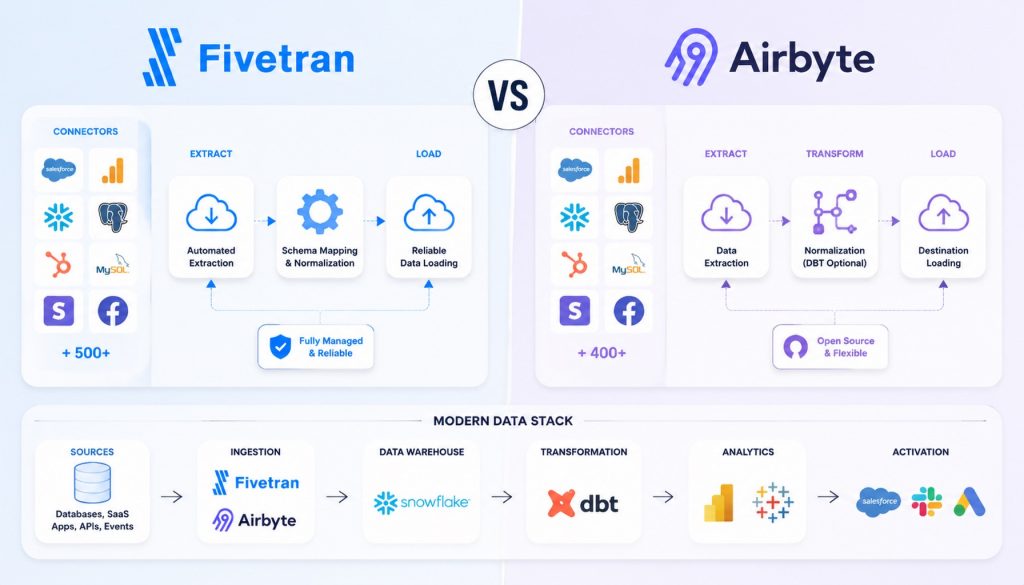
This story keeps repeating across the industry. In 2026, the data integration market is going through a value correction. Fivetran and Airbyte represent two fundamentally different paths: fully managed convenience versus open-source cost control. This article breaks down where each tool fits, what each one costs in practice, and how to decide between them based on your team’s engineering capacity and compliance posture.
The Pricing Problem
A data engineer we’ll call Sarah faced a concrete problem: her company needed to sync 50 million rows per month from Salesforce, PostgreSQL, and Google Analytics into Snowflake. Fivetran quoted $4,500/month under the MAR (Monthly Active Rows) billing model. Airbyte Cloud came in at $1,800/month with per-connector plus usage-based pricing. Self-hosted Airbyte would run about $300/month in AWS compute.
On the surface, that looks like a 15x cost difference. But Sarah understood the tradeoffs went beyond the invoice.
Fivetran promises zero-ops. You configure a connector and the platform handles everything: schema changes, API rate-limit retries, anomaly alerts. When your team has no dedicated data engineer, that promise carries real dollar value.
Airbyte promises full ownership. The source code is auditable, self-hosting keeps data inside your network, and the CDK (Connector Development Kit) lets you write custom connectors in Python. If you have data engineering capacity, that flexibility carries real dollar value too.
Sarah chose self-hosted Airbyte. The deciding factor was not price. Her company had strict data compliance requirements where customer data could not pass through third-party servers. Fivetran routes data through its own transit servers before landing it in the warehouse, which was a red line under their compliance framework.
How MAR Billing Compounds
Fivetran’s MAR model charges for every row that changed during the billing period (inserts, updates, deletes). The first 500,000 rows are free, then pricing scales at roughly $100-120 per million rows. The math gets expensive fast in write-heavy workloads.
Consider an e-commerce company with 100,000 new orders per day. Each order gets modified an average of three times (payment, shipment, fulfillment). That produces 9 million active rows per month from a single table. Sync ten tables at similar velocity and MAR crosses 100 million. At Fivetran’s rates, that means $10,000-15,000 per month.
Airbyte Cloud charges differently: a base fee per connector ($50-200/month) plus data transfer volume (roughly $0.50-1.00 per GB). The same scenario above lands somewhere around $2,000-3,000/month.
Self-hosted Airbyte has no licensing fee. You need a server (a t3.large handles most workloads at about $100/month) and an engineer who knows Docker. But “free” does not mean “no cost.” Maintenance windows, version upgrades, and failure investigation all consume engineering hours.
An industry survey from early 2026 found that 38% of Fivetran customers were actively evaluating alternatives or had already started migrating. Cost was the primary driver, but not the only one.
Connector Ecosystem: Maintained vs Community-Driven
Fivetran offers 500+ pre-built connectors. Airbyte has 350+. The raw numbers obscure a more important distinction in maintenance models.
Every Fivetran connector is maintained by paid engineers and tested against production environments. When Salesforce changes an API, when MySQL ships a new version, when AWS S3 adjusts throttling behavior, Fivetran patches compatibility before most customers notice. You do not track upstream API changelogs. Sync continues working.
Airbyte connectors are community-maintained. Popular connectors (PostgreSQL, MySQL, Snowflake, S3) receive frequent updates and perform well. Less popular connectors may sit untouched for months. When you hit a bug in one of those, the fix involves forking the code yourself. For teams with engineering depth, this is fine. For a two-person analytics team, it can become a multi-day incident.
CDC Coverage
Fivetran supports CDC (Change Data Capture) for 20+ databases, including Oracle and SQL Server. Airbyte’s CDC support concentrates on PostgreSQL, MySQL, and MongoDB. Oracle support remains in beta.
SaaS Connector Depth
Fivetran covers a large number of vertical SaaS tools (HubSpot, Marketo, Zendesk, NetSuite) with connectors that handle rate limiting, pagination, and field mapping specific to each platform. Airbyte covers mainstream SaaS applications, but niche tools may require a custom CDK connector.
Custom Connectors
This is where Airbyte pulls ahead. The CDK provides a Python SDK that lets you build a new connector in hours. Fivetran also offers an SDK, but with more restrictions. Most custom scenarios require engaging their professional services team.
A fintech company needed to sync data from an internal risk-scoring system built on PostgreSQL and Redis. Fivetran’s response: “requires evaluation, likely needs custom development.” The Airbyte approach: write a CDK connector in two days, then open-source it to the community.
Deployment Models and Data Sovereignty
Fivetran operates as pure cloud SaaS. Your data passes through Fivetran’s servers before landing in the destination warehouse. Fivetran holds SOC 2 Type II, GDPR, and HIPAA certifications. Those certifications do not change the physical reality that data leaves your network perimeter.
For many companies, this is acceptable. For regulated industries (financial services, healthcare, government), it is not. In 2026, EU data sovereignty regulations tightened further. Some European companies now explicitly require that data never transits through US-based company infrastructure.
Airbyte offers three deployment options:
Airbyte Cloud is a fully managed experience similar to Fivetran. Data passes through Airbyte’s servers. Pricing runs 30-50% below Fivetran, though connector coverage and stability are still catching up.
Self-hosted (Docker/Kubernetes) runs entirely on your infrastructure. Data never leaves your network. You handle upgrades, monitoring, and backups. This option requires a team with DevOps capability.
Airbyte Enterprise (hybrid cloud) is the 2026 addition. The control plane lives in Airbyte’s cloud while the data plane runs inside your VPC. You get the managed UI and scheduling without data leaving your network. This balances operational convenience against sovereignty requirements.
A growing pattern across the industry: companies run a mixed setup where sensitive data flows through self-hosted Airbyte while non-sensitive data syncs through Fivetran or Airbyte Cloud to reduce operational overhead.
Enterprise Features Comparison
Data integration in 2026 requires more than moving bytes from source to destination. Here is how the two platforms compare across enterprise requirements:
| Capability | Fivetran | Airbyte Cloud | Airbyte OSS |
|---|---|---|---|
| dbt Integration | Native (post-acquisition) | External (dbt Cloud/Core) | External (dbt Cloud/Core) |
| Schema Evolution | Automatic (add columns, handle type changes) | Semi-manual (confirmation required) | Semi-manual |
| Anomaly Detection | Built-in (volume drops, sync duration, quality) | Dashboard + basic alerts | Logs only |
| RBAC | Full (roles, SSO, audit logs) | Available | Not included |
| SLA | 99.9% uptime (enterprise plan) | No public SLA | Depends on your infra |
| Compliance Certs | SOC 2 Type II, HIPAA BAA, GDPR | SOC 2 | Self-attested |
| Support | 24/7 with dedicated TAM | Business hours | Community/GitHub |
The dbt Labs acquisition in mid-2026 gave Fivetran a significant integration advantage. You can now configure dbt models directly in the Fivetran UI and trigger transformations immediately after sync completion. Airbyte users can achieve the same workflow, but it requires separate dbt Cloud or dbt Core configuration on the warehouse side.
A healthcare data company’s CTO summarized their decision: “We chose Fivetran not because it’s cheaper. Our compliance team needs to see a HIPAA BAA, SOC 2 reports, and an incident response SLA. Airbyte’s technology is strong, but enterprise procurement requires more than technology.”
Latency: Where Both Tools Hit Their Ceiling
Fivetran’s default sync interval ranges from a few minutes to one hour. Enterprise plans can push down to 15 minutes (at additional cost) and business-critical plans reach 1-minute intervals (at significantly more cost). The underlying architecture remains batch-oriented.
Airbyte Cloud offers a minimum 5-minute sync interval. Self-hosted Airbyte allows custom scheduling. Neither platform provides true streaming delivery.
For millisecond-level latency requirements (fraud detection, real-time recommendations, live monitoring), both tools are the wrong choice. Those use cases belong to a streaming stack: Kafka, Flink, or Debezium.
A practical trend in 2026: data teams have stopped pursuing “real-time everything.” The cost and complexity of real-time pipelines vastly exceeds batch processing. Most analytics workloads (BI dashboards, marketing attribution, financial reconciliation) perform fine at hourly or daily granularity. Teams reserve streaming architecture for the small number of use cases that actually demand it.
Time-to-Value and Ongoing Maintenance
Fivetran’s setup time is about one hour. Create an account, select source and destination, configure the connector, click sync. The UI is intuitive with sensible defaults. Non-technical users (analysts, product managers) can configure basic sync tasks without engineering support.
Airbyte OSS requires 1-2 days for initial setup. You need a server with Docker and Docker Compose installed, then you pull images, run docker-compose up, open the web UI on port 8000, configure connectors, understand normalization settings, and learn to read sync logs for troubleshooting.
Airbyte Cloud setup time is closer to Fivetran at 1-2 hours, though you still need to understand concepts like incremental sync modes, cursor fields, and CDC replication slots.
The long-term maintenance cost matters more than initial setup:
Fivetran requires about 1-2 hours per month checking sync status and handling occasional alerts. You rarely touch configuration. Upgrades, security patches, and performance optimization happen on Fivetran’s side without your involvement.
Airbyte OSS demands 2-5 hours per week across upgrade management, failed sync investigation, resource tuning, and configuration backups. When you hit a bug, the path forward is a GitHub issue or a code fork.
Airbyte Cloud falls in between at 1-3 hours per month, primarily for occasional manual schema change handling.
For a two-person data team, Fivetran may be the better investment even at $3,000/month more, because reclaimed engineering time goes toward higher-value analytical work. For a team with five or more data engineers who already manage data infrastructure, adding Airbyte to the stack is incremental overhead against significant cost savings.
Decision Framework
Fivetran fits when:
- No dedicated data engineering staff, or engineering time is fully allocated elsewhere
- Heavy reliance on SaaS connectors (Salesforce, HubSpot, Marketo, NetSuite)
- Compliance requirements demand vendor-provided SOC 2, HIPAA, and GDPR certifications
- Budget allows for convenience pricing in exchange for zero operational burden
- 24/7 support and contractual SLA are procurement requirements
- The dbt integration story matters (post-acquisition native support)
Airbyte Cloud fits when:
- Basic data engineering capability exists on the team, but no desire to manage infrastructure
- Budget constraints require lower integration costs
- Primary data sources are mainstream (PostgreSQL, MySQL, Snowflake, S3, BigQuery)
- Occasional manual schema management is acceptable
- Enterprise-grade RBAC is not a hard requirement
Airbyte OSS fits when:
- Dedicated DevOps or data engineering team is in place
- Data sovereignty requires that no data transits third-party servers
- Custom connectors or sync logic modifications are needed
- Data volume is large enough that MAR-based billing becomes prohibitive (hundreds of millions of rows monthly)
- The team is willing to trade operational responsibility for full control
- Contributing to open-source community is a bonus
What Changed in 2026
Fivetran acquired dbt Labs. This was the biggest news in the data integration space this year. The combined platform now offers end-to-end ELT plus transformation in a single UI. For teams already committed to the Fivetran ecosystem, this reduces toolchain fragmentation.
Airbyte Enterprise launched hybrid cloud. Control plane in the cloud, data plane in the customer’s VPC. This addresses the data sovereignty objection that previously pushed regulated companies toward self-hosted deployments while reducing the operational cost of running everything yourself.
AI-native connectors emerged. Both platforms now offer connectors for vector databases, LLM API logs, and embedding stores. Airbyte open-sourced connectors for Pinecone, Weaviate, and Qdrant. Fivetran built official connectors for OpenAI usage logs and Anthropic API logs.
Renewal pricing drove a migration wave. Fivetran’s Q1 2026 renewals averaged 30-50% price increases. This triggered a visible migration wave, with many mid-market teams evaluating Airbyte or other alternatives. Fivetran’s market share continues to grow, but the growth rate is decelerating.
The Real Tradeoff
An e-commerce company might run Fivetran for Shopify and Google Ads data (convenience), self-hosted Airbyte for internal PostgreSQL replication (control), and custom Python scripts for legacy system extraction (necessity). No single tool covers every scenario perfectly.
A fintech that migrated from Fivetran to Airbyte OSS saved $150,000 annually. They also spent one engineer’s 30% capacity on Airbyte maintenance, absorbed two four-hour sync outages caused by botched upgrades, and invested a full month in migration and validation testing.
A healthcare data company stays on Fivetran despite paying 10x what Airbyte would cost. Their compliance team trusts Fivetran’s HIPAA BAA, trusts their incident response process, trusts their 99.9% uptime SLA. That trust has a dollar value.
When evaluating these tools, the useful questions are:
- How much data engineering capacity does the team have today?
- What is the dollar value of “not thinking about data pipelines”?
- What are the hard compliance constraints on data transit?
- What does projected data volume growth look like over 18 months?
- How much customization will the pipeline require?
The answers do not live in feature comparison matrices. They live in your organization’s staffing, regulatory environment, and growth trajectory. Pick the tool that fits the team you have, not the team you plan to hire.
Related Reading
- Data Integration Tools for Startups 2026: Fivetran vs Airbyte vs Hevo vs Stitch
- Choosing Your Data Integration Platform in 2026: Fivetran, Airbyte, Hevo, and Stitch Compared
Stay updated with our latest AI insights