A five-person DevOps team opened their Terraform Cloud renewal email in Q1 2026. The annual bill had jumped from $180,000 to $270,000, a 50% increase with no new features to justify the delta. The team lead forwarded the email to their Slack channel with one line: “We need to talk.”
Three months later, that team had migrated 600 Terraform modules to OpenTofu, replaced their Fivetran data pipelines with self-hosted Airbyte, and swapped Datadog for a Grafana plus SigNoz stack. Annual infrastructure tooling spend dropped 58%.
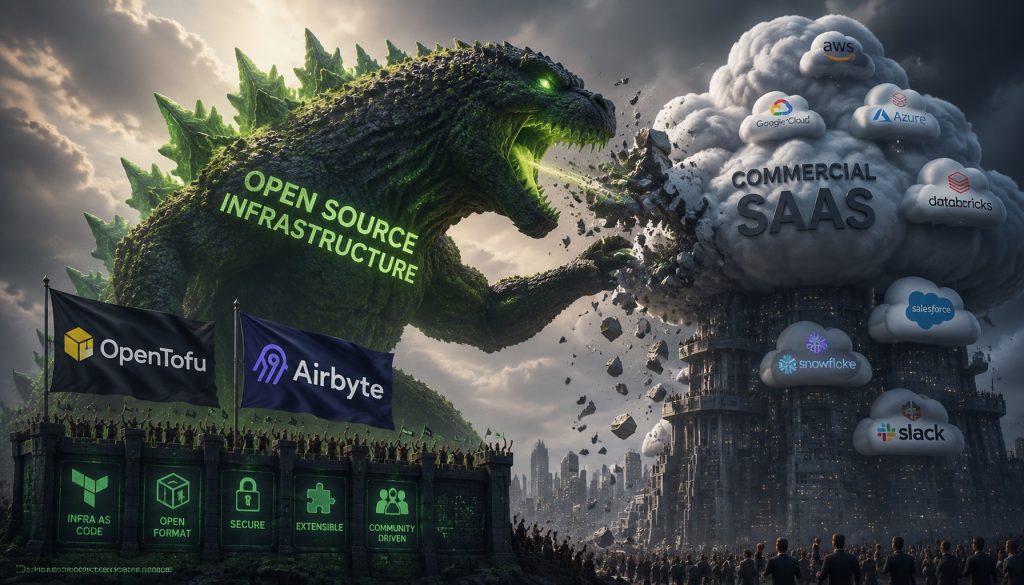
This is not an isolated case. In 2026, open source infrastructure is systematically eroding commercial SaaS territory across the stack.
The Trust Crisis: License Changes and Their Consequences
The timeline matters.
In August 2023, HashiCorp changed Terraform’s license from Mozilla Public License (MPL 2.0) to Business Source License (BSL 1.1). BSL is not an OSI-approved open source license. It prohibits anyone from using Terraform to build a “competing product,” and the definition of “competing” remains vague enough to make legal departments uncomfortable.
The community responded fast. By September 2023, the Linux Foundation announced OpenTofu, a fork based on the last MPL-licensed Terraform release. IBM, Alibaba, Gruntwork, and Spacelift publicly backed the project on day one.
In late 2024, IBM acquired HashiCorp for $6.4 billion. Terraform, Vault, Consul, Nomad: all became IBM assets. IBM needs to recoup that investment, and enterprise license tightening, feature gating, and ecosystem lock-in are the predictable commercial playbook.
This pattern is not new. Elastic switched Elasticsearch from Apache 2.0 to SSPL in 2021, and AWS immediately forked OpenSearch. MongoDB took the same path in 2018. In 2024, Elastic added AGPL as an option under community pressure, but once trust breaks, repair costs far exceed maintenance costs.
According to a Q2 2026 industry survey, 38% of Terraform users are evaluating or actively migrating to alternatives. OpenTofu’s annual download growth exceeds 300%, with cumulative downloads approaching 10 million. GitHub stars reached 29,300 as of June 2026.
The logic is simple: when your infrastructure tooling vendor can change the rules at any time, you either accept that risk or take back control.
The Economics: How Much Can Open Source Actually Save?
Cost is the primary migration driver, far more powerful than any technical ideology.
Data integration is one of the clearest examples. Fivetran charges by Monthly Active Rows (MAR). A mid-size SaaS company processing 50 million rows per month typically sees Fivetran bills in the $120,000 to $180,000 annual range. Switching to self-hosted Airbyte drops infrastructure costs (Kubernetes cluster plus storage) to roughly $20,000 to $40,000 per year, plus about half an engineer’s time for maintenance. Net savings: 50-70%.
A more extreme case: one e-commerce platform had a single high-frequency update table (8 million row changes per day) that tripled their Fivetran monthly bill within one quarter. After moving to Airbyte, the same data volume produced only infrastructure costs with no per-row billing surprises.
Observability shows even wider gaps. Datadog’s pricing model stacks per-host fees with per-module SKUs. Infrastructure monitoring runs $15-23 per host per month, then add APM ($31/host/month), log management ($0.10/GB ingested), and Synthetics (per-test pricing). A 50-host team running Infrastructure plus APM plus Logs easily exceeds $5,000 per month, or over $60,000 annually.
SigNoz self-hosted? A ClickHouse plus OpenTelemetry combination runs $800-1,500 per month in infrastructure costs (cloud VMs plus storage) for the same 50-host scale, covering logs, traces, and metrics. Even including engineering maintenance time, total cost sits at 20-30% of the Datadog equivalent. SigNoz’s published benchmarks claim customers save up to 80% after migration.
Infrastructure as Code follows the same pattern. Terraform Cloud’s Team and Governance tier starts at $70 per user per month. Enterprise pricing is custom but commonly exceeds $100 per user per month. OpenTofu paired with open source CI/CD pipelines (GitHub Actions, GitLab CI) delivers comparable functionality at near-zero tooling cost.
| Category | Commercial Option | Open Source Alternative | Annual Cost (50-host / mid-size) | Typical Savings |
|---|---|---|---|---|
| Data Integration | Fivetran | Airbyte (self-hosted) | $120-180K vs $20-40K | 50-70% |
| Observability | Datadog | SigNoz + Grafana | $60K+ vs $10-18K | 70-80% |
| IaC Platform | Terraform Cloud | OpenTofu + CI/CD | $42-60K vs ~$0 tooling | 90%+ |
| Transformation | dbt Cloud | dbt Core (Apache 2.0) | $50-100K vs $0 license | 100% tooling |
Technical Maturity: From “It Works” to Production-Ready
Two years ago, choosing open source alternatives required a leap of faith. Connector coverage was thin, documentation was incomplete, communities were small. Those concerns were valid then.
In 2026, the situation is different.
OpenTofu has iterated to version 1.12.x, and the codebase diverged significantly from Terraform throughout 2025. OpenTofu-exclusive features now include native state file encryption (supporting AWS KMS, PBKDF2, and other key providers), dynamic provider configuration, loopable import operations, and provider iteration. These capabilities either don’t exist in Terraform’s open source release or require the paid Enterprise edition.
Migration remains smooth for now. Both projects share compatible core language semantics and state file formats. Existing Terraform modules run on OpenTofu with near-zero modification. But this window is narrowing: as each project introduces exclusive features, future migration complexity will increase. Teams considering the switch face a “migrate now or pay more later” calculation.
Airbyte offers over 350 connectors in its open source release as of 2026, covering major SaaS platforms, databases, and API sources. The Connector Development Kit (CDK) lets Python developers build custom connectors in one to two days. Airbyte Cloud provides a managed option at pricing typically 30-50% below Fivetran.
For comparison, Fivetran (which completed its merger with dbt Labs in June 2026) maintains over 500 connectors with higher quality consistency since all are maintained by paid engineering staff. Airbyte’s advantage lies in flexibility: self-hosting means data never leaves your network, a hard requirement for regulated industries.
Grafana plus SigNoz covers the three pillars of observability: metrics, logs, and distributed traces. SigNoz natively supports OpenTelemetry and uses ClickHouse (the columnar database running at Uber and ByteDance) for storage, delivering strong query performance at scale. Grafana’s dashboard ecosystem and alerting capabilities are already industry standard. Together, they cover Datadog’s core use cases.
PostgreSQL deserves mention at the database layer. It is the de facto open source relational database standard, with performance and features that match or exceed many commercial options. Choosing AWS RDS PostgreSQL or Google Cloud SQL for PostgreSQL over Aurora or Cloud Spanner preserves migration capability: your data formats and query syntax work in any PostgreSQL-compatible environment.
Composable Architecture vs. All-in-One Platforms
Fivetran and dbt Labs completed their merger in June 2026, serving over 100,000 data teams. The merger logic is end-to-end data infrastructure: data movement plus transformation plus governance in a single platform.
This is exactly the model the open source ecosystem opposes.
Composable architecture means choosing the best tool for each layer and using open standards (SQL, OpenTelemetry, Apache Iceberg) as connective tissue. Data integration through Airbyte, transformation through dbt Core (still open source under Apache 2.0), orchestration through Dagster or Prefect, storage in Iceberg format, analytics via DuckDB or ClickHouse.
The benefits of this approach come in three dimensions. First, no single point of failure. A Fivetran outage takes down your entire pipeline; a self-hosted Airbyte instance’s availability is determined by your own Kubernetes cluster. Second, pricing transparency. You pay for compute and storage, not for “platform access.” No MAR multiplication leading to bill surprises. Third, component-level replaceability. When a better tool appears, swapping one component costs far less than replacing an entire platform. OpenTelemetry’s OTLP protocol means your instrumentation code doesn’t change when switching backends from SigNoz to Grafana Tempo or vice versa.
The trade-off is real: you own the integration layer, version compatibility testing, and operations. This is not a free lunch. It is a transaction where engineering time buys control and long-term cost predictability.
Community Velocity: Why Open Source Ships Faster
OpenTofu delivered multiple features that Terraform’s backlog had carried for years, all within two years of the fork. Client-side state encryption was an RFC community members submitted to Terraform in 2016. OpenTofu shipped it in under a year.
The difference comes down to governance. OpenTofu operates under the Linux Foundation with a Technical Steering Committee (TSC) meeting biweekly. Community members participate directly in RFC discussions and code contributions. Terraform under IBM follows commercial priorities: new capabilities are more likely to land in paid Terraform Cloud/Enterprise tiers than in the open source release.
Airbyte’s connector development model shows similar dynamics. The CDK lowers the contribution barrier, enabling community developers to respond quickly when a SaaS product updates its API. When Notion ships a new API version, community patches typically arrive faster than commercial vendors’ planned release cycles.
Grafana’s ecosystem is the textbook example. Grafana Labs keeps its core products (Grafana, Loki, Tempo, Mimir) open source while monetizing through Grafana Cloud and enterprise support. This model demonstrates that open source and commercial success coexist when the company doesn’t treat its community as unpaid beta testers.
The Counter-Argument: Open Source Is Not a Silver Bullet
The open source narrative frequently glosses over several realities that engineering leaders must weigh honestly.
Operational overhead is non-zero. Self-hosted Airbyte requires ongoing Kubernetes cluster maintenance: upgrades, scaling, incident response. OpenTofu state management needs your own remote backend setup. SigNoz’s ClickHouse cluster demands tuning as data volumes grow. All of this requires dedicated personnel. A 20-person startup without a platform engineering function may find that self-hosted Airbyte’s hidden costs exceed Fivetran’s invoice.
SLAs and commercial support carry real value. Datadog guarantees 99.9% availability with dedicated technical account managers on call. Self-hosted SigNoz availability is your responsibility. When ClickHouse OOMs at 3 AM, nobody is paged except your own team. For regulated industries (finance, healthcare), a vendor’s SOC 2 Type II certification, HIPAA compliance, and FedRAMP authorization are not optional line items.
User experience gaps exist. Fivetran’s automatic schema drift handling, anomaly detection, and retry mechanisms work out of the box. Airbyte remains less polished in these details. Datadog’s Session Replay, Synthetic Monitoring, and Real User Monitoring form a digital experience suite with no direct open source equivalent.
Not every team can self-host. A data team with three analysts and zero infrastructure engineers cannot realistically operate an Airbyte cluster on Kubernetes. Fivetran’s “zero maintenance” value proposition is real for these teams. They are paying an insurance premium for not having to worry about infrastructure.
Migration Playbook: A Phased Approach
The pragmatic strategy is neither “all-in on open source” nor “stay commercial forever.” It requires honest assessment of organizational capability.
Start with three questions. How much engineering bandwidth can your team allocate to infrastructure maintenance? If the answer is “almost none,” fully self-hosted solutions probably don’t fit. Airbyte Cloud or SigNoz Cloud offer a middle path: open source core, managed operations. How strict are your data compliance requirements? If data cannot leave specific geographic regions or network boundaries, self-hosting becomes the only option regardless of cost. What does your growth curve look like? If data volume grows more than 3x annually, usage-based commercial SaaS pricing compounds painfully, while self-hosted open source scales at near-linear marginal cost (primarily storage and compute).
Phase your migration rather than executing a single cutover. Start in non-critical environments: manage dev infrastructure with OpenTofu, sync a few non-core data sources through Airbyte, monitor a handful of microservices with SigNoz. Build operational confidence before expanding to production workloads.
For Terraform-to-OpenTofu migration specifically, the current window remains favorable. Core language and state file compatibility keeps risk low and engineering effort small. But as each project introduces exclusive features, the cost of waiting only increases.
Looking Ahead: 2027 and Beyond
Industry analysts broadly agree that open source infrastructure adoption will continue accelerating over the next two years. The driving forces include AI workload cost pressure (GPU spending is already enormous, and observability plus data pipelines shouldn’t consume remaining budget), multi-cloud becoming the default posture (amplifying vendor lock-in risk), and platform engineering culture spreading (more organizations building internal infrastructure teams capable of operating open source tools).
The Fivetran/dbt Labs merger represents the commercial camp’s defensive play: bundling to reduce switching incentives. IBM will almost certainly introduce more paid feature gates in Terraform, further accelerating OpenTofu adoption. Datadog’s 15-plus product SKU model is being systematically unbundled by the OpenTelemetry ecosystem.
Open source infrastructure will not fully replace commercial SaaS, just as Linux did not eliminate Windows. But it is resetting what constitutes a “reasonable price” and “acceptable level of control” across the industry. When open source achieves 80% feature coverage at 20-30% of the cost, commercial vendors must make a compelling case for that remaining 20% gap.
The question for your organization is not a technology decision. It is a capability question: can you operate the toolstack you choose? If yes, open source delivers freedom and economics. If no, commercial SaaS sells you the service of not having to worry. Both are rational choices. The key is being honest about where your team actually stands.
Related Reading
- Open-Source Infrastructure Is Eating the Cloud: OpenTofu, Airbyte & the Post-Vendor-Lock-In Era
- Open Source Infrastructure Is Eating the Cloud: OpenTofu, Airbyte, and the Post-Vendor Lock-In Era
Stay updated with our latest AI insights