A B2C brand’s data team gathered on a Tuesday morning in March 2026. The agenda: their CDP bill had jumped from $8,000 to $22,000 per month. No new features. No warning. Just a spike tied to user growth that seemed wildly out of proportion to the value they were getting back.
The head of data pulled up a spreadsheet. Half the events flowing into the CDP were already landing in their Snowflake warehouse, transformed by dbt models the team had built over the past year. The warehouse data was fresher, more granular, and cost a fraction of what they were paying for the CDP. Someone asked the obvious question: why are we paying for two systems that do the same thing?
Six months later, they had ripped out the all-in-one CDP and replaced it with a warehouse-native stack. The outcome wasn’t just cost savings. It was a fundamental shift in how they thought about customer data.
Why All-in-One CDPs Are Losing Ground
The original promise of the customer data platform was elegant. One tool to collect, clean, unify, and activate customer data across every channel. For teams without data engineering resources, it solved a real problem. But that elegance came at a price, and by 2026, more teams are deciding the price is too high.
The first friction point is pricing opacity. Most CDPs charge based on monthly tracked users or events, which sounds reasonable until you realize the bill can grow faster than your business. A 50% increase in product usage can translate to a 200% increase in CDP costs. There’s no line-item breakdown showing which events are expensive, which destinations are burning budget, or where to optimize. You see the total and have to take it or leave it.
The second issue is data fragmentation. Customer behavioral data lives in the CDP. Financial data sits in the ERP. Product analytics might be in Amplitude or Mixpanel. The data warehouse holds everything else. To run cross-system analysis, teams either export CDP data into the warehouse, which adds another ETL pipeline and another invoice, or rebuild business logic inside the CDP’s limited SQL editor. Neither option feels good.
The third problem is rigidity. CDPs are designed to support a specific set of use cases. If your workflow fits that mold, great. If it doesn’t, you’re stuck. Want to integrate a niche SaaS tool? Wait for the vendor to build it. Want to apply a machine learning model to user cohorts? The CDP’s sandbox environment wasn’t built for that. Want to customize event schemas in ways the CDP doesn’t anticipate? You’re out of luck.
These aren’t theoretical complaints. They show up in budget reviews and architecture meetings. A B2B SaaS company with 100,000 monthly active users reported spending $18,000 per month on their CDP while their Snowflake bill for the same data volume was under $3,000. A fintech team found that 70% of the transformations they needed were easier to write in dbt than in their CDP’s proprietary transformation layer.
The breaking point often comes when a company already has a modern data warehouse. Once Snowflake or BigQuery is in place, the CDP starts to feel redundant.
The Warehouse-Native Alternative
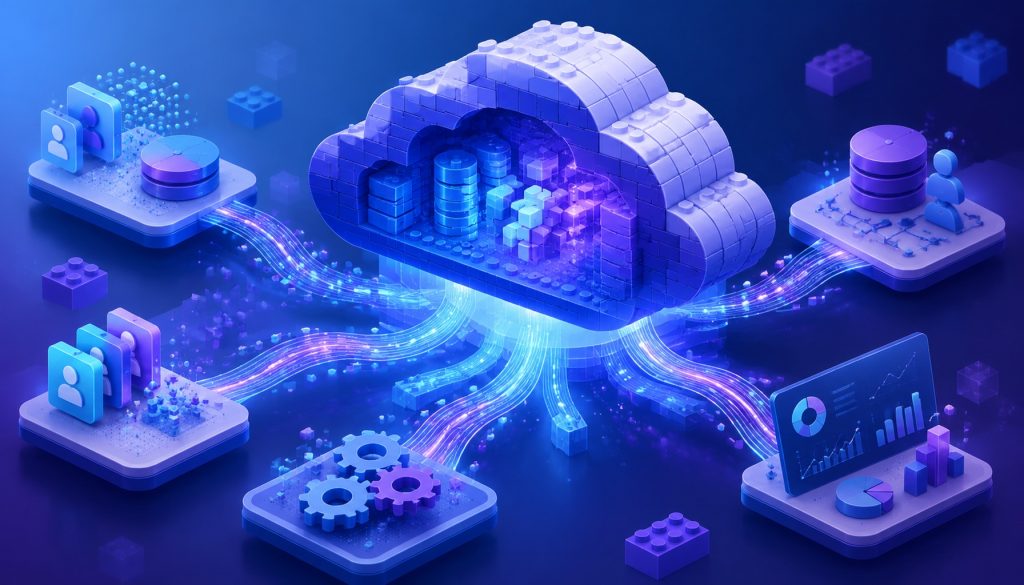
The composable data stack flips the architecture. Instead of a monolithic CDP at the center, the data warehouse becomes the single source of truth. Everything else plugs in around it.
The typical setup has four layers. First, an event collection tool like RudderStack or even Segment, but used only for tracking and routing raw events, not for transformation or storage. Second, a cloud data warehouse like Snowflake, BigQuery, or Databricks where all the data lands. Third, a transformation layer built on dbt, where raw events get reshaped into business models. Fourth, a reverse ETL tool like Hightouch or Census that syncs the transformed data from the warehouse into downstream systems like Salesforce, HubSpot, and Facebook Ads.
The logic is straightforward. Data flows into the warehouse first. Transformations happen there, in SQL or Python, version-controlled in Git. Once the data is shaped correctly, reverse ETL pushes it to wherever it needs to go. The warehouse is the hub. Everything else is a spoke.
This architecture delivers three core advantages. Cost transparency is the first. Snowflake and BigQuery charge separately for compute and storage, with clear query-level cost attribution. Reverse ETL tools typically charge per destination or sync volume, which is easier to predict than user-based pricing. One growth-stage SaaS company reported annual savings of $80,000 after migrating from an all-in-one CDP to a warehouse-native stack, mostly because they could see exactly where their money was going and optimize accordingly.
Flexibility is the second. With dbt, you can write any transformation logic you need using SQL or Python. With Snowflake, you can run machine learning models using Snowpark. With reverse ETL tools, you can build custom API integrations to any system. There’s no vendor-imposed ceiling on what you can do.
Data sovereignty is the third. The data lives in your warehouse, not in a SaaS vendor’s proprietary database. If your reverse ETL tool raises prices or shuts down, you can swap it out without touching your data models. If you need to comply with new privacy regulations, you control the entire data pipeline. The stack is composable in the literal sense: you can replace any piece without rebuilding the whole thing.
The Hidden Costs of Composability
The tradeoff is engineering complexity. All-in-one CDPs are managed services. You don’t think about infrastructure, uptime, or version control. With a composable stack, you own all of it.
That means maintaining dbt models in Git, managing Snowflake user permissions and cost controls, monitoring reverse ETL sync jobs for failures, and implementing data quality checks with tools like Great Expectations or Monte Carlo. It also means debugging issues that span multiple tools. If a user cohort isn’t syncing to Facebook Ads, the problem could be in the dbt transformation, the warehouse query, the reverse ETL mapping, or the Facebook API itself.
This requires at least one dedicated data engineer, often more. A 2026 survey by a data infrastructure consultancy found that companies migrating from a packaged CDP to a composable stack typically need three to six months to complete the transition, including hiring, setup, and knowledge transfer.
The second tradeoff is latency. All-in-one CDPs are optimized for real-time sync, often with sub-minute delays. The composable stack has a longer path: event collection, warehouse ingestion, dbt transformation, reverse ETL sync, destination API. If your dbt models run once per hour, the time from user action to downstream activation is at least an hour, sometimes longer.
By 2026, some teams are solving this with streaming architectures. Kafka and Flink can feed real-time data into Snowflake’s streaming tables, and reverse ETL tools are adding support for incremental sync. But streaming adds another layer of complexity and cost.
For teams that need instant activation, the all-in-one CDP still has an edge. For teams that can tolerate hourly or even daily sync, the composable stack makes more sense.
Who Should Choose What
The decision comes down to team maturity and use case complexity.
Stick with an all-in-one CDP if you don’t have a data engineer on staff, your data needs are straightforward (basic event tracking and syncing to a handful of tools), your monthly active user count is under 10,000 (where free tiers or starter plans are still affordable), or you depend on sub-minute sync latency for time-sensitive workflows like abandoned cart recovery.
Switch to a composable stack if you already have at least one data engineer, your analytics require sophisticated modeling (customer lifetime value prediction, multi-touch attribution, dynamic segmentation), your data volume exceeds 100 GB per month, you need cost control and data ownership, or you’re already running Snowflake or BigQuery for other parts of your business.
The middle ground is emerging under the banner of composable CDPs. Tools like RudderStack and Lytics are offering a hybrid model: they let your data warehouse remain the source of truth, but they provide a managed activation layer so you don’t have to build and maintain reverse ETL yourself. Events flow into your Snowflake instance, and the CDP reads directly from there to sync downstream. You get warehouse-native data ownership without the operational burden of stitching together multiple open-source or point-solution tools.
This model appeals to teams that want the flexibility of a composable stack but lack the engineering capacity to manage it end-to-end.
The Market Is Shifting
A 2026 Gartner report noted that more than 40% of enterprises are evaluating a move from traditional CDPs to warehouse-native architectures. Three forces are driving this.
The first is the explosion of the dbt ecosystem. What started as a transformation tool has become the de facto operating system for the modern data stack. There are now over 1,000 dbt packages covering marketing attribution, cohort analysis, lifetime value modeling, and more. Capabilities that used to be locked inside CDP black boxes are now available as open-source SQL templates that anyone can fork and customize.
The second is the maturation of reverse ETL. Hightouch and Census both raised significant funding rounds in 2024 and 2025, and their product velocity has accelerated. They now support over 200 downstream integrations, covering roughly 80% of what traditional CDPs offer. The gap is closing fast.
The third is warehouse cost deflation. Snowflake and BigQuery storage costs have dropped by half over the past three years. For data-intensive companies, storing customer data in the warehouse is now cheaper than storing it in a CDP’s proprietary database.
This doesn’t mean CDPs are going away. The core value proposition of tools like Segment, event collection and schema standardization, remains strong. What’s changing is the role. CDPs are shifting from the center of the data stack to the edge. They collect and route data, but they no longer store or activate it. The warehouse takes over those responsibilities.
A Question of Organizational Readiness
Technology decisions are ultimately organizational decisions. The composable stack isn’t inherently better. It’s a different distribution of complexity. Instead of paying a vendor to handle infrastructure, you bring that complexity in-house in exchange for lower cost and higher flexibility.
If your team can absorb that complexity, the composable stack delivers meaningful advantages. If your team can’t, the all-in-one CDP remains the pragmatic choice. There’s no single right answer for 2026, only the answer that fits your team’s capabilities and constraints.
One data leader at a mid-market e-commerce company put it plainly after completing their migration: “We didn’t switch because warehouse-native is better. We switched because we finally had the people and the infrastructure to make it work. Two years ago, we didn’t. The question isn’t which stack is best. It’s which stack your team is ready for.”
Related Reading
- The Rise of Composable Data Stacks: Why Companies Are Ditching All-in-One CDPs in 2026
- Composable Data Stack vs Traditional CDP: B2B SaaS Reality Check
Stay updated with our latest AI insights