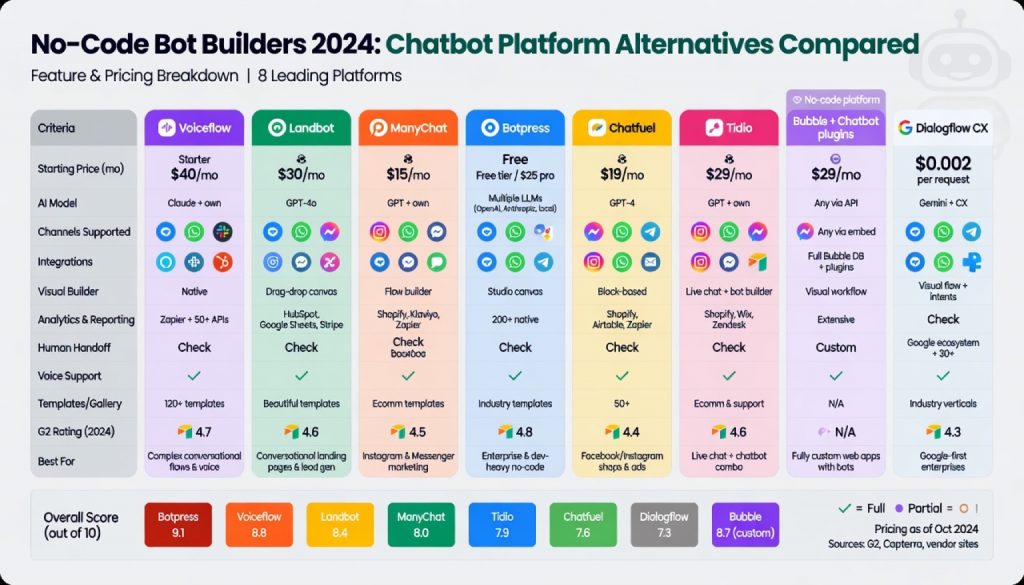
Botpress rebuilt its Studio interface, and the result split its user base. Developers who already understood flows, cards, and hooks adapted fine. Everyone else hit a wall. Product managers who just want a working support bot now need to parse config files. Self-hosting still requires PostgreSQL, Redis, environment variables, and CORS troubleshooting. Enterprise support lives behind a paywall, and the open-source community can’t match commercial response times.
If your team is evaluating alternatives, this breakdown covers five options across the spectrum: Voiceflow, Rasa, Chatbase, Typebot, and Flowise. Each targets a different combination of technical skill, deployment preference, and use case.
The selection criteria that matter most: ease of onboarding, pricing transparency, AI model flexibility, and integration depth.
Where Botpress Still Works (and Where It Doesn’t)
Botpress remains a strong choice for enterprises that need self-hosted chatbot infrastructure with multilingual support across 100+ languages. Data sovereignty is its calling card.
The friction comes from the V12+ redesign. The visual editor became a secondary tool while flow configuration shifted toward code-first patterns. For teams without dedicated developers, this inversion of priorities feels backwards. Self-hosting means provisioning databases, managing environment variables, and debugging cross-origin issues before you can even test a conversation flow. And when something breaks, you’re relying on community forums unless you’re on a paid plan.
The alternatives below solve different subsets of this problem. Some trade self-hosting for usability. Others go deeper into code-first territory but with better developer ergonomics. Pick based on what your team actually needs, not what sounds impressive on a features page.
Voiceflow: Built for Product Teams Without Developer Bandwidth
Voiceflow treats conversation design like Figma treats interface design. The canvas is collaborative: drag in question cards, branching logic, and API call nodes, draw connections between them, and the flow is done. No YAML. No config files. Product managers, designers, and CS leads can all edit the same bot in real time.
AI integration is straightforward. Drop in your OpenAI, Anthropic, or Google API key. Voiceflow handles prompt management, context windowing, and fallback routing automatically. The built-in simulator lets you test every branch without deploying anything to production. Click “Run,” have a conversation with your bot, see exactly where the logic breaks.
Pricing starts at free (2 projects, 1,000 conversations) and scales to Pro at $40/month (unlimited projects, 20,000 conversations, team collaboration). Enterprise plans add SSO and private deployment.
The tradeoff against Botpress is clear: Voiceflow drops self-hosting in exchange for the smoothest visual builder on the market. If nobody on your team writes code for a living, or if non-technical stakeholders need direct access to bot design, Voiceflow removes the most friction.
Best fit: customer support automation, product demos, sales assistants, and any scenario where iteration speed matters more than infrastructure control.
Rasa: Full Control for Teams With Python Engineering Capacity
Rasa is a pure-code, open-source framework written entirely in Python. Every piece of data and every model stays on your infrastructure. Banks, healthcare organizations, and government agencies choose Rasa for one reason: compliance requirements prohibit data leaving their environment.
The customization depth is extreme. You can write your own NLU training data, tune intent classification thresholds, plug in Hugging Face Transformers, or modify the dialogue management engine’s source code directly. Deployment options cover Docker containers, Kubernetes clusters, private clouds, and even Raspberry Pi hardware. Because it’s Python-native, integrating with Pandas, SQLAlchemy, FastAPI, or any other library in the ecosystem takes minimal effort.
The cost is onboarding time. Your team needs to understand YAML configuration structure, write training stories, configure the NLU pipeline, and debug action servers. Even with solid documentation, the path from zero to production takes a minimum of two weeks for experienced developers. The open-source version is free. Rasa Pro adds enterprise analytics and version management at custom pricing.
Compared to Botpress, Rasa sits one layer deeper. Botpress at least offers a Studio UI. Rasa is VSCode plus YAML files, full stop. If you have a dedicated Python team and need maximum data control with maximum customization, Rasa delivers both.
Best fit: regulated industries (finance, healthcare, government), teams with strong Python skills, projects requiring custom NLU models or on-premise deployment.
Chatbase: Document-to-Bot in Five Minutes
Chatbase compressed the entire chatbot creation workflow into a single action: upload your content. Feed it PDFs, Word documents, web page URLs, or plain text. Chatbase extracts the content, vectorizes it, builds a knowledge base, and generates answers using GPT-4 or Claude. No intent definitions. No conversation flow design. No rules to write. The AI answers questions based on whatever documents you provided.
It supports 80+ languages with automatic detection and switching. The embed code is two lines of JavaScript pasted into your site’s tag. Answer quality depends on two variables: your document quality and your choice of LLM (GPT-4 produces noticeably better results than GPT-3.5).
Pricing: free tier (20 messages/month, 1 chatbot), Hobby at $19/month (2,000 messages, 5 chatbots), Standard at $99/month (10,000 messages, unlimited chatbots).
What Chatbase gives up compared to Botpress is flow control. You cannot build multi-step sequences like “collect email first, then recommend a product.” The AI operates freely within the knowledge base you gave it. If your use case is “users ask questions about our docs, bot answers accurately,” Chatbase is the lowest-effort path to production.
Best fit: documentation Q&A, customer support on existing knowledge bases, internal wikis, any scenario where content already exists and you just need a conversational interface on top of it.
Typebot: Open-Source No-Code Builder With Structured Data Collection
Typebot sits at the intersection of Typeform and chatbot builder. The visual editor lets you drag in text messages, multiple-choice buttons, conditional branches, and variable assignments, then wire them together. Complex sequences work naturally: user selects a product type, sees pricing based on that selection, enters their email, data flows to Google Sheets, Zapier triggers a follow-up workflow.
Integration coverage is broad: webhooks (hit any HTTP endpoint), Google Sheets (write directly to spreadsheets), Zapier and Make (connect to 5,000+ apps), and OpenAI API (generate responses inline). Self-hosting requires nothing more than Docker Compose and a PostgreSQL database. The entire codebase is open source.
Pricing splits between the self-hosted open-source version (free) and cloud hosting ($39/month, which adds managed infrastructure, custom domains, and removes branding).
The visual editor is more intuitive than Botpress Studio, but Typebot’s AI capabilities are limited. It’s better described as a “conversational form” than an “intelligent assistant.” If your primary need is collecting structured user data and triggering downstream automations, Typebot is the best open-source option available.
Best fit: lead qualification forms, market research surveys, appointment booking, structured data collection with automation triggers.
Flowise: Visual LangChain for AI Engineers
Flowise is a drag-and-drop interface for LangChain concepts. If you already understand chains, agents, tools, and memory in the LangChain framework, Flowise lets you assemble these components visually instead of writing Python.
LLM support is broad: OpenAI GPT-4, Anthropic Claude, open-source models (Llama, Mistral), and locally-hosted Ollama instances. Vector database integration includes Pinecone, Weaviate, Qdrant, and Supabase Vector. The primary use case is building RAG (Retrieval-Augmented Generation) applications: upload documents, chunk them, vectorize, store in a database, retrieve relevant fragments at query time, and feed them to an LLM for answer generation.
Fully open source with simple Docker deployment. Flowise Cloud is still in beta; the self-hosted version is free.
Flowise targets a different user than Botpress. It’s for AI engineers building complex LLM applications with multi-step reasoning, tool calling, and knowledge base retrieval. It’s the fastest prototyping tool for that workflow. But if you just want a simple support bot, Flowise’s learning curve is comparable to Botpress or steeper.
Best fit: RAG applications, AI agent prototypes, knowledge base search systems, any project requiring chained LLM calls with retrieval.
Comparison Table
| Tool | Starting Price | Learning Curve | Self-Hosting | AI Model Support | Best For | Integration Depth |
|---|---|---|---|---|---|---|
| Voiceflow | Free / Pro $40/mo | Low (drag-and-drop) | No | GPT, Claude, Gemini | Product managers, non-technical teams | Extensive |
| Rasa | Free (open source) | High (code-driven) | Yes | Custom NLU + any model | Python developers in regulated industries | Strong |
| Chatbase | Free / $19/mo | Very low (upload and go) | No | GPT-4, Claude | Teams needing fast deployment | Moderate |
| Typebot | Free (open source) / $39/mo | Low (visual) | Yes | OpenAI API | Lead gen, form collection | Strong |
| Flowise | Free (open source) | Medium (requires LangChain knowledge) | Yes | Multiple LLMs + local models | AI engineers building RAG apps | Extensive |
Picking the Right Tool
The decision tree is short:
Non-technical team, speed is the priority. Go with Voiceflow. The visual editor is the best in class, team collaboration works out of the box, and nobody needs a developer background to ship a working bot.
Strict data control requirements, engineering team available. Go with Rasa. Fully open source, deployable anywhere, and built for industries where data cannot leave your perimeter.
Just need document Q&A working today. Go with Chatbase. Upload your content, get a working bot in five minutes. GPT-4 answers are good enough for most knowledge base scenarios.
Want open source plus visual editing without the Botpress learning curve. Go with Typebot. Intuitive drag-and-drop, solid automation integrations, one-command Docker deployment.
Building complex RAG pipelines, already comfortable with LangChain. Go with Flowise. Visual assembly of LangChain workflows, multi-LLM support, vector database integration, and the fastest path from concept to working prototype.
The Bottom Line
Botpress remains a capable open-source chatbot platform, particularly for enterprises that need self-hosting and multilingual support. But the market has specialized. Voiceflow owns the usability space. Rasa owns the data sovereignty space. Chatbase owns the zero-config deployment space. Typebot owns structured data collection. Flowise owns the AI engineering workflow space.
Match the tool to your team’s actual constraints: headcount, technical skill, compliance requirements, and time to first deployment. The chatbot builder market in 2026 is mature enough that forcing a general-purpose tool into a specialized role wastes more time than evaluating the right fit from the start.
Related Reading
- AI Customer Support Chatbot Builders in 2026: Chatbase vs Voiceflow vs Intercom Fin vs Tidio vs Botpress
- Botpress vs Voiceflow in 2026: Which AI Chatbot Platform Fits Your Team?
Stay updated with our latest AI insights