SDR teams stopped sending emails by hand a long time ago. AI-powered outreach is table stakes now. But the market has split into distinct categories, and picking the wrong tool burns budget for months before anyone admits the fit is off.
Apollo, Outreach, Salesloft, and Clay get lumped together in every “best sales tools” listicle, but they solve different problems for different team sizes. This breakdown covers real 2026 pricing (including the hidden costs vendors don’t put on their websites), the actual strengths and gaps of each platform, and a decision framework based on team size and sales complexity.
No fluff. If you already know what these tools are, skip straight to the comparison table or the decision framework at the end.
Apollo: The All-in-One Value Play
Apollo bundles a 275M-contact database with outreach automation. For teams that need to find leads *and* reach them without stitching together three separate subscriptions, it remains the most cost-effective entry point.
2026 Pricing
- Free tier: 50 contact credits/month (enough to kick the tires)
- Basic: $49/user/month (annual), 1,200 contact credits
- Professional: $79/user/month (annual), 3,600 credits + sequence automation
- Organization: $119/user/month (annual), 12,000 credits + international dialer + AI call insights
Monthly billing runs 15-25% higher. And if you need LinkedIn automation, you’re bolting on Phantombuster or Expandi, which pushes the real cost to $120-180/month per seat.
Where Apollo Wins
The built-in database is the differentiator. You skip the $15K+ ZoomInfo contract entirely. Sequences handle email, LinkedIn, and phone in one workflow. The AI email generation pulls from lead data to write personalized openers (not great openers, but functional ones). CRM sync with Salesforce and HubSpot works out of the box.
Where Apollo Falls Short
Data quality is inconsistent, especially for SMB contacts outside the US. The LinkedIn automation is surface-level compared to dedicated tools. Email deliverability gets no special treatment: there’s no warm-up tooling, no dedicated IP management, and emails land in spam more often than they should for the price.
Who Should Buy Apollo
Startups and teams under 5 SDRs who need one platform and can’t justify $20K+ in annual tooling spend. Apollo’s database coverage is strongest in North America, which is convenient if that’s your ICP. The tool scales awkwardly past 10-15 users, though, because data quality complaints multiply with volume.
Outreach: The Enterprise Execution Platform
Outreach is built for sales orgs with 50+ reps and dedicated Sales Ops headcount. It’s the most powerful sequencing engine on the market, but it’s also the most expensive and the hardest to deploy.
2026 Pricing
Outreach doesn’t publish pricing. You talk to sales. Based on Vendr contract data:
- Starting price: ~$100-120/user/month (annual, 20-seat minimum)
- Typical deal size: $20,000-$50,000/year depending on team size and modules
- Hidden costs: Implementation fees run $1,000-8,000. Annual renewals increase 10-15%.
The platform is modular: Engage (sequences), Call (dialer), Meet (meeting intelligence), Deal (pipeline analysis), Forecast, and Amplify (content management). Each module adds to the per-seat cost.
Where Outreach Wins
The sequence engine handles complex multi-step, multi-channel workflows with conditional branching that no competitor matches. Salesforce integration is the deepest in the category, with near real-time bidirectional sync. AI-powered call analysis, email sentiment scoring, and close probability predictions give managers actual visibility into pipeline health. And the compliance story (SOC 2, GDPR, HIPAA) satisfies enterprise procurement without custom work.
Where Outreach Falls Short
There’s no contact database. You still need ZoomInfo, Apollo, or Cognism for data. The learning curve is steep: new reps need 2-4 weeks to get productive. And the sales process for buying Outreach mirrors the complexity of the product itself. Small teams have almost no bargaining power.
Who Should Buy Outreach
Enterprise sales teams (50+ reps) with complex, multi-touch sales cycles and dedicated Sales Ops support. If you’re already deep in Salesforce and need the tightest possible CRM integration, Outreach is the benchmark. Below 20 seats, the minimum commitment and implementation overhead make it a poor fit.
Salesloft: The Mid-Market Sweet Spot
Salesloft competes directly with Outreach. It covers about 90% of the same feature set with a friendlier UI, faster onboarding, and pricing that doesn’t require a CFO sign-off.
2026 Pricing
Also not published, but more transparent than Outreach:
- Advanced: ~$125-165/user/month (annual, 10-seat minimum)
- Premier: 20-40% above Advanced, includes AI workflow automation (Rhythm)
- Negotiation reality: Vendr data shows buyers consistently cut 35-45% off the initial quote
The dialer is a separate add-on. Call recording and AI analysis (Conversations module) cost extra too.
Where Salesloft Wins
The interface is cleaner. New reps ramp in days instead of weeks. Rhythm, the AI workflow engine, automatically surfaces the next best action based on buyer behavior signals. The Conversations module (call recording + AI transcription + keyword extraction) is strong for coaching. Deal pipeline analysis gives real-time health scores per opportunity.
Where Salesloft Falls Short
Same gap as Outreach: no built-in database. LinkedIn integration is weaker than Apollo’s native connection. And contract renewals come with 8-12% annual increases that compound fast over a 3-year commitment.
Who Should Buy Salesloft
Mid-sized sales teams (10-50 reps) that want enterprise-grade sequencing and coaching tools without Outreach’s price tag or implementation burden. If you’re migrating off Outreach to cut costs, Salesloft absorbs most workflows without major re-engineering. The 35-45% negotiation discount is real and worth pushing for.
Clay: The Data Orchestration Layer
Clay isn’t a sales outreach tool. It’s a data platform that sits upstream of your outreach stack. If your sales motion depends on deep personalization and multi-source data enrichment, Clay handles the preparation layer that makes everything downstream more effective.
2026 Pricing
Clay uses credit-based pricing. Different operations consume different credit amounts:
- Free: 100 credits/month (testing only)
- Starter: $134/month (annual), 2,000 credits
- Explorer: $349/month (annual), 10,000 credits
- Growth: $495/month (annual), 30,000 credits + CRM sync
- Pro: $640/month (annual), 100,000 credits
One email enrichment task burns 1-5 credits. AI-generated personalized emails consume 10-20 credits. Teams running high-volume ABM campaigns routinely spend 30-50% more than their plan price suggests because AI operations eat credits fast.
Where Clay Wins
75+ data source integrations (Apollo, ZoomInfo, Clearbit, LinkedIn, Twitter, GitHub) connected through a single interface. Waterfall enrichment automatically cascades through sources until it finds the data point you need. The AI personalization engine generates emails based on a prospect’s LinkedIn activity, company news, tech stack, and recent hires. And the Notion-style table interface means non-engineers can build complex data flows without code.
Where Clay Falls Short
Clay does not send emails. You still need Instantly, Lemlist, or Smartlead for delivery. Credit consumption is unpredictable, especially when AI operations are involved. And the tool requires understanding data flow logic. SDRs who just want to load a list and hit send will struggle.
Who Should Buy Clay
Sales Ops teams that prepare enriched lead lists for SDRs. Teams running ABM strategies that require hyper-personalized messaging at scale. Technical founders who want maximum automation in their prospecting pipeline. Clay pairs with a sending tool; it doesn’t replace one.
Head-to-Head Comparison
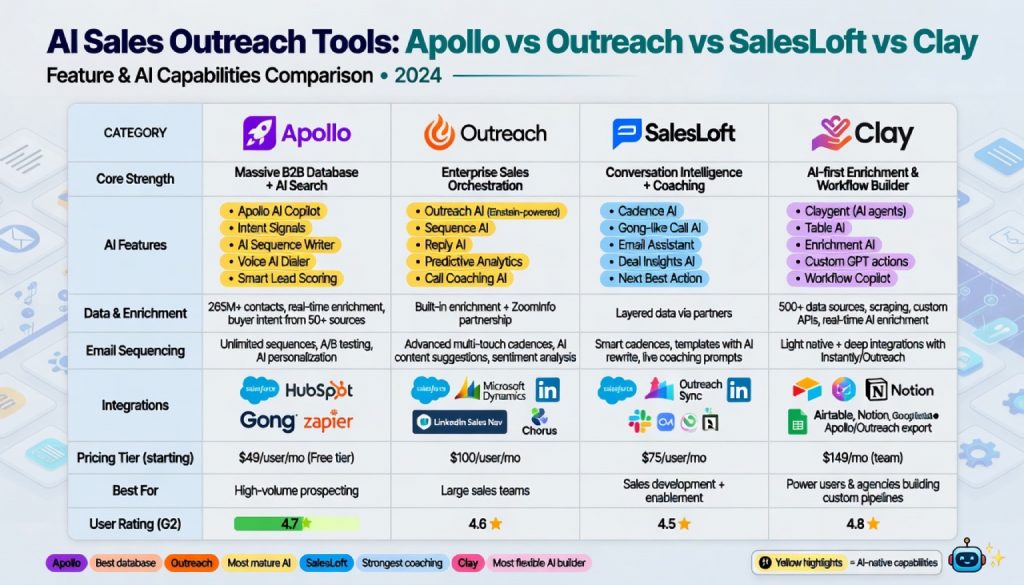
| Tool | Starting Price | Core Strength | Main Weakness | Best Use Case |
|---|---|---|---|---|
| Apollo | $49-119/user/mo | Database + outreach in one | Data quality inconsistent | Small teams, limited budget |
| Outreach | $100-120/user/mo | Most powerful sequences | Expensive, steep learning curve | Enterprise teams 50+ |
| Salesloft | $125-165/user/mo | User-friendly, AI workflows | No database, pricey | Mid-sized teams 10-50 |
| Clay | $134-640/mo (credits) | Data orchestration master | Not an outreach tool | Sales Ops, ABM strategy |
Decision Framework
Under 5 SDRs, budget under $10K/year: Go with Apollo. The built-in database eliminates the need for a separate data vendor. Data quality won’t be perfect, but it’s sufficient for early-stage prospecting in North America. You can always layer Clay on top later when personalization becomes a priority.
10-50 reps, want enterprise features without enterprise pricing: Salesloft is the pick. Negotiate hard on that initial quote (35-45% discount is standard based on Vendr data). The Rhythm AI engine and Conversations module justify the premium over Apollo for teams that have outgrown basic sequences. Make sure you budget for the dialer add-on if phone is part of your cadence.
50+ reps with complex sales processes: Outreach earns its price at this scale. The sequence engine’s conditional branching, the Salesforce integration depth, and the forecasting modules become force multipliers when you have dedicated Sales Ops maintaining the system. The implementation cost and learning curve amortize across a large team.
Running ABM or need deep personalization: Add Clay to whatever outreach tool you already use. Don’t replace your sending platform with Clay. Use it for data preparation and AI-personalized messaging, then push enriched contacts into Instantly or Smartlead for delivery.
Mistakes That Burn Budget
Buying features your team ignores. Outreach and Salesloft pack dozens of capabilities into their platforms. If your SDRs only use basic sequences and ignore the AI coaching, call recording, and pipeline analytics, you’re paying 3x what you need. Start simpler. Upgrade when your team actually hits the ceiling.
Underestimating total stack cost. Apollo at $79/month looks cheap until you add ZoomInfo for better data ($500+/month), Phantombuster for LinkedIn automation ($69/month), and Smartlead for deliverability ($39/month). Calculate the full stack price before committing to any single tool.
Accepting the first quote. Outreach and Salesloft both inflate initial pricing. Use Vendr or similar procurement platforms to benchmark real market rates. Teams under 20 seats can typically negotiate 30-40% below the first number they see.
Confusing Clay with a sending tool. Clay prepares data. It does not deliver messages. If you buy Clay expecting Apollo-like send functionality, you’ll be plugging a gap within the first week. Understand each tool’s actual scope before signing.
The Bottom Line
These four tools occupy different positions in the sales stack. Apollo compresses database and outreach into one affordable platform. Outreach and Salesloft both handle execution, split by team size and budget. Clay operates upstream, making whatever you send more targeted and more personal.
The right choice depends on three variables: team size, budget, and how complex your sales motion actually is today (not how complex you imagine it becoming in 18 months). Run trials, get feedback from the reps who will use the tool daily, and commit only when you’ve confirmed the workflow fits. The most expensive mistake in sales tooling isn’t picking the wrong vendor. It’s buying a platform your team doesn’t adopt.
Stay updated with our latest AI insights