Your team has this problem: critical documents scattered across Slack, Notion, Google Drive, and a dozen other tools. Finding anything takes too long. Asking colleagues feels like an interruption. AI-powered enterprise search is supposed to fix this, but the market is crowded and the marketing copy all sounds the same.
Glean, Guru, Coveo, and AlphaSense each claim to be the answer. They’re not interchangeable. Each serves a different type of organization, at wildly different price points, with different trade-offs. This guide covers real pricing, actual strengths and weaknesses, and specific recommendations based on company size and industry.
Glean: The $4.6B Workplace AI Assistant
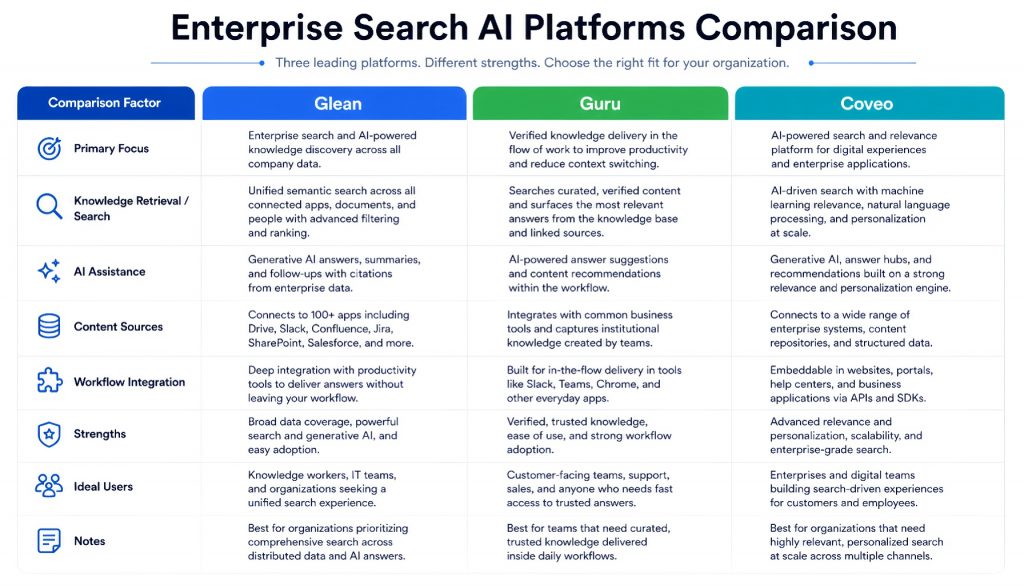
Glean hit a $4.6B valuation in 2024 and has become the default recommendation for mid-to-large tech companies. It connects to nearly every tool your company uses (Slack, Google Drive, Notion, Jira, Confluence, custom internal systems) and layers AI on top so employees can search across all of them with natural language queries.
Pricing: Starts around $45-50/user/month. The full generative AI features (Work AI suite) add another $15/user/month. For a 100-person team, expect $70-80K annually at minimum. High data volume or custom deployment requirements can double that number. Pricing is opaque and requires a sales conversation.
Where it works well:
The integration coverage is strong. Most mainstream SaaS tools are supported out of the box, and the AI search experience handles natural language queries competently. The interface is modern and onboarding is straightforward compared to legacy enterprise search products.
Where it falls short:
Deployment cycles run long. Small companies may not have the patience or the dedicated IT resources to get through setup. Some users report that AI-generated answers occasionally hallucinate or cite unreliable sources within the connected data. And the cost is hard to justify for teams under 50 people.
Best fit: Mid-to-large tech companies (200+ employees) with complex tool stacks, healthy budgets, and a need for a single search layer across everything. If you’re budget-constrained or your team is small, this is overkill.
Guru: Knowledge Cards with Built-in Verification
Guru has been in knowledge management since 2016. Its approach differs fundamentally from Glean: instead of indexing everything passively, Guru relies on teams proactively creating “knowledge cards.” Each card has an assigned owner who periodically verifies accuracy. The system prompts owners when cards go stale.
Pricing: $10-20/user/month. Significantly cheaper than Glean and accessible for small teams.
Where it works well:
The knowledge card model fits naturally for SOPs, process documentation, and standardized answers. The verification system keeps content fresh by nudging owners to review their cards on a schedule. Guru’s March 2026 Slack MCP integration is notable: it participates in Slack conversations in real time rather than just indexing messages after the fact. Pricing makes it viable for teams that can’t afford Glean.
Where it falls short:
AI capabilities are weaker than Glean’s. Guru is more “knowledge base with search” than “AI assistant.” The entire system depends on your team actually maintaining knowledge cards. If your company culture doesn’t support active documentation, the cards go stale and the tool becomes unreliable. Guru has also lost mindshare to Glean in the past two years.
Best fit: Teams that value knowledge curation over AI-powered discovery. Customer support, operations, and sales departments that need standardized processes and verified answers. Works best in organizations where people already document willingly.
Coveo: Enterprise Search for Complex, Regulated Industries
Coveo is a veteran enterprise search vendor with over a decade of deployment history. It handles internal search but also powers customer-facing experiences: e-commerce product recommendations, smart answer suggestions in support portals, personalized content delivery.
Pricing: Starts at $600/month, but that’s the entry-level tier. Enterprise deployments are priced by query volume, data volume, and user count. Expect sales negotiations. Small companies can skip this entirely.
Where it works well:
Feature coverage is broad: search, recommendations, and personalization are bundled together. Coveo has deep penetration in finance, e-commerce, and large enterprises with mature case studies and proven compliance controls. It supports complex permission hierarchies that regulated industries require.
Where it falls short:
Deployment is complex and requires a specialized technical team. The learning curve is steep for administrators. Multiple users report hitting API rate limits during data import, which creates bottlenecks during initial setup. This is not a plug-and-play product.
Best fit: Large enterprises in finance, insurance, or e-commerce that need both internal search and customer-facing recommendation capabilities. Requires a dedicated IT team for deployment and ongoing maintenance. If you only need simple internal search, Coveo is far too heavy.
AlphaSense: Financial Research, Wall Street Standard
AlphaSense occupies a different category from the other three. It’s not a general enterprise search tool. It’s a specialized financial research platform covering earnings reports, analyst reports, SEC filings, expert interview transcripts, and news. AI helps analysts and investors find relevant information quickly for investment decisions.
Pricing: Opaque. Annual subscriptions for small teams (10-25 people) start around $40-50K/year. Large institutional packages exceed $100K. No cheap entry version exists.
Where it works well:
Financial data coverage is comprehensive and high quality. AI summarization can distill key insights from lengthy documents quickly. The January 2026 next-gen generative search feature enables end-to-end research agent workflows. Industry adoption is strong: 85% of S&P 100 companies use the platform.
Where it falls short:
It’s finance-only. Other industries can’t extract value from it. The price point locks out smaller firms. New users need time to learn the interface and query patterns to get the most out of it.
Best fit: Investment firms, private equity, investment banks, and corporate strategy departments that need deep industry research and competitive analysis. If your work isn’t finance-related, this tool has nothing for you.
Comparison Table
| Tool | Pricing | Core Strength | Main Weakness | Best Fit |
|---|---|---|---|---|
| , , , | , , , , – | , , , , , , , – | , , , , , , , – | , , , , , |
| Glean | $45-65/user/mo | Broad integration, strong AI search | Expensive, slow deployment, opaque pricing | Mid-large tech companies, complex tool stacks |
| Guru | $10-20/user/mo | Knowledge verification, affordable | Weaker AI, depends on team discipline | Support, ops, sales teams |
| Coveo | $600/mo+ (enterprise) | Full-stack search + recommendations | Complex deployment, steep learning curve | Finance, e-commerce, large enterprises |
| AlphaSense | $45-125K/year | Deep financial data, strong AI analysis | Finance-only, high cost | Investment firms, banks, strategy departments |
Which Tool Fits Your Situation
50-500 person tech company with multiple tools and scattered data: Glean is the most straightforward choice if your budget supports it. It connects everything quickly and the AI layer provides immediate value across the organization.
Small-to-mid team with limited budget, primarily needing documented SOPs and standard answers: Guru offers the best value. The knowledge card model works well for teams that already have a documentation culture. Don’t overspend on Glean when your core need is verified answers, not AI-powered discovery.
Finance, e-commerce, or insurance company needing customer-facing search and recommendation features: Coveo is the professional-grade option. Budget for a dedicated technical team to handle deployment and ongoing maintenance.
Investment firm or corporate strategy department doing deep industry research: AlphaSense is the industry standard. The annual cost is high, but the time savings on research workflows make the ROI straightforward to calculate.
One practical note: don’t make this decision based on feature lists alone. Every vendor offers demos or trials. Get actual users (not just IT leadership) to test each tool and report back on what feels natural in their daily workflow. A powerful tool that nobody wants to open is a waste of budget.
Frequently Asked Questions
How secure is data in these tools?
All four support enterprise-grade security standards: SOC 2 and GDPR certifications are baseline. For specific compliance requirements (HIPAA, FedRAMP, industry-specific regulations), confirm with the vendor’s security team. Glean and Coveo both support private deployment options for organizations with strict data residency requirements.
Can these integrate with custom internal systems?
Glean and Coveo support custom API integrations for proprietary systems. Guru and AlphaSense focus primarily on mainstream SaaS tool connections. If your organization relies heavily on custom-built internal tools, confirm integration feasibility with vendors before signing a contract.
Do we need a dedicated team to maintain these tools?
It depends on the tool. Glean and Guru are relatively low-maintenance after initial setup, requiring mainly configuration updates and permission management. Coveo requires dedicated technical staff for ongoing operation. AlphaSense is primarily a user training challenge since the platform itself needs minimal technical maintenance.
How long does deployment take?
Glean: 2-4 weeks. Guru: 1-2 weeks. Coveo: 1-3 months depending on complexity. AlphaSense: 1-2 weeks. These are conservative estimates. Actual timelines depend on your data volume, number of integrations, and internal approval processes.
The Bottom Line
These four tools represent different philosophies about enterprise search. Glean pursues all-in-one integration with AI at the center. Guru emphasizes human-curated, verified knowledge. Coveo targets complex enterprise scenarios where search, recommendations, and personalization intersect. AlphaSense goes deep on vertical financial research rather than broad.
There’s no universal “best” option. The right choice depends on your team size, budget, industry, technical capacity, and how your people actually work today. Map those constraints to the comparison table above and you’ll narrow to one or two candidates worth trialing.
Stay updated with our latest AI insights