Lin gets a Slack message at 3 AM. Her engineer in Brazil wants to know why this month’s paycheck is $200 short. She pulls up the Google Sheet she uses as a payroll ledger and finds a manual currency conversion error. Her 12-person SaaS company spans seven countries, and every pay cycle feels like defusing a bomb she didn’t know existed.
This is a common scene at remote-first startups. Once your team crosses borders, payroll stops being an admin task you run once a month. It becomes a system-level problem involving labor law compliance, tax filings, benefits administration, and FX losses. Pick the wrong tool and you either bleed money on hidden fees or accidentally violate employment law in a country you barely knew had rules about church tax.
Three problems remote payroll has to solve
Compliance scales exponentially. One employee in Germany means you handle social insurance contributions, church tax declarations, and paid leave calculations. One in Brazil means 13th-month salary. One in France means 35-hour workweek rules and strict termination protections. Each new country doesn’t add complexity linearly. It multiplies it.
Employee experience drives trust. Can people check pay stubs on their phone? How many days does contractor invoice approval take? Is onboarding paperwork digital or print-and-scan? These details shape how your team feels about working for you.
Cost predictability matters more than cost. EOR (Employer of Record) platforms charge $500-700 per person per month in platform fees alone. Stack FX markups, country surcharges, and compliance deposits on top, and the final bill can exceed the sticker price by 30-60%. At seed stage, every dollar has a burn-rate cost. Unpredictable payroll spend wrecks cash flow planning.
With those three problems in mind, here are the five most common choices.
Deel: speed and global coverage
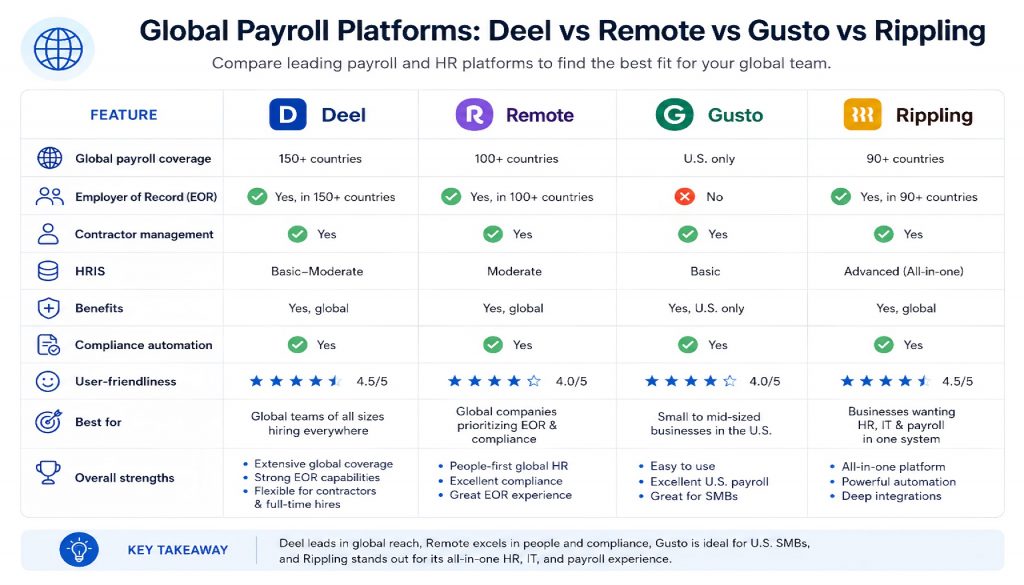
Founded in 2019, Deel processes over $22 billion in annual payroll across 150+ countries. The product line breaks down clearly: EOR for full-time employees starts around $599/person/month, contractor management at $49/person/month, and global payroll (for companies with their own entities) at $29/person/month.
Deel’s strength is speed. A typical scenario: you spot a great indie developer in Bucharest on Product Hunt and want to convert them from contractor to full-time. Deel can complete the Romanian EOR onboarding in days without you registering a local entity. That contractor-to-employee conversion path is a killer feature for fast-growing teams.
The downside is pricing transparency. The $599 is only the platform fee. It doesn’t include actual salary, local taxes, or benefits. FX markups run 0.6-2%, and some countries carry an additional $50-150 surcharge. A full-time employee in France costs meaningfully more per month than the headline number suggests. Seed-stage teams need to factor these hidden costs into budget models.
Remote: owned entities, shorter compliance chains
Also founded in 2019, Remote took a different path: building its own legal entities in every market rather than relying on partner networks. When something goes wrong, there’s no finger-pointing between platform and local partner. Remote owns the compliance chain end to end.
EOR pricing lands at roughly $599/person/month on annual contracts, $699 on monthly. Contractor management runs $29/person/month. The most underrated capability is equity and stock option administration. For tech companies granting options to international employees, Remote’s experience handling option tax compliance across jurisdictions is among the strongest in the category.
The ideal use case: a Series A AI company with eight researchers across Europe, each needing country-specific option tax treatment. Remote’s owned-entity model gives you a single legal counterparty for all of it, with no compliance gaps between intermediaries.
Where Remote trails is depth in Asia-Pacific and Latin America. Coverage nominally hits 150+ countries, but onboarding speed and local expertise in some emerging markets still lag behind Deel.
Gusto: the best US payroll experience at a fraction of the cost
If most of your team is in the United States with only a handful of overseas contractors, Gusto occupies a different category entirely. It’s not a global EOR platform. It’s a US domestic payroll product built to an extremely high standard.
Pricing favors small teams: the Simple plan runs $49/month base plus $6/person/month. Plus costs $80/month base plus $12/person/month. A 10-person US team pays under $200/month in payroll software fees. Compare that to EOR platform costs and the gap is enormous.
The product design sets the bar for the category. Employee self-service onboarding, automatic W-2 and 1099 processing, tax form generation and filing, health insurance and 401(k) management in one place. A founder with zero HR background can run payroll in 30 minutes.
The profile that fits: a 15-person US SaaS company with engineers in New York and Austin, plus three overseas contractors paid through Deel or Remote. The core team runs on Gusto. Experience is excellent, cost is low, compliance automation is strong. Gusto added an EOR entry point in 2026 through a partnership with Remote, but that’s more of a referral channel than a core capability.
Gusto’s boundaries are clear. It doesn’t fit a purely distributed company with full-time employees in ten countries. But for a US headquarters with a few international contractors, it’s the best value primary payroll.
Rippling: payroll inside an employee operating system
Rippling has different ambitions than the other four. It’s not just a payroll tool. It attempts to unify HR, IT device management, expense reporting, and application permissions into a single “employee operating system.” Payroll is one module in that system.
The base platform starts around $8/person/month, but that’s just the entry ticket. Add payroll, HR, and IT management modules and a 50-person team easily exceeds $3,000/month in total fees. EOR coverage spans roughly 80 countries, fewer than Deel or Remote, but expanding.
Rippling fits a specific scenario: a 40-100 person company past the “manage everything in Google Sheets” stage, needing a unified platform that connects onboarding, device provisioning, software permissions, and payroll. When a new hire starts, Rippling can simultaneously create their company email, assign Slack permissions, configure laptop security policies, and set up payroll. That end-to-end automation is the unique value.
The tradeoff is global compliance depth. EOR is an add-on product for Rippling, not the core. Legal expertise in complex jurisdictions doesn’t match Deel or Remote. If your primary need is “compliantly hire in seven countries,” Rippling might not be the first choice. If your primary need is “one platform for the entire employee lifecycle,” it offers something the others don’t.
Papaya Global: built for large-team analytics
Papaya Global targets mid-to-large enterprises. EOR starts around $599-650/person/month across 160+ countries, with strong analytics dashboards and a multi-currency payment engine.
A 200-person company with employees in 15 countries that needs unified payroll data views, cross-border payment reconciliation, and comparative social security cost analysis will find Papaya’s data capabilities a step above the competition. The platform positions itself as a “Workforce Operating System,” using AI-driven data pipelines to aggregate payroll, tax, and benefits data across countries into a single CFO-facing view.
For early-stage startups, Papaya is overkill. Contracts tend to be longer, implementation fees higher, and the interface is designed for enterprise-level operational patterns. With 10-20 people in 3-5 countries, you won’t get enough value from the platform to justify the overhead.
The right fit: post-Series B, 100+ employees, multi-country operations where the need isn’t “help me hire one person” but “help me manage an entire global payroll system.”
Comparison table
| Dimension | Deel | Remote | Gusto | Rippling | Papaya Global |
|---|---|---|---|---|---|
| , , , , , – | , , , | , , , , | , , , – | , , , , , | , , , , , , , – |
| EOR starting price | ~$599/person/mo | ~$599/person/mo (annual) | N/A (not core) | Quote-based | ~$599-650/person/mo |
| Contractor management | $49/person/mo | $29/person/mo | $35 base + $6/person/mo | Quote-based | Quote-based |
| Country coverage | 150+ | 150+ | US-focused | ~80 (expanding) | 160+ |
| Entity model | Partial owned + partners | Fully owned | N/A | Partial owned | Partner network |
| Best team size | 5-500 | 10-300 | 5-100 (US) | 30-500 | 100-5000 |
| Key integrations | Slack, QuickBooks, Xero, BambooHR | BambooHR, Greenhouse, HiBob | QuickBooks, Xero, Slack | 650+ (including IT tools) | SAP, Oracle, Workday |
The table gives you a quick filter, but real selection decisions depend on more than parameters.
Recommendations by stage
Seed (3-10 people, 2-4 countries). Budget is tight, compliance needs are just starting. If most employees are in the US, run Gusto for domestic payroll and put overseas contractors on Deel or Remote’s contractor tier. With fewer than three global full-time employees, Deel’s per-person EOR model is flexible with no minimum commitments.
Series A (15-50 people, 5-8 countries). You have HR staff now and need a more formal compliance structure. Remote’s owned-entity model performs well in strict European markets like Germany, France, and the Netherlands. If you also need IT device management and permission automation, Rippling becomes attractive at this stage.
Series B+ (50-200+ people, 8+ countries). Payroll complexity is growing exponentially. The CFO needs a global view. Papaya Global’s analytics start paying for themselves. Alternatively, continue with Deel or Remote but negotiate volume discounts. Deel’s per-person EOR pricing can drop to the $350-500 range at scale.
Fully remote but US-concentrated (20-80 people, multi-state). Gusto Plus or Premium handles multi-state payroll. Pair it with Remote’s contractor tier for a small number of overseas collaborators. Rippling also competes well here, especially when you need unified Mac/PC device security policy management.
How to think about the decision
A payroll tool isn’t software you buy once. It’s infrastructure you’ll be bound to for 3-5 years. Migration costs are extreme: employee contracts need re-signing in every country, social security accounts need re-establishing, historical tax data needs seamless transfer.
The question to ask isn’t “who’s $50 cheaper right now.” It’s: when the team hits 50 people in 18 months, can this platform keep up? If you enter Japan, does it have a local entity or a reliable partner? When an employee has a problem, can the support team respond in the local language?
Lin ended up choosing Deel for her global team and Gusto for the three US-based employees. Six months later, the company grew to 20 people. Deel’s contractor-to-employee conversion flow let her bring on full-time engineers in Poland and the Philippines without disrupting project timelines. That combination won’t fit everyone, but she found the right answer for her stage.
Every company has a different country distribution, team size, growth rate, and compliance sensitivity. Rather than chasing a single “best” tool, the more practical move is to map out where the team will be in 12-18 months and work backward to match platform coverage and pricing structure. Tools will iterate, but the logic of choosing the right partner stays the same.
Related Reading
- Payroll for Remote-First Startups in 2026: Deel, Remote, Gusto, Rippling, and Papaya Compared
- Remote-First Payroll Software: Deel vs Remote vs Gusto vs Rippling vs Papaya Global
Stay updated with our latest AI insights