Vercel is the default choice for frontend deployment. The DX is polished, the Next.js integration is unmatched, and the free tier gets you started in minutes. But once your traffic crosses a threshold, the pricing stops making sense. Bandwidth at $40 per 100GB, a single-seat Pro plan at $20/month, and Team plans starting at $400/month create a gap where small-to-mid teams get squeezed.
The bigger problem is lock-in. Vercel’s Edge Functions, Middleware, and Image Optimization are proprietary implementations. When you decide to move, you discover how much of your code depends on platform-specific behavior.
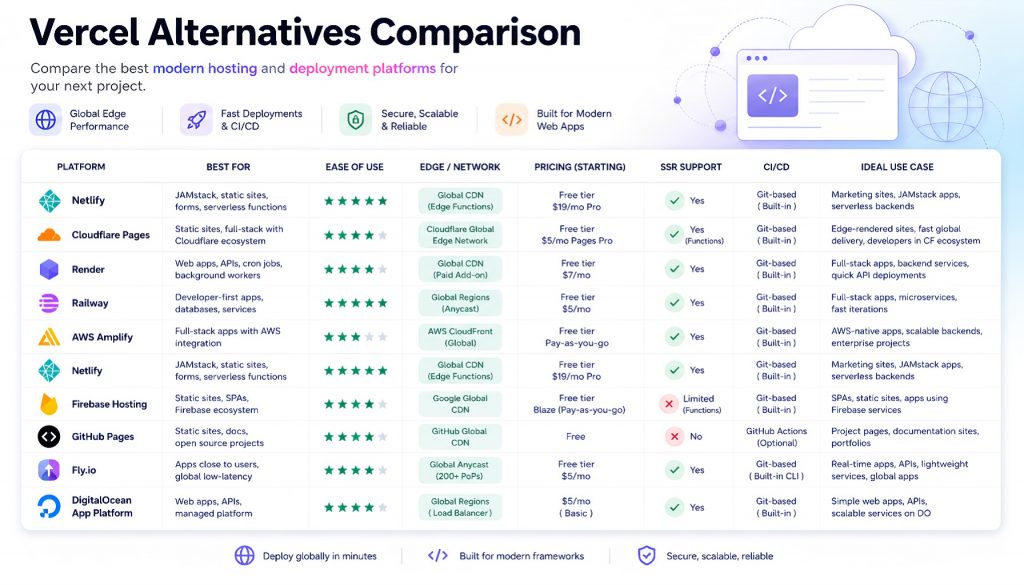
This article compares five alternatives across pricing, performance, lock-in risk, and ideal use cases. Each one solves a different piece of the Vercel puzzle.
When to consider switching
You should evaluate alternatives if your project meets any of these criteria:
- Monthly bandwidth exceeds 100GB
- Multiple team members need access without per-seat costs eating the budget
- Your monthly spend needs to stay under $100
- You want deployment portability between platforms
If you’re a solo developer on the free tier building side projects, Vercel is still hard to beat. The alternatives become relevant when money and team size enter the picture.
Netlify: the closest feature match
Netlify is Vercel’s oldest competitor, and the two platforms overlap more than they differ. If you want a similar experience with less lock-in, Netlify is the straightforward swap.
The free tier gives you 100GB bandwidth and 300 build minutes per month. Edge Functions run on standard Deno, which means your edge logic is portable. Built-in form handling, identity management, branch previews, rollbacks, and A/B testing come out of the box.
The trade-offs are real. Build speeds run 20-30% slower than Vercel. CDN coverage in Asia lags behind Cloudflare. The Pro plan at $19/month still charges $55 per 100GB for bandwidth overages, so high-traffic sites still face surprise bills.
Netlify fits teams that want full-stack deployment features and are willing to accept slower builds in exchange for reduced vendor lock-in. The migration path from Vercel is relatively short since the deployment model is nearly identical.
Pricing: Free tier, Pro at $19/month, Business at $99/month.
Cloudflare Pages: unlimited bandwidth at no cost
Cloudflare Pages is the fastest-growing alternative in 2026, and the reason is simple: the free tier has no bandwidth cap. Zero. You could serve a terabyte of static assets and pay nothing for transfer.
Behind that pricing sits Cloudflare’s global network with 300+ edge nodes. Latency is consistently low across regions. Workers integration gives you server-side compute at the edge, and the platform supports full-stack frameworks including Next.js, SvelteKit, and Remix.
The constraints are around builds and ecosystem maturity. The free tier caps you at 500 builds per month. There’s no equivalent to Vercel’s Image Optimization API, so you need a separate image pipeline. Logging and analytics are minimal compared to Vercel’s dashboard. Next.js support is community-maintained through the @cloudflare/next-on-pages adapter, which occasionally lags behind upstream releases.
Cloudflare Pages is the right pick for high-traffic sites on tight budgets, static sites, and Jamstack applications where bandwidth cost is the primary concern. If your app doesn’t rely on Vercel-specific APIs, the savings are significant.
Pricing: Free tier with unlimited bandwidth, Workers Paid at $5/month unlocks higher build limits.
Railway: one platform for your entire stack
Railway takes a different approach. Instead of optimizing for frontend deployment, it provides containerized infrastructure for your full application stack. Frontend, backend, database, cache, object storage, all managed from one dashboard.
You deploy a Node.js API, a PostgreSQL database, a Redis instance, and your Next.js frontend to the same project. GitHub integration handles CI/CD, monorepo support works without workarounds, and pricing is purely usage-based at $0.000463 per GB-hour of memory.
Railway doesn’t include a dedicated CDN. Static asset delivery relies on putting Cloudflare or another CDN in front of your Railway services. Cold starts are slower than Vercel’s edge network. The free tier provides only $5 of monthly credit, which runs out quickly under any real load.
This platform makes sense when you’re currently stitching together Vercel plus Supabase plus Redis plus a separate backend host. Railway consolidates that into a single provider with transparent per-resource billing. The total cost is often lower, and you get one set of logs and one deployment pipeline.
Pricing: $5 free credit per month, then pay-as-you-go with no fixed monthly fee.
Render: stable infrastructure for production workloads
Render occupies the space Heroku left behind. It’s more enterprise-oriented than Railway and more general-purpose than Vercel, with a focus on reliability for production applications.
Static sites deploy free with unlimited bandwidth and unlimited builds. Web services, databases, and background workers live under a unified management interface. SSL, DDoS protection, and health checks are built in rather than bolted on.
The minimum cost for a web service is $7/month. The free tier includes cold starts that add several seconds to the first request after inactivity. CDN performance sits behind Cloudflare and Vercel’s edge networks. Frontend framework support exists but isn’t the platform’s focus, so you won’t find the same level of Next.js-specific optimization.
Render fits teams that prioritize uptime and operational maturity over deployment speed and frontend DX. If your application needs to stay up and you want clear SLAs, Render delivers that without the complexity of managing your own infrastructure.
Pricing: Static sites free, web services from $7/month, enterprise pricing available.
Fly.io: global edge deployment for latency-sensitive apps
Fly.io deploys your application as containers distributed across 30+ regions worldwide. The platform automatically routes users to the nearest instance. Unlike CDN-based solutions that only cache static assets at the edge, Fly.io runs your actual application code close to users.
The standout feature is stateful edge deployment. You can run databases that follow your users geographically, which matters for applications where read latency directly affects user experience. The platform is technology-agnostic since everything runs in containers.
The learning curve is steep. Configuration happens through fly.toml files and the Fly CLI. Deploying a static site requires writing a Dockerfile, which is more work than Vercel’s zero-config approach. The free tier gives you 3 shared-CPU VMs, enough to experiment but not enough for production traffic.
Fly.io is for teams that need globally distributed compute and are willing to invest configuration time to get it. If your users are spread across continents and milliseconds matter, this platform delivers performance that CDN-fronted single-region deployments can’t match.
Pricing: 3 free VMs, then pay-as-you-go based on resource consumption.
Comparison table
| Platform | Free bandwidth | CDN nodes | Full-stack support | Lock-in risk | Best for |
|---|---|---|---|---|---|
| , , , , , | , , , , , , , – | , , , , , – | , , , , , , , , , – | , , , , , , , | , , , , , |
| Netlify | 100GB | 20+ | Yes | Low | Feature parity with Vercel |
| Cloudflare Pages | Unlimited | 300+ | Yes | Low | High-traffic, budget-conscious |
| Railway | N/A (no CDN) | N/A | Yes | Low | Consolidated full-stack apps |
| Render | Unlimited (static) | Limited | Yes | Low | Production reliability |
| Fly.io | Limited | 30+ regions | Yes | Medium | Global low-latency apps |
Migration tips
Three things catch people when moving off Vercel:
Image optimization. Vercel’s next/image component uses a built-in optimization service. On other platforms, you need to configure a custom loader. Cloudflare Images provides the closest equivalent. Alternatively, use a service like imgix or Bunny Optimizer and point your loader configuration there.
Edge middleware. Vercel’s Middleware API is proprietary. Moving to Cloudflare Workers requires a rewrite, but the resulting code uses standard Web APIs and runs anywhere that supports them. The migration effort pays off in portability.
Environment variable structure. All platforms support environment variables, but Vercel’s three-tier system (Production, Preview, Development) needs manual mapping. Most alternatives use a simpler model where you define variables per environment or per branch.
Start by deploying a branch preview on the new platform. Verify that builds complete, pages render correctly, and API routes respond as expected. Once you’re confident, switch your production domain using a CNAME record. Keep the old Vercel project around for a week in case you need to roll back.
The market in 2026
Developer behavior is shifting. Cloudflare Pages’ growth shows that unlimited bandwidth matters more than a polished deployment UI. Railway and Render pulling users from the Vercel-plus-multiple-services pattern indicates that consolidation beats best-of-breed when operational overhead is the bottleneck.
Vercel remains the best platform for Next.js applications that need tight framework integration. If you use Vercel-specific features heavily, the switching cost is real and the platform earns its price. But if your application runs on standard web APIs and your bill keeps climbing, these five alternatives offer concrete savings without sacrificing much in developer experience.
Pick based on your primary constraint. Bandwidth cost points to Cloudflare. Full-stack consolidation points to Railway. Production reliability points to Render. Global latency requirements point to Fly.io. Maximum feature overlap with Vercel points to Netlify. Test with a branch deployment before committing. The money you save can go toward better tooling, more infrastructure, or just staying under budget while your traffic grows.
Related Reading
- Best Vercel Alternatives in 2026: 5 Frontend Deployment Platforms Compared
- Vercel Alternatives in 2026: Netlify, Cloudflare Pages, Railway, Render, and Fly.io Compared
Sources
Pricing and capability claims above were checked against vendor documentation. Verify current numbers before purchasing, since vendors change tiers often.
Stay updated with our latest AI insights