Everyone’s watching humanoid robots. Figure’s latest demo gets millions of views. Boston Dynamics posts another parkour video and the internet loses its mind. Investors pour billions into companies promising a robot in every home by 2030.
I think they’re looking at the wrong machine.
The first system to achieve real embodied AI, the kind where a physical body perceives, reasons, and acts in the messy real world with full autonomy, won’t walk on two legs. It will roll on four wheels. Cars are going to crack this problem first, and it won’t even be close.
This isn’t a contrarian take for the sake of it. When you line up the structural advantages that vehicles hold over humanoid robots across six dimensions, the conclusion feels almost obvious. Cars have clearer tasks, better bodies, richer data, friendlier environments, faster paths to revenue, and more mature governance. Let me walk through each one.
The Task Boundary Problem
Here’s a question that doesn’t get asked enough: what does “success” look like for embodied AI?
For a humanoid robot in your kitchen, success means… everything. Crack an egg without crushing it. Navigate around a toddler’s toys. Understand that the cat on the counter is not an obstacle to be moved but a creature with preferences. Handle a spilled glass of wine on a hardwood floor differently than on tile. The task space is essentially unbounded.
For a car, success means getting from point A to point B without hitting anything, while following traffic laws. That’s it. The task is complex in execution but narrow in definition.
This distinction matters enormously for AI development. Every machine learning system performs better when you can clearly specify the objective function. Self-driving cars optimize for a handful of measurable goals: safety (zero collisions), efficiency (reasonable travel time), comfort (smooth acceleration and braking), and legality (obeying traffic rules). You can score these. You can benchmark them. You can tell when the system is improving.
Humanoid robots operating in homes? Good luck defining the objective function for “be helpful.” The ambiguity alone makes the learning problem orders of magnitude harder.
Tesla’s FSD system processes a specific visual vocabulary: lane markings, traffic signals, other vehicles, pedestrians at crosswalks. Waymo’s sensors map a structured world of roads, intersections, and parking lots. Compare this to what Figure 02 would need to understand to operate in an average American household: thousands of object categories, countless social contexts, physical interactions that vary by material, weight, fragility, and cultural expectation.
I’m not saying home robots are impossible. I’m saying they’re solving a harder version of the same fundamental problem, and they’re solving it with worse tools.
The Body Advantage
The automotive industry has spent over a century perfecting the physical platform. When AI researchers talk about embodied intelligence, they tend to focus on the “intelligence” part and treat the “embodied” part as an engineering detail. It’s not. The body is half the problem.
Consider what a modern car already has:
Sensing. A 2025 production vehicle carries cameras, radar, ultrasonic sensors, GPS, IMUs, and increasingly LiDAR. These sensors are weatherproofed, vibration-tested, temperature-rated, and designed to run continuously for years. The sensor suite on a Tesla Model 3 captures data across multiple spectrums with sub-millisecond synchronization.
Boston Dynamics’ Atlas is impressive, but its sensor package is built for lab demonstrations, not 100,000 miles of daily operation in rain, snow, dust, and direct sunlight.
Actuation. A car’s actuators are simple and reliable. Steering, throttle, brakes. Three primary control channels. Electric vehicles add regenerative braking as a fourth. These systems have failure modes that are well-understood, with decades of engineering behind redundancy and fault tolerance.
A humanoid robot has 20 to 40 degrees of freedom, each requiring a motor or actuator that must be precisely coordinated. Each joint is a potential failure point. The mechanical complexity is staggering, and we haven’t solved it for consumer-grade reliability. Figure’s robots work in controlled factory settings. They don’t survive a toddler climbing on them.
Power. An EV battery provides 60 to 100 kWh of energy, enough to run compute-intensive AI inference for hours while simultaneously moving a two-ton vehicle at highway speeds. Charging infrastructure exists nationwide. The power problem for cars is solved.
Humanoid robots carry battery packs that last 1 to 4 hours under load. Atlas runs for about 90 minutes. Figure 02 demos rarely exceed an hour. Until battery energy density improves dramatically or we accept robots that need to charge every 90 minutes, the power limitation constrains everything.
Thermal management. AI inference chips generate heat. A car has a purpose-built cooling system that can dissipate hundreds of watts continuously. Robots face tight thermal constraints because adding cooling hardware adds weight, which demands more power, which generates more heat. It’s a vicious cycle that car designers solved decades ago.
The car’s body isn’t just adequate for embodied AI. It’s optimized for it in ways that roboticists can only dream about.
Data Flywheels: The Compounding Advantage
This is where the gap becomes almost unfair.
Tesla has over 6 billion miles of real-world driving data from its fleet. Every Tesla on the road is a data collection platform, capturing edge cases, recording near-misses, logging how human drivers handle novel situations. This data flows back to train the next generation of FSD models, which deploy to the fleet, which collects more data. The flywheel spins faster every quarter.
Waymo has logged over 20 million miles of fully autonomous driving and billions of miles in simulation. Cruise, before its setback, had accumulated significant urban driving data in San Francisco.
Now ask: where is the equivalent data flywheel for humanoid robots?
It doesn’t exist. There is no fleet of robots in homes generating continuous behavioral data at scale. Figure operates in controlled warehouse environments. Boston Dynamics robots are research platforms, not data collection networks. The largest robotics datasets are tiny compared to driving data, measured in thousands of hours rather than billions of miles.
This data asymmetry has cascading effects. More data means better models. Better models mean safer deployment. Safer deployment means more vehicles on roads. More vehicles mean more data. Cars are already deep into this virtuous cycle. Robots haven’t started it yet.
There’s a structural reason for this gap. Cars go places constantly. A car in regular use drives 30 to 50 miles per day, encountering hundreds of novel scenarios per trip. A home robot would mostly sit idle, occasionally doing tasks that might generate a few minutes of interesting training data. The data generation rate per deployed unit is incomparably higher for vehicles.
Simulation helps, but simulation without real-world grounding produces brittle systems. Cars have both. Robots have mostly simulation.
Roads Are Rule-Encoded Environments
Consider the operating environment of a car versus a humanoid robot.
Roads are engineered spaces. They have lane markings that specify where vehicles should be. They have traffic signals that dictate when to stop and go. They have speed limits, right-of-way rules, merge conventions, and standardized signage. A road is, in computational terms, a partially observable environment with explicit rule encoding.
Yes, driving has edge cases. Construction zones, erratic drivers, animals crossing highways, unusual weather. But the baseline environment is structured, regulated, and predictable. A car that handles 99% of situations correctly can still deliver massive value because the remaining 1% tends to cluster in recognizable patterns.
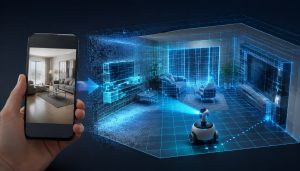
A home is an unstructured environment. Objects move. People rearrange furniture. Children leave toys in unexpected places. The lighting changes. The floor surface varies from room to room. There are no lane markings for hallways, no traffic signals for doorways, no speed limits for kitchen navigation.
Open-world environments are the hardest problem in robotics. They require common-sense reasoning about physics, social norms, and object permanence. They demand handling situations that were never in the training data because homes are infinitely variable.
Waymo operates in mapped cities where every curb, crosswalk, and traffic signal is cataloged. The car knows what to expect before it arrives. A home robot entering a new house has zero prior map of the environment and must build understanding from scratch while simultaneously performing useful work.
This environmental advantage compounds with the data advantage. Because roads are structured, the data collected on roads is more learnable. Patterns repeat. Rules apply. Extrapolation from known scenarios to similar ones works better in regulated spaces than in chaotic ones.
Commercial Viability: Money Follows Function
The path to profitability for autonomous vehicles is clear and already being traveled.
Waymo operates a commercial robotaxi service in San Francisco, Phoenix, and Los Angeles. Riders pay money to ride in cars with no human driver. That’s not a pilot. That’s a business. In early 2025, Waymo was completing over 150,000 paid rides per week. Revenue exists. Unit economics are improving.
Tesla’s FSD subscription generates recurring revenue from millions of vehicles. Even in its current supervised state, customers pay $99 per month or $8,000 one-time for the software. When FSD reaches full autonomy, Tesla’s plan to deploy robotaxis using existing customer vehicles creates a business model with near-zero marginal hardware cost.
The logistics sector adds another revenue layer. Aurora Innovation’s autonomous trucks are running freight routes. TuSimple (before its complications) demonstrated coast-to-coast autonomous trucking. Amazon has invested heavily in autonomous delivery. The freight industry alone represents a multi-trillion dollar market waiting for autonomous solutions.
Now compare this to humanoid robots. Where’s the revenue?
Figure’s business plan centers on factory work, replacing humans on assembly lines. This is viable but narrow. The factory environment is controlled enough that you don’t need humanoid form. Specialized robots already do this work well.
The broader vision, robots in homes doing household chores, lacks a clear monetization path at current capability levels. A robot that can fold laundry but can’t load a dishwasher or clean a bathroom isn’t worth $50,000 to a consumer. The capability threshold for consumer value is much higher for home robots than for vehicles. A car that drives itself 95% of the time already saves you hours per week. A robot that handles 95% of household tasks doesn’t exist and won’t for years.
Money flows toward problems that are nearly solved, not problems that are barely started. Autonomous vehicles are in the “nearly solved” category for constrained use cases. Home robots are still in the research category for general use.
Governance and Regulation: The Unsexy Advantage
Nobody writes breathless articles about regulatory frameworks. But governance is what separates technology that deploys at scale from technology that stays in labs.
Autonomous vehicles benefit from decades of existing automotive regulation. The National Highway Traffic Safety Administration (NHTSA) has clear jurisdiction. State DMVs issue permits for autonomous testing. Insurance frameworks exist, imperfect but functional. Liability assignment, while still debated, follows established precedents from automotive law.
California, Arizona, Texas, and other states have specific legislation governing autonomous vehicle testing and deployment. Waymo has permits. Cruise had permits. Zoox has permits. The legal pathway exists.
For humanoid robots in homes, what’s the regulatory framework? There isn’t one. Product liability law applies broadly, but there’s no equivalent of NHTSA for domestic robots. No testing permits. No deployment licenses. No mandatory safety standards for a robot that operates in your living room around your children.
This regulatory vacuum might seem like freedom, but it’s actually a barrier. Companies investing billions want legal clarity. They want to know what “safe enough” means in regulatory terms. They want insurance products that cover their liability. They want standards that, once met, provide legal protection.
Autonomous vehicles have all of this, imperfectly, but in a form that enables commercial deployment. Humanoid robots will need to build this regulatory infrastructure from scratch, and that takes decades, not years.
The Evolutionary Path
How does a car become a full embodied AI agent? Not in one leap, but through four stages.
Stage 1: Assistive Intelligence (where most cars are today). The AI handles specific subtasks while the human maintains overall control. Lane-keeping, adaptive cruise control, automatic emergency braking. The car perceives and reacts but doesn’t decide. Tesla’s Autopilot and GM’s Super Cruise operate here.
Stage 2: Conditional Autonomy (where leaders are now). The AI drives independently in defined conditions while the human serves as backup. Tesla FSD supervised, Waymo in geofenced areas, Mercedes Drive Pilot on highways. The car perceives, decides, and acts, but within boundaries.
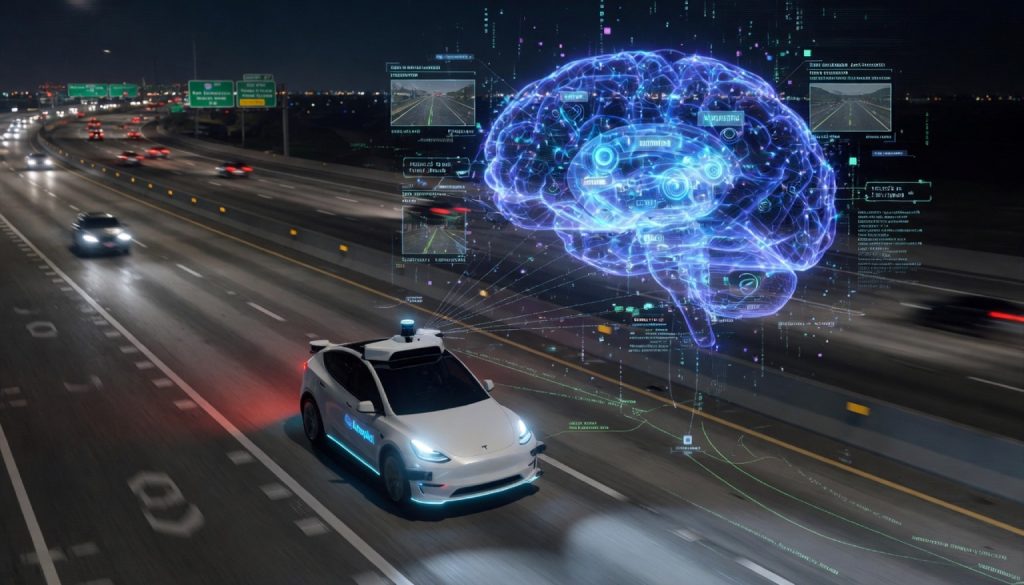
Stage 3: Operational Autonomy (emerging). The AI operates without human backup in expanding domains. Waymo in three cities without safety drivers. The car handles novel situations, makes judgment calls, and operates for hours without human input. This is embodied AI by any reasonable definition: a physical system perceiving the world, reasoning about it, and taking autonomous action.
Stage 4: Networked Embodied Agent (future). Individual vehicles share perception and knowledge in real time, creating collective intelligence. A car in Phoenix encounters a novel construction pattern and that knowledge propagates to every vehicle in the network within minutes. Cars negotiate with each other and with infrastructure. They become nodes in a distributed embodied intelligence network.
We’re already at Stage 2 broadly and Stage 3 in limited deployment. The progression from here requires engineering improvements, not fundamental breakthroughs. Better sensors, more compute, more data, refined algorithms. The path is steep but visible.
For humanoid robots, Stage 1 barely exists in consumer form. We’re watching demos of Stage 2 capabilities in factory settings. The jump from factory demo to home deployment crosses multiple unsolved fundamental problems in manipulation, reasoning, and adaptation.
What Cars Teach Us About Embodied AI
The car’s journey to autonomy is generating insights that apply to all embodied AI systems.
Perception-action coupling. Self-driving systems have shown that end-to-end learning, going directly from sensor input to control output, can outperform modular approaches. Tesla’s shift to vision-only FSD, removing radar and relying purely on camera-based neural networks, demonstrated that sufficient data and compute can replace specialized sensors. This insight transfers directly to robot perception.
Simulation-to-reality transfer. The autonomous vehicle industry has invested billions in simulation technology. NVIDIA’s Omniverse, Waymo’s simulation platform, and Tesla’s custom simulator generate synthetic training data at massive scale. These simulation techniques, validated against real-world driving performance, will accelerate robot training when the time comes.
Safety-critical AI deployment. Cars are teaching us how to deploy AI systems where failures kill people. The methodologies for validation, testing, redundancy, and graceful degradation being developed for autonomous vehicles will become the engineering foundation for any embodied AI system operating near humans.
Edge computing at scale. Running complex neural networks in real-time on vehicle hardware has driven advances in inference chips, model compression, and power-efficient computing. NVIDIA’s Orin and Thor platforms, Tesla’s FSD computer, and Mobileye’s EyeQ chips exist because cars demanded them. Robots will inherit these advances.
The Counter-Arguments
Fair to address the pushback.
“But cars are just driving. That’s not general intelligence.” True. Embodied AI doesn’t require generality to be real. A system that perceives, reasons, and acts in the physical world is embodied AI whether it drives a car or folds laundry. The point is that cars will be the first to achieve this reliably at scale.
“Humanoid robots have better investment momentum right now.” Also true. Figure raised $675 million. 1X raised $100 million. The hype cycle favors robots. But investment momentum and technical readiness are different things. Many well-funded ventures fail because the underlying technology isn’t ready. Self-driving cars have had their own hype cycle and are now emerging into real deployment. Robots are earlier in that same cycle.
“Waymo took 15 years and billions of dollars.” Yes, and it’s now operating a profitable robotaxi service in three cities. The timeline was long, but the trajectory reached commercialization. Humanoid robots don’t yet have a Waymo equivalent, a company with an operational product serving paying customers in open environments.
“Chinese EV makers are ahead.” They might be, specifically in the speed of deployment. Companies like Baidu’s Apollo, Huawei’s ADS, and various Chinese EV brands are pushing autonomous features aggressively. The competitive dynamics differ by region, but the fundamental argument holds regardless of which geography leads: cars have structural advantages over robots for embodied AI.
What This Means for the Industry
If cars are the first viable embodied AI, several implications follow.
First, the talent and techniques that emerge from autonomous vehicles will flow into robotics. Engineers who solved perception for driving will bring those skills to manipulation. The technology transfer will be directional, from cars to robots, not the reverse.
Second, the data moats being built by Tesla, Waymo, and others represent embodied AI moats, not just driving moats. A company with billions of miles of real-world perception-action data has a foundation that’s applicable well beyond transportation.
Third, regulation developed for autonomous vehicles will become the template for robot governance. Whatever standards NHTSA develops for self-driving cars will inform how agencies eventually regulate home robots.
Fourth, public trust in embodied AI will be built through vehicles, not robots. Every safe Waymo ride, every successful FSD trip, normalizes the idea of AI making physical-world decisions. This cultural acceptance matters when robots eventually enter homes.
Cars Won’t Be the Endgame
Let me be clear: cars are not the final form of embodied AI. They’re the proving ground. The training wheels. The first viable commercial deployment of physical intelligence operating in the real world.
The endgame is broader. Robots in homes, hospitals, construction sites, farms, and disaster zones. Drones navigating complex airspaces. Underwater vehicles exploring ocean floors. Machines that manipulate the physical world with human-level dexterity and superhuman endurance.
But endgames don’t matter if you can’t find a starting point. You need a domain where the technology works well enough to generate revenue, where revenue funds further development, where development produces better technology, where better technology enables expansion into new domains.
Cars are that starting point. They have the task clarity, the physical platform, the data engine, the environmental structure, the business model, and the regulatory framework to serve as embodied AI’s first commercially viable form.
The robot future is coming. The vehicle future is already here.
Five years from now, I expect we’ll look back and see the autonomous vehicle industry not as a separate phenomenon from embodied AI, but as its first chapter. The companies that cracked self-driving will have more to say about physical intelligence than the companies currently building humanoid prototypes.
The most important embodied AI system of 2026 isn’t walking. It’s driving.
Related Reading
- Losing Control Doesnt Require Consciousness: The Night AI Breached AI
- After ChatGPT Started Running Ads, Which AI Tools Are Still Worth Paying For in 2026?
Stay updated with our latest AI insights