On July 9, OpenAI shipped ChatGPT Work. You give it a goal. It runs autonomously for hours. It hands back finished artifacts: spreadsheets, slide decks, documents, functioning web apps. Not outlines. Not suggestions. Completed deliverables.
This is the product OpenAI has been building toward since GPT-4 made conversational AI feel like table stakes. The same day, they released GPT-5.6, merged Codex desktop into the main ChatGPT interface, and announced the retirement of Atlas, their standalone AI browser. Four moves in a single day, all pointing the same direction: the AI assistant is becoming an AI worker.
What ChatGPT Work Actually Does
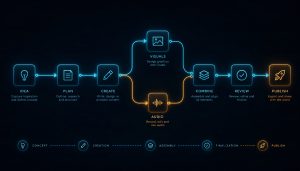
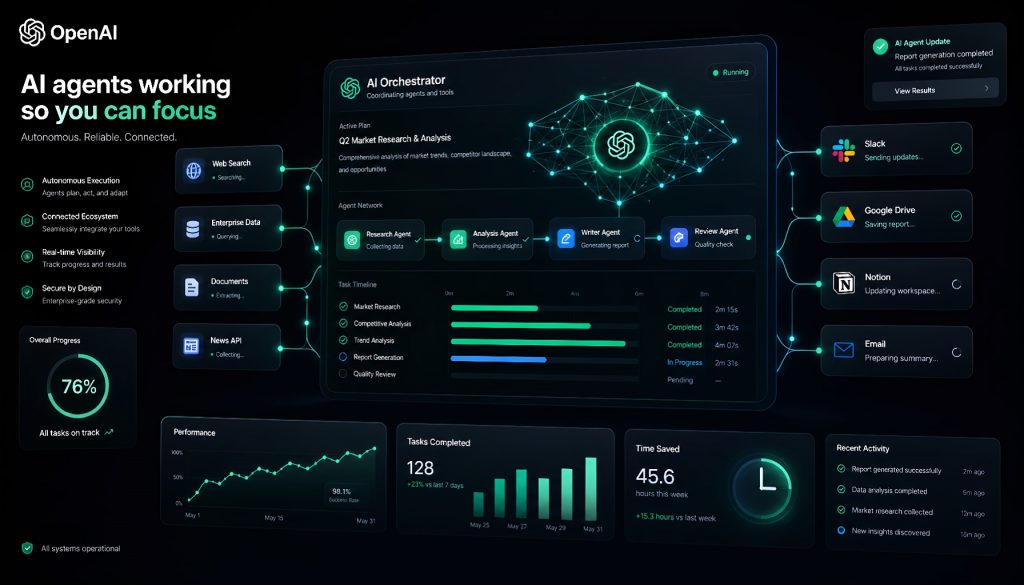
The pitch is simple. You describe an outcome. ChatGPT Work breaks it into subtasks, executes them sequentially or in parallel, and delivers the result. It can browse the web for research, write and run code, generate visualizations, build interactive prototypes, draft long-form documents, and assemble presentations. All without you watching over its shoulder.
The key difference from previous ChatGPT capabilities: duration and autonomy. Earlier versions could do multi-step tasks if you stayed in the loop, confirming each step. ChatGPT Work removes that requirement. You set the goal, walk away, come back to finished output.
Think of the difference between asking someone to help you write a market analysis versus handing it off entirely. The first is a conversation. The second is delegation. OpenAI is betting that delegation is what paying users actually want.
The Numbers Behind the Pivot
Why now? The usage data tells the story.
Codex, which started as a developer tool, now has over 5 million weekly active users. More than 1 million of them use it for non-coding work: writing reports, building spreadsheets, creating presentations. The tool grew beyond its original audience organically, without OpenAI pushing it there.
Codex also accumulated 1,400+ plugin connectors, integrations that let it interact with external services, pull data from APIs, and push outputs to tools people already use. That connector ecosystem is now part of ChatGPT Work’s foundation.
The merger of Codex desktop into ChatGPT is an acknowledgment of what already happened. Users weren’t treating Codex as a coding tool. They were treating it as an execution engine. OpenAI is just making the branding match the behavior.
Atlas Dies So the Agent Can Live
The retirement of Atlas, OpenAI’s standalone AI browser, looks like a product cut. It’s actually a statement about architecture.
Atlas launched as a dedicated browsing agent. You could point it at the web and it would research, summarize, and extract information. It was useful. It also represented a design philosophy that OpenAI is now abandoning: the idea that each AI capability needs its own interface.
The new philosophy is unification. Browsing isn’t a separate product. It’s one capability among many, embedded inside a single assistant that can also code, write, design, and build. An agent that does real work needs to browse the web the same way a human employee does, as part of completing a larger task, not as an activity unto itself.
This mirrors what happened with search engines and browsers over the past decade. Search used to be a destination. Now it’s a feature inside everything. AI browsing is following the same path: from standalone tool to embedded capability.
The Pricing Signal
OpenAI chose usage-based metering for ChatGPT Work instead of a flat monthly subscription. This tells you something important about how they expect the product to be used.
Flat subscriptions work when usage is predictable and roughly uniform across customers. Usage-based pricing works when variance is high, when some users will consume 10x or 100x what others do. OpenAI expects ChatGPT Work usage to be spiky and uneven. Some users will run it once a week. Others will have it executing tasks continuously.
This pricing model also creates a natural alignment between value delivered and revenue captured. If ChatGPT Work produces a finished market analysis that would have taken an analyst two days, charging per-task makes more economic sense than bundling it into a $20/month plan. It positions the product closer to contractor pricing than software pricing.
For enterprise buyers, this means budgeting for ChatGPT Work looks more like budgeting for freelance labor than budgeting for SaaS seats. That’s a new procurement conversation most organizations haven’t had yet.
GPT-5.6: The Engine Upgrade
The simultaneous release of GPT-5.6 isn’t coincidental. ChatGPT Work needs a model that can maintain coherence over long task sequences, handle ambiguity in initial instructions, and recover from intermediate failures without human intervention.
Earlier models could do impressive single-turn work. Multi-turn conversations were solid. But autonomous multi-hour task execution requires a different kind of reliability. The model needs to plan, execute, hit dead ends, backtrack, and still produce coherent output. GPT-5.6 is apparently the first model OpenAI considers good enough for that use case.
We don’t have detailed benchmarks yet. What we have is OpenAI’s willingness to stake a major product launch on it. That’s its own kind of benchmark.
The Real Shift: From Advisor to Executor
Every AI product until now has operated in advisory mode. You ask a question, you get an answer. You describe a problem, you get a suggestion. You paste in code, you get a review. The human still does the work. The AI just helps them do it faster or better.
ChatGPT Work breaks that pattern. The AI does the work. The human defines what work needs doing, reviews the output, and decides what to do with it.
This isn’t a subtle distinction. It changes who the user needs to be. Advisory AI rewards people who are good at execution but need help thinking. Executor AI rewards people who are good at judgment but bottlenecked on execution.
The person who benefits most from ChatGPT Work isn’t the junior analyst who needs help writing their first market report. It’s the senior director who knows exactly what 12 reports they need but can’t get headcount to produce them. The value proposition shifts from “do better work” to “get more work done.”
What Becomes Scarce
When execution costs drop to near zero, the bottleneck moves upstream. If anyone can produce a polished slide deck or a functioning prototype in hours, the differentiator isn’t production quality. It’s knowing which deck to build. Which prototype to test. Which question to answer.
Judgment becomes the scarce resource. Specifically: the judgment to know what’s worth doing before you do it.
This is the part most commentary about AI agents misses. The conversation fixates on capability, on what the AI can produce. But the harder problem is specification, knowing what to ask for. An autonomous agent that can execute for hours is only as valuable as the instructions it receives.
Bad judgment plus perfect execution produces polished garbage at scale. Good judgment plus autonomous execution produces actual leverage.
For organizations, this means the people who can frame problems clearly, who can write a one-paragraph brief that produces useful output, become disproportionately valuable. Prompt engineering was a preview of this dynamic. ChatGPT Work makes it the whole game.
The Competitive Landscape Implications
Google, Anthropic, and Microsoft are all building agent products. But OpenAI’s move with ChatGPT Work creates a specific competitive frame: the winner is whoever ships the most reliable autonomous executor first.
Not the best chatbot. Not the most accurate question-answerer. The most trustworthy worker, the agent you can hand a task to and trust the output without micromanaging the process.
That’s a different race than “who has the best model on benchmarks.” It’s a systems problem: reliability, tool integration, error recovery, output quality consistency. The 1,400+ Codex connectors matter here. The years of RLHF training on user preferences matter. The volume of real-world usage data from 5 million weekly Codex users matters.
OpenAI’s bet is that they’re furthest ahead on the full stack required for reliable autonomous execution, not just model intelligence, but the surrounding infrastructure of tools, integrations, and feedback loops.
What to Watch
Three things will determine whether ChatGPT Work becomes a core enterprise tool or a novelty:
Reliability at scale. Can it handle ambiguous instructions gracefully? Does it fail loudly when it can’t complete a task, or does it produce confident-looking garbage? Early users will test this aggressively.
Integration depth. The 1,400+ connectors are a start, but enterprise work happens inside specific tools. Salesforce, Jira, Confluence, internal databases. The agent needs to read from and write to the systems where work actually lives.
Trust calibration. Users need to learn what kinds of tasks they can delegate fully versus which ones need checkpoints. That’s a learning curve for both the product and its users. OpenAI will need to build interfaces that help people understand when to trust the output and when to verify.
The Bottom Line
ChatGPT Work is OpenAI’s attempt to cross the gap between “AI that helps you work” and “AI that does work for you.” The technology is reaching the point where this is feasible. Whether it’s reliable enough for high-stakes use cases remains unproven.
But the direction is clear. The AI industry spent 2023-2025 proving that models could understand and generate. 2026 is about proving they can execute. OpenAI just made their biggest bet on that thesis.
The question for every team evaluating this: what work in your organization is bottlenecked on execution rather than judgment? That’s where autonomous agents create value first. Everything else is a demo.
Related Reading
- ChatGPT Work: OpenAI Agents Now Deliver Finished Work, Not Chat Replies
- OpenAI Just Killed the AI Demo Era. Now What?
Stay updated with our latest AI insights