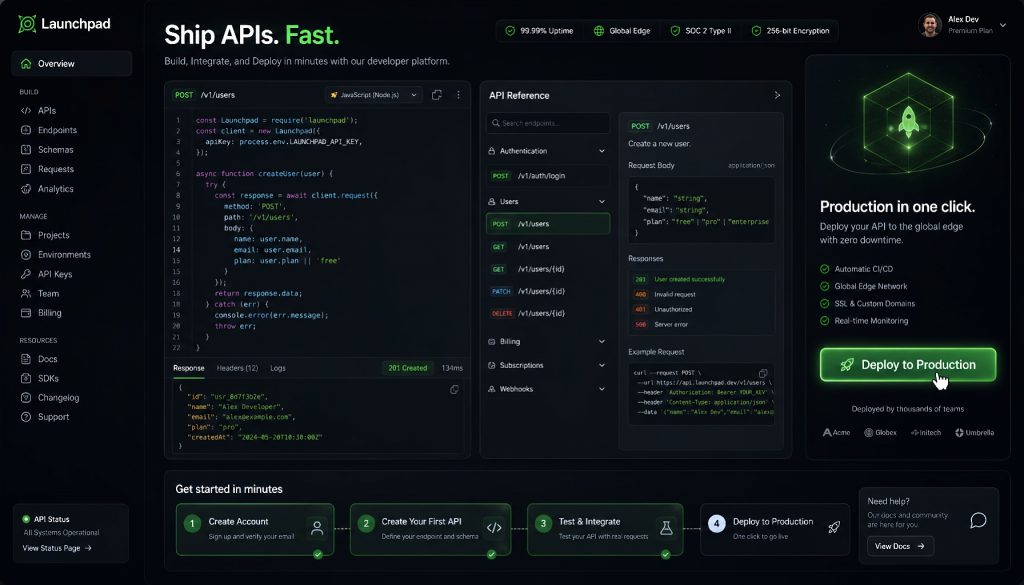
A three-person team shipped a production SaaS app in 72 hours last month. Not a hackathon toy. A real product with authentication, a database, deployment pipeline, and paying users by day four. Their stack: Clerk for auth, Neon for the database, Vercel for hosting. Total infrastructure code written: about 40 lines.
This isn’t an outlier anymore. It’s the new baseline. And it’s destroying the economics of enterprise SaaS from the bottom up.
The Replacement Cycle Is Already Here
Something shifted in the developer tools market around 2024, and by mid-2026 the results are impossible to ignore. A new class of DX-first companies is pulling users away from entrenched incumbents, not by offering more features, but by offering less friction.
The pattern repeats across categories:
Clerk vs. Okta/Auth0. Clerk gives you working authentication in under five minutes. Copy a component, add your API key, done. Compare that to Okta’s OIDC configuration, token rotation setup, and session management boilerplate, which routinely takes a full sprint to implement correctly. By mid-2026, Clerk’s paying customer count passed Auth0’s pre-acquisition peak. That’s not a rounding error. That’s a market moving.
Neon vs. Amazon RDS. Neon introduced database branching, the same mental model developers already use with Git. Need a copy of production for testing? Branch it. Takes seconds, costs nearly nothing. RDS makes you snapshot, restore, wait, configure security groups, update connection strings. Neon crossed $100M in annual recurring revenue by late 2025, growing at a rate that took RDS years longer to achieve.
Vercel vs. AWS Amplify. With Vercel, you push to Git and your app is live. That’s the entire workflow. AWS Amplify requires 7-8 pages of configuration across IAM roles, build settings, environment variables, custom domains, and redirect rules before you see anything in production. Developers voted with their keyboards.
Supabase vs. Firebase. Supabase runs on standard PostgreSQL. Your queries, your data, portable anywhere. Firebase locks you into a proprietary document store with its own query language, its own rules syntax, its own everything. If you leave, you rebuild. Supabase hit 80,000 GitHub stars, making it one of the fastest-growing open source projects in the infrastructure space.
What Makes DX a Moat, Not Just a Feature
Good docs and a clean API are table stakes. The companies winning this race have built something harder to replicate: a three-layer moat that compounds over time.
Layer 1: Product Design Consistency
DX-first tools feel like a single product even as they grow. Every new feature follows the same interaction patterns, the same naming conventions, the same mental model. Clerk’s organization management works exactly like you’d expect if you’ve used their user management. Neon’s branching UI mirrors their query console.
Enterprise tools bolt on acquisitions. After Okta bought Auth0, developers dealt with two dashboards, two API styles, two documentation sites, and conflicting session models. Every acquisition adds surface area without reducing complexity.
Layer 2: The Community Flywheel
When integration takes five minutes instead of five days, developers share what they built. Those shared examples become unofficial documentation. Other developers copy and extend them. The community generates more adoption material than any marketing team could produce.
Supabase gets thousands of community tutorials, starter templates, and integration guides created every month. This isn’t manufactured content. It’s organic signal from developers who had a good experience and want to show others. That flywheel is almost impossible to kickstart retroactively.
Layer 3: Workflow Integration Depth
DX-first tools embed into how developers already work. Vercel hooks into Git. Neon integrates with your ORM. Clerk drops into your component tree. They don’t ask developers to change workflows. They slot into existing ones.
Enterprise tools typically demand you adapt to them. New dashboards to check, new CLIs to learn, new mental models to internalize. Each one pulls developers out of flow state.
The Economics Tell the Story
The financial model behind DX-first adoption inverts traditional enterprise SaaS economics in ways that matter enormously for founders and investors.
| Metric | Traditional Enterprise SaaS | DX-First Tools |
|---|---|---|
| Primary buyer | CTO / VP Eng (top-down) | Individual developer (bottom-up) |
| Sales motion | Demo → POC → procurement → legal | Sign up → build → hit limits → upgrade |
| Time to first value | 2-6 weeks | Under 30 minutes |
| CAC as multiple of ACV | 1.0-1.5x | 0.1-0.3x |
| Expansion trigger | Contract renewal negotiation | Usage growth / team growth |
| Churn signal | Budget review | Developer switches stack |
| Champion | Executive sponsor | The dev who chose it |
That CAC difference is the number that should make every SaaS investor pay attention. When your customer acquisition cost is one-tenth of the incumbent’s, you can price aggressively, grow faster on less capital, and still maintain healthy unit economics. Traditional enterprise sales teams cost $500K-$1M per rep fully loaded. DX-first companies acquire customers through documentation, free tiers, and organic sharing.
The expansion motion is different too. Enterprise SaaS expands through contract renegotiation, usually annually. DX-first tools expand continuously as teams grow and usage increases. One developer picks Neon for a side project. It works well. They use it at their startup. The startup grows to 50 engineers, all on Neon. No sales call required at any step.
Why Incumbents Can’t Just “Fix Their DX”
If great developer experience wins, why don’t Okta and AWS just invest in better DX? They’ve tried. The results have been mediocre at best. Three structural reasons explain why.
The innovator’s dilemma is real here. Okta makes money from enterprise contracts sold to security teams. Simplifying the product threatens the complexity that justifies six-figure deals. Every “easy mode” feature they ship risks cannibalizing their own premium tiers. Their incentive structure actively punishes simplification.
Organizational structure prevents it. DX-first companies organize around the developer journey. Every team, from infrastructure to docs to API design, optimizes for the same user. Enterprise companies organize around product lines, business units, and customer segments. The authentication team doesn’t talk to the billing team doesn’t talk to the SDK team. Nobody owns the full developer experience because it cuts across every org chart boundary.
Technical debt is load-bearing. AWS Amplify can’t rethink their configuration model without breaking thousands of existing deployments. Okta can’t simplify their token flow without invalidating their security certifications. The installed base becomes a constraint that prevents the kind of clean-slate thinking DX-first startups start with.
This is textbook disruption. The incumbents see it happening. They have smart people, large budgets, and clear market intelligence. And they still can’t respond effectively because their entire business model depends on the complexity that DX-first tools eliminate.
What This Means for Builders and Investors
If you’re building a developer tool, the playbook is clear:
Time to first value is your north star metric. Not features, not enterprise compliance checkboxes, not integration breadth. How fast can a developer go from zero to something working? If the answer is more than 15 minutes, you’re vulnerable to someone who can do it in three.
Community adoption is your growth engine, not your marketing strategy. The difference matters. Marketing strategies get budget allocated quarterly. Growth engines compound indefinitely. Invest in making your tool so easy to use that developers can’t help but show others.
Bottom-up adoption doesn’t mean bottom-up pricing forever. Clerk, Neon, and Vercel all have enterprise tiers. But they earned the right to sell enterprise by first winning individual developers. The enterprise contract is the monetization event, not the acquisition strategy.
For investors evaluating developer tool companies, the signals to watch:
- GitHub stars and contributor growth (community strength)
- Time-to-hello-world in documentation (product quality proxy)
- Organic mention frequency in developer communities (pull vs. push demand)
- Ratio of self-serve to sales-assisted revenue (efficiency of growth model)
- Developer NPS vs. buyer NPS gap (sustainable vs. imposed adoption)
The Next Categories to Flip
The DX-first disruption wave isn’t finished. Several enterprise categories still offer terrible developer experiences and are ripe for the same playbook.
Monitoring and observability. Datadog charges per host, per metric, per log line, creating a pricing model that actively discourages instrumentation. Axiom and Highlight.io are betting that consumption-based pricing with instant setup can pull developers away from tools that punish them for collecting data.
CI/CD. Jenkins is a maintenance burden. GitHub Actions has scaling pain. CircleCI keeps changing pricing. The category is waiting for someone to make build pipelines as simple as Vercel made deployments.
Security tooling. Most security products are designed for security teams, not developers. They generate alerts that developers ignore because integrating them into the development workflow requires weeks of configuration. The company that makes security feel like a linter, fast, inline, and automatic, will own the next decade of application security.
Data pipelines. Moving data between systems still requires dedicated engineers writing and maintaining custom integrations. Whoever brings Vercel-level simplicity to data movement will find an enormous market.
The Bigger Picture
The developer tools market is undergoing a structural shift, not a cyclical one. The companies that treat developer experience as their core product, not a layer on top of their actual product, are building advantages that compound quarterly.
For SaaS founders: if developers interact with your product and the integration takes more than a few minutes, a DX-first competitor is coming for you. It might already exist.
For investors: CAC advantages of 5-10x don’t show up often. When they do, they tend to produce category winners. The DX-first wave is still early enough to matter.
For enterprise incumbents: your moat was never the technology. It was the switching cost. DX-first tools are making switching costs approach zero. Figure out your response before your developers figure it out for you.
Related Reading
- Developer Experience Is the New Competitive Moat in Infrastructure SaaS
- Developer Experience Is the Only Moat That Matters in 2026
Stay updated with our latest AI insights