Software engineering is going through a structural shift. Not the kind where you swap one framework for another, but the kind where you wake up and realize your team’s operating model has changed underneath you. In 2026, AI agents have moved from autocomplete assistants to autonomous collaborators that plan, execute, test, and ship code while you sleep. For engineering leaders at B2B SaaS companies, this is no longer a “future of work” thought experiment. It’s a staffing question, a process question, and an org design question, all at once.
This piece breaks down what’s actually happening on the ground: how multi-agent systems work in production, where autonomy hits its limits, and what this means for the people building software today.
The Progression from Autocomplete to Autonomous Execution
The path from 2023 to 2026 followed a clear escalation in agent capability, though it didn’t feel gradual to the teams living through it.
In 2023, AI coding tools predicted your next line. Useful for boilerplate, but fundamentally passive. You drove; the tool suggested.
In 2024, chat-based interfaces let you ask questions and get explanations. You could request a function implementation, but you still had to copy-paste the output into your editor and verify it yourself.
In 2025, tools gained the ability to apply edits directly. You could ask for a refactor and get a diff. But each step required your confirmation. The agent wouldn’t move forward without you clicking “accept.”
In 2026, agents execute end-to-end. You describe a task (with constraints and acceptance criteria), and the agent plans its approach, writes code across multiple files, runs tests, diagnoses failures, iterates on fixes, and submits a pull request. The entire loop happens without human intervention. You review the output in the morning.
This shift from “suggest” to “execute” is the defining change. The agent is no longer a tool you wield. It’s a collaborator you delegate to.
Multi-Agent Systems in Production
The more consequential development is that teams aren’t running one agent. They’re running fleets.
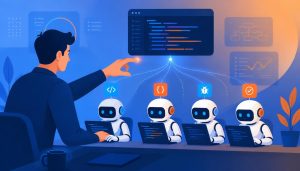
A typical setup in a mid-stage SaaS company now looks like this: one agent handles implementation, another writes and maintains tests, a third performs code review against the team’s style guide and architectural patterns, and a fourth updates documentation. These agents communicate through structured handoffs. The implementation agent’s output triggers the test agent. A test failure routes back to the implementation agent with context. Once tests pass, the review agent evaluates the PR against team standards. If it passes, the documentation agent updates relevant docs.
This isn’t theoretical. NVIDIA and ServiceNow announced an enterprise-grade autonomous agent system in mid-2026 that covers the full cycle from requirement analysis to deployment. IBM’s research division published findings arguing that competitive advantage in AI will come not from individual model capability, but from how well organizations orchestrate multi-agent collaboration.
One engineering director at a Series C company described their setup: five human engineers working alongside twelve AI agents. The agents handle execution. The humans handle decisions, reviews, and system-level thinking. The team reports a 3x throughput increase with no measurable decline in code quality.
The economics here are hard to ignore. A fleet of agents operating 24 hours a day, executing well-specified tasks, costs a fraction of equivalent engineering headcount. For SaaS companies under margin pressure, this changes the calculus on team size and composition.
What Changes for Engineering Leaders
The shift from “humans write code” to “humans direct agents that write code” ripples through every layer of engineering management.
Where engineers spend their time looks different. Less time writing CRUD endpoints and glue code. More time on system design, performance modeling, security posture, and defining the constraints that agents operate within. The craft of software engineering is moving upstream, toward architecture and specification.
Code review changes in character. When an agent submits a PR, you’re rarely catching syntax errors or missing null checks. You’re evaluating design decisions: did the agent choose an appropriate data structure? Does this implementation align with the system’s overall architecture? Is this the right abstraction boundary? Review becomes a design activity rather than a proofreading activity.
Team structure shifts from horizontal to vertical. The old model (frontend team, backend team, QA team) assumed humans specialized by execution domain. The new model needs people who can think across the full stack and direct agents at each layer. Roles like “AI coordinator” and “system architect” carry more weight than “senior React developer.”
A CTO at a 200-person SaaS company shared this observation: their junior engineering headcount dropped 40% over 18 months, while demand for senior engineers grew 60%. Agents absorbed routine implementation work. But someone still needs to define what “good” looks like, and that requires deep experience.
Where Agent Autonomy Breaks Down
For all their capability, agents have clear boundaries. Understanding these boundaries is the difference between productive delegation and expensive failure.
Agents handle well-specified tasks effectively. “Implement a user login flow with OAuth2, rate limiting, and session management per our auth service patterns” is a good agent task. “Design a login experience that balances security with user convenience for our enterprise buyers” is not. The second requires understanding user psychology, business context, and product positioning that agents don’t have.
Agents optimize locally but struggle with global architectural decisions. An agent can speed up a database query or reduce memory allocation in a hot path. It cannot decide whether your service should be decomposed into microservices, or whether your current monolith is actually the right choice for your stage. Those decisions require weighing organizational capacity, operational complexity, hiring plans, and business trajectory.
Agents fix known bugs but don’t anticipate unknown attack vectors. A security engineer at a fintech company put it bluntly: agents produce functionally correct code, but they don’t think like attackers. They don’t understand the business-specific threat model. They don’t know which compliance requirements apply to which data flows. Humans still own the security boundary.
The practical implication: autonomy works on a spectrum. For routine, well-patterned work (and there’s a lot of it in most codebases), agents can operate with minimal supervision. For novel design work, security-sensitive changes, or decisions that affect system topology, human judgment remains essential.
What Early Adopters Are Reporting
Several notable SaaS companies have gone public with their results.
Shopify’s engineering organization reported that their agent systems independently complete roughly 30% of daily development tasks. Canva’s team shared that 50% of initial code review passes are handled by AI agents before a human reviewer sees the PR. Notion’s CTO stated in a mid-2026 interview that team productivity increased 2.5x year-over-year, attributing most of the gain to agent adoption.
These are production deployments at scale, not pilot programs or hackathon demos. The pattern is consistent: agents handle volume, humans handle judgment. The combination outperforms either alone.
The Organizational Challenges Nobody Warns You About
Adopting agents at scale isn’t primarily a technical challenge. It’s an organizational one.
The trust problem comes first. Can you let an agent modify production code while you’re asleep? Can you let it choose a technical approach without pre-approval? Most engineering cultures are built on the assumption that a human reviews every change before it ships. Relaxing that assumption, even partially, requires new safety mechanisms: automated guardrails, rollback systems, anomaly detection on agent behavior. Teams that solve the trust problem (through observability and controlled autonomy, not blind faith) move faster than those that default to gating every action.
The skills transition is the second challenge. Traditional engineering career ladders reward code output. But when agents produce most of the code, the valuable human skill becomes specification quality, review judgment, and system thinking. Many engineers haven’t made this mental shift. Training programs are already pivoting: demand has moved from “teach me a new framework” to “teach me how to review agent output and design agent-executable task specifications.”
Performance evaluation is the third. How do you assess an engineer’s contribution when they wrote 200 lines of code but directed agents that produced 15,000? Is the right metric tasks completed, system reliability, architectural decisions made, or agent fleet effectiveness? Most orgs are still figuring this out. The teams converging fastest tend to evaluate based on outcomes (features shipped, incidents avoided, system health) rather than activity.
What This Means for Your Team Right Now
If you lead an engineering organization at a B2B SaaS company, the practical questions are immediate:
Where in your codebase is work well-specified enough for agent delegation today? Most teams find that 20-40% of their backlog fits this profile without any process changes.
What review and safety infrastructure do you need before expanding agent autonomy? At minimum: automated test gates, rollback capability, and observability into agent decision-making.
How does your hiring profile need to shift? You likely need fewer implementers and more architects, reviewers, and people who can write precise specifications.
What does your team structure look like in 12 months if agent capability continues on its current trajectory? The teams planning for this now will adapt faster than those caught flat-footed.
The companies pulling ahead aren’t asking whether to adopt AI agents. They’re asking how to organize around them. The competitive gap between agent-native teams and traditional teams is widening every quarter. For engineering leaders, the question isn’t whether this shift is real. It’s whether your organization is structured to take advantage of it.
Related Reading
- AI Agents vs. SaaS: Will Autonomous Agents Replace Your Software Stack by 2027?
- The AI Tool Shift Nobody is Talking About: From Chatbots to Autonomous Agents
Stay updated with our latest AI insights