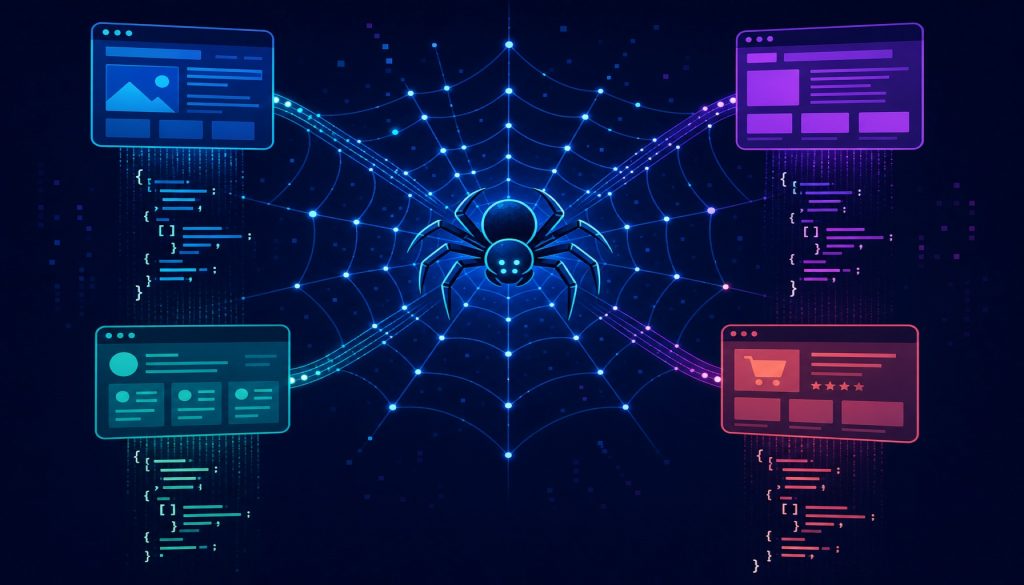
Think of a data engineer trying to feed an LLM with fresh web content. You’ve picked your sources, you know what pages matter, but then you hit the grind: proxies, rate limits, JavaScript-rendered DOM trees, paywalls, bot detection, and HTML soup that makes your parser cry. The web wasn’t built for clean extraction. Every site is a new puzzle.
Four tools have carved out different answers to that problem. Firecrawl sells itself as the extraction layer for AI apps. Apify bills itself as a serverless actor platform for scraping workflows. Browse AI promises no-code robots that turn websites into APIs. Diffbot positions itself as enterprise-grade crawl and extraction infrastructure. They all scrape web pages, but the workflows they enable are fundamentally different.
The wrong choice here doesn’t just waste budget. It sends you down a product philosophy that doesn’t match your actual bottleneck. If you need clean markdown for RAG, buying a heavyweight actor runtime is overkill. If you need orchestrated, resumable scraping at scale, a lightweight extraction API won’t cut it. If your ops team wants monitoring dashboards and Zapier hooks, a developer-first CLI tool will gather dust.
This comparison walks through what each tool actually does, where it excels, and which workflow it was designed to serve.
What Makes These Four Tools Different From Each Other
Firecrawl’s documentation is blunt about its mission: turn any URL into clean data. It outputs markdown, HTML, JSON, screenshots, links, images, even branding and audio. The pitch is aimed squarely at LLM ingestion pipelines, not traditional web scraping stacks. It’s an extraction layer, not a crawler orchestration platform.
Apify speaks a different language. Its core primitive is the Actor: a serverless program that accepts structured JSON input, performs web scraping, browser automation, or data processing, and returns structured output. Actors can run manually, via API, or on a schedule. You can publish them, monetize them, and chain them into workflows. Apify is selling a runtime, not a single-purpose scraper.
Browse AI takes the no-code route. The homepage emphasizes point-and-click setup, monitoring, change detection, prebuilt robots, 7,000+ integrations, and turning websites into APIs. It repeatedly highlights dynamic content handling, automatic retries, proxies, and bot evasion. The message is: you don’t need to write code to turn a site into a reliable data source.
Diffbot reads like enterprise extraction infrastructure. Its documentation separates crawling from extraction cleanly: crawling discovers links, extraction processes pages through the Extract API. The focus isn’t on ease of setup. It’s on controlling crawl scope, processing criteria, automatic extraction, and large-scale handling.
Why These Four Keep Getting Compared (And Why That’s Misleading)
If you search for “best web scraping tool 2026,” you’ll find all four of these in the same listicle. That’s because they all technically scrape web pages. But lumping them together is like comparing a JSON parser, a message queue, a spreadsheet app, and a data warehouse because they all “handle data.”
The confusion comes from the fact that “web scraping” describes a capability, not a use case. When someone says “I need a web scraping tool,” they might mean:
- I need to clean up web pages so my LLM can ingest them.
- I need to run scraping jobs reliably on a schedule with monitoring and retries.
- I need my ops team to pull data from competitor sites without writing code.
- I need to discover and extract structured data from thousands of sites at scale.
Those are four completely different problems. The tools that solve them look nothing alike. Comparing them on a feature checklist misses the point. The right question isn’t “which tool has more features.” It’s “which tool was built to solve the problem I actually have.”
A Comparison Table: Don’t Mix Up LLM-Ready Parsers, Actor Platforms, No-Code Robots, and Enterprise Crawlers
| Dimension | Firecrawl | Apify | Browse AI | Diffbot |
|---|---|---|---|---|
| Core positioning | LLM-ready web scraping / extraction | Actor-driven scraping and automation platform | No-code web scraping and monitoring | Enterprise crawl + extraction infrastructure |
| Official narrative | Clean markdown / JSON / screenshots for apps | Serverless Actors for workflows and scraping | Point-and-click robots + monitoring | Crawl discovers, extraction processes |
| Strongest use case | RAG, Agents, web content cleaning | Large-scale scrape automation, browser workflows | Continuous collection and monitoring for ops teams | Large-scale site discovery, structured extraction |
| Onboarding | API-first, developer-friendly | API + Console + Store + Scheduler | Visual no-code interface | API / enterprise configuration |
| Dynamic content | Supports JS-rendered, PDFs, images | Strong, especially with actors/browser | Strong, emphasizes human-like actions | More crawl + extract pipeline oriented |
| Output formats | markdown, html, json, links, images, etc. | Determined by Actor, highly flexible | Tabular data, monitoring results, API/integrations | Extract API structured results |
| Best fit for | Dev teams building LLM ingest | Teams making scraping an operational execution layer | Non-technical teams, ops, growth, intel gathering | Enterprise data teams, knowledge extraction teams |
| Biggest weakness | More extraction-focused, not a full scrape OS | Too heavy for non-technical teams | Less dev flexibility than Apify / Firecrawl | Higher learning curve and integration cost |
Firecrawl: The Web Scraping Tool That Feels Like It Was Built for Agents and RAG
Firecrawl doesn’t try to be everything. Its documentation states plainly that it handles proxies, caching, rate limits, JS-blocked content, dynamic websites, PDFs, and images. It outputs markdown, structured data, screenshots, or HTML. That product definition is useful for teams building AI ingestion pipelines today.
Where Firecrawl Excels
The strength isn’t volume. It’s that what you scrape is immediately usable by a model.
When you build RAG, web Q&A, agent research, or content cleaning pipelines, the pain point isn’t whether you can fetch HTML. It’s that the HTML you fetch is too dirty. Firecrawl was designed to solve that. It also supports extracting JSON via schema or prompt, which saves time for teams that need to convert pages into structured fields quickly.
The output quality matters more than you’d think. A typical web page contains navigation menus, ads, cookie banners, related articles, social share buttons, comments sections, and a footer with 50 links. If you dump that into an embedding model, you’re diluting the actual content with noise. If you feed it to an LLM for summarization, you’re wasting tokens on boilerplate. Firecrawl strips all of that and returns the core content in a format that models can actually use.
It also handles formats that break traditional scrapers. PDFs get converted to text. Images get extracted with URLs. JavaScript-heavy sites get rendered before extraction. You don’t need to build separate pipelines for different content types.
Where It Falls Short
The boundary is equally clear. Firecrawl isn’t trying to be an actor marketplace, browser workflow orchestrator, scheduling platform, or commercial ecosystem. If you need an extraction layer, it’s solid. If you need a long-term scalable scraping operating system, it’s not as complete as Apify.
It’s also not built for workflows where you need fine-grained control over every step of the scraping process. If your use case requires custom retry logic, conditional navigation based on page content, or multi-step interactions with form submissions and authentication flows, you’ll end up working around Firecrawl’s abstraction rather than with it.
The pricing model assumes you’re scraping at API-call volume, not at “download the entire web” volume. If you need to scrape millions of pages a month, you’re probably in Diffbot territory.
Apify: Not a Single Scraper, But a Scraping Execution Platform
Apify’s positioning has gotten clearer over the years. It doesn’t sell one scraper. It sells Actor runtime. Actors can be web scrapers, browser automations, or data processors. They accept structured JSON input, produce structured output, and can run manually, via API, or on a schedule. You can publish and monetize them.
Where Apify Excels
Flexibility, orchestration, and ecosystem.
If your scraping needs go beyond converting one webpage to markdown and require multi-site workflows, different login states, various automation chains, long-term scheduled runs, and integration with other systems, Apify’s platform feel is comfortable. It’s more like an app store and execution layer for scraping teams.
The actor marketplace is one of Apify’s biggest advantages. Need to scrape Instagram, LinkedIn, Amazon, or Google Maps? Someone has already built an actor for that. You can run it as-is, fork it and customize it, or use it as a reference for building your own. The marketplace turns scraping from a “build everything from scratch” problem into a “configure and deploy” problem.
The platform also handles all the operational concerns that make scraping hard at scale. Actors run in isolated containers with configurable memory and CPU. Runs are logged and can be replayed. Failed runs can auto-retry. Outputs are stored and can be exported in multiple formats. Webhooks notify you when runs complete. You can chain actors together into workflows where one actor’s output becomes another actor’s input.
If you’re running scraping as a business operation, not a one-off task, this is the infrastructure you need.
Where It Falls Short
The problem is that it feels like a platform. For teams that just want quick web extraction to feed an LLM, Apify can feel too heavy. You can do a lot, but not every team needs a full runtime.
The learning curve is real. Understanding actors, storages, proxies, input schemas, and the platform’s execution model takes time. If you’re used to writing a quick Python script with BeautifulSoup, Apify’s architecture is a conceptual leap.
For non-technical teams, Apify is a non-starter. The interface assumes you understand how web scraping works. You need to read actor documentation, configure JSON input, and debug selector issues. Browse AI was built specifically to avoid those barriers.
Browse AI: Ops Teams Can Get Started Faster
Browse AI’s product narrative is direct: point-and-click scraping, AI-powered monitoring, prebuilt robots, website-to-API conversion, plus 7,000+ integrations. The homepage emphasizes automatic adaptation to site changes, simulating human actions, dynamic content support, and the ability to scrape 500,000 pages concurrently. It’s speaking to non-technical teams: stop waiting for engineers to write one-off scripts.
Where Browse AI Excels
Low barrier to entry, strong continuous monitoring.
Many business scenarios aren’t one-time scrapes. They’re tracking prices, inventory, job postings, or competitor page updates. Browse AI fits those continuous monitoring and business integration workflows well. You don’t need to understand the scraping stack to pipe data into Google Sheets, Zapier, Airtable, or an API.
The setup process is visual. You load a page, click on the elements you want to extract, and Browse AI figures out the selectors. You can set up monitoring to check for changes hourly, daily, or weekly. When something changes, you get an alert. The data flows into wherever you need it without touching code.
The prebuilt robots are another advantage. Browse AI maintains templates for common scraping tasks: extracting search results, monitoring product availability, pulling job listings, scraping social media profiles. You pick a template, fill in the parameters, and you’re scraping in minutes.
For ops teams, growth teams, and research teams that don’t have engineering resources, this is the fastest path from “I need this data” to “I have this data.”
Where It Falls Short
The limitation shows up when you need finer control, deeper dev integration, or more complex custom workflows. Browse AI ultimately isn’t a developer-first platform. Its advantage is speed and convenience, not low-level control.
When sites change their structure, Browse AI’s automatic adaptation works most of the time, but not always. When it fails, you’re dependent on Browse AI’s support to fix it. With a code-based scraper, you can debug and fix it yourself.
The integration options are broad but shallow. You can send data to thousands of destinations, but you can’t write custom transformation logic in the middle of the pipeline. If your workflow is “scrape, filter, enrich, deduplicate, then load,” Browse AI handles the scrape and the load, but the middle steps require another tool.
Diffbot: More Like Enterprise-Grade Crawl and Extraction Infrastructure
Diffbot has a different flavor from the other three. Its documentation separates crawling and extraction in a very engineering-oriented way: crawl discovers links, extraction sends pages to the Extract API. You control crawl patterns, processing patterns, HTML processing patterns, and regular expressions. You decide which URLs to crawl but not process, and which pages enter the extraction pipeline.
Where Diffbot Excels
Large-scale discovery and structured processing.
If your goal isn’t scraping one page from one site, but continuously discovering large volumes of pages in a domain and performing structured extraction, Diffbot feels more like infrastructure than a tool. It fits enterprise intelligence, site cluster discovery, and knowledge graph preprocessing workflows.
Diffbot’s extraction APIs understand semantic structure across millions of sites without per-site configuration. The Article API extracts author, publish date, body text, and images. The Product API extracts price, availability, specs, and reviews. The Discussion API extracts threads, posts, and user metadata. These aren’t brittle selector-based extractions that break when a site redesigns. They’re ML models trained to recognize content patterns.
The crawling engine can start from a seed URL and discover every relevant page on a domain. You define rules for which URLs to follow, which patterns indicate article pages or product pages, and how deep to crawl. Diffbot handles deduplication, politeness delays, and distributed crawling. The output is a structured dataset ready for analysis, not a pile of HTML files you still need to process.
For teams building competitive intelligence platforms, market research databases, or knowledge extraction pipelines, this level of automation and scale is what makes the product viable.
Where It Falls Short
The cost is that it’s not lightweight for average teams. If you just want LLM data cleaning, monitoring a few sites, or quickly building a scraper, Diffbot is likely heavier than you need.
The pricing reflects the enterprise positioning. You’re not paying $20/month for a few thousand API calls. You’re negotiating a contract based on your crawl volume and extraction needs. That makes sense for companies processing millions of pages, but it’s a non-starter for individuals or small teams.
The setup also requires more expertise. Defining crawl patterns, tuning processing rules, and integrating the extraction output into your data pipeline all assume you have data engineering resources. This isn’t a tool you hand to a non-technical user.
How to Choose in 2026: Start With What Layer You’re Stuck On
You’re building RAG, Agents, or web Q&A
Look at Firecrawl first. What you actually need isn’t a crawler. It’s an extraction layer that converts dirty web pages into LLM-ready content.
When you feed web data to a language model, the quality of extraction determines whether your RAG system hallucinates or delivers accurate answers. A scraper that dumps raw HTML forces you to build your own cleaning pipeline. Firecrawl handles that layer: it strips navigation, ads, and boilerplate, preserves semantic structure, and outputs markdown that embeddings can actually work with. If your bottleneck is “the web pages we fetch are too messy for the model,” this is the tool that was built for that problem.
The alternative is spending engineering time building your own parsing layer on top of a generic scraper. That works, but it’s not where most teams want to spend their cycles when they’re trying to ship a product.
You need long-term scraping automation with orchestration, scheduling, and reuse
Look at Apify first. Its value isn’t any single scraper. It’s the full actor mechanism and execution platform.
Scraping isn’t always a one-time data pull. Sometimes it’s a recurring job that runs nightly, handles different login states across sites, chains multiple extraction steps together, retries on failure, and needs to be monitored. Sometimes you want to build a scraper once and run it across 50 different domains with different input configurations. Sometimes you need a marketplace where you can grab a pre-built scraper for a common site instead of writing it from scratch.
Apify’s actor model handles all of that. Actors are self-contained, versioned, parameterized programs. You can run them on a schedule, trigger them via webhook, monitor their runs, inspect their logs, and pipe their output into other actors or external systems. If your scraping workflow is complex enough that “run a script” doesn’t cut it anymore, Apify is the execution layer that makes scraping operationally manageable.
The tradeoff is complexity. If you just need to scrape five product pages once a week, spinning up an actor runtime is heavier than you need. But if scraping is a core part of your data infrastructure, Apify stops being overhead and starts being the foundation.
You’re on an ops, growth, or non-technical team and don’t want to ping engineers every time
Look at Browse AI first. It’s clear on the no-code scraping, monitoring, and integration line.
A lot of scraping needs don’t come from engineering. They come from growth teams tracking competitor pricing, ops teams monitoring supplier availability, sales teams gathering lead data, or research teams collecting market intelligence. Those teams know what data they need and where it lives. What they don’t have is Python skills or the patience to learn Puppeteer.
Browse AI is designed for that user. You point at the data you want, the tool figures out how to extract it, and you get a feed that updates on a schedule. No code, no infrastructure, no debugging selectors. You get change alerts when a monitored page updates, you can pipe the data into Zapier or Google Sheets, and you can set up monitoring dashboards without touching a terminal.
The limitation is flexibility. When your extraction needs get complicated (conditional logic, multi-step workflows, custom parsing rules) you’ll hit the ceiling of what a no-code tool can express. Browse AI isn’t trying to be a developer tool. It’s trying to let non-developers get scraping done without waiting for engineering capacity.
You’re doing large-scale website discovery, structured extraction, or enterprise data pipelines
Look at Diffbot first. Its strength is process control over crawl and extract, not lightweight onboarding.
Most scraping tools assume you already know which URLs you want to scrape. Diffbot starts one layer earlier: discovering those URLs in the first place. Its crawling engine can traverse a domain, identify article pages, product pages, discussion threads, and other structured content types, and route each page type to the appropriate extraction API. The extraction APIs understand semantic structure (author, publish date, product price, review rating) across millions of sites without per-site customization.
That makes Diffbot a fit for use cases where “scraping” isn’t the right word. Competitive intelligence firms that need to monitor thousands of company websites. Market research teams that want to map an entire industry’s online presence. Knowledge base builders that need to ingest structured data from heterogeneous sources. Data teams building entity resolution pipelines that depend on high-quality, schema-compliant extraction.
The cost is onboarding time and budget. Diffbot’s pricing is built for enterprise use cases, not side projects. The control it offers (crawl rules, processing rules, custom extraction models) is powerful, but it assumes you have the time and expertise to tune it. If your scraping need is “I want to track ten product pages,” Diffbot is massive overkill. If your scraping need is “I need to discover and extract structured data from 100,000 URLs a month,” Diffbot starts making sense.
The Real Question: Do You Need to “Scrape a Page” or “Turn Pages Into Long-Term Usable Data Assets”
The biggest difference between these four products isn’t whether they can scrape. It’s what stage of the problem they’re trying to solve.
Firecrawl solves the “clean extraction for AI ingestion” problem. If your blocker is that raw HTML breaks your RAG pipeline, this is the tool.
Apify solves the “scraping as infrastructure” problem. If your blocker is that running scraping jobs reliably, at scale, with proper monitoring and orchestration is hard, this is the tool.
Browse AI solves the “non-technical teams need data too” problem. If your blocker is that waiting for engineering to build every scraper creates a bottleneck, this is the tool.
Diffbot solves the “large-scale discovery and extraction” problem. If your blocker is that you need to find, classify, and extract structured data from an entire domain or industry, this is the tool.
Each tool is excellent at the problem it was designed to solve. None of them is the right answer for every use case. The question isn’t “which tool is best.” The question is “which problem am I actually solving.”
What These Tools Actually Cost (And What You’re Paying For)
Pricing structure tells you a lot about who the tool is built for.
Firecrawl charges per API request. As of early 2026, the free tier includes 500 credits (roughly 500 pages), and paid plans start around $20/month for 3,000 credits. You’re paying for extraction quality, not infrastructure.
Apify charges for compute time. Actors consume platform credits based on how long they run and how much memory they use. Free tier gives you $5 of platform credit per month; paid plans start at $49/month for $50 in credit. You’re paying for execution runtime and storage.
Browse AI charges per monitored robot. The free tier allows two robots with limited runs. Paid plans start at $49/month for up to 10 robots with higher run limits. You’re paying for monitoring and ease of use.
Diffbot doesn’t publish self-serve pricing on the homepage. You request a quote based on volume. Crawl plans are priced by pages crawled and processed per month. You’re paying for large-scale infrastructure and enterprise support.
The pricing model reflects the product philosophy. Firecrawl is priced for API integrations. Apify is priced for compute workloads. Browse AI is priced for business teams with fixed monitoring needs. Diffbot is priced for enterprise data contracts.
When the “Wrong” Tool Is Actually Fine
Not every choice has to be optimal. Sometimes the tool you already know is better than the tool that fits the use case perfectly but requires two weeks of onboarding.
If your team already runs infrastructure on Apify, using an Apify actor for a simple scraping job is fine, even if Firecrawl would technically be lighter. The marginal cost of using what you already have is lower than the cost of adding a new vendor.
If your ops team already pays for Browse AI and uses it for price monitoring, adding one more robot to scrape competitor blog posts is fine, even if a developer could write a more flexible scraper. The value is in shipping fast, not in architectural purity.
If you have an enterprise Diffbot contract and you need to scrape a handful of news sites, using Diffbot’s Extract API is fine, even though it’s over-provisioned for the task. You’ve already paid for it.
The comparison matters most when you’re choosing your first tool or when your current tool is clearly failing. If you’re not stuck, you don’t need to optimize.
Conclusion: Choose by Workflow, Not by Hype
Firecrawl fits teams that need to “feed pages to models first.” Apify fits teams that need to “turn scraping into a long-term execution layer.” Browse AI fits teams that want to “hand collection and monitoring to the business side.” Diffbot fits teams doing “large-scale crawl and extraction.”
When choosing a web scraping tool in 2026, don’t start by asking who’s most popular. Start by asking whether you’re missing content cleaning, execution orchestration, business integration, or enterprise-scale extraction. The tool that solves your actual bottleneck is the right tool, even if it’s not the one everyone is talking about.
FAQ
What’s the biggest difference between Firecrawl and Apify?
Firecrawl is more like a web content extraction layer focused on quickly converting pages into markdown, JSON, and other LLM-ready data. Apify is more like an execution platform focused on Actors, scheduling, browser automation, and long-term scraping workflows.
Is Browse AI suitable for dev teams?
It works, but its core advantage isn’t dev flexibility. It’s no-code setup, monitoring, and fast integration. Dev teams that care more about low-level control usually lean toward Firecrawl or Apify.
Is Diffbot still relevant in 2026?
Yes, especially for large-scale crawling, link discovery, structured extraction, and enterprise data pipelines. It’s not the lightest option, but it still has a place in heavy-duty scenarios.
What’s the most common mistake when choosing a tool for RAG?
Treating tools that “can scrape pages” as tools that “can feed LLMs directly.” Many products can fetch pages, but they won’t automatically convert dirty pages into clean data suitable for model ingestion.
Which one should ops teams look at first?
If the core need is less coding, continuous monitoring, and quick integration with Google Sheets or automation platforms, Browse AI is usually the easiest path to deployment.
Related Reading
- AI Browser Automation Tools: Browser Use vs Stagehand vs Skyvern vs Playwright, Who Fits Your Agent in 2026?
- AI Workflow Automation Tools: Gumloop vs Zapier AI vs n8n AI vs Make AI, Who Fits Your Automation Needs in 2026?
- AI Document Parsing Tools: LlamaParse vs Unstructured vs Azure Document Intelligence vs Google Document AI, Who Fits Your Workflow in 2026?
Stay updated with our latest AI insights