You try to build an AI that does research, writes drafts, reviews its own work, and publishes. The research looks decent. The writing drifts off target. The review stage turns into a self-congratulation exercise, perfect scores across the board. The formatting breaks during publish.
One agent handling every role is like asking someone to be reporter, editor, designer, and operations manager at once. Not a skills problem. An attention and specialization problem.
2026 brought a systematic answer: teams of agents working together.
This isn’t hype. Deloitte projects the autonomous AI agent market hitting $8.5 billion in 2026 and $35 billion by 2030. IBM and Forrester predict multi-agent teams will autonomously divide work, cross-check each other, and self-heal failures this year. A DevOps experiment showed multi-agent incident response delivering actionable recommendations 100% of the time. Single-agent systems: 1.7%.
Not “a bit better.” Orders of magnitude apart.
Why Single Agents Hit a Wall
Three hard ceilings.
Context windows have limits. Latest models claim million-token support, but effective utilization falls far short. Load one agent with research materials, writing guidelines, SEO rules, and publishing workflows, and the context fills fast. When information piles up, attention gets diluted. The agent doesn’t forget. It just can’t focus.
Specialization conflicts. Writing requires divergent thinking. Review demands critical scrutiny. Publishing needs strict process adherence. Three modes crammed into one agent means constant mode-switching, each transition carrying overhead. Writing fiction while debugging code. Both suffer.
Zero concurrency. Single agents run serially. Research finishes, then writing starts, then review, then publish. Four steps queued end-to-end, efficiency ceiling locked low. Multi-agent systems run parallel: one researching the next piece while another writes the current one and a third reviews the last.
Anthropic’s 2026 Agentic Coding Trends Report put it clearly: software development is shifting from “writing code” to “orchestrating agents that write code.”
Same shift applies to content production, operations, data analysis.
Three Collaboration Patterns, Different Use Cases
Multi-agent collaboration isn’t throwing agents together and hoping. How you organize them determines the efficiency ceiling.
Three patterns dominate.
Orchestrator (Leader-Worker)
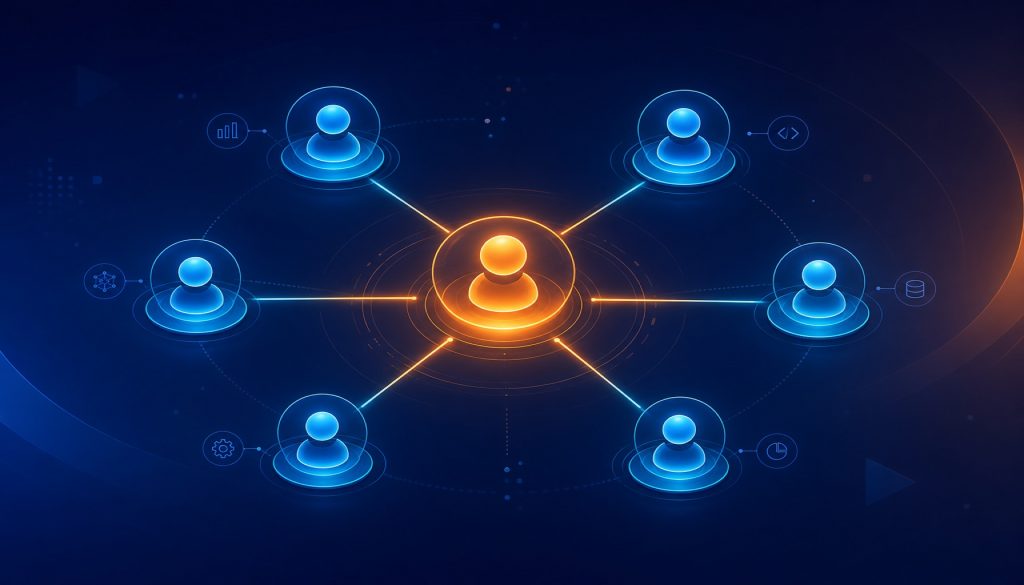
One lead agent acts as coordinator, breaking tasks into pieces, assigning them to worker agents, collecting results, and making final decisions.
Most mature pattern. OpenClaw’s sessions_spawn follows this model: the main agent dispatches sub-agents for specific tasks, sub-agents automatically report back when done.
Strengths: clear control, easy to debug, lead agent gates quality.
Weakness: the lead agent is a bottleneck. If its judgment fails, the whole chain goes wrong. Workers can’t talk directly to each other. All information flows through the coordinator, slowing complex tasks.
Peer-to-Peer (Decentralized)
No hierarchy. Agents collaborate as equals through shared documents, message passing, or other coordination mechanisms.
Moxt’s document @-mention system demonstrates this: multiple agents annotate, edit, and cross-reference within a single document, no central dispatcher required.
Strengths: flexible. Agents freely combine without fixed hierarchy constraints. Works well for creative and exploratory tasks.
Weakness: no clear decision-maker. Easy to end up with everyone talking, no one deciding. Coordination cost rises with task complexity.
Hierarchical (Multi-Layer)
Agent → Supervisor Agent → Orchestrator → Agent Ecosystem. Structured like corporate org charts. Google ADK’s agent tree uses this design: each layer manages only its direct reports, escalates results upward.
Built for scale. When dozens or hundreds of agents coordinate, flat orchestrator patterns can’t keep up. Hierarchical structures handle it.
Cost is complexity. More layers mean slower information flow and harder debugging. Small teams using this are bringing a sledgehammer to crack a nut.
How to choose? Simple tasks: orchestrator. Creative tasks: peer-to-peer. Enterprise-scale: hierarchical. Most scenarios, orchestrator is enough.
A2A + MCP: Making Different Frameworks Talk
When agents multiply, one problem emerges: how do agents from different frameworks and platforms communicate?
Two protocols are solving this in 2026.
Google’s A2A (Agent2Agent) protocol, donated to the Linux Foundation. Handles agent-to-agent interoperability. Whether you built your agent with CrewAI, LangGraph, or AutoGen, A2A support means they can discover each other, communicate, and delegate tasks.
Anthropic’s MCP (Model Context Protocol) manages a different dimension: standardized interfaces between agents and tools or data sources. When an agent needs to query databases, call APIs, or read files, MCP provides unified connection patterns.
Clear division: MCP governs “what tools agents use.” A2A governs “how agents talk to each other.”
These protocols matter because multi-agent collaboration expands from “within-framework coordination” to “cross-framework, cross-platform coordination.” CrewAI agent teams previously only worked inside CrewAI. With A2A, they can talk to LangGraph agents and coordinate with Google ADK agents.
At this point, multi-agent collaboration breaks down platform silos for real.
Platform Comparison: Three Schools, Three Approaches
Tools for multi-agent collaboration split into three camps.
Command-Line School: OpenClaw / Hermes
Self-hosted, full control. Dispatch sub-agents via command line, manage task distribution through sessions_spawn, automatic reporting when sub-agents complete.
For users with strong technical backgrounds who need complete control over data and workflows.
I ran a four-agent collaboration pipeline on OpenClaw: Agent Bright gathers materials, Agent Writer drafts, Agent Strict reviews, Writer revises based on feedback. High automation, but debugging costs add up. When a sub-agent stalls, manual intervention is needed. Timeouts require watchdogs. Quality misses mean reruns.
High capability ceiling, but you play “CTO of the agent team.”
SaaS School: Moxt
Visual interface, no command line required. On Moxt’s platform, agents collaborate through document @-mentions. Agent marketplace offers 100+ pre-built agents ready to use.
For users who don’t want to touch code and need fast onboarding. Low barrier, drag-and-drop orchestration, what you see is what you get. Flexibility limited by platform capabilities, data lives on the platform.
Framework School: CrewAI / LangGraph / AutoGen / Google ADK
Developer-focused programming frameworks, each with distinct strengths:
| Framework | Collaboration Model | Best For | Learning Curve |
|---|---|---|---|
| CrewAI | Role-based (each agent has defined role) | Team workflows, content production | Medium |
| LangGraph | State graphs (nodes + edges + conditional branches) | Complex conditional logic, multi-step decisions | Higher |
| AutoGen / AG2 | Conversation-driven (agents advance through dialogue) | Research experiments, exploratory tasks | Medium |
| Google ADK | Hierarchical tree (parent-child agent tree) | Enterprise-scale orchestration | Higher |
| OpenAI Agents SDK | Explicit handoff (clear agent-to-agent transitions) | Linear workflows, customer service | Lower |
Framework selection logic: Look at your task shape first, then pick the matching collaboration model. Linear workflows: OpenAI Agents SDK. Role division: CrewAI. Complex branches: LangGraph. Large scale: Google ADK.
Real Case: Four-Agent Writing Pipeline
An actual working example.
I built a content production pipeline on OpenClaw with four specialized agents:
Agent 1 (Topic Scout) searches daily AI news, deduplicates against published articles, outputs two topic candidates.
Agent 2 (Writer) receives topics, drafts according to preset style templates and SEO rules. 3,000-4,000 words, including comparison tables, FAQs, data citations.
Agent 3 (Reviewer) checks for AI writing patterns (quantitative scoring), validates SEO completeness, verifies factual accuracy. Rejects substandard work back to Writer for revision.
Agent 4 (Publisher) generates cover images, SSHs to WordPress for publication, configures RankMath SEO, uploads WeChat version, validates HTTP 200 response.
End-to-end from topic to publish: 30-40 minutes. Single-agent serial execution takes at least 60-90 minutes with higher quality variance. When one agent writes then reviews itself, it’s basically no review at all.
Key insight: Multi-agent value isn’t speed. It’s quality improvement through specialized division of labor. Separating reviewer from writer creates real checks and balances.
What the Next 12 Months Brings
“AI Workforce Manager” becomes a job title. When companies deploy dozens of coordinating agents, who manages them? Who defines division of labor, permissions, collaboration rules? Not IT operations. Not product management. It needs a new role: someone who understands AI capability boundaries, can design agent team architecture, and can resolve inter-agent conflicts.
Corporate org charts include agent teams. Not shallow “every employee gets an AI assistant” applications. Certain functions in certain departments get directly handled by agent teams. Customer service is already doing this. Content teams, data analysis teams, DevOps teams are next.
Physical-world agent collaboration launches. Multi-agent collaboration currently lives in the digital world: writing code, writing articles, analyzing data. But coordination between logistics robots, between self-driving vehicles, between different robots on factory floors follows the same organizational principles. A2A protocol design already considers physical agent scenarios. 2026-2027 will show the first cross-digital-physical multi-agent collaboration cases.
Common Questions
Q: How does multi-agent collaboration differ from traditional microservices architecture?
Microservices follow fixed patterns: input A always produces output B, services communicate through API calls. Multi-agent collaboration differs: each agent has autonomous decision-making capability, outputs aren’t fully predictable, agents negotiate through natural language or structured messages. Microservices suit fixed-process scenarios. Multi-agent suits tasks requiring judgment and creativity.
Q: Will multi-agent collaboration be expensive?
Depends how you count. Individual API calls do increase, token consumption goes up. But factor in quality gains reducing rework and time savings from parallelization, total cost often drops. Deloitte data shows multi-agent solutions in DevOps scenarios deliver 59 times the actionable recommendation rate of single agents, eliminating massive manual review costs.
Q: For someone starting with multi-agent collaboration now, which tool is most reliable?
For developers, CrewAI or LangGraph have the smoothest onboarding, active communities, solid documentation. Don’t want to code? Moxt is currently the most user-friendly SaaS option. Need full control? OpenClaw or Hermes for self-hosted solutions. Start by running a simple two-agent collaboration, then expand gradually.
Q: Are A2A and MCP protocols mature now?
MCP is widely adopted, most mainstream frameworks support it. A2A was just donated to Linux Foundation, standard still evolving, but Google, Salesforce, and other major players are driving implementation. Second half of 2026 will show more real cross-framework interoperability cases. Current advice: watch but don’t rush to bet on it. Get multi-agent collaboration working within a single framework first.
Q: What’s the most common pitfall in multi-agent collaboration?
Three frequent traps. First: unclear instructions between agents leading to unexpected output. Fix: every agent’s task description must include specific steps, expected deliverables, and validation criteria. Second: no timeout or watchdog mechanisms, agents stall undetected. Fix: set timeout mechanisms and automatic checks for every sub-agent. Third: over-trusting agent self-assessment, treating “I’m done” as actual completion. Fix: use independent reviewer agents for cross-validation.
Stay updated with our latest AI insights