If you build software, you’ve probably bumped into the same problem from the other side: an AI agent that can write poetry but can’t pull a row from your database. The model is smart. The connection layer is missing.
That’s the gap MCP fills. Model Context Protocol is an open standard, originally published by Anthropic in November 2024, that defines how AI agents talk to external tools and data sources. Think of it as a universal adapter between any LLM-powered agent and any software service that wants to be accessible to AI.
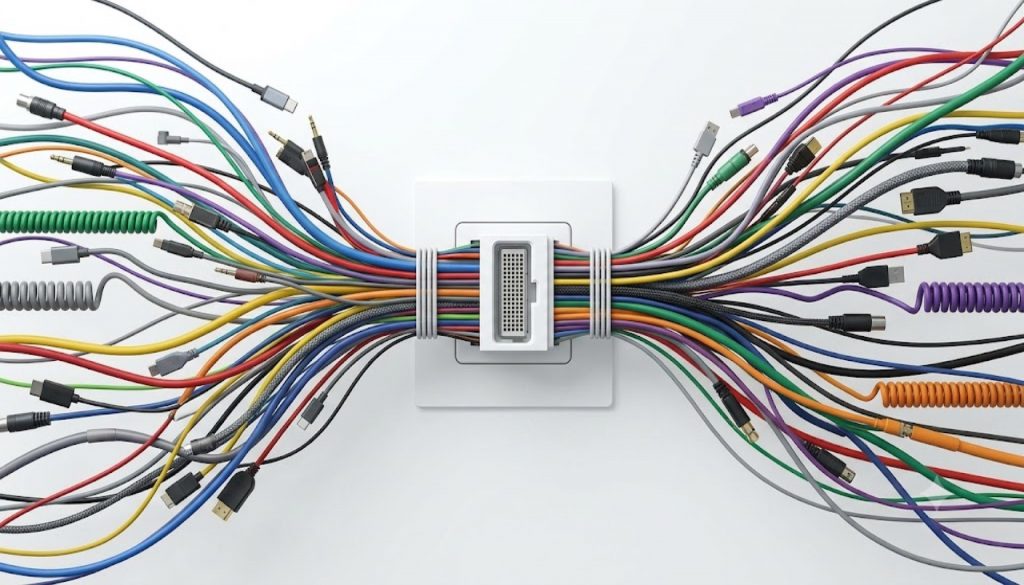
The analogy everyone reaches for is USB-C. Before USB-C, every device shipped with its own cable. Phones, tablets, cameras, headphones, each one different. USB-C collapsed all of that into a single connector. MCP does the same thing for the agent-to-tool boundary. One protocol, many tools, many models.
The problem it solves
Anyone who has tried to ship an agent in production knows the pain. You want your agent to query a Postgres database, create a Linear ticket, and send a Slack message. Each integration requires custom glue code: authentication handling, schema translation, error recovery, permission scoping. Multiply that by every model you might want to swap in and you get what Anthropic calls the N×M problem. N models times M tools, each combination requiring its own adapter.
Before MCP, the standard approach was to hand-roll function-calling integrations per tool. Or you’d route everything through middleware like Zapier or n8n, which works for simple triggers but breaks down when an agent needs bidirectional context and multi-step execution.
MCP collapses N×M into N+M. A tool developer implements one MCP server. An agent framework implements one MCP client. After that, any agent can talk to any tool without bespoke wiring.
How it works (the 60-second version)
MCP uses a client-server architecture over JSON-RPC 2.0. The agent hosts an MCP client. Each tool runs an MCP server. The server exposes three primitives:
- Tools: functions the agent can invoke (e.g.,
query_database,send_email) - Resources: data the agent can read (e.g., file contents, database schemas)
- Prompts: reusable instruction templates the server provides to guide the agent
The client discovers available servers, negotiates capabilities, and invokes tools on the agent’s behalf. Transport is flexible: local stdio for same-machine integrations, HTTP with Server-Sent Events for remote servers.
What makes this different from plain OpenAPI specs or function-calling schemas is the context layer. MCP servers can expose structured context (schemas, documentation, constraints) alongside the callable functions, so the agent understands what a tool does without hardcoded prompt engineering.
Why MCP won’t die like other “standards”
You’ve seen protocol wars before. The skepticism is fair. But MCP’s position is different from most contenders in a few concrete ways.
First, timing. Anthropic shipped it in November 2024, roughly six months before Google’s A2A (Agent-to-Agent) protocol. That head start matters because developers have already built thousands of MCP servers. Ecosystem inertia is the hardest thing to reverse in a protocol fight.
Second, scope discipline. MCP only handles agent-to-tool connectivity. It does not try to define agent-to-agent communication (that’s A2A), and it does not try to define how agents render UI (that’s AG-UI / A2UI). Narrow scope means fewer objections and faster adoption.
Third, competitive alignment. OpenAI adopted MCP in March 2025. Google’s Agent Development Kit supports it natively. In late 2025, Anthropic donated MCP to the Linux Foundation’s Agentic AI Foundation, with OpenAI and Block as co-stewards. When your three largest competitors all join the same governance body, you’re past the “standards war” phase and into the “shared infrastructure” phase.
The current stack looks like a layered architecture rather than competing alternatives:
| Layer | Protocol | What it handles |
|---|---|---|
| Agent ↔ Tool | MCP | Connecting agents to external services and data |
| Agent ↔ Agent | A2A | Multi-agent coordination and delegation |
| Agent ↔ UI | AG-UI / A2UI | Rendering agent actions in user interfaces |
Each layer solves a different problem. They compose rather than compete. For a deeper look at how these agent interoperability protocols relate to each other, we covered the full landscape earlier this year.
What this means if you ship B2B SaaS
If your product has an API, you should be thinking about an MCP server. Here’s why.
AI agents are becoming the new integration surface. The same way mobile apps needed REST APIs in 2012, and the same way Slack bots needed webhook endpoints in 2017, AI agents in 2025-2026 need MCP servers to discover and use your product. If your tool doesn’t have one, agents will route around you to a competitor that does.
The investment is modest. An MCP server is a thin wrapper around your existing API. You expose your endpoints as MCP tools, your documentation as resources, and your common workflows as prompts. Anthropic’s SDK supports Python and TypeScript. Google’s ADK has native MCP support built in. Most teams can ship a basic MCP server in a sprint.
The strategic payoff compounds. Once agents can reach your product, you become part of the automated workflow layer. Your tool gets recommended by AI assistants, gets composed into multi-step agent tasks, gets embedded in contexts where a human would never have opened your UI manually. That’s distribution you didn’t have to pay for.
What this means for agent builders
If you’re building agents or agent frameworks, MCP simplifies your integration story substantially.
Before MCP, every new tool integration meant writing and maintaining a plugin. Your plugin surface area grew linearly with the number of tools you supported, and each plugin was a maintenance liability. Model swaps could break everything because each integration was coupled to specific function-calling conventions.
With MCP, you implement the client once. After that, your agent can connect to any MCP server without additional code on your side. The tool developer maintains the server; you maintain the client. The boundary is clean.
This also changes how you think about model portability. Because MCP sits between the agent framework and the tool layer, you can swap the underlying model without touching your integrations. The tool connections are protocol-level, not model-level. This is a direct answer to the vendor lock-in problem that has kept many teams from committing to a single agent platform.
What this means for end users (soon)
If you’re not a developer, the effects of MCP will show up as capability gains in the AI tools you already use. Your AI assistant will start doing things it couldn’t do before: booking meetings by checking your calendar and your contacts’ availability, filing expense reports by pulling receipt data from your email and submitting to your company’s expense system, writing weekly updates by aggregating data from your project management tool and your git history.
The underlying shift is from “AI that answers questions” to “AI that executes tasks.” MCP is the plumbing that makes execution possible across tool boundaries.
You’ll also gain more freedom to switch between AI providers. When tool connectivity is standardized at the protocol level, your choice of AI assistant becomes less sticky. The tools you’ve connected don’t need to be rewired when you try a different model. Competition between AI providers will happen on reasoning quality and UX, not on who has more proprietary integrations locked down.
The security question nobody’s ignoring
Any protocol that lets an AI agent invoke tools on your behalf raises obvious security concerns. MCP addresses this with a few design choices: explicit capability negotiation (the client declares what it needs, the server grants or denies), human-in-the-loop confirmation for sensitive actions, and OAuth 2.1 for remote server authentication.
But the real security story is still being written. Permission scoping, audit logging, and abuse prevention are active areas of work within the Agentic AI Foundation. If you’re evaluating MCP for production use, treat the security surface the same way you’d treat any new API integration: principle of least privilege, audit everything, and assume the agent will try things you didn’t anticipate.
The bottom line
MCP is not a new AI capability. It won’t make your models smarter or your prompts better. What it does is standardize the connection layer between agents and tools, turning a bespoke integration problem into a protocol-level one.
Standardization sounds boring until you remember that HTTP standardized document retrieval, SMTP standardized email delivery, and OAuth standardized authorization flows. Each of those unlocked a generation of products that couldn’t have existed without the shared layer beneath them.
MCP is the same bet, placed on the agent-to-tool boundary. If AI agents are going to move from demos to production workflows, they need a reliable, standard way to connect to the software that runs your business. That’s what MCP provides. The three largest AI labs have agreed on it. The Linux Foundation governs it. Thousands of servers already exist.
The protocol layer is settled. What gets built on top of it is the interesting question now.
Stay updated with our latest AI insights