On March 26, 2026, Bloomberg’s Mark Gurman reported that Apple will introduce a Siri Extensions system in iOS 27, allowing third-party AI assistants like Claude, Gemini, and Grok to integrate directly with Siri. ChatGPT loses its exclusive position, and users gain the freedom to choose their preferred AI assistant through system settings.
At first glance, this looks like Siri finally evolving beyond simply handing off queries to ChatGPT. Look deeper, and you see what might be Apple’s most strategic move in the AI era.
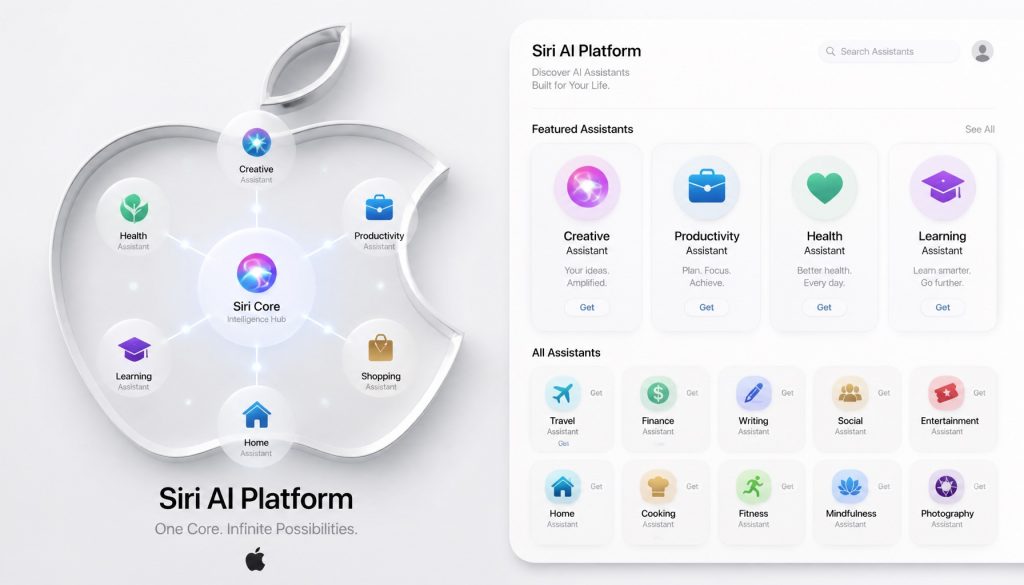
This isn’t about “Siri getting smarter.” Apple is transforming Siri into the App Store of the AI world.
The App Store Playbook, AI Edition
Rewind to 2008. When the iPhone first launched, all applications came from Apple. Then the App Store arrived, and the game changed. Apple no longer needed to build the best apps, only the best platform. Developers would build the apps; Apple would handle distribution, review, and payments.
Eighteen years later, the same playbook is unfolding in AI.
The iOS 27 Extensions system creates an AI version of the App Store. Apple provides the unified entry point (Siri), the unified interface (a new standalone Siri app, codenamed Campos), the unified distribution channel (App Store), and the unified payment system (Apple takes a cut of AI subscriptions). Third-party AI companies supply the intelligence; Apple supplies the experience.
The brilliance of this strategy lies in how Apple acknowledges its shortcomings in AI model capabilities while converting that weakness into a platform opportunity.
According to analysis from Elephas.app, Apple attempted to make Anthropic’s Claude the core engine for Siri, but negotiations collapsed over pricing. Google’s Gemini ultimately secured the position in a contract worth approximately $1 billion annually. Yet Apple clearly refuses to put all its eggs in one basket. The Extensions system ensures that even with Gemini as the default engine, users retain the ability to choose alternatives.
Classic Apple maneuver: use platform control to hedge against technical dependency risk.
But there’s a crucial difference from the original App Store era. When Apple launched the App Store, its own applications (Safari, Mail, Maps) might not have been best-in-class, but they were at least functional. In the AI era, Siri’s native capabilities have faced persistent criticism. From 2011 to 2024, Siri remained essentially a rule-based voice command system, an entire generation behind true AI assistants. The core features Apple Intelligence promised at WWDC 2024 (Personal Context for understanding user data, screen awareness, cross-app operations) still hadn’t fully materialized by March 2026.
In other words, Apple isn’t opening its platform from a position of strength. It’s opening from a position of playing catch-up. This fundamentally differs from the 2008 App Store launch, when the iPhone itself already stood as the best smartphone available.
Models as Personalities: The Overlooked Question
Siri Extensions brings more than just functional choice. It introduces a deeper question: when you select an AI model, you’re actually selecting a personality.
This isn’t metaphorical. Academic research has confirmed that different large language models exhibit measurable, statistically significant personality differences.
In 2023, Serapio-García and colleagues used the standardized IPIP-NEO personality assessment (the Big Five model, 120 questions) to test 18 large language models. Their findings showed that LLM personality measurements are both reliable and valid. The same model tested multiple times produces consistent results; different models show significant variations.
A 2024 study by Jiang and colleagues, presented at the NAACL conference, pushed this research further with PersonaLLM. They didn’t just administer questionnaires to models; they had models write creative stories, then analyzed whether the linguistic features of those stories aligned with their measured personalities. The results confirmed the connection. Models scoring high in conscientiousness produced more careful, planned writing; models high in extraversion generated more socially engaged, interactive content.
Looking at mainstream models specifically, Claude demonstrates higher conscientiousness (more careful, more organized, more inclined toward deliberation). ChatGPT shows greater extraversion (more enthusiastic, more helpful, more socially adept). Gemini exhibits stronger openness (more creative, more willing to explore novel directions).
What does this mean in practice? When Apple makes Gemini the default Siri engine, it’s effectively choosing a default AI personality for billions of users: a more open, more creative assistant that may lack Claude’s caution. When users switch to Claude through Extensions, they’re not just getting different answers. They’re getting an assistant with a completely different approach to tasks.
This raises a core platform design question: should AI assistants adhere to unified behavioral standards, or should diversity be allowed?
Apple’s historical answer has always favored standardization. From Human Interface Guidelines to App Store review rules, Apple pursues consistent user experience. But in the AI agent domain, standardization means erasing the personality differences that form the core competitive advantage of different models.
Consider this scenario: if Apple requires all AI systems integrating with Siri to follow a unified “Apple tone” (polite, concise, attitude-neutral), then Claude’s thoughtfulness and Grok’s sharp humor both disappear. Users get a collection of AIs wearing different outfits but speaking identical lines.
Conversely, if Apple takes a completely hands-off approach and lets each AI maintain its own style, users will experience jarring discontinuity when switching between AIs within the Siri interface. One moment they’re interacting with measured Gemini; the next moment they’re dealing with unfiltered Grok.
This dilemma represents a unique challenge Apple must confront as an AI platform. The App Store era didn’t face this problem because each app had its own interface. But Siri Extensions forces all AIs into the same interface, making personality clashes inevitable.
“Openness” Within the Walled Garden
Apple packages Siri Extensions as “open,” but that openness deserves skeptical quotation marks.
Compare this to fully open AI agent platforms. Take OpenClaw as an example, an open-source AI agent framework where users can freely choose any model (GPT, Claude, Gemini, open-source models, local models), freely define agent personality and behavior patterns, freely install any plugin without review, run on any device, and maintain complete control over data flow.
Now examine Apple’s Extensions: users can only select AI services that pass App Store review. AI companies must develop integrations according to Apple’s specifications. Apple controls the interface and interaction patterns. Specific hardware is required (devices with 12GB RAM or more). Apple takes a cut from AI subscriptions.
This isn’t openness. This is controlled pluralism. Apple has moved from “only one AI” to “you can choose from several AIs I’ve approved.” The logic perfectly mirrors the App Store: you have freedom of choice, but only within boundaries Apple has drawn.
For average users, this may be sufficient. Most people neither need nor want to configure their own AI agents; they simply want Siri to provide good answers when they ask questions. Apple’s approach lowers barriers, provides adequate choice, and maintains experience consistency.
For power users and developers, this falls far short. Real AI agents don’t just answer questions. They need to execute complex multi-step tasks, access various tools and APIs, and make autonomous decisions based on user preferences. These capabilities require deep system integration and unrestricted toolchains, which Apple’s sandbox model inherently constrains.
More critically, Apple’s review mechanism may become an innovation bottleneck in the AI era. AI development cycles are measured in weeks. New models, new capabilities, new use cases emerge constantly. App Store review timelines and rule restrictions could leave the iOS AI experience perpetually half a step behind.
Microsoft and Google are walking different paths. Copilot is deeply bound to Office 365; Gemini is deeply integrated with Google Workspace. They’re not building platforms; they’re embedding AI capabilities directly into their productivity tools. This approach sacrifices freedom of choice but delivers deeper integration and smoother experience.
Three different routes, each with distinct tradeoffs. Apple builds a platform with multi-model choice but constrained by the walled garden. Microsoft and Google pursue deep integration with single models but smoother experiences. Open-source frameworks offer complete freedom but with steep technical barriers.
The future of AI agents likely won’t be “one assistant answers all questions” but rather “multiple specialized agents collaborate on complex tasks.” In this direction, Apple’s Extensions system has taken only a small step. It addresses the question of “which AI answers questions” but hasn’t yet touched the question of “how multiple AIs collaborate.”
Can Apple Do Better?
Speaking bluntly, Apple’s track record in AI doesn’t inspire confidence.
When Siri launched in 2011, it was revolutionary. It was the first voice assistant used by mainstream consumers. But over the following decade, Apple made almost no fundamental upgrades to Siri. While Google Assistant and Alexa rapidly evolved between 2016 and 2020, Siri continued processing voice commands with rule-based systems.
Apple Intelligence at WWDC 2024 should have marked a turning point. Apple promised personal data understanding, screen awareness, cross-app operations, and a smarter Siri. But by March 2026 (nearly two years after the announcement), these core features still hadn’t fully shipped. iOS 18.1 and 18.2 primarily delivered Writing Tools, notification summaries, and ChatGPT integration, with the notification summaries facing widespread criticism over accuracy issues.
This pattern of “promise much, deliver slowly” invites caution about the iOS 27 Siri overhaul. WWDC 2026 is scheduled for June 8, but according to Elephas.app’s analysis, the complete personalized Siri functionality isn’t expected until fall 2026. Given Apple’s history of delays, the actual timeline could stretch even further.
Yet complete pessimism isn’t warranted. Apple holds several advantages other companies struggle to replicate.
On privacy, Apple’s on-device processing and Private Cloud Compute architecture give it a natural edge in privacy protection. When users send requests to third-party AIs through Siri, Apple can function as a middleware layer controlling data flow. Google and Microsoft can’t do this because they are themselves AI providers.
On user base, more than 2 billion active Apple devices exist worldwide. Any AI company wanting to reach consumer-level users will find it difficult to bypass iOS. The Extensions system offers AI companies an unprecedented distribution channel: direct access to users through Siri, without requiring users to download a separate app.
On payment infrastructure, the App Store payment system is already highly mature. AI subscriptions purchased through the App Store, with Apple taking its cut and users paying with their existing Apple IDs, creates a seamlessly integrated flow.
On hardware integration, Apple controls the entire stack from chip to operating system. Neural Engine, on-device model inference, system-level API access: these are things no third-party platform can provide. When Siri needs to access your photos, emails, and calendar to answer questions, the advantage of system-level integration is overwhelming.
The question is whether these advantages can translate into actual product experience. Apple has the best hardware, the largest user base, the most mature payment infrastructure, but its execution in AI software has been consistently disappointing.
If Apple can deliver on the following points, it has a real chance to establish a unique competitive position in the AI agent space. First, deliver Personal Context so Siri understands user data. Second, give Extensions sufficient system permissions so third-party AIs can execute actions, not just answer questions. Third, balance review speed with security so App Store review doesn’t become a bottleneck. Fourth, allow models to maintain their personalities instead of using a uniform Apple tone to erase what makes different AIs distinctive.
The Platform Wars Are Just Beginning
Apple’s transformation of Siri into an AI platform points in the right direction. In an era of rapid AI model iteration with no clear winner, building a platform is smarter than building models. Control the entry point and distribution; let others compete on model capabilities. This is what Apple does best.
But correct direction doesn’t guarantee good execution. Two years of Apple Intelligence delays have already consumed substantial trust. If the iOS 27 Siri overhaul once again “promises much, delivers little,” the market’s patience may run out.
The deeper question is this: will the future of AI agents be platformized or decentralized? Apple is betting on the former, with all AIs reaching users through the unified Siri entry point. The open-source community is betting on the latter, where users should completely control their own AI agents without platform restrictions.
These two paths aren’t necessarily mutually exclusive. Average users may find Apple’s approach more suitable: simple, secure, ready out of the box. Power users and developers may gravitate toward open-source solutions: free, flexible, with unlimited possibilities.
But one thing is certain: when you choose an AI platform, you’re not just choosing functionality. You’re also choosing what kind of personality your AI assistant will have when interacting with you. That choice is limited within Apple’s walled garden and unlimited on open platforms.
The question isn’t whether Siri will become more powerful. The question is whether Apple can build an AI platform that balances control with creativity, standardization with personality, and openness with quality. The answer will shape how billions of people interact with AI in the years ahead.
Related reading
- The AI Agent App Store Problem: Why Nobody Has Cracked Skill Distribution Yet
- When Easy to Use Becomes a Business Moat: How DX Rewrote the 2026 SaaS Playbook
- The Browser Wars Are Back: When Your Browser Becomes Your Agent
- AI Industry Consolidation: What Cohere-Aleph Alpha Means for Vendor Strategy
Stay updated with our latest AI insights