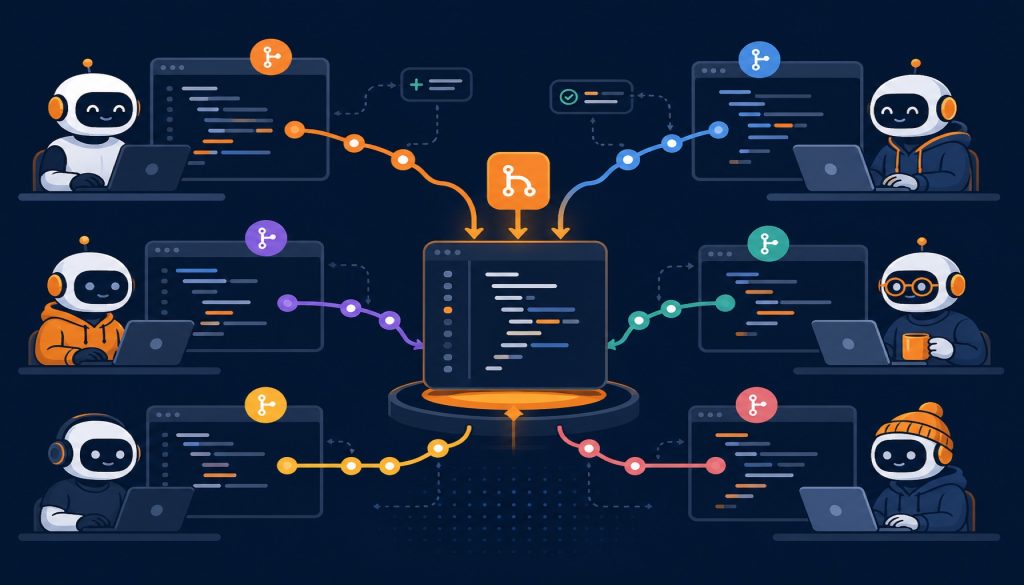
If you still think of AI coding as “an IDE assistant that autocompletes a few lines,” GitHub’s recent moves will probably look like minor feature updates. You’d be missing the real direction.
For two years, the central question in AI coding has been whether an AI could act like a teammate: take a task, break it into steps, find context, run tools, edit multiple files, and deliver results. That question is shifting. What matters now isn’t who autocompletes faster, but who first turns a single AI assistant into a multi-agent workflow that runs inside your repository.
In March 2026, GitHub released several key signals. Copilot coding agents got semantic code search. JetBrains gained stronger agentic capabilities. And then came a piece worth chewing on: “How Squad runs coordinated AI agents inside your repository.” Put these together and the picture is clear. The next generation of AI coding tools won’t compete on “how smart is the model” but on whether they can build a verifiable, collaborative, task-splitting execution layer inside real repositories.
The Real Comparison Isn’t Who Acts More Like a Chatbot
Most AI coding tools still sell a familiar fantasy: you describe what you want, and the AI writes it like an engineer who gets you.
The problem with that pitch is it assumes the entire development process fits in one brain. Real projects don’t work that way. Codebases have legacy constraints, module boundaries, permission issues, test requirements, and context only the team knows.
Whether an AI can write code reliably has never been about demo performance. It’s about whether the AI gets lost in a complex repository.
That’s why the most valuable part of GitHub’s recent updates isn’t “we swapped in a stronger model.” It’s that GitHub is filling in critical gaps:
- Giving coding agents semantic code search, not just grep-style matching
- Building clearer plan / sub-agent / custom agent structures in IDEs and repositories
- Embedding multi-agent coordination directly into repository-native workflows
This signals something important. The industry is admitting that single-agent mode hits a ceiling on medium to large projects.
Why Semantic Search Matters More Than It Sounds
When people hear semantic code search, the first reaction is usually: oh, smarter code search.
But it’s more than that.
Many agents fail not because they can’t write syntax, but because they can’t find the right context. An agent knows it needs to modify authentication logic, but it can’t locate the custom permission middleware the team built. It knows it needs to hook into the payment flow, but it can’t find the adapter with the unintuitive name. Result: it can write, but it writes the wrong thing.
Semantic search isn’t about making search “advanced.” It’s about acknowledging something real: in large codebases, many critical relationships don’t show up in string matching.
This directly impacts three core agent capabilities.
Locating code. The agent doesn’t need to know the exact class name, function name, or file path to reach the right spot.
Task decomposition. When an agent can reliably find adjacent modules, call chains, and past implementations, the plan it generates won’t be theoretical.
Multi-agent coordination. If one agent searches context, one modifies implementation, and one writes tests, they need to share a reliable context location system.
So semantic search isn’t a small upgrade. It’s a step from “can write” to “can find, break down, and coordinate.”
What GitHub Is Really Betting On: Repository Orchestration, Not Super-Agents
GitHub’s Squad article reveals an important product judgment. The future isn’t one all-powerful coding super-agent. It’s an agent system that runs inside repositories, can be inspected by humans, and can be constrained by process.
This sounds like fracturing “one strong AI” into pieces, which seems less exciting. But for real teams, it’s more practical.
Software development has never been a pure intelligence contest. It’s organizational work.
- Someone understands requirements
- Someone locates context
- Someone changes code
- Someone tests edge cases
- Someone does final review
If AI coding enters real production environments, it will eventually take a similar shape.
So the questions worth asking now aren’t “which model ranks first on code benchmarks” but these:
- Can it break tasks into trackable steps?
- Can it clearly define different agent boundaries?
- Can human engineers quickly review each step’s output?
- Does it collaborate within existing repository workflows, or force teams to adapt to it?
This is where GitHub has an advantage. It’s not the best at telling AGI stories, but it’s closest to real development: repositories, PRs, code search, permissions, reviews, historical context. That’s GitHub’s home ground.
How This Reshapes AI Coding Tool Competition
If this direction holds, AI coding tool competition will reshuffle along at least three lines.
From model choice to execution structure. People used to compare Claude, GPT, Codex, Copilot on who’s stronger. That still matters, but it’s not enough.
No matter how strong the model, if execution structure is single-threaded, single-context, single-role, it distorts in real repositories. On the other hand, a tool with better execution structure, more stable context systems, and workflows closer to real team collaboration can ship reliably even if its model isn’t the strongest.
Put simply, model capability becomes table stakes. Execution orchestration becomes differentiation.
From “can it write” to “can it fit into team process.” Real enterprises won’t hand over core repositories just because an agent can write demos. They want to know:
- Can it hook into existing review processes?
- Can it work with issue / PR / CI systems?
- Can it be constrained by permissions and policies?
- Can we trace responsibility when it errors?
This is why GitHub’s current path is more interesting than just “stronger model.” Enterprises aren’t buying a performative coding tool. They’re buying an execution component that fits into existing engineering systems.
From individual power-up to team productivity system. The first wave of AI coding tools benefited solo developers most. One person in an editor, with AI assist for autocomplete, bug fixes, and boilerplate, already felt great.
But the next, larger market isn’t individual power-ups. It’s team-level productivity:
- Some trivial changes handed to agents
- Some code search and context assembly done by agents as prep work
- Some security checks, secret scanning, and documentation chained together by agents
At that point, one intelligent agent isn’t enough. You need a system that can schedule, collaborate, hand off, and leave traces inside repositories.
What This Means for Regular Developers
If you’re an individual developer, the most practical takeaway isn’t “go chase multi-agent right now” but to check whether your situation needs it yet.
Who should keep using single agents or single assistants:
- Personal projects or small codebases
- Main needs are autocomplete, refactoring, small feature implementation
- Context is focused, switching cost is low
- Not dependent on team processes or complex reviews
In these cases, single agents still work and are often lighter and faster.
Who should start watching multi-agent / repository orchestration:
- Team projects with multiple collaborators
- Complex repositories where search and location are already pain points
- Need AI to participate in real issue / PR / review / test flows
- Want AI to not just answer questions but actually take on part of engineering work
You’ll notice that what’s valuable isn’t “answers that sound human” anymore. It’s “execution that works like part of the team.”
My Take on the Next Phase of AI Coding in 2026
I’m increasingly convinced that the next watershed in AI coding won’t be who first builds a “super programmer.” It’ll be who first assembles agent orchestration, context retrieval, repository workflow, and review visibility into a system that actually ships.
In other words, the agents that survive won’t necessarily be the best at writing code. They’ll be the ones that can do work inside teams without causing chaos.
That standard doesn’t sound sexy, but it’s real.
Software teams never pay for wow moments. They pay for control. If an agent acts like a genius intern who’s brilliant one moment and breaks things the next, people get excited at first, then stop trusting it with critical work. But if an agent can consistently find context, follow process, and leave results in PRs and repository history, it stops being just an assistant. It starts becoming part of the engineering system.
Bottom Line
If you’re still viewing 2026 AI coding tools through the lens of “an AI that helps me write code,” you’re probably a step behind.
What to watch next isn’t who acts more like a chatbot or who autocompletes more smoothly. It’s who first matures multi-agent coordination plus repository-native workflows plus verifiable execution paths.
GitHub’s recent moves matter not because of a few new features, but because GitHub is telling the market: AI coding enters production not with one smarter brain, but with a system that acts more like an organization.
Related reading
- Cursor vs Claude Code vs Windsurf vs GitHub Copilot: Which AI Coding Tool Wins in 2026
- Claude Code vs Codex CLI vs Gemini CLI: Which Terminal AI Coding Assistant Feels Like a Teammate in 2026
- Cursor vs Copilot vs Claude Code vs Windsurf: Which AI Coding Tool Is Right for You in 2026?
- Which AI Email Assistant Actually Saves You Time? Superhuman AI vs Spark AI vs Notion Mail vs Gmail AI in 2026
- Copilot Slipped an Ad Into Your Pull Request: The Trust Ceiling of AI Coding Tools
Stay updated with our latest AI insights