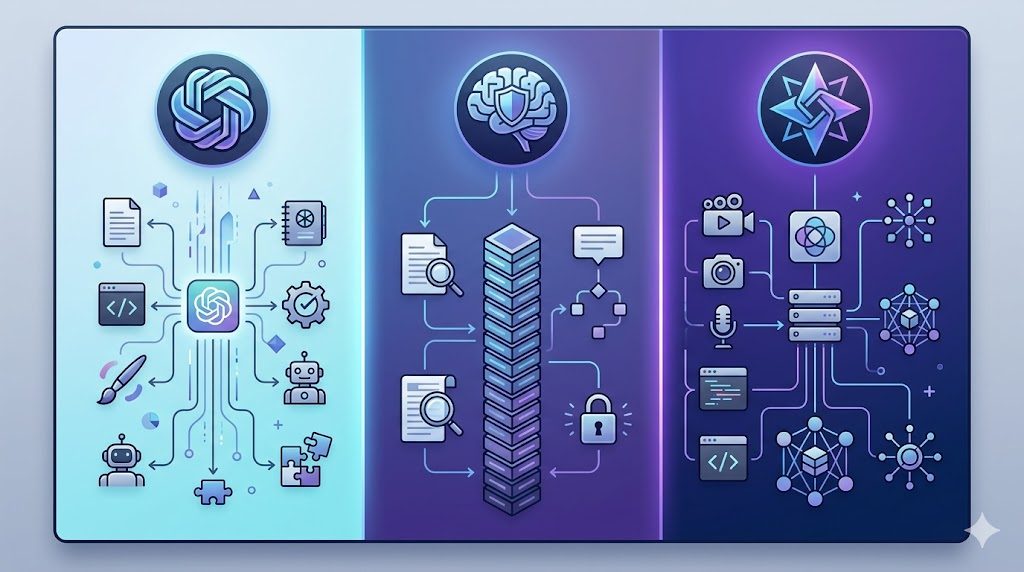
By June 2026, the AI battleground has reached fever pitch. ChatGPT, Claude, and Gemini—three flagship models—each claim dominance in their territory, all declaring themselves “the best.” But for everyday users and developers, only one question truly matters: Which AI model is the right fit for my needs?
Don’t fall for marketing hype. This article cuts through the noise with the latest benchmark data and real-world testing to give you a straightforward answer.
Quick Take: Which Model Wins Where?
| Use Case | Best Choice | Why |
|---|---|---|
| Complex coding & debugging | Claude Opus 4.7 | Leads SWE-bench, 65% fewer errors |
| Multi-step reasoning | Gemini 3.1 Pro | 94.1% GPQA, exceeds PhD-level |
| Rapid prototyping | ChatGPT GPT-5.5 | Mature ecosystem, complete toolchain |
| High-volume API calls | Gemini 3.1 Pro | Lowest cost ($2/M input), 1M token context |
| Writing & content creation | Claude Opus 4.7 | Nuanced tone, best long-form coherence |
| Real-time search & fact-checking | Gemini 3.1 Pro | Native Google Search, 93.2% accuracy |
Bottom line: There’s no universal “best,” but Claude excels at coding and writing, Gemini leads in reasoning and cost-efficiency, and ChatGPT offers the most balanced performance with the strongest ecosystem.
Performance Showdown: Who Has the Technical Edge?
Coding Capabilities: Claude Takes a Narrow Lead
In SWE-bench Verified (real GitHub issue resolution)—the toughest coding benchmark—here’s how the models ranked in June 2026:
- GPT-5.5: 82.6% (OpenAI’s latest flagship)
- Claude Opus 4.7: 82.0% (Anthropic’s top-tier model)
- Gemini 3.5 Flash: 78.8% (Google’s speed-focused variant)
- GPT-5.4: 78.2%
- Claude Sonnet 4.6: 77.4%
Key insight: While GPT-5.5 edges ahead on raw scores, Claude Opus 4.7 delivers more consistent real-world performance. It produces “shortcut” or hacky solutions 65% less often, meaning the code it generates is more maintainable and robust over time.
Gemini holds its own in coding, but still trails behind Claude and GPT when handling complex logic or multi-file refactoring.
Real-world recommendations:
– Need to debug tricky bugs or conduct code reviews? Choose Claude.
– Want quick scripts or broader tech stack support? Go with ChatGPT.
– Dealing with massive codebases (>100K tokens)? Gemini’s 1M context window is your friend.
Reasoning Power: Gemini Dominates Scientific Thinking
GPQA Diamond (PhD-level scientific reasoning) results:
- Gemini 3.1 Pro: 94.1% (far exceeds human PhD average of 65-70%)
- GPT-5.5: 92-94% (slight variance depending on test configuration)
- Claude Sonnet 4.6: 89-90%
Key insight: Gemini shines in multi-step reasoning and cross-domain synthesis, especially when problems require juggling math, physics, and chemistry simultaneously. Claude’s reasoning is solid but slightly behind, with its strength lying more in language understanding and contextual coherence. ChatGPT strikes the best balance between reasoning and coding, but tops neither category.
Writing & Creativity: Claude’s Emotional Depth Is Unmatched
This dimension resists easy quantification, but user feedback and comparative testing reveal clear patterns:
- Claude: Rich emotional layering in long-form content, stable tone, natural humor. Perfect for blogs, stories, and deep dives.
- ChatGPT: Clear structure, factual accuracy, but leans “formal” and lacks personality. Ideal for business docs and technical whitepapers.
- Gemini: Crisp and punchy, but loses coherence in longer pieces with jarring tonal shifts. Best for short copy and quick summaries.
Real test case: We asked all three models to write a 1,500-word piece on AI ethics. Claude’s version read like human writing—opinionated, reflective. ChatGPT’s felt like a Wikipedia entry. Gemini’s resembled PowerPoint bullet points.
Cost Comparison: Who Saves You Money?
| Model | Subscription | API Input | API Output | Context Window |
|---|---|---|---|---|
| Claude Opus 4.7 | $20/month | $5.00/M tokens | $25.00/M tokens | 1M tokens |
| ChatGPT Plus | $20/month | $2.50/M tokens | $15.00/M tokens | 128K tokens |
| ChatGPT Pro | $200/month | Same as above | Same as above | Unlimited usage |
| Gemini Advanced | $19.99/month | $2.00/M tokens | $12.00/M tokens | 1M tokens |
| Gemini Ultra | $249.99/month | Same as above | Same as above | Unlimited usage |
Key insights:
– Individual users: Subscription pricing is nearly identical ($20/month), so you can’t go wrong with any option.
– Heavy API users: Gemini is the cheapest—20% less than ChatGPT and 60% less than Claude. Processing 50 million tokens daily (e.g., customer service bots) could save you $45,000 annually with Gemini.
– Pro tier users: ChatGPT Pro ($200/month) undercuts Gemini Ultra ($249/month) while delivering stronger performance.
Important caveat: Claude Opus 4.7’s “thinking tokens” (adaptive thinking) are billed at output rates ($25/M tokens). Complex reasoning tasks can burn 30-50% more tokens than expected.
Use Case Recommendations: Which Model Fits Your Workflow?
Scenario 1: Software Development & Programming
First choice: Claude Opus 4.7
– Near-top SWE-bench score (82%) with higher code quality.
– 200K context window handles mid-sized projects in one pass.
– Excels at debugging, refactoring, and architecture design.
Alternative: ChatGPT GPT-5.5
– Better for rapid prototyping and broader tech stack coverage (Firebase, AWS, React, etc.).
– Strongest integration with Code Interpreter, Plugins, and GitHub Copilot.
Skip Gemini: Unless you’re working with massive codebases (>100K tokens), Gemini’s coding chops trail the competition.
Scenario 2: Content Creation & Writing
First choice: Claude Opus 4.7
– Consistent tone and emotional depth in long-form writing—ideal for blogs, fiction, and marketing copy.
– Can mimic specific styles (Hemingway, Joan Didion, etc.).
Alternative: ChatGPT
– Best for structured content like technical whitepapers and product documentation.
Skip Gemini: Fine for short copy, but struggles with long-form coherence.
Scenario 3: Data Analysis & Research
First choice: Gemini 3.1 Pro
– 94.1% GPQA score surpasses PhD-level reasoning.
– Native Google Search integration with 93.2% fact-checking accuracy.
– 1M token context processes entire research paper collections in one go.
Alternative: ChatGPT
– Better for structured data tasks (SQL generation, data visualization) via Code Interpreter.
Scenario 4: Conversational AI (Customer Service, Assistants)
First choice: Gemini 3.1 Pro
– Lowest API pricing ($2/M input) for high-frequency calls.
– Fast response times with minimal latency.
Alternative: ChatGPT
– Superior for complex multi-turn conversations (booking systems, workflow automation) thanks to mature Function Calling and Agents capabilities.
Final Verdict: Stop Overthinking, Choose Based on Need
The AI model landscape of 2026 is mature enough that there’s no absolute “best”—only “best fit.”
For individual users:
– All three cost $20/month—trial each for a week and see what feels right.
– Primarily coding? Pick Claude.
– Mainly research and fact-checking? Go Gemini.
– Need well-rounded capabilities? ChatGPT has you covered.
For developers:
– High API volume? Choose Gemini (cheapest).
– Need top code quality? Go with Claude.
– Want the most complete ecosystem and tooling? Pick ChatGPT.
Pro tip: Don’t put all your eggs in one basket. Many teams now use Claude for coding, Gemini for reasoning, and ChatGPT for rapid prototyping. Multi-model platforms like Playcode and Lorka AI let you access 15+ models with a single subscription.
The fiercer the AI competition, the better for users. By June 2026, all three models are powerful enough—you just need to figure out what you actually need them to do.
Ready to Pick Your AI Model?
Whether you’re coding the next big app, writing compelling content, or analyzing complex datasets, choosing between ChatGPT vs Claude vs Gemini in 2026 comes down to your specific workflow. Each model has carved out its strengths—Claude for craftsmanship, Gemini for efficiency, and ChatGPT for versatility.
Want to stay ahead of AI developments? Subscribe to our newsletter for weekly deep dives into the latest model updates, benchmark breakdowns, and real-world testing. We cut through the hype so you can make informed decisions.
Have questions about which model fits your project? Drop a comment below—our community of developers and AI practitioners is here to help.
Stay updated with our latest AI insights