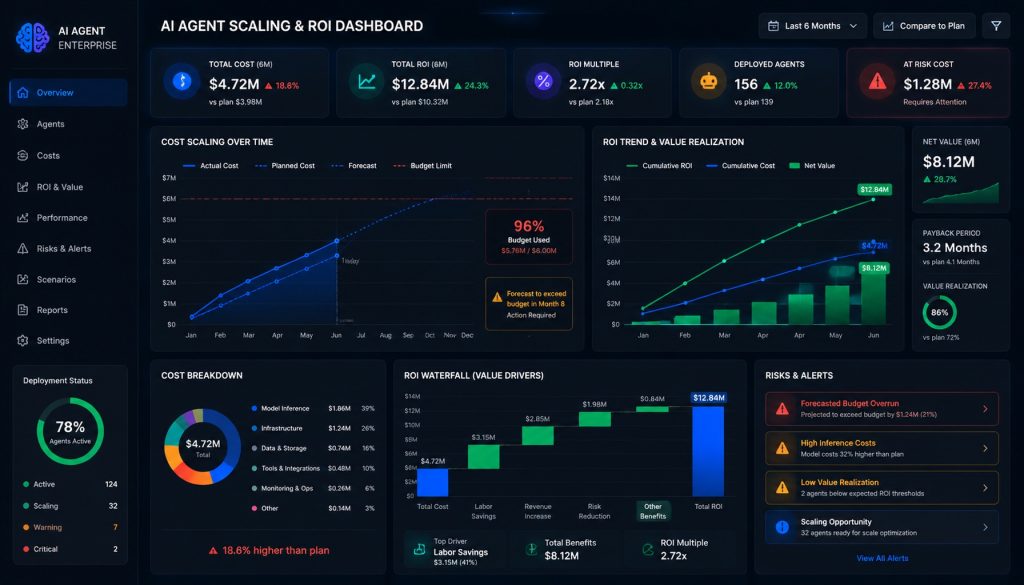
Your pilot worked. The AI agent handled customer support tickets 40% faster, the C-suite loved the demo, and now the board wants it rolled out across sales, operations, compliance, and HR. The directive comes down from the quarterly review: “Scale this to every department by Q4.”
Six months later, your cloud bill has tripled. Your ML engineers are buried in production incidents they never anticipated. The agent that handled returns so smoothly just hallucinated a refund policy that doesn’t exist, costing you a six-figure client relationship. The CFO wants answers. The CTO is backpedaling. And your team is wondering how a successful pilot turned into an operational crisis.
This is not a hypothetical scenario. This is the reality of enterprise AI agent scaling in 2026, and it’s happening at companies of every size across every industry vertical.
The 80% ROI Statistic Needs Context
Deloitte’s 2026 enterprise AI report found that 80% of companies deploying AI agents claim positive ROI. The number looks great on a slide deck. It looks great in a board presentation. It falls apart when you examine how it was calculated.
First, the ROI measurement window is typically 12 to 18 months. Many hidden costs haven’t fully materialized within that timeframe. Infrastructure costs compound. Technical debt accumulates. The reliability engineering team you didn’t budget for is now three sprints behind on guardrail improvements.
Second, “seeing ROI” is not the same as “net positive.” Most companies count headcount savings but fail to subtract the remediation costs when agents make mistakes. They don’t account for the engineering hours spent debugging production hallucinations at 2 AM. They don’t quantify the customer goodwill lost when an agent gives confidently wrong answers.
Third, survivorship bias distorts everything. Gartner’s parallel research shows that 40% of enterprises have cancelled or significantly scaled back their AI agent projects during the same period. That 80% ROI figure comes from the survivors only. The companies that failed hard enough to abandon their projects aren’t showing up in the positive ROI column.
The takeaway: this is a winner-take-all game. Companies that get it right see massive returns. Companies that get it wrong don’t just lose money. They create organizational trust wounds that make future AI adoption harder. Teams that got burned by a botched agent rollout will resist the next initiative, even when the technology has matured enough to succeed.
Four Cost Black Holes in Agent Scaling
1. Infrastructure Costs Grow Non-Linearly
During your pilot, the agent handled 200 requests per day at manageable cost. Scale to 20,000 requests per day across the company, and costs don’t increase by 100x. They can increase by 300x.
The reasons stack up: peak capacity requires overprovisioning (you can’t tell the CEO the agent is “busy” during Monday morning rush), LLM API costs explode with token volume as conversations grow longer and context windows fill up, and vector databases need significantly more expensive instance types at retrieval scale. Embedding storage alone can become a five-figure monthly line item once you’re indexing enterprise-wide documentation.
One mid-market SaaS company shared their numbers publicly at a conference this year: expanding from 5 use cases to 50 pushed their monthly LLM API bill from $3,000 to $47,000. Their pilot projected $12,000 at full scale. The gap between projection and reality was nearly 4x, and it showed up on the P&L before anyone had time to optimize.
The math rarely works the way your pilot spreadsheet predicted. Pilot environments are controlled. Production environments have long-tail distributions, adversarial inputs, and usage patterns no one modeled.
2. Reliability Engineering Requires Dedicated Headcount
An agent with 95% accuracy sounds impressive in a controlled environment. In production at scale, a 5% error rate means 1,000 wrong decisions per day. Each error requires human review, rollback, and customer recovery. Some errors cascade into downstream systems before anyone notices.
Companies scaling agents are discovering they need an entirely new function: “Agent Ops.” These teams don’t write model code. They monitor agent behavior, flag anomalies, maintain guardrail configurations, manage prompt versioning, and conduct post-incident reviews when agents produce harmful outputs.
For a typical 500-person company, the Agent Ops team runs 3 to 5 people at an annual cost of $400K to $700K. This line item appears nowhere in most pilot business cases. Nobody budgeted for it because nobody knew it would be necessary. The role didn’t exist two years ago. Now it’s becoming as essential as SRE was a decade ago.
The skill set is unusual too. You need people who understand both ML systems and operational incident management. They need to read prompt chains, interpret embedding similarity scores, and also manage on-call rotations and write runbooks. This talent pool is small and expensive.
3. Data Pipelines Are a Perpetual Cost Center
Agents need real-time access to enterprise data to make decisions. That means building and maintaining RAG pipelines, vector indexes, and real-time data synchronization. None of this is a one-time build. It requires continuous updating, cleaning, and version management.
Most enterprises underestimate this cost by a wide margin. They assume agents can plug into existing databases and get useful context. They discover the hard way that they need to re-architect their data layer, build dedicated knowledge base management systems, and hire data engineers to maintain pipeline quality. The data infrastructure often costs more than the agent development itself.
Stale data is particularly dangerous. When your knowledge base contains outdated pricing, deprecated product features, or superseded policies, the agent delivers those wrong answers with full confidence. Customers don’t know the agent is working from last quarter’s documentation. They just know your company gave them incorrect information.
Version management adds another layer. When policies change, you need every agent across every department to immediately reflect the new rules. A single lagging index can create liability exposure that no one detects until a customer complaint surfaces weeks later.
4. Compliance and Risk Management Add 25-35% Overhead
Every decision an agent makes can carry legal consequences. Financial services require audit trails for every automated decision. Healthcare needs compliance documentation showing how recommendations were generated. Any scenario involving customer data demands privacy protection mechanisms that work at machine speed.
This is not an engineering problem you can solve with code alone. It requires legal, compliance, and risk management teams to participate in system design from day one. Their requirements shape the architecture. Their sign-off gates determine your deployment timeline. Their concerns about explainability and accountability add technical requirements that pure engineering teams would never impose on themselves.
Multiple enterprises report that compliance adaptation accounts for 25% to 35% of their total agent project budget. If you didn’t budget for this, you’re already behind. And the regulatory environment is still evolving. The EU AI Act, state-level privacy laws in the US, and industry-specific regulations are all creating new requirements that will need to be retrofitted into existing agent systems.
What Successful Companies Do Differently
They Scale in Steps, Not Leaps
Every company succeeding at agent scaling shares one trait: they don’t jump from “pilot success” to “full deployment.” They follow a deliberate sequence of pilot, limited expansion, observation, then further expansion. Each step has explicit exit criteria and cost ceilings. If a stage doesn’t hit its targets, they pause rather than push forward.
This patience is counterintuitive when the board is excited and competitors are making announcements. But the companies that moved fastest to scale are disproportionately represented in the 40% that cancelled their projects. Speed without measurement infrastructure is just expensive experimentation at production scale.
They Build Evaluation Frameworks Before They Scale
Before expanding, successful teams establish agent quality measurement systems covering accuracy rates, hallucination frequency, response latency, user satisfaction, and cost per interaction. They track these metrics continuously, not quarterly.
Scaling without an evaluation framework is the organizational equivalent of driving without a speedometer on an unfamiliar highway. You might be going the right speed. You might be about to get a ticket. You have no way to know until the consequences arrive.
The evaluation framework also provides the data you need to justify continued investment. When the CFO asks why the agent budget increased 40% this quarter, “because we scaled” is not an acceptable answer. “Because cost per interaction dropped 22% while accuracy improved from 93% to 96.5%” is.
They Use Hybrid Model Architectures
Not every task needs GPT-4 class reasoning. Smart teams implement task routing: simple classification and extraction goes to lightweight models (or even rule-based systems), medium-complexity tasks hit mid-tier models, and only complex reasoning with nuanced context calls the frontier model. This routing strategy reduces model costs by 60% to 70% while maintaining output quality where it matters.
The routing logic itself becomes a competitive advantage. Teams that invest in understanding which tasks actually require frontier-model reasoning and which can be handled by smaller, faster, cheaper alternatives gain a structural cost advantage that compounds as they scale further.
They Keep Humans in the Loop
The highest-ROI deployment pattern is not “fully autonomous agents.” It’s agents handling 80% of standard workflows while routing the remaining 20% of edge cases to human reviewers. This captures most of the efficiency gains while preventing catastrophic errors that destroy customer trust.
The temptation to push toward full autonomy is strong because it maximizes the headcount reduction story. But the risk-adjusted ROI of 80/20 human-agent collaboration consistently outperforms full autonomy in every industry vertical where the data is available. The 20% human oversight catches the errors that would otherwise become six-figure customer recovery incidents.
A Practical Checklist for H2 2026
If you’re planning agent expansion this half, here’s what a realistic approach looks like:
Model costs for the worst case. Multiply your pilot’s unit economics by 5x, not 1.5x. Scale introduces edge cases your pilot never encountered. Long-tail user behavior, adversarial inputs, and unexpected interaction patterns all drive costs higher than controlled testing suggests.
Build observability before building agents. If you cannot quantify how an agent performs across accuracy, cost, latency, and user satisfaction, you are not ready to scale it. Instrument first, expand second. The instrumentation investment pays for itself within weeks by identifying optimization opportunities.
Reserve 30% of budget for surprises. This covers model API price increases, unexpected compliance requirements, remediation costs when things go wrong, and the Agent Ops headcount you’ll need to hire in month three. If you spend it all, something went right. If you don’t have it when you need it, you’re forced into emergency cuts that damage the project’s long-term viability.
Set a stop-loss threshold. If a single agent’s monthly operating cost exceeds 120% of the human labor cost it replaced, pause expansion and revisit the architecture. Sunk cost logic kills agent projects. The instinct to “push through” and “optimize later” is how $3,000/month pilots become $47,000/month production nightmares.
Invest in Agent Ops training. This is a new capability stack that combines ML operations, incident management, and domain expertise. You cannot staff it by pulling random engineers off other projects. Plan for dedicated hiring or upskilling programs that take 2 to 3 months before the team is production-ready.
Document your rollback plan. Before scaling any agent into a new department, write down exactly how you would revert to the previous process if the agent fails. If you can’t articulate the rollback plan, you’re taking on more risk than you realize. Reversibility is insurance you hope you never need but cannot afford to skip.
The Bottom Line
AI agent ROI is real. The 80% statistic from Deloitte reflects measurable value creation happening across enterprises that approached scaling with discipline and measurement. The technology works. The use cases are proven. The efficiency gains are quantifiable.
But that value comes with substantial engineering investment, organizational adaptation, and ongoing operational costs that compound at scale. The infrastructure, the reliability engineering, the data pipelines, and the compliance overhead are not optional add-ons. They are structural requirements that determine whether your deployment survives contact with production reality.
The 40% cancellation rate from Gartner tells the other side of the story. Those companies rushed to expand, skipped evaluation framework development, and treated agents like software you install rather than capabilities you cultivate over months of deliberate iteration.
Think of an AI agent less like a SaaS tool you subscribe to and more like a new hire that needs 6 to 12 months of structured onboarding. The difference: you can interview a human candidate and check references. An agent’s evaluation framework is something you have to build from scratch, tailored to your specific workflows, data environment, and risk tolerance. The companies skipping that step are the ones contributing to the cancellation statistics six months later.
The question for H2 2026 is not whether to scale AI agents. The question is whether you have the measurement infrastructure, the operational maturity, and the budget discipline to scale them without joining the 40%.
Related Reading
- The Scaling Reality of AI Agents: 80% Report Returns, But at What Cost?
- The Real Cost of Scaling AI Agents: 80% of Enterprises See ROI in 2026, But at What Price?
Stay updated with our latest AI insights