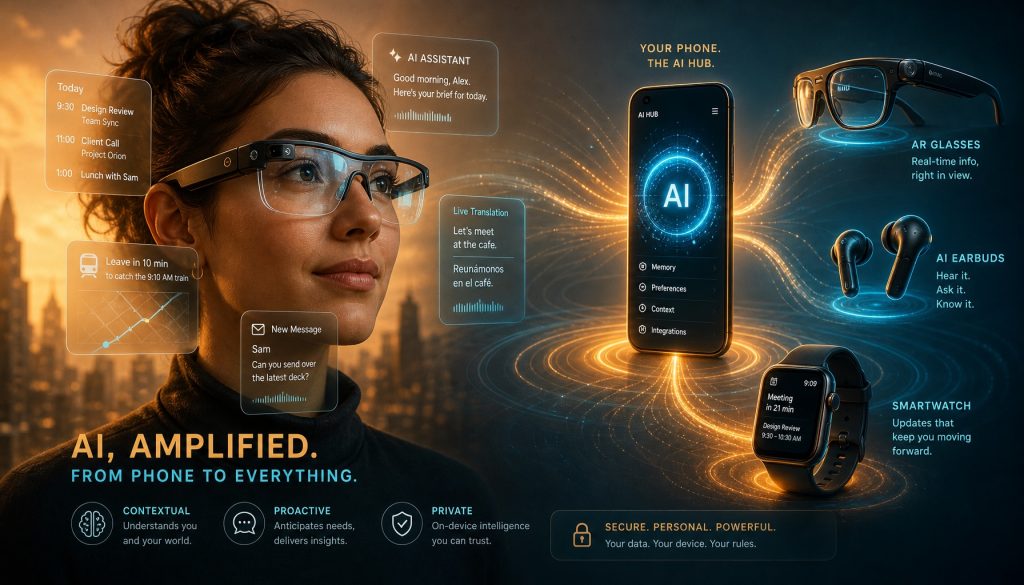
You pull out your phone. You open an app. You tap the microphone button. You wait for the response. You close the app. The AI assistant stops existing until you need it again.
Most AI assistants today are smart enough to impress you in a demo, but they still behave like software you activate on demand. They live inside chat windows, and when you’re not actively using them, they vanish into the background. They don’t watch your device state. They don’t act as a continuous hub that can hand off tasks between different terminals. They exist only when summoned.
This article answers a different question than “when will AI glasses go mainstream.” The real question is deeper: why will AI assistants inevitably move from software into a hub-and-terminal architecture, and what makes the connection layer harder to solve than the model itself?
The Real Shift Is Happening at the Form Factor Level
If you only look at chat interfaces, you’ll misread where AI assistants are headed. You’ll think the race is about who sounds smarter, who responds faster, who handles voice more naturally.
That’s surface level. The deeper change is that AI is slowly breaking out of the single-app shell and moving toward a continuously online system architecture.
You can already see clear signals of this shift. Voice interaction latency has dropped to near-conversational levels. Visual understanding is entering real-time scenarios instead of just post-capture recognition. More products are no longer satisfied being a chat box. They’re trying to connect calendars, devices, email, browsers, and physical terminals.
AI is moving from “software that chats” to “something that lives at the operating system layer.” The question is no longer whether it can answer your question well. The question is whether it can stay online, remember context, and execute across multiple endpoints without you having to restart it every time.
Why Hub-and-Terminal Beats a Single Powerful App
Real wearable AI has never been about cramming every capability into one device. The winning architecture separates the brain from the limbs.
The hub stays online continuously. It handles memory, scheduling, cross-task reasoning, and long-term context. The terminal handles perception and interaction. That terminal might be your phone today, your laptop tomorrow, your earbuds next week, your glasses next year.
Once this architecture works, the AI assistant stops being trapped inside a chat window. It extends into your real environment through whichever terminal makes sense at the moment. You’re no longer “opening a tool.” You’re invoking a hub that was already running.
This is why the real competition won’t be about which app feels most like a chatbot. The competition will be about who first gets the continuously online hub and the swappable terminals to work smoothly together.
OpenClaw’s Dual-Machine Setup Already Runs a Working Prototype
We built a concrete dual-machine system: a Linux server running the Gateway, a Windows desktop running the Node. It sounds like an engineering experiment, but the significance isn’t “controlling two machines simultaneously.” The significance is that it already demonstrates the prototype relationship of future wearable AI.
The Gateway acts like the hub. It stays online long-term, retains context, handles scheduling, and can trigger tasks proactively. The Node acts like the terminal. It extends the AI’s capabilities into specific devices, watching screens, clicking buttons, controlling browsers, executing local actions.
Once this relationship is established, the AI’s boundary changes immediately. It’s no longer just “answering you in a window.” It can complete entire action chains across machines, across environments, across terminals.
Push this one step further and you’ll see: if the Node isn’t a computer but glasses, earbuds, or a watch, the logic doesn’t need rewriting. Only the terminal form factor changes.
This is why this article should be read alongside our piece on the AI agent identity crisis. One discusses the external form of hub-and-terminal. The other discusses the internal identity of an agent as a continuously existing entity. They’re two sides of the same evolution.
The Hardest Part Isn’t Voice or Vision
Many people’s first thought about AI’s final form involves voice and vision. They’re visible. They’re exciting. They make good demos.
But the least glamorous yet most experience-defining component is the connection layer.
Think of the connection layer as the invisible pipe between hub and terminal. It doesn’t solve whether a single demo succeeds. It solves these unglamorous but critical problems: Can the terminal auto-recover after disconnection? Does the interaction collapse when round-trip latency spikes? How do you handle authentication so it’s both secure and not annoying? How do you sync state across devices without making the AI seem like it suddenly lost its memory?
We’ve hit every one of these problems in our dual-machine system. When the Node disconnects, the experience instantly degrades from “feels like an assistant” to “feels like an unstable remote script.” When round-trip latency increases, multi-step operations become visibly sluggish. Tighten authentication and users find it tedious. Loosen it and you hit security boundaries.
The real battle for future AI glasses and AI earbuds won’t just be whether the model is smart enough. It will be whether the connection layer is stable enough.
Why Humane AI Pin Failed While Meta, Apple, and OpenAI Keep Pushing Forward
The failure of Humane AI Pin is easy to misinterpret as “wearable AI doesn’t work.” That’s the wrong lesson.
The more accurate reading: it failed not because the direction was wrong, but because it tried to make a single terminal carry the entire system. Every layer collapsed under that constraint.
The more viable path is exactly the opposite. Separate the brain from the terminal. Keep the terminal light, handling only capture and display. Put heavy computation, long-term memory, and cross-task scheduling in the hub. Make the connection layer handle the stable, fast link between them.
Meta’s Ray-Ban glasses, Google’s Project Astra, Apple’s wearable roadmap, OpenAI’s hardware plans are all moving in this direction to varying degrees. They’re not all successful yet, but they all signal one thing: the industry is betting not on “a better chatbot app” but on a continuously online AI system.
The architecture matters more than the device. Humane tried to build a standalone miracle device. The companies still in the race are building systems where the miracle happens across multiple components working together.
Who Gets Affected First
This shift won’t happen as a universal switchover on some announced date. It will show up first in specific groups.
High-frequency information workers will turn their AI from a chat box into a cross-device execution layer first. They already juggle multiple screens, multiple contexts, multiple tools. They need an AI that can persist across all of them without restarting its understanding every time they switch devices.
Creators and operators need a continuously online hub that can string together capture, judgment, and publishing. They can’t afford to lose context every time they move from research to writing to distribution. They need something that remembers the whole chain.
Heavy device users naturally need an AI that maintains continuous presence across multiple terminals, not something that starts from scratch every time. They’re already living in multi-device workflows. An AI that can’t follow them across those devices feels broken.
This is why FuturePicker keeps writing about agent platform landscapes, real barriers in the agent era, and technology democratization in the AI agent age. The real change isn’t about which individual tool is stronger. The entire interaction form factor is migrating.
The Connection Layer Decides Whether AI Becomes Infrastructure or Stays a Demo
Most people underestimate how much work happens in the invisible layer between hub and terminal. Voice recognition and computer vision get the spotlight. They’re measurable. They make exciting announcements. But they’re not the bottleneck anymore.
The bottleneck is making the connection layer work reliably under real-world conditions. That means handling network instability without breaking the user’s mental model of a continuous assistant. That means syncing state fast enough that switching terminals feels seamless. That means authenticating securely without making users repeat themselves or re-login constantly.
Every company building wearable AI hits this wall. You can demo a prototype that works under controlled conditions. Getting it to work when the user walks into a parking garage, switches from WiFi to cellular, or moves between devices mid-task is a different problem entirely.
This is also why some of the most interesting infrastructure work is happening outside the big labs. Projects like OpenClaw that focus on agent continuity across machines are solving the same class of problems that will determine whether AI glasses feel magical or frustrating. The problems don’t go away when you shrink the terminal. They get harder.
Always-On Means the AI Has to Earn Its Place
When an AI assistant transitions from software to an always-on system, the bar changes. Software can be mediocre and still survive because you only open it when you need it. If it disappoints you, you close it and move on.
An always-on system that stays in your environment has to earn its presence. If it interrupts you incorrectly, you’ll turn it off. If it drains your battery, you’ll stop wearing it. If it breaks context when you switch terminals, you’ll stop trusting it with important tasks.
This is why the hub-and-terminal architecture isn’t just about technical elegance. It’s about survival. A single device trying to do everything will make tradeoffs that frustrate users. Separate the concerns, and each component can do its job well. The hub can stay powerful and online without worrying about weight or battery. The terminal can stay light and wearable without sacrificing capability.
The companies that figure out this balance first will own the next platform. Not because they built the best chat interface. Because they built a system that users trust to stay present in their lives.
Why This Matters for the Next Two Years
If you only think of AI as a chat tool, you’ll miss the next two years of change. The real competitive edge won’t come from better answers. It will come from building an AI that can stay online as a hub, extend into multiple terminals, and make the connection layer reliable enough that users stop thinking about it.
That shift is already underway. The companies that understand this are building infrastructure for continuous presence, not just better demos. The ones that don’t are still optimizing for chat quality and wondering why users don’t stick around.
The AI assistant’s endgame isn’t a smarter piece of software. It’s a continuously online hub plus a set of terminals that switch based on context. The value isn’t in adding another hardware shell. The value is in making the hub-terminal-connection triad work smoothly enough that users forget it’s even there.
So the judgment is simple: AI assistants are moving from software to wearable devices, but the real prize isn’t the device itself. The prize goes to whoever solves hub-terminal-connection first and makes it stable enough to bet your workflow on.
Frequently Asked Questions
Why will AI assistants move from apps to wearable devices?
AI is transitioning from “exists only when opened” software to a continuously online hub with multi-terminal access. As voice, vision, device integration, and proactive capabilities advance together, AI will break out of the single chat window constraint and extend into persistent presence across multiple form factors.
Why is the connection layer more critical than voice and vision?
Even the best voice and vision capabilities require a stable connection layer to become real user experience. Disconnection recovery, latency control, secure authentication, and state synchronization determine whether the AI feels like a reliable assistant or an unstable tool. When these fail, the entire experience collapses regardless of model quality.
How does OpenClaw’s dual-machine system relate to future AI glasses?
They share the same underlying relationship: a hub handles continuous presence and coordination, while terminals handle perception and interaction. Today it’s a server plus desktop. Tomorrow it can be a cloud hub plus glasses, earbuds, or watch. The terminal form changes, but the hub-terminal-connection logic remains constant.
What made Humane AI Pin fail while others keep building wearable AI?
Humane AI Pin tried to pack the entire system into a single device, causing every layer to collapse under constraints. The viable path separates concerns: lightweight terminals for capture and display, heavy computation in the hub, reliable connection layer between them. Meta, Apple, and OpenAI are building systems, not standalone miracle devices.
Related Reading
- On-Device AI Is Eating Cloud Inference From the Inside Out
- Local-First AI Agents: Why On-Device Inference Is the Default by 2028
Stay updated with our latest AI insights