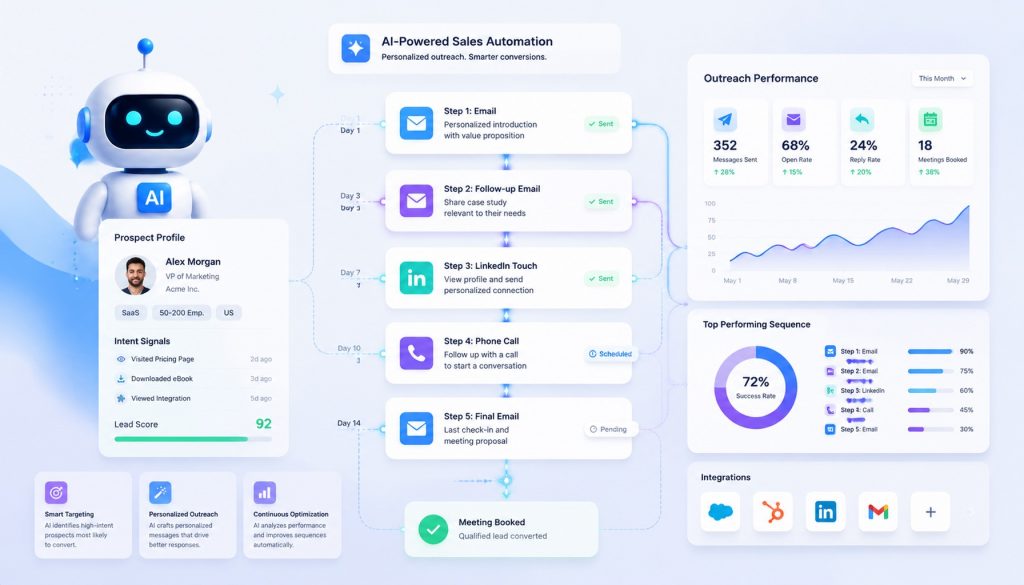
Sales development reps stopped sending emails by hand a long time ago. AI-powered outreach platforms are table stakes now, and the market has four major players worth evaluating: Apollo, Outreach, Salesloft, and Clay. Each serves a different team profile, budget range, and workflow complexity.
This comparison covers real 2026 pricing (including the costs vendors don’t advertise), feature differences that actually matter, and a decision framework based on team size and sales motion.
Apollo: The All-in-One Database and Outreach Bundle
Apollo stands apart because it bundles a 275M-contact database with outreach automation in a single platform. For teams that need to source leads and contact them without stitching together multiple tools, Apollo removes friction at the lowest price point.
Pricing (2026)
- Free: 50 contact credits/month, enough to test the product
- Basic: $49/user/month (annual), 1,200 contact credits
- Professional: $79/user/month (annual), 3,600 credits plus sequence automation
- Organization: $119/user/month (annual), 12,000 credits plus international dialer and AI call insights
Monthly billing adds 15-25% over annual contracts. If you need LinkedIn automation, Apollo can’t do it natively. Third-party tools like Phantombuster or Expandi push real monthly cost to $120-180.
Where Apollo Excels
The built-in contact database is the headline feature. You skip paying for ZoomInfo entirely, which saves $10,000-30,000/year for most teams. Sequence automation covers email, LinkedIn touchpoints, and phone in one workflow. The AI email writer generates personalized openers from lead data, and CRM sync with Salesforce or HubSpot works without middleware.
Where Apollo Falls Short
Data accuracy drops noticeably for SMB contacts outside the US. LinkedIn automation requires bolting on external tools. Email deliverability is average at best since Apollo lacks dedicated inbox warming or domain reputation management. Emails land in spam more often than with purpose-built sending tools.
Who Should Buy Apollo
Startups and teams under 5 SDRs with limited budgets. If you don’t want to manage a multi-tool stack and your target market is primarily North American, Apollo gives you the most coverage per dollar.
Outreach: Enterprise Sales Execution for Large Teams
Outreach is built for sales organizations with 50+ reps and dedicated Sales Ops support. It’s the most feature-dense platform in this comparison, with pricing to match.
Pricing (2026)
Outreach does not publish pricing. Based on Vendr procurement data:
- Starting price: Around $100-120/user/month (annual, 20-seat minimum)
- Typical contract: $20,000-$50,000/year depending on team size and modules
- Hidden costs: Implementation fees run $1,000-8,000, and annual renewals increase 10-15%
Outreach sells modular: Engage (sequences), Call (dialer), Meet (meeting intelligence), Deal (pipeline analysis), Forecast, and Amplify (content management). Each added module increases per-seat cost.
Where Outreach Excels
The sequence engine is the most powerful on the market. Complex multi-step, multi-channel workflows with conditional branching logic go deeper than any competitor. Salesforce integration is the industry benchmark with near real-time bidirectional sync. AI-driven insights cover call recording analysis, email sentiment scoring, and close probability prediction. For compliance-heavy industries, Outreach holds SOC 2, GDPR, and HIPAA certifications.
Where Outreach Falls Short
No built-in contact database. You still need ZoomInfo, Apollo data exports, or another source. The learning curve is steep: most teams report 2-4 weeks before new reps are productive. Pricing negotiations are slow, and small teams have limited bargaining power.
Who Should Buy Outreach
Enterprise sales teams of 50+ with dedicated Sales Ops. Companies running complex, multi-stakeholder deals with long sales cycles. Organizations already deep in the Salesforce ecosystem wanting the tightest possible CRM integration.
Salesloft: Enterprise Features at a Friendlier Price
Salesloft competes directly with Outreach and matches roughly 90% of its functionality. The differentiators: a cleaner interface, faster onboarding, and somewhat lower pricing.
Pricing (2026)
Salesloft also doesn’t publish pricing, but is more transparent than Outreach:
- Advanced edition: Around $125-165/user/month (annual, 10-seat minimum)
- Premier edition: 20-40% above Advanced, includes AI workflow automation (Rhythm)
- Negotiation room: Vendr data shows buyers regularly cut 35-45% off the initial quote
Note: the dialer is a separate add-on. Call recording and AI analysis (Conversations) are also extra charges.
Where Salesloft Excels
The interface is noticeably cleaner than Outreach, and new rep onboarding takes days instead of weeks. Rhythm AI is the standout feature: an automated workflow engine that triggers next-best-actions based on buyer signals. The Conversations module offers call recording with AI transcription, keyword extraction, and coaching scorecards. Pipeline health tracking gives managers real-time deal visibility.
Where Salesloft Falls Short
Same gap as Outreach: no built-in database. LinkedIn integration is less native than Apollo’s. Contract renewals typically come with 8-12% price increases, which adds up over multi-year commitments.
Who Should Buy Salesloft
Mid-sized sales teams of 10-50 reps who want enterprise-grade features without Outreach’s price tag or complexity. Teams that prioritize call coaching and sales training. Organizations migrating off Outreach to reduce costs while keeping core functionality.
Clay: Data Orchestration for Hyper-Personalization
Clay occupies a different category. It’s not an outreach tool. It’s a data orchestration platform that prepares leads and generates personalized messaging. You still need a separate sending tool (Instantly, Lemlist, Smartlead) to actually deliver emails.
Pricing (2026)
Clay uses credit-based pricing where different operations consume different amounts:
- Free: 100 credits/month for testing
- Starter: $134/month (annual), 2,000 credits
- Explorer: $349/month (annual), 10,000 credits
- Growth: $495/month (annual), 30,000 credits plus CRM sync
- Pro: $640/month (annual), 100,000 credits
One data enrichment task (like finding an email address) uses 1-5 credits. AI-generated personalized emails consume 10-20 credits each. Actual monthly cost often runs 30-50% higher than the plan price suggests once AI operations ramp up.
Where Clay Excels
Clay connects 75+ data sources: Apollo, ZoomInfo, Clearbit, LinkedIn, Twitter, GitHub, and dozens more. The waterfall enrichment system queries multiple sources sequentially until it finds the data point you need. The AI personalization engine writes emails based on a prospect’s recent LinkedIn activity, company news, job changes, and tech stack. All of this happens through a no-code interface that looks like a Notion spreadsheet.
Where Clay Falls Short
Clay does not send emails. It prepares data and drafts copy, then you export to a sending platform. Credits burn fast when you use AI-heavy operations, making costs unpredictable. The platform requires understanding data flow logic, which means non-technical SDRs struggle without Sales Ops support.
Who Should Buy Clay
Sales Ops teams responsible for building high-quality lead lists. Companies running Account-Based Marketing that need deep personalization at scale. Technical founders who enjoy building automation workflows and want maximum control over their data pipeline.
Head-to-Head Comparison
| Tool | Starting Price | Core Strength | Main Weakness | Best Use Case |
|---|---|---|---|---|
| Apollo | $49-119/user/mo | Database + outreach bundled | Data quality inconsistent for SMB | Small teams, tight budget |
| Outreach | $100-120/user/mo | Most powerful sequence engine | Expensive, steep learning curve | Enterprise teams 50+ |
| Salesloft | $125-165/user/mo | Clean UX, AI workflows | No database, rising renewal costs | Mid-sized teams 10-50 |
| Clay | $134-640/mo (credits) | Data orchestration + personalization | Not a sending tool | Sales Ops, ABM programs |
How to Decide
Startup with under 5 SDRs and a tight budget: Go with Apollo. The bundled database eliminates your biggest expense, and one platform covers prospecting through outreach. Data quality won’t match ZoomInfo, but it’s sufficient for early-stage pipeline building.
Mid-sized team of 10-50 reps wanting enterprise features: Go with Salesloft. You get 90% of Outreach’s capability at a lower price with faster onboarding. The Rhythm AI workflow engine adds real productivity gains. Push back on the initial quote since 35-45% discounts are standard.
Enterprise team of 50+ with complex deal cycles: Go with Outreach. The sequence engine depth, Salesforce integration quality, and sales intelligence breadth justify the premium at scale. Budget for implementation support and a 3-4 week ramp period.
Sales Ops running ABM or personalization-heavy strategy: Add Clay to your existing stack. Don’t replace your outreach tool. Use Clay for data enrichment and message personalization, then export to Instantly or Smartlead for delivery.
Mistakes That Cost Teams Money
Buying more tool than your team will use. Outreach and Salesloft pack dozens of features. If your SDRs only run basic email sequences, you’re paying for capabilities that sit unused. Start simple. Upgrade when reps actually hit the ceiling of their current tooling.
Ignoring total stack cost. Apollo looks affordable at $79/month. But once you add ZoomInfo for better data accuracy, Phantombuster for LinkedIn automation, and Smartlead for deliverability optimization, your real cost exceeds $200/month per rep. Map out the full stack before committing.
Accepting the first quote. Both Outreach and Salesloft inflate initial pricing. Use Vendr or comparable procurement data to understand real market rates. Even small teams can negotiate 30-40% off list price with the right benchmarks.
Confusing Clay with an outreach platform. Clay handles data preparation and personalized copy generation. It does not send emails or manage sequences. Teams that buy Clay expecting Apollo-like end-to-end functionality end up frustrated and overspent.
Bottom Line
Your ideal tool depends on three variables: team size, budget, and sales process complexity. Apollo delivers the most value per dollar for small teams. Salesloft hits the sweet spot between features and cost for mid-market. Outreach owns the enterprise segment. Clay solves a different problem entirely and works best as a complement to your sending infrastructure.
Skip the feature comparison spreadsheets with 200 line items. Pick the tool that matches your current team size and workflow, run a trial with your actual SDRs, and commit to whatever they’ll use daily. The most powerful platform in the world adds zero value if your reps work around it instead of through it.
Related Reading
- Outbound Sales CRM 2026: Close vs Pipedrive—Which Fits Your Team?
- Cursor vs Claude Code 2026: Which AI Coding Tool Should Developers Actually Choose?
Stay updated with our latest AI insights