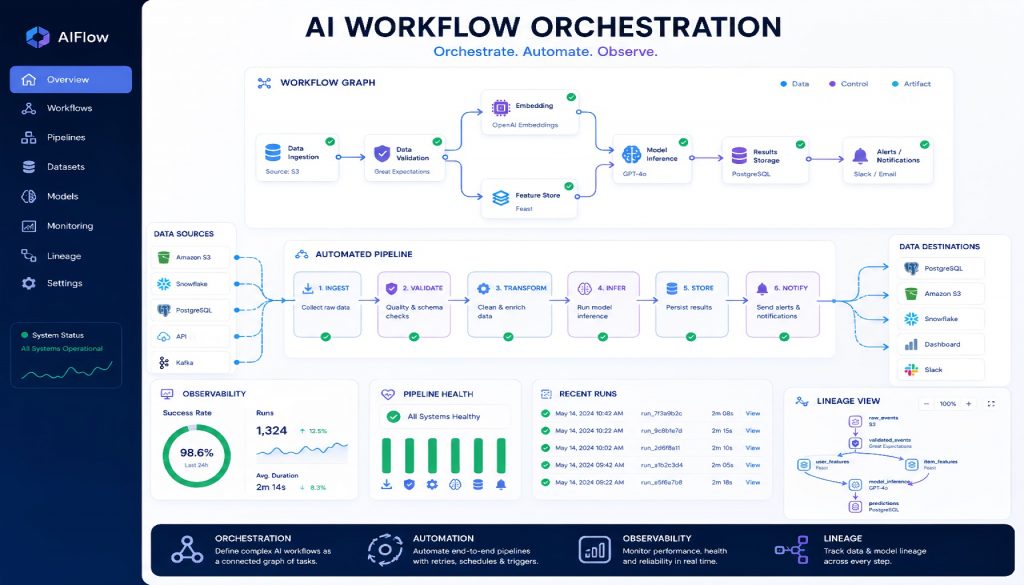
A data engineer stares at error logs, manually restarting a failed ETL job for the third time. Step 47 broke today. Last week it was step 23. The root cause is always the same: no orchestration layer, just scripts chained together with hope and duct tape.
This was daily life for data teams in the early 2020s. Tasks failed with no clear restart point. State scattered across log files. One broken link brought the entire pipeline down. Workflow orchestration tools exist to fix exactly this: managing multi-step processes with automatic retries, state tracking, dependency resolution, and error recovery.
By 2026, the field has split into distinct categories. Apache Airflow remains the established data pipeline scheduler, with its Python DAG syntax now an industry standard. Prefect and Dagster represent the next generation of data orchestration, targeting Airflow’s weak spots with better developer experience. Temporal takes a fundamentally different path: it’s not a “data pipeline tool” at all, but a general-purpose distributed workflow engine for any process that needs reliable execution over long timeframes.
These four tools get compared constantly, but they solve problems at different layers. Pick the wrong one and you’re either swatting flies with a sledgehammer or felling trees with a paring knife. This article breaks them down across positioning, programming model, state management, and use cases so you can match the right tool to your team’s actual needs.
How Do Temporal, Airflow, Prefect, and Dagster Compare?
Core Positioning
| Dimension | Temporal | Airflow | Prefect | Dagster |
|---|---|---|---|---|
| , , , , , – | , , , , , | , , , , – | , , , , – | , , , , – |
| Primary focus | General workflow engine for business process orchestration | Data pipeline scheduling for batch ETL | Modern data flow orchestration (Airflow improved) | Data-centric orchestration with lineage and observability |
| Programming model | Normal function calls with automatic state management | DAG + Operators with declarative dependencies | Python functions + decorators | Asset dependency graph with declarative lineage |
| State management | Durable execution: state persists automatically, survives restarts | Task state in DB; failures require full task re-run | Task state in Prefect Server; supports partial re-runs | Asset state and lineage unified; supports incremental refresh |
| Learning curve | Medium. Few core concepts, but durable execution model takes time to internalize | Steep. DAG parsing, execution context, XCom, multiple Executor types | Gentle. If you know Python, you’re mostly there | Medium. Asset and lineage concepts need learning, but design is intuitive |
| Ops complexity | High. Temporal Server + Cassandra/PostgreSQL + Elasticsearch | High. Webserver + Scheduler + Executor + DB + message queue | Medium. Prefect Server + PostgreSQL, simpler than Airflow | Medium. Dagster Daemon + Dagit + PostgreSQL |
Scenario Fit Matrix
| Scenario | Temporal | Airflow | Prefect | Dagster |
|---|---|---|---|---|
| , , , , , | , , , , , | , , , , – | , , , , – | , , , , – |
| Order fulfillment workflows | Best fit | Not suited | Not suited | Not suited |
| Batch ETL pipelines | Overkill | Best fit | Best fit | Good fit |
| Real-time data pipelines | Not designed for this | Not supported | Not supported | Possible but not ideal |
| ML training pipelines | Possible | Good fit | Good fit | Strong fit |
| Data warehouse modeling | Not suited | Good fit | Good fit | Best fit |
| Microservice orchestration | Best fit | Not suited | Not suited | Not suited |
What Is Temporal Best For?
Temporal’s founding team came from Uber’s Cadence project. The problem they set out to solve wasn’t “schedule data tasks.” It was “how do you make complex processes execute reliably in distributed systems?” Payment flows, user onboarding sequences, cross-service approval chains: these are Temporal’s target scenarios.
Core Concept: Durable Execution
Temporal’s signature feature is durable execution. Your workflow code looks like ordinary function calls, but the state of every step gets persisted automatically. Process crashes? It resumes from where it left off after restart. An API call times out? Automatic retry. A downstream service goes down? The workflow waits for recovery, then continues.
This “write it like synchronous code, run it like a distributed system” experience is Temporal’s main selling point. You don’t build your own state machines. You don’t write complex error recovery logic. Temporal’s execution engine handles all of that.
Programming Model
Temporal workflows are written in standard programming languages (Go, Java, Python, TypeScript, .NET) with no special DSL required. A workflow is just a function that calls Activities (the units that do actual work), starts child workflows, or waits for external signals.
“`python
@workflow.defn
class OrderWorkflow:
@workflow.run
async def run(self, order_id: str) -> str:
# Step 1: Check inventory
await workflow.execute_activity(
check_inventory,
order_id,
start_to_close_timeout=timedelta(seconds=30),
)
# Step 2: Charge payment
payment_result = await workflow.execute_activity(
charge_payment,
order_id,
start_to_close_timeout=timedelta(minutes=5),
)
# Step 3: Ship order
await workflow.execute_activity(
ship_order,
order_id,
start_to_close_timeout=timedelta(hours=1),
)
return “Order completed”
“`
This code reads like three sequential steps. But Temporal guarantees that any failed step gets retried automatically, process restarts don’t affect execution, and each step’s timeout is managed independently. You write zero state management code.
Best-Fit Use Cases
Temporal works best for long-running processes with complex state that demand high reliability:
- Order fulfillment (place order, pay, ship, deliver, confirm receipt, with hours or days between steps)
- Employee onboarding (application, approval, background check, contract signing, with human review gates)
- Cross-system data sync (read from System A, transform, write to System B, verify consistency)
- Microservice orchestration (Saga-pattern distributed transactions with compensation logic)
Where it doesn’t fit: pure batch data processing, scheduled tasks, simple cron jobs. Temporal shines when you have “complex state + long execution time.” If your task is “run a SQL export every night at 2 AM,” Temporal is overkill.
Pricing and Deployment
Temporal offers an open-source edition (MIT license) and a managed cloud service (Temporal Cloud). The open-source version requires deploying Temporal Server yourself (depends on Cassandra/PostgreSQL + Elasticsearch), suited for teams with ops capacity. Temporal Cloud bills by Action count: free tier includes 1 million Actions per month, paid plans start at $200/month.
Is Airflow Still the Standard for Data Pipelines?
Airflow was born at Airbnb in 2014 and became an Apache top-level project in 2019. By 2026, it’s still the most widely used scheduling tool in data engineering. You’ll see “Airflow experience” in job postings far more often than the other three combined.
Core Concept: DAGs as Task Dependency Graphs
Airflow’s central abstraction is the DAG (Directed Acyclic Graph). You define a set of tasks and the dependencies between them. Airflow schedules execution in dependency order. Task A finishes before Task B runs. Tasks C and D run in parallel. Task E waits for both C and D to complete.
This explicit dependency declaration maps naturally to data pipelines: extract data from a database, clean and transform it, then load it into a warehouse. Each step is an independent task with clear upstream/downstream relationships.
Programming Model
Airflow DAGs are defined in Python, but the execution model differs from a normal Python program. DAG files get parsed repeatedly (once per minute by default), so you can’t put heavy computation in the DAG file itself. Actual task logic lives inside Operators.
“`python
from airflow import DAG
from airflow.operators.python import PythonOperator
from datetime import datetime, timedelta
def extract_data():
# Pull data from source database
pass
def transform_data():
# Clean and transform
pass
def load_data():
# Load into data warehouse
pass
with DAG(
‘etl_pipeline’,
start_date=datetime(2026, 1, 1),
schedule_interval=’@daily’,
catchup=False,
) as dag:
extract = PythonOperator(
task_id=’extract’,
python_callable=extract_data,
)
transform = PythonOperator(
task_id=’transform’,
python_callable=transform_data,
)
load = PythonOperator(
task_id=’load’,
python_callable=load_data,
)
extract >> transform >> load # Define dependencies
“`
The >> operator defines the execution order: extract completes before transform runs, which completes before load runs.
Best-Fit Use Cases
Airflow works best for scheduled batch data processing:
- ETL/ELT pipelines (daily sync from production databases to a data warehouse)
- Data quality checks (hourly validation runs)
- Report generation (weekly business reports)
- ML training pipelines (data prep, feature engineering, model training, evaluation)
Where it doesn’t fit: real-time stream processing (Airflow is not a streaming engine), sub-second scheduling, or long-running business processes (Airflow’s task design assumes “run and finish”).
Pricing and Deployment
Airflow is open-source and free (Apache 2.0 license). Self-hosting requires PostgreSQL/MySQL + Redis/RabbitMQ + a Celery/Kubernetes Executor. Managed options include:
- AWS MWAA (Managed Workflows for Apache Airflow): starting at $0.49/hour
- Google Cloud Composer: starting at $0.074/vCPU/hour
- Astronomer: starting at $100/month (managed Airflow + enterprise support)
How Does Prefect Differ from Airflow?
Prefect’s founding team felt Airflow’s design had aged poorly: DAG files parsed repeatedly, failures requiring full DAG reruns, a dated UI. They launched Prefect in 2018 with the goal of building “a better Airflow.”
Core Concept: Negative Engineering
Prefect’s design philosophy is called “negative engineering”: don’t impose restrictions. Let users write code in familiar ways. No special DSL to learn. No DAG parsing mechanics to understand. Just write normal Python functions and mark them with @flow and @task decorators.
Programming Model
Prefect Flows and Tasks are plain Python functions. You can use if/else, for loops, try/except. Writing a Prefect flow feels identical to writing a regular script.
“`python
from prefect import flow, task
@task
def extract_data():
# Pull data
return data
@task
def transform_data(data):
# Transform
return transformed
@task
def load_data(data):
# Load
pass
@flow
def etl_pipeline():
data = extract_data()
transformed = transform_data(data)
load_data(transformed)
if __name__ == “__main__”:
etl_pipeline()
“`
This code runs directly (python etl.py) or deploys to Prefect Server for scheduled execution. No special DAG parsing required. No execution context to internalize.
Best-Fit Use Cases
Prefect’s positioning overlaps with Airflow, but it’s a stronger fit when you need:
- Dynamic task generation (task count depends on runtime data, not a static DAG definition)
- Fast iteration cycles (Prefect’s local dev experience beats Airflow by a wide margin)
- Strong observability (Prefect Cloud’s UI and monitoring are far more modern than Airflow’s)
- Python-native teams (Prefect’s API feels more natural to Python developers)
Where it doesn’t fit: same as Airflow. Not suited for real-time streaming or long-running business processes.
Pricing and Deployment
Prefect 2.0 is open-source (Apache 2.0). You can self-host Prefect Server. Prefect Cloud is the managed offering with a free tier (20,000 Task Runs/month), paid plans from $250/month (Starter Plan), billed by Task Run volume.
When Should You Choose Dagster?
Dagster went open-source in 2019. Its founder previously built data infrastructure at Facebook and Palantir. The thesis: existing orchestration tools are “task-centric,” but data engineering should be “data-centric.” Tasks are the means; data is the end.
Core Concept: Software-Defined Assets
Dagster’s central abstraction is the Asset. An Asset can be a database table, a file, an ML model. You define “how to produce this Asset,” and Dagster tracks dependencies between Assets, data lineage, and freshness timestamps.
This declarative approach shifts your focus from “what tasks do I run?” to “what data do I need?” Dagster derives execution order automatically.
Programming Model
Assets are defined with the @asset decorator. The function’s return value is the Asset content. Function parameters declare upstream Asset dependencies.
“`python
from dagster import asset
@asset
def raw_orders():
# Read raw order data from database
return pd.read_sql(“SELECT * FROM orders”, conn)
@asset
def clean_orders(raw_orders):
# Clean data; depends on raw_orders
return raw_orders.dropna()
@asset
def order_metrics(clean_orders):
# Compute metrics; depends on clean_orders
return clean_orders.groupby(‘date’).agg({‘amount’: ‘sum’})
“`
These three Assets form a dependency chain: raw_orders then clean_orders then order_metrics. Dagster executes them in order and tracks each Asset’s last-updated time and full lineage.
Best-Fit Use Cases
Dagster fits best in data-intensive scenarios:
- Data warehouse modeling (dbt + Dagster is a popular combination)
- Feature engineering pipelines (feature tables that ML training depends on)
- Data product development (BI dashboards and data APIs backed by managed tables)
- Organizations requiring data lineage (compliance, audit trails, impact analysis)
Where it doesn’t fit: general-purpose business process orchestration. Dagster’s design assumes you’re “producing data assets,” not running order flows or approval chains.
Pricing and Deployment
Dagster is open-source (Apache 2.0). Self-hosting requires Dagster Daemon + Dagit UI + PostgreSQL. Dagster Cloud is the managed version with a free tier (single user, limited resources), paid plans from $399/month (Pro Plan), billed by Compute Credits.
Which Orchestration Tool Should You Choose?
If you run daily ETL jobs and batch data processing
Go with Airflow or Prefect. Airflow is the industry standard with a mature ecosystem and a large hiring pool. Prefect is the modern choice with better developer experience and a friendlier UI. For teams starting fresh in 2026, Prefect is the safer bet. If your team already has Airflow expertise, there’s no compelling reason to migrate.
Skip Temporal (overkill for batch work) and Dagster (steeper onramp for straightforward ETL).
If you’re building a data warehouse and need lineage tracking
Go with Dagster. Its Asset model maps naturally to warehouse tables and transformations. Paired with dbt, it gives you unified management of data transformations and full lineage visibility.
Second choice: Airflow + an external lineage tool like OpenLineage. Prefect lacks native lineage support at Dagster’s depth.
If you’re orchestrating business processes with complex state and long execution times
Temporal is your only real option. Order fulfillment, employee onboarding, cross-system approval flows: Temporal’s durable execution was built for this. The other three tools were not designed for these scenarios and will fight you every step of the way.
If you’re building ML training pipelines
Airflow, Prefect, and Dagster all work. Your choice depends on what else you need:
- Already using Airflow? Stick with it.
- Prioritize developer experience? Pick Prefect.
- Need feature table management and lineage? Pick Dagster.
Temporal is a poor fit here because ML training is typically batch work that doesn’t need durable execution guarantees.
If you need Saga-pattern microservice orchestration
Temporal, full stop. Distributed transactions, compensation logic, cross-service coordination: this is what Temporal was built for. None of the other three tools belong in this category.
What Should You Ask Before Choosing?
The choice between these tools comes down to “what problem am I actually solving?” Temporal solves reliable execution of complex business processes. Airflow and Prefect solve scheduled data task coordination. Dagster solves data lineage and observability.
In 2026, the boundaries between these tools are clearer than ever. Temporal isn’t trying to steal Airflow’s data engineering market. Dagster isn’t building general-purpose business orchestration. Pick the right tool and your team ships faster. Pick the wrong one and you spend your days fighting the framework instead of building product.
If you’re still unsure, ask yourself three questions:
- Are my workloads scheduled batch jobs, or long-running stateful processes?
- Do I need data lineage tracking as a first-class feature?
- How much operational overhead can my team absorb?
The answers point to the right tool every time.
Related Reading
- Temporal vs Airflow vs Prefect vs Dagster: AI Workflow Orchestration in 2026
- AI Workflow Orchestration 2026: Temporal vs Airflow vs Prefect vs Dagster
Stay updated with our latest AI insights