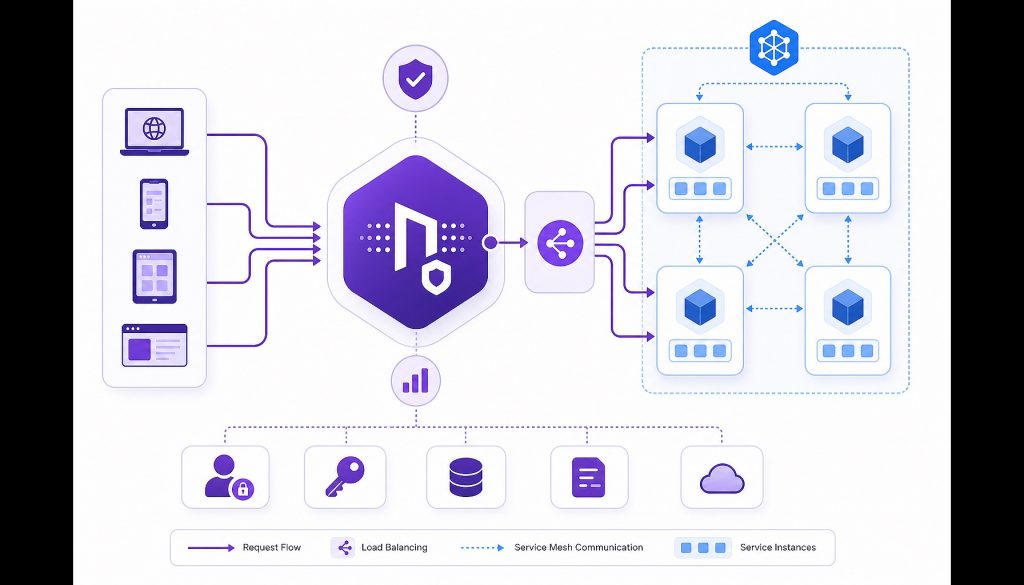
After splitting into microservices architecture, the biggest headache is inter-service communication and unified entry management. You might have 20 services scattered across different ports—where should external requests route to? How to handle authentication? Rate limiting? Write it for each service? Maintenance would drive you crazy.
API gateways solve this—extracting cross-cutting concerns like authentication, rate limiting, monitoring, and routing to handle uniformly at the entry layer. In 2026, mainstream solutions include Kong, Tyk, KrakenD, Traefik, and AWS API Gateway, each with different approaches. Kong has tons of plugins but eats memory, KrakenD delivers explosive performance but complex configuration, Traefik is container-friendly but weak on enterprise features.
This article doesn’t pile up feature lists—it talks practical scenarios: what each tool excels at, where the pitfalls are, and how to choose.
Kong: The Plugin-Rich Veteran
Kong is based on Nginx + OpenResty, open-sourced since 2015 with 300+ plugins in its library. Authentication (OAuth2, JWT, LDAP), rate limiting (sliding window, redis cluster), logging (Datadog, Splunk), transformation (request/response transformer)—pretty much everything has ready-made plugins.
Core Strengths: The plugin ecosystem is genuinely strong. Need Prometheus monitoring? Install the prometheus plugin, routes/latency/error codes auto-collected. Want canary releases? The canary plugin splits traffic by weight. Active community—GitHub issues usually have answers for problems you encounter.
Pricing: Open-source version free, Enterprise version (Kong Enterprise) starts at $3000/month with RBAC, developer portal, advanced analytics. Small-to-medium teams can get by with open-source, large companies need multi-tenant isolation and audit logs before considering Enterprise.
Best For: Scenarios with many APIs and diverse requirements. For example, you have 50 microservices—some need OAuth2, some need IP whitelisting, some need request body transformation—Kong’s plugin combinations cover most needs.
Pitfalls: High memory usage, single instance running 100 APIs consumes about 500MB. Configuration stored in PostgreSQL or Cassandra—if database goes down, gateway is affected too. High-availability deployment requires extra master-slave switching setup. Declarative config (DB-less mode) is lightweight but doesn’t support dynamic modifications—every config change requires restart.
Practical Advice: Suitable for companies with ops teams capable of managing database clusters. If your team has only 3 people, Kong’s maintenance overhead will consume most of your time.
Tyk: High-Performance Written in Go
Tyk is written in Go, with single-threaded performance 30% stronger than Kong—official benchmark shows 12000 req/s vs Kong’s 9000 req/s (test environment: 4 core / 8GB RAM). Supports GraphQL federation, WebSocket proxying, API versioning—suits modern API architectures.
Core Strengths: Dashboard is very intuitive—API creation, version switching, analytics charts all in one interface. Developer Portal comes with auto-generated docs and API key application workflow, saving you from building admin backends. Rate limiting algorithms support Redis Sentinel and Redis Cluster, more stable in high-concurrency scenarios.
Pricing: Open-source version free, Cloud version from $250/month (managed service, saves ops), Enterprise version from $1500/month (multi-datacenter, RBAC, custom plugins). Half the price of Kong, great value.
Best For: Medium-to-high concurrency scenarios, especially products exposing APIs to external users. For example, SaaS platforms needing to provide customer APIs—Tyk’s developer portal and API key management are ready to use without reinventing the wheel.
Pitfalls: Plugin ecosystem weaker than Kong’s. Custom plugins must be written in Go or use gRPC plugin protocol (Python/Node.js), debugging less convenient than Kong’s Lua plugins. GraphQL features exist but performance optimization for complex queries isn’t as mature as Apollo Gateway.
Practical Advice: First choice if your tech stack is Go. Performance is sufficient, maintenance simple, documentation complete. If you need extensive custom plugins, Kong might be more suitable.
KrakenD: Stateless Performance Beast
KrakenD bills itself as a “stateless API gateway”—all configuration in one JSON file, no database dependency. Startup just reads config and forwards requests, benchmark hits 50000 req/s (16 core machine), median latency 1.2ms.
Core Strengths: Performance is truly fierce. Strong API aggregation capability—for example, frontend needs user info + order list + recommended products, KrakenD makes one request calling three backend services concurrently, merging responses to reduce client request count. Supports response filtering—backend returns 100 fields, frontend only needs 10, trim at gateway layer to save bandwidth.
Pricing: Open-source version free, Enterprise version (KrakenD Enterprise) from $1000/month mainly for technical support and SLA guarantees. Compared to other tools, Enterprise version offers great value.
Best For: High-performance, low-latency scenarios like game backends, IoT device gateways, high-frequency trading systems. Stable backend services not needing frequent routing rule changes.
Pitfalls: Configuration is static JSON, changes require service restart. Although official Flexible Configuration (remote config) exists, it still requires restart to take effect—less dynamic than Kong/Tyk. No UI management interface, all configuration manual JSON writing, steep learning curve. Plugins written in Go require recompiling binaries.
Practical Advice: Suits scenarios where performance is critical and configuration change frequency is low. If you need to modify routing rules 10 times daily, KrakenD will drive you crazy. Recommend GitOps + CI/CD automated deployment—manual JSON editing is error-prone.
Traefik: Cloud-Native Automation Expert
Traefik is a product of the container era, deeply integrated with Kubernetes, Docker Swarm, and Consul. Add an annotation to a Service in K8s, Traefik auto-discovers routing rules without manual configuration. Supports Let’s Encrypt automatic HTTPS certificate application and renewal—genuinely worry-free.
Core Strengths: Dynamic service discovery is the killer feature. Deploy a new microservice, Traefik auto-detects and configures routing; service goes offline, auto-removes. Supports multiple protocols (HTTP, TCP, UDP, gRPC), WebSocket and HTTP/2 out-of-the-box. Dashboard displays routing topology in real-time, very intuitive for debugging.
Pricing: Open-source version free, Enterprise version (Traefik Enterprise) from $3000/month with distributed rate limiting, API management, advanced monitoring. Open-source version totally sufficient for small teams.
Best For: Kubernetes environments, especially scenarios with many microservices changing frequently. Companies with small DevOps teams needing automation.
Pitfalls: Weak enterprise features—open-source version lacks fine-grained permission control and audit logs. Rate limiting depends on middleware with configuration complexity higher than Kong plugins. Performance worse than KrakenD—official benchmark around 12000 req/s.
Practical Advice: Prioritize Traefik in K8s clusters, works most smoothly with Ingress Controller. If you’re still deploying on VMs, Traefik’s advantages won’t materialize—better to choose Kong/Tyk.
AWS API Gateway: Worry-Free Managed Service
AWS API Gateway is a fully managed service—no need to set up servers or handle high availability yourself. Create API, configure routes, set rate limits all in AWS console with mouse clicks, online in minutes. Deeply integrated with Lambda, DynamoDB, Cognito—most convenient for Serverless architectures.
Core Strengths: Zero operations—AWS handles scaling, failover, patch updates. Pay-per-request billing ($3.50 per million requests), very cheap for low-traffic scenarios. Supports API version management, stage environments (dev/test/prod), Canary releases.
Pricing: REST API $3.50/million requests + data transfer $0.09/GB, HTTP API $1.00/million requests (streamlined feature set). Cheaper than self-hosting below 10 million monthly requests, self-hosting more cost-effective beyond that.
Best For: Heavy AWS users with backend services all on Lambda/ECS. Startups with low traffic and no ops team—managed service saves time and effort.
Pitfalls: Vendor lock-in, high migration costs. Cold start latency 10-500ms, unsuitable for low-latency scenarios. Custom plugins basically impossible, limited to AWS-provided authorizers and validators. VPC access requires configuring VPC Link, each connection $0.01/hour, monthly cost $7.2.
Practical Advice: Suitable for small teams with pure AWS tech stack. If you have multi-cloud deployment needs or traffic large enough to require fine-tuning, self-hosted gateways are more flexible.
Selection Decision Framework
| Scenario | Recommended Tool | Reason |
|---|---|---|
| Diverse plugin needs | Kong | 300+ plugins cover most scenarios |
| External API exposure | Tyk | Built-in developer portal and API key management |
| Extreme performance requirements | KrakenD | 50000 req/s, 1.2ms latency |
| Kubernetes environment | Traefik | Auto service discovery, Let’s Encrypt auto-certs |
| AWS tech stack | AWS API Gateway | Seamless Lambda integration, zero ops |
| Team < 5 people | Tyk / Traefik | Low ops cost, friendly docs |
| Multi-tenant isolation needed | Kong Enterprise / Tyk Enterprise | RBAC + audit logs |
Performance Comparison (test environment: AWS c5.2xlarge, 8 vCPU / 16GB RAM):
- KrakenD: 50000 req/s, latency p50=1.2ms
- Tyk: 12000 req/s, latency p50=3.8ms
- Traefik: 11000 req/s, latency p50=4.1ms
- Kong: 9000 req/s, latency p50=5.2ms
- AWS API Gateway: managed service, performance guaranteed by AWS, measured p50=15ms (including cold start)
Memory Usage:
- KrakenD: 100MB (100 routes)
- Traefik: 150MB (100 routes)
- Tyk: 300MB (100 routes)
- Kong: 500MB (100 routes)
Conclusion
There’s no perfect API gateway, only suitable choices.
Kong suits complex requirements with heavy plugin dependencies, but accept high memory usage and database dependency. Tyk is the balance of performance and usability, first choice for small-to-medium teams. KrakenD is a performance beast but static configuration with poor dynamism. Traefik thrives in K8s, don’t consider it for traditional deployments. AWS API Gateway is worry-free but locked-in, suitable for AWS all-in users.
Recommend running open-source versions for a few weeks first, see if your team finds them comfortable, then decide whether to buy Enterprise. API gateways are infrastructure—wrong choice has high migration costs. Better to spend an extra week on POC than rush the decision.
By 2026, microservices architecture has matured with far richer tool choices than three years ago. But remember: tools are just tools, architecture design and team capability are fundamental. No matter how awesome your gateway config is, if backend services are poorly written, you still can’t handle traffic.
Related Reading
- API Gateway Showdown 2026: Kong vs Tyk vs KrakenD vs Traefik vs AWS
- API Gateway Comparison 2026: Kong vs Tyk vs KrakenD vs Traefik vs AWS
Stay updated with our latest AI insights