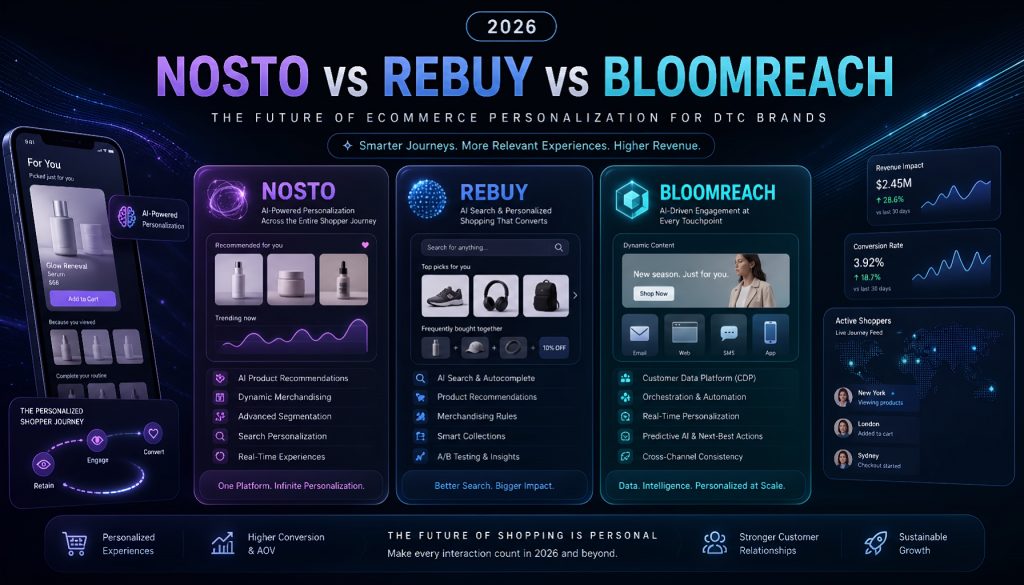
Last month, a friend running a pet food subscription brand vented to me: his Shopify store was clearing $500K/month in revenue, but repeat purchase rate stayed stuck at 22%. He tried manually configuring cross-sell recommendations in the cart, segmenting email lists by category, even hiring a part-timer to shuffle homepage placements daily. Three months later, conversion rate hadn’t budged.
Then he installed Rebuy’s Smart Cart. First month, average order value jumped 14%. Not because he suddenly got smarter. The machine is simply better at slipping in the right recommendation during those 3 seconds before checkout.
That experience crystallized something for me: in 2026 DTC ecommerce, personalization is no longer a nice-to-have. Customer acquisition costs have risen 222% over the past eight years. The average new customer costs $29 to acquire at a loss. Pushing conversion rate on existing traffic up by even 5 percentage points is pure profit.
The problem? Too many personalization tools exist, ranging from a few dozen dollars to hundreds of thousands per year. Features overlap, pricing models vary wildly. I spent weeks pulling apart the five platforms DTC brands consider most often.
Rebuy: The Conversion Machine for Shopify
Say you’re a beauty DTC brand doing 2,000 orders per month on Shopify Plus. Your pain points are specific: high cart abandonment, low average order value, customers disappearing after checkout.
Rebuy was built for exactly this. Its Smart Cart is a slide-out sidebar that completely replaces Shopify’s default cart, packed with AI-driven upsell logic: a “spend $20 more for free shipping” progress bar, threshold-triggered free gifts, dynamic bundle suggestions. Merchants using Rebuy report that Smart Cart alone drives five-figure monthly revenue increases.
Pricing is straightforward: Starter plan at $99/month (up to 1,000 orders), Scale at $249/month (2,500 orders), Pro at $499/month (5,000 orders). If you don’t need the full suite, you can buy individual modules: Cart & Upsell, Checkout & Post-Purchase, Search & Collections, Rules & A/B Testing. Each module priced separately. The bundled Platform One starts around $534/month.
Rebuy’s limitations are equally clear: Shopify only. If you’re on WooCommerce, BigCommerce, or anything else, you can’t even install it. Price scales steeply with order volume: from 2,500 to 7,500 orders, monthly cost jumps from $249 to $749. Some advanced features (Checkout Extensions) require Shopify Plus.
But if you’re a Shopify DTC brand, Rebuy delivers the most predictable ROI right now. Magic Spoon, DIME Beauty, and Olipop all use it. The platform has generated over $3.8 billion in attributed revenue for merchants.
Nosto: The Official Personalization Partner for Shopify Plus
Different scenario: you’re a fashion brand with 10,000+ SKUs, and customers browse your site frequently but don’t buy. You need more than cart-level upsells. You need full-site personalization from homepage to search to category pages.
Nosto earned G2’s Ecommerce Personalization Leader badge in Spring 2026 and holds the official “preferred personalization partner” status with Shopify Plus. Its coverage is broader than Rebuy’s: product recommendations, site search, merchandising, user-generated content (UGC), popups, A/B testing, plus an AI Agent called Huginn that monitors revenue data around the clock and surfaces optimization opportunities automatically.
Nosto also shipped a full Shopify Markets integration in 2026, enabling multi-market personalization. Same store, different recommendations and content for customers in different regions.
Pricing is where Nosto gets tricky. There’s an Incubator plan at $99/month, but that’s just a starting point. Full plans use a revenue-share model: 2.5% to 4% of Nosto-attributed sales. Fine for small stores. Once monthly revenue crosses a certain threshold, that percentage starts to bite. Multiple G2 and Capterra reviews flag this. Beyond Incubator, pricing isn’t public; you talk to sales. Reports suggest the actual starting point for small stores is around $500/month.
The learning curve is steep. Getting full value from all features requires significant time investment and support from a customer success manager. But if you’re a fashion, beauty, or lifestyle brand on Shopify Plus and you’ve outgrown basic recommendation plugins, Nosto is the natural next step up.
Klevu (now Athos Commerce): Search-Driven Personalization
Have you noticed how terrible site search is on most ecommerce stores? A customer searches “loose linen shirt for beach wedding” and gets a wall of irrelevant results. If your catalog has thousands of SKUs, poor search experience means throwing money away.
Klevu merged with Searchspring in early 2025 to form Athos Commerce. The combined platform integrates AI search, automated merchandising, personalized recommendations, and multi-channel product syndication. Its core strength is natural language processing: supporting 30+ languages, understanding the intent behind a search query rather than just matching keywords.
Klevu’s personalization engine remembers each customer’s browsing behavior across sessions. Return visitors get search results and category pages adjusted based on their previous browsing and purchase history. For high-ticket items where customers typically visit multiple times before buying, this cross-session continuity is particularly valuable.
On pricing, the Shopify App Store lists: recommendations at $449/month (includes 500K impressions), merchandising at $549/month. Post-merger, the full platform has moved to custom quotes. The previously public $449-849/month range is now just a reference point. Pricing fluctuates based on number of domains, session volume, and SKU count.
Klevu/Athos fits mid-to-large retailers with 500+ SKUs and meaningful traffic. If you only have 200 products and modest monthly visits, the ROI math gets hard. But if customers frequently complain about not finding things, or your site search conversion rate sits below 2%, Klevu is likely the most direct-return investment.
Dynamic Yield: Enterprise Personalization Backed by Mastercard
Different scale entirely: you’re a brand doing $100M+ in annual revenue, operating across 20+ markets, needing highly unified yet sufficiently differentiated personalization across regions and devices.
Mastercard acquired Dynamic Yield in 2022. The product, now called Experience OS, earned its eighth Gartner Magic Quadrant Leader rating for personalization engines in 2026. Not just Leader placement, but the highest position for both “Ability to Execute” and “Completeness of Vision.” In Gartner’s accompanying Critical Capabilities report, it’s the only vendor scoring highest across all three use cases: Marketing, Digital Commerce, and Service & Support.
What can Experience OS do? Full-site personalization, product recommendations, A/B and multivariate testing, server-side personalization, email and push personalization, plus predictive spending insights powered by Mastercard transaction data. That last piece is its unique moat. No competitor has access to global payment network-level consumer behavior data.
Scale: 400+ clients, approximately $85M in annual revenue. Electrolux deploys personalization across 63 domains and 21 markets. Luisaviaroma manages 5 separate brands. Official data shows product recommendations contributing roughly 25% of client revenue, DTC channel contribution reaching 16%, and Element features lifting conversion rates up to 88%.
No public pricing exists, but extrapolation from available information puts average contract value above $200K/year. Reference reports cite a floor around $35K/year, but that’s minimum configuration. For brands doing $100M+ with personalization budgets between $500K and $2M, this is the expected range.
Dynamic Yield is not for DTC brands doing $500K/month. It’s for mature brands that have already found product-market fit and are scaling globally.
Bloomreach: When You Need More Than Personalization
Final scenario: you’re a large retailer with tens or hundreds of thousands of SKUs. You need AI search, marketing automation, content management, and a conversational shopping assistant. And you don’t want these capabilities scattered across five or six different tools.
Bloomreach’s ambition exceeds every other platform here. Its product line has three pillars: Discovery (AI search and recommendations), Engagement (CDP + marketing automation), and Content (headless CMS). In 2026 it launched Loomi AI Agent for automated marketing campaigns, plus Clarity, a conversational shopping assistant where customers can chat with your store in natural language to find products.
The cost of this full-stack coverage is price and complexity. Bloomreach publishes no pricing figures at all. Every product page has a “Request Pricing” button. Based on available information: single module (search only) runs approximately $35-100K/year, single module (marketing only) approximately $50-150K/year, multi-module combinations $100-300K/year, full platform $150-400K/year. Implementation services are additional, typically $25-75K. Contracts are annual, mandatory.
For a rough monthly comparison at 50K contacts on the marketing module alone, expect $2,500-4,000/month. Add search and you’re past $5,000+. For context: Klaviyo at the same contact volume runs about $1,250/month. The gap is 2-3x.
Bloomreach’s reporting has drawn complaints from multiple users as “overwhelming.” Not too little information, too much, presented in unintuitive ways. Documentation for advanced configuration is thin, and dependency on the support team is high. But if you need one platform to manage search, recommendations, email, SMS, CDP, and content, with the budget and engineering team to absorb the complexity, Bloomreach is the most capable option available.
All Five Side by Side
| Dimension | Rebuy | Nosto | Klevu/Athos | Dynamic Yield | Bloomreach |
|---|---|---|---|---|---|
| Starting price | $99/mo | $99/mo (Incubator) | ~$449/mo | ~$35K/yr | ~$35K/yr (single module) |
| Pricing model | Order-volume tiers | Revenue share 2.5-4% | Session/SKU/domain based | Contract quote | Module fees + usage |
| Core capability | Cart upsell, bundles, checkout optimization | Full-site recs, search, UGC, popups | AI search, merchandising, cross-session personalization | Omnichannel personalization, A/B testing, Mastercard spending insights | AI search + CDP + marketing automation + CMS |
| Platform support | Shopify only | Shopify, BigCommerce, Magento, SFCC | Shopify, Magento, BigCommerce, SFCC, custom | Platform-agnostic | Platform-agnostic |
| Best fit | $50K-$2M/mo DTC | $200K-$5M/mo Shopify Plus | 500+ SKU mid/large retail | $100M+ annual global brands | $50M+ annual mid/large enterprise |
| A/B testing | Yes (module purchase) | Yes (full-site) | Limited | Deep multivariate | Yes |
| Implementation | 2-4 weeks | 4-8 weeks | 4-6 weeks | 8-16 weeks | 12-24 weeks |
The Selection Logic Is Straightforward
Back to the original question: how do you choose?
If you’re a Shopify DTC brand doing $100K-$1M per month and your core need is lifting AOV and cart conversion, Rebuy is the shortest path. It doesn’t do search. It doesn’t do email personalization. But at “getting people who are already in the cart to buy more,” it’s the sharpest tool available right now.
If your problems extend beyond the cart (homepage needs to be different for every visitor, search results need intelligent ranking, content should shift based on user profiles), Nosto covers more ground. You just have to accept that its pricing model charges more as you perform better.
If your store has a massive catalog and search is the critical path for traffic conversion, Klevu/Athos goes deeper in that one vertical than either of the above. It won’t optimize your cart, but it will help more people find what they’re looking for.
Dynamic Yield and Bloomreach represent different dimensions of choice. Dynamic Yield fits brands already operating globally that need unified cross-channel personalization strategy. Mastercard’s data asset is an irreplaceable differentiator. Bloomreach fits mid-to-large enterprises wanting one platform for search + marketing + content management, at the cost of implementation complexity and steep annual fees.
One decision framework might be more useful than feature comparisons: what’s your current personalization maturity level? If you haven’t even implemented basic product recommendations yet, jumping straight to Dynamic Yield is using a rocket launcher on mosquitoes. Start with Rebuy or Nosto, run the basics, wait until monthly revenue is stable past $1M, then evaluate heavier platforms. That path remains the most practical in 2026’s DTC landscape.
That said, tools only solve execution-level problems. The ceiling on your personalization strategy isn’t determined by which platform you use. It’s determined by how deeply you understand your customers: when they need guidance, and when they need space. No AI Agent can figure that out for you yet.
Related Reading
- Nosto vs Rebuy vs Bloomreach: E-commerce Personalization for DTC Brands in 2026
- Ecommerce Personalization Tools Compared: Rebuy vs Nosto vs Klevu vs Dynamic Yield vs Bloomreach (2026)
Stay updated with our latest AI insights