The Short Version
If you’re running a lean SaaS support team and want something live by Friday, Intercom Fin is probably your best bet. If you’re an enterprise operation handling tens of thousands of tickets across chat and phone, Ada remains the most mature independent option. Forethought just got acquired by Zendesk—still functional, but its long-term neutrality is anyone’s guess. And Decagon? It’s the ambitious newcomer with bleeding-edge features and a price tag to match.
That’s the quick answer. But the real question isn’t just “which tool has more features.” It’s about where the AI customer support market is headed, and which bet makes sense for your team right now.
Why This Comparison Matters Right Now
In March 2026, Zendesk announced its acquisition of Forethought—the largest deal the company has made in nearly two decades. For anyone paying attention to the AI support automation space, this was more than just M&A news. It signaled something bigger: the independent AI agent layer is getting absorbed by the platforms.
Think about what’s happened over the past year. Intercom shipped Fin. Salesforce doubled down on Einstein. Zendesk built its own AI agents and then bought Forethought on top of that. Freshdesk rolled out Freddy AI. The “AI handles your tickets” category isn’t novel anymore—it’s table stakes. The question has shifted from “should we use AI for support?” to “whose AI should we trust?”
If you’re currently on Forethought, this is a natural moment to reassess. If you haven’t picked a tool yet, the landscape has never been more confusing. Four platforms, four different philosophies, wildly different price points. Let’s break it down.
Forethought: The Acquired Veteran
Forethought was one of the earlier players in AI-powered ticket automation. Its core capabilities—automatic ticket classification, Tier-1 auto-responses, and agent assist suggestions—are well-proven across hundreds of enterprise deployments.
Pricing: Not public. You’ll need to talk to sales. Industry estimates put the median contract around $59,500/year. There’s no self-service signup, no free trial, and you’ll need at least 20,000 historical tickets before their model can start training on your data.
Integrations: Over 70 tools supported, including Zendesk, Salesforce, Intercom, Freshdesk, HubSpot, and ServiceNow. Broad coverage here—it was built to be platform-agnostic.
Implementation: 30 to 90 days. Expect a dedicated onboarding team and a meaningful time investment from your side.
The elephant in the room: Zendesk says Forethought will keep supporting non-Zendesk customers. That’s the official line. But let’s be realistic—when a company gets acquired by a platform vendor, investment priority inevitably shifts toward that platform’s ecosystem. Will Forethought still be investing heavily in its Freshdesk and Intercom integrations two years from now? Nobody can promise that.
Best for: Enterprise teams already on Zendesk with high ticket volumes (10,000+/month), comfortable with longer implementation timelines, and fine with the acquisition uncertainty.
Ada: Enterprise-Grade and Platform-Independent
Ada’s been around since 2016, making it the most seasoned independent player in this comparison. With 350+ enterprise customers and a $1.2 billion valuation, it’s got the track record to back up its positioning.
Pricing: $30K to $300K+ per year, fully custom-quoted. No self-service option. This is enterprise sales, through and through.
Integrations: Zendesk, Salesforce, Freshworks, Gorgias, and 12+ other platforms. Notably, Ada supports voice channels—a capability most competitors still lack.
Implementation: 8 to 16 weeks, sales-led with a dedicated implementation team.
Where it shines: Multi-channel coverage is Ada’s differentiator. If your support team handles both chat and phone calls, Ada is one of very few tools that can deploy AI across both. Its compliance posture is also the strongest in this group—SOC 2 Type II, HIPAA, GDPR, and PCI certifications. For regulated industries like healthcare and fintech, that matters.
Where it doesn’t: It’s expensive. The implementation timeline is long. For a 5-person support team handling 2,000 tickets a month, Ada is overkill.
Best for: Large support operations (50,000+ tickets/month), teams needing voice + chat coverage, organizations in regulated industries that require enterprise-grade compliance.
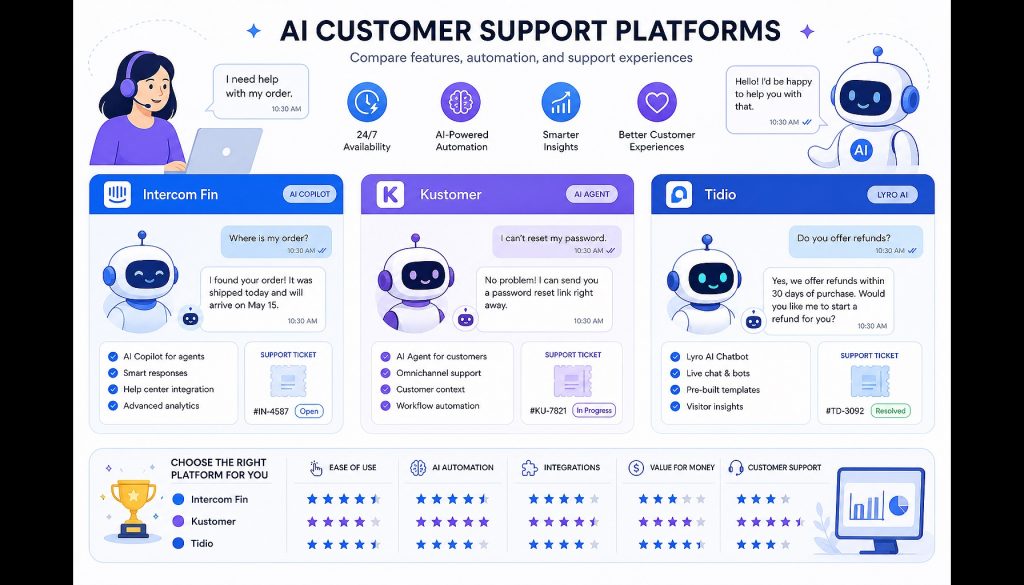
Intercom Fin: The Path of Least Resistance
Fin is Intercom’s native AI agent, built directly into the Intercom platform. If you’re already running Intercom as your help desk, turning on Fin is almost frictionless—it’s right there in your dashboard.
Pricing: $0.99 per resolution. No annual contract minimums, no upfront commitment. You pay for what gets resolved. For teams with moderate ticket volumes, this is by far the most accessible pricing model in the space.
Integrations: Native to Intercom. It can connect to external systems through APIs, but the core experience is designed entirely around Intercom’s ecosystem.
Implementation: Minutes to hours. Import your knowledge base, flip the switch, and Fin starts responding. There’s genuinely nothing faster in this category.
Where it shines: Speed to value. Transparent, predictable pricing. Seamless integration with Intercom’s conversational support model. It’s also strong on proactive engagement—triggering messages before customers even open a ticket.
Where it doesn’t: If you’re not on Intercom, Fin’s value drops significantly. The per-resolution pricing can get expensive at scale—at 10,000 resolutions per month, you’re looking at nearly $10K/month or $120K/year, which pushes into Ada territory. And there’s no voice support.
Best for: SaaS teams already on Intercom, handling 1,000 to 10,000 tickets per month, who want AI support live with minimal effort.
Decagon: The Well-Funded Newcomer
Decagon launched in 2023 and has already hit a $4.5 billion valuation with 100+ enterprise customers. The product iterates fast, and the engineering team punches above its weight. But the price tag reflects the hype.
Pricing: $95K to $590K+ per year, custom-quoted. This makes Decagon the most expensive option in this comparison by a wide margin.
Integrations: Zendesk, Salesforce, Intercom, and Kustomer. The integration list is short, but each connection goes deep rather than broad.
Implementation: Approximately 6 weeks, with a dedicated engineering team handling the setup.
Where it shines: Decagon’s product philosophy goes beyond “answer tickets automatically.” Its Knowledge Suggestions feature proactively identifies gaps in your knowledge base. Watchtower monitors AI response quality in real time. Built-in A/B testing lets you experiment with different resolution strategies. If you care about continuously improving your support knowledge system—not just deflecting tickets—Decagon’s approach is the most forward-thinking.
Where it doesn’t: The cost is prohibitive for most teams. The company is young, and long-term stability hasn’t been proven. Integration coverage is narrow—if you’re on Freshdesk or HubSpot, you’re out of luck.
Best for: Enterprise teams willing to pay a premium for cutting-edge AI capabilities, especially those with high standards for response quality and a desire to actively improve their knowledge operations.
Head-to-Head Comparison
| Dimension | Forethought | Ada | Intercom Fin | Decagon |
|---|---|---|---|---|
| Starting price (annual) | ~$59.5K | ~$30K | $0.99/resolution | ~$95K |
| Self-service signup | No | No | Yes | No |
| Implementation time | 30–90 days | 8–16 weeks | Minutes | ~6 weeks |
| Voice support | No | Yes | No | No |
| Help desk integrations | 70+ | 12+ | Intercom native | 4 |
| Security compliance | SOC 2 Type II | SOC 2 + HIPAA + PCI | SOC 2 Type II | SOC 2 Type II |
| Platform independence risk | High (Zendesk-owned) | Low | Low (but Intercom-locked) | Low |
| Best ticket volume range | 10,000+/mo | 50,000+/mo | 1,000–10,000/mo | 10,000+/mo |
A Decision Framework That Actually Helps
Rather than dumping a feature matrix on you and calling it a day, here’s how to think about this decision based on your actual situation:
You’re already on Intercom? Start with Fin. Zero friction, pay-per-resolution, and you can turn it off tomorrow if it doesn’t work. There’s no cheaper way to validate whether AI support automation works for your team.
You need AI handling both chat and phone calls? Ada is your only real option here. Voice support is still rare in this category, and Ada does it well.
You’re on Zendesk with heavy ticket volume? Keep an eye on Forethought’s post-acquisition trajectory. It still works fine today, but start building a contingency plan. Zendesk’s own native AI agents may eventually absorb most of what Forethought offers.
You want the most advanced AI capabilities and have budget to spare? Decagon. Its product vision is the most ambitious, and features like Knowledge Suggestions and Watchtower address problems most competitors haven’t even acknowledged yet.
Your budget is tight and you just need something that works? Look beyond these four. Tools like My AskAI (starting at $199/month plus $0.10 per conversation) or eesel AI (starting at $239/month) offer solid automation at a fraction of the cost. They’re not as powerful, but for teams under 5,000 tickets per month, the ROI math works out better.
The Bigger Picture: Platform vs. Independent
There’s a structural shift happening in AI customer support that’s worth understanding before you commit to any tool.
The market is splitting into two distinct layers. The platform layer—Zendesk, Intercom, Salesforce, Freshdesk—ships AI agents as built-in features, deeply integrated with their own ecosystems. These tools benefit from tight data access and native UX, but they lock you into a single vendor’s world. The independent layer—Ada, Decagon, and formerly Forethought—runs across multiple help desk platforms, offering flexibility at the cost of slightly less native integration depth.
Zendesk acquiring Forethought effectively pulled an independent player into the platform layer. That’s one fewer truly neutral option on the market. And it won’t be the last acquisition—expect Salesforce and Freshworks to make similar moves over the next 12 to 18 months as they race to consolidate the AI support stack.
Here’s what that means for your decision: if platform independence matters to you (because you might switch help desks in the future, or you operate a multi-platform environment across different business units), Ada and Decagon are the remaining credible independent choices. If you’ve already committed fully to one help desk platform and have no plans to leave, using its native AI agent is probably the path of least resistance—and honestly, the native tools have gotten good enough for most use cases.
Neither approach is inherently wrong. But you should make this choice intentionally, understanding the tradeoffs, not just drift into whatever’s easiest to turn on today.
Frequently Asked Questions
Can non-Zendesk customers still use Forethought after the acquisition?
Yes, for now. Zendesk has publicly committed to maintaining Forethought’s existing integrations and honoring current contracts. But acquisition promises have a shelf life—ask anyone who relied on a feature from a product that got acqui-hired and then sunset within 18 months. Monitor their release notes and integration updates closely over the next two to three quarters. If you notice Freshdesk or Intercom integrations falling behind on updates while Zendesk-native features ship faster, that’s your signal to start evaluating alternatives and planning a migration.
Per-resolution pricing vs. annual contracts—which saves more money?
It depends entirely on volume. Below roughly 5,000 resolutions per month, Intercom Fin’s $0.99/resolution model usually costs less than an annual contract with Ada or Forethought. Above that threshold, annual contracts typically offer better unit economics. Run the math with your actual numbers.
What resolution rates should I actually expect?
Industry averages land between 40% and 70%. Every vendor will show you case studies hitting 80%+, but those are best-case scenarios with clean knowledge bases and straightforward ticket types. Your results depend on knowledge base quality, ticket complexity, and how many of your inquiries are truly repetitive Tier-1 issues.
Will these tools replace human agents entirely?
No, and anyone telling you otherwise is selling something. AI agents are excellent at repetitive, well-documented queries—password resets, order status checks, feature explanations, shipping updates, basic troubleshooting steps. They handle the volume that burns out your team. But complex issues, emotionally charged customers, edge cases that require business judgment, and situations where a real human connection matters—those still need people. The goal isn’t headcount reduction for its own sake. It’s letting your human agents spend their energy on conversations that genuinely require empathy, creativity, and expertise instead of copy-pasting the same password reset instructions for the fortieth time today.
Do I need engineering resources for implementation?
Intercom Fin: barely any. Ada and Decagon: expect 6-16 weeks of implementation involving technical staff. Forethought: needs substantial historical ticket data and a longer training period. Budget your team’s time accordingly—the sticker price isn’t the only cost.
Looking at AI support tooling from other angles? Our Intercom vs Zendesk 2026 comparison covers the help desk platform decision, and our AI customer support QA tools breakdown tackles quality assurance.
Stay updated with our latest AI insights