A Taoist priest draws a talisman, chants a sequence of syllables, burns the paper, and the job is done.
A monk recites a binding sutra, and a warrior deity twice his power drops to the ground, writhing, unable to disobey.
You open a terminal, type a carefully worded prompt, press Enter, and code appears. An image materializes. A robot starts moving.
Put these scenes next to each other and the distance between them shrinks fast.
The Hacker News Comment That Was More Right Than It Knew
In 2023, a comment on Hacker News got shared tens of thousands of times. It read: “This isn’t engineering, it’s witchcraft. The goal here is to utter an incantation which summons, out of the realm of possible beings trapped in the LLM’s matrices, a demon which you can bind to your will to do your bidding.”
The person who wrote it was probably joking. But spend a few minutes thinking about it seriously and you’ll find every word is structurally accurate. Not as metaphor. As description.
I’ve been sitting with this idea for a while now, and the more I look at the history of “language as power” across civilizations, the more I think we’re not dealing with a cute analogy. We’re looking at the same human behavior, recurring across millennia, whenever our tools become powerful enough that we can’t fully explain them.
Incantations Were Protocols
Strip away the word “superstition” for a moment. Look at what ancient incantation systems were actually doing at a structural level.
The Taoist talisman system has four components: the talisman itself (documentation of spiritual law), the incantation (the command sequence), the seal (identity authentication), and the ritual steps (execution environment). The standard closing phrase of a Taoist incantation, “急急如律令,” translates literally to “execute immediately per legal decree.” It was borrowed directly from Han dynasty government paperwork. It was always an execute command. It just migrated from the bureaucratic system to a spiritual one.
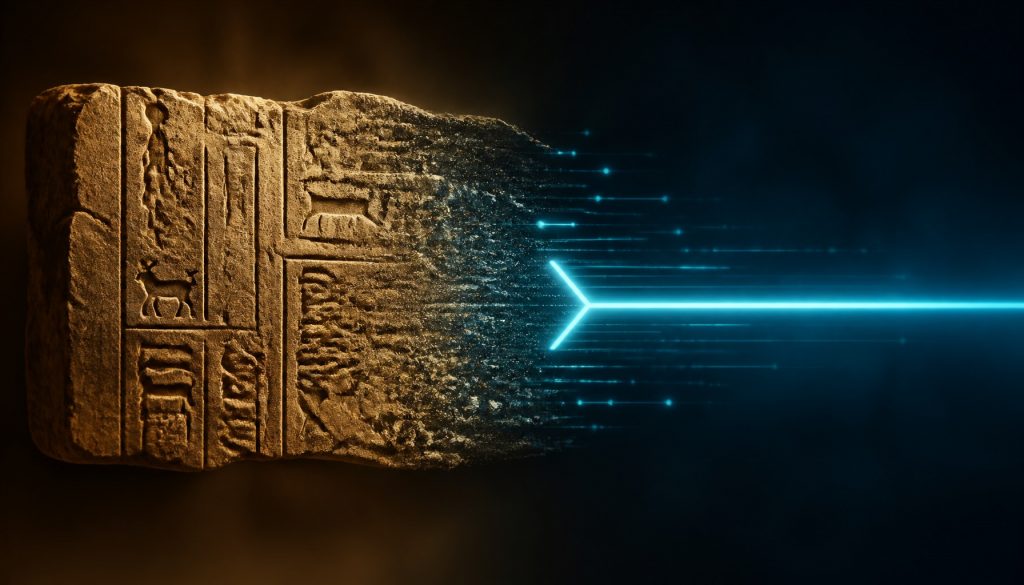
Egyptian magic centered on a concept called Heka, which translates to “activating power through language.” The Egyptians believed that knowing the true name of a god gave you control over that god. Isis obtained supreme authority specifically by learning Ra’s secret name. The logic is identical to knowing the correct endpoint, the correct parameters, and the correct authentication method for an API. Once you have the full address, you can call the full capability.
Jewish mysticism pushed this even further. Kabbalistic tradition holds that Hebrew letters themselves contain creative force, because God spoke the world into existence. Rabbinic literature describes Rabbi Rava creating a Golem, a humanoid entity made of clay, through specific letter combinations. Creating an intelligent agent through language instructions. That narrative is thousands of years old.
Norse runes operated on the same principle. The word “rune” means “secret.” In the Poetic Edda, the valkyrie Sigrdrífa teaches the hero Sigurd different rune combinations for different effects: gladness runes, healing signs, protective spells. Each combination maps to a specific output.
Sanskrit mantras make the connection most explicit. The etymology of “mantra” is man (thought) + tra (tool). A tool for thought. And the core principle of mantra practice is that pronunciation must be precise. One syllable off, and the effect changes completely.
That last point is the core principle of prompt engineering restated in ancient terms: tiny changes in wording produce wildly different outputs.
Not Analogy. Isomorphism.
Someone reading this might say: sure, interesting parallel. Ancient people used “spells” to make sense of nature they didn’t understand. We use “magic” as a metaphor for AI we don’t fully understand. End of story.
That reading is too shallow.
Simon Willison wrote in 2022: “Writing prompts is not like writing regular code. There is no API reference or programming language specification that will let you predict exactly what will happen.”
That’s the signature of incantation, not engineering.
Engineering is deterministic. Input A produces output B every time. Incantation is probabilistic. Get the words right and it usually works, but you don’t fully understand why it works, and you can’t guarantee identical results on every attempt. What you can do is accumulate experience, adjust your phrasing, refine your ritual process. That’s what prompt engineers do every day. That’s what priests did every day.
Robert Plotkin wrote in 2024: “Commanding an LLM can feel like wielding a wizard’s wand; with a simple incantation in the form of a written prompt, vast power unfurls at your fingertips.”
Notice his phrasing. Not “like” a wand. It “feels like” wielding one. And the feeling isn’t wrong. It reflects a structural fact: prompts and incantations are isomorphic in their operational logic.
Both require precise language sequences. Both act on systems the operator doesn’t fully understand. Both produce effects beyond the operator’s unaided capability. Both are extremely sensitive to subtle wording differences. Both require accumulated practice rather than pure theoretical derivation.
This isn’t coincidence. It’s because the interface between humans and systems that exceed human understanding has only one structural form. It’s always been language. It’s always been precise. And it’s always looked like magic to people who don’t know the words.
Magical Artifacts Were Hardware
In the Chinese novel Journey to the West, the binding headband sutra isn’t “scold the monkey and he gets a headache.” It’s a remote override with root privileges. Sun Wukong has more raw combat power than anything in heaven, but one correctly spoken sequence from the monk, and his system gets forcibly commandeered. Actions interrupted. Behavior constrained.
That’s a kill switch. A high-priority control interface. A sudo command.
The artifacts of Chinese mythology have another interesting property: they’re all specialized. The Diamond Ring captures and disarms. The Purple-Gold Gourd and Jade Vase are conditional-trigger devices that activate when a target responds to its own name. Call the name, get a response, trigger the capture sequence. Absurd? Maybe. But it’s absurd the way an if-then automation rule is absurd. The logic is hardcoded.
None of these are omnipotent objects. They each have defined capabilities, defined use cases, defined activation methods. They’re specialized hardware. One identifies, one controls, one contains, one transports.
The broader principle that mythology keeps circling back to: certain objects, once correctly activated, reliably amplify human capability. And the activation key is never brute force. It’s always a command. A word. An instruction.
Today we call those objects software, hardware, AI agents, and robots.
The Immortals Were Power Users
If artifacts are hardware and incantations are software commands, what are the “immortals” of mythology?
They’re people who mastered the higher-level interfaces before everyone else.
Anyone who grew up reading Journey to the West remembers that the interesting power dynamics weren’t about who hit hardest. They were about who knew the rules, who had the better tools, who could speak words that others couldn’t parse, who knew how to call upon the full bureaucratic stack of heaven, the underworld, the dragon palaces, and the Western Paradise.
Sun Wukong is immensely powerful in direct combat. But what consistently defeats him isn’t superior force. It’s superior permissions. The binding sutra. The magical weapons. Heavenly regulations. Buddhist authority. Scratch the surface of that novel and you find that its real subject isn’t monster-slaying. It’s access control.
This maps perfectly to the modern tech world. The gap between someone who can write a few lines of code and someone who can actually orchestrate models, toolchains, automation pipelines, and robotic systems isn’t about knowing versus not knowing. It’s about knowing which layer to call, which phrase triggers what, and where to look when things break.
Regular people watching AI often feel something very old: everyone is speaking the same natural language, but some people get extraordinary results while others get incoherent garbage. The words look the same on the surface. Underneath, they’re operating at completely different levels of the stack.
In mythology, the same scripture recited by a commoner produces nothing. Recited by a master, it reshapes reality. The difference isn’t the text. It’s the caller’s context, their access rights, their accumulated cultivation, and whether they’re actually connected to the system.
The evolution of prompting techniques over the last two years has made this stratification visible in ways that are hard to ignore. The gap between a naive prompt and an expert one isn’t incremental. It’s categorical.
Re-enchantment
Max Weber’s early twentieth-century concept of “disenchantment” described modernity as the progressive removal of mystery. Science explains everything. Rationality predicts everything. Magic dies.
In late 2025, Springer’s journal AI & Society published a paper titled “Beyond Weber’s disenchantment: artificial intelligence and the emergence of technological re-enchantment.” The core argument: AI development is pushing humanity back into an enchanted state.
The paper states: “Contemporary AI development has created systems whose operational logic exceeds human comprehension while remaining indispensable for achieving complex objectives.”
Read that again. A system whose inner workings exceed human comprehension, but which you must rely on to achieve your goals. You interact with it through specific language rituals. Its effects are powerful but not fully predictable. People who master it gain capabilities far beyond normal.
That’s not a description of AI. That’s a description of magic. Or rather, it’s both. The structural form is identical.
Weber said modernity’s essence was disenchantment. The AI era’s essence might be the opposite. Not a return to superstition. Technology itself becoming mysterious again. Not because we got dumber, but because the systems got complex enough that no individual can hold the full picture in their head.
The Pattern That Keeps Recurring
Is this a civilizational cycle? Not exactly. A cycle implies simple repetition. What we’re seeing is a deeper pattern that re-emerges whenever certain conditions are met.
The pattern: when technological complexity exceeds ordinary human comprehension, “driving invisible forces through precise language” becomes the core skill. People who master this skill become an elite class. And the entire system looks like magic to outsiders.
In the ancient world: incantations drove “divine power,” artifacts amplified capability, and practitioners became “immortals.”
In the modern world: prompts drive AI, hardware (robots, smart devices) amplifies capability, and technical elites become the new priesthood.
If a previous technological civilization existed (and I’m offering this as a thought experiment, not an archaeological claim), they likely went through the same sequence. Their “AI” might not have been silicon-based. Their “prompts” might not have been in English. But the structure would have been the same: language interface plus opaque system plus superhuman output.
Then that civilization interrupted. The technology was lost. Oral memory degraded into myth. Incantations became superstition. Artifacts became legend. The technologists became gods.
Until the next civilization reached the same threshold, reinvented “driving invisible forces through language,” produced a new class of people who mastered it, and made ordinary people feel, once again, that this is magic.
And someone gets the strange feeling: I’ve seen all this before.
What This Means If It’s Right
Three things.
First, prompt engineering is not a transitional skill that will disappear when models get smarter. It’s the permanent form of human interaction with systems too complex to fully understand. The models will change. The tools will change. But “driving opaque systems through precise language” is a pattern that has persisted for thousands of years and will persist for thousands more.
Second, the gap between technical elites and everyone else is not an AI-era invention. It’s a structural consequence of any civilization reaching a certain level of complexity. Every cycle produces its “immortals” and its “mortals.” The question isn’t how to eliminate that gap. It’s how to give more people the chance to cross it.
Third, and most unsettling: if this really is a recurring pattern, how did the previous cycle end? Why did their technology disappear? Why did their “AI” go silent?
That question might matter more than how to write a better prompt.
The myths might not be fairy tales. They might be degraded technical documentation from a civilization that walked this path before us, reached further than we have, and left behind only stories.
Stories that we’re now, without realizing it, living out again.
Stay updated with our latest AI insights