I’ve spent the better part of a decade watching companies agonize over this decision. Zendesk or Intercom. The question comes up in every ops review, every board deck where “customer experience” gets its own slide. And in 2026, the answer is less obvious than ever, because both platforms have made aggressive bets on AI that fundamentally change what you’re buying.
Here’s what I think most comparison articles get wrong: they treat this as a feature checklist. It’s not. You’re choosing between two different philosophies about how customer support should work. Get that wrong and no amount of feature parity will save you.
Two Philosophies, One Budget
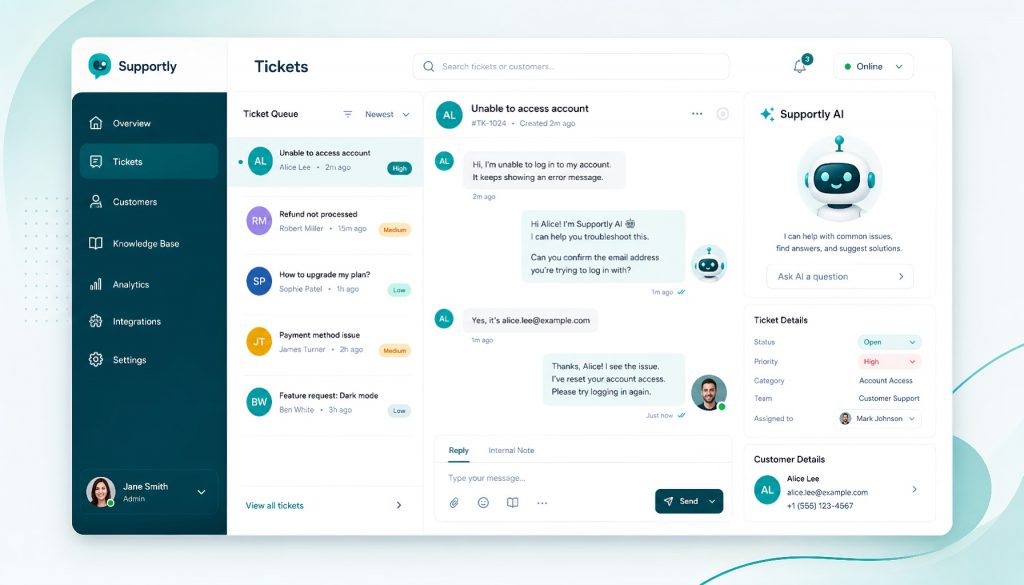
Zendesk thinks in tickets. Every customer interaction becomes a structured object with a status, a priority, an assignee, and a lifecycle. Tickets get routed, escalated, merged, and closed. The system is built for accountability and audit trails.
Intercom thinks in conversations. The unit of work is a thread, not a ticket. Conversations flow between bot and human, between channels, between teams. The system is built for speed and continuity.
Neither philosophy is wrong. But one of them maps better to how your team actually works today.
If your support org has tiers (L1, L2, L3), SLA contracts, compliance requirements, and agents who specialize in specific product areas, the ticket model will feel natural. If your support is more fluid, your team is smaller, and you want customers to feel like they’re chatting with someone rather than filing a case, the conversation model wins.
The Core Comparison
Before I get into opinions, here’s where things stand feature-by-feature:
| Dimension | Zendesk | Intercom |
|---|---|---|
| Core model | Ticket-based | Conversation-based |
| AI positioning | Augment human agents | AI-first autonomous resolution |
| AI bot | AI Agent (formerly Advanced Bot) | Fin AI Agent |
| Self-resolution rate | ~10-25% (official) | Claims up to 50%+ (case studies) |
| Multichannel | Email/chat/phone/social/SMS | Chat/email/social/SMS (weak phone) |
| Ticket mgmt depth | Very strong (multi-status, tiers, macros) | Medium (conversation-focused) |
| Knowledge base | Guide (mature, standalone) | Articles (embedded in messenger) |
| Analytics | Explore (strong, highly customizable) | Built-in reports (improving fast) |
| Best for team size | Mid to large (50+ agents) | SMB to mid (5-200 agents) |
| Starting price | $19/agent/mo (Support Team) | $29/seat/mo (Essential) |
Now let me unpack the rows that actually matter for your decision.
AI Strategy: Augmentation vs Autonomy
This is where the two platforms have diverged most sharply in 2025-2026, and it’s the single biggest factor you should weigh.
Zendesk’s AI Agent (what used to be called Advanced Bot) is designed to assist human agents. It drafts responses, suggests macros, summarizes long threads, and handles simple FAQ deflection. The self-resolution rates Zendesk publishes hover around 10-25%. Their bet is clear: AI makes your existing team faster, but humans stay in the loop for anything non-trivial.
Intercom’s Fin AI Agent is playing a different game entirely. Fin is positioned as a frontline resolver, not an assistant. Intercom’s published case studies show 50%+ autonomous resolution rates for some customers. Fin reads your help docs, handles multi-turn conversations, asks clarifying questions, and only escalates when it can’t help.
The implications for your budget are significant. If Fin actually resolves half your volume without human intervention, you need fewer seats. But you’re paying per resolution ($0.99 each on the base plan), which means your AI costs scale with volume in ways that are hard to predict during a pilot.
I’ve seen this play out both ways. Companies with clean, well-structured knowledge bases see Fin perform remarkably well. Companies with fragmented docs, complex edge cases, or highly technical products find that Fin escalates too often, and you’re paying per-resolution for conversations that still end up with a human anyway.
Zendesk’s approach is more conservative but more predictable. You know what you’re spending because it’s seat-based. The AI makes each seat more productive, but you’re not betting your staffing model on bot resolution rates.
My take: If your support volume is high, your questions are repetitive, and your docs are solid, Fin’s economics can be compelling. If your support is complex, relationship-driven, or requires deep product knowledge, Zendesk’s augmentation model carries less risk.
Channel Coverage: Omnichannel vs Chat-First
Zendesk has been building omnichannel support for over a decade. Email, live chat, phone (via Talk), SMS, WhatsApp, Facebook, Instagram, X/Twitter. The phone integration is native and mature, with IVR, call recording, and voicemail-to-ticket. For teams where phone is still a meaningful channel (enterprise B2B, healthcare, financial services), this matters.
Intercom started as a chat widget and has expanded outward. Email support works well now. Social channels are covered. But phone remains a weak spot. You can integrate third-party telephony, but it’s not the same as native phone support built into the agent workspace.
If your customers primarily reach you through chat and email, Intercom covers you fine. If phone is more than 15-20% of your inbound volume, Zendesk is the safer choice unless you’re willing to run a separate phone system alongside Intercom.
Daily Experience: What Your Agents Actually See
I think this gets overlooked in most comparisons because it’s hard to capture in a feature table. But the daily workflow difference is real.
A Zendesk agent’s day looks like a queue. Tickets come in, get assigned (manually or via round-robin/skills-based routing), and sit in views filtered by priority, status, and topic. Agents work through their queue, apply macros for common responses, escalate when needed, and track SLA timers. The system rewards thoroughness. Every ticket has a clear lifecycle from open to solved to closed.
An Intercom agent’s day looks like a messenger inbox. Conversations appear in real-time, and the boundary between bot-handled and human-handled is fluid. Fin might start a conversation, partially resolve it, then hand off to a human with full context. The agent picks up mid-thread. There’s less ceremony around status transitions and more emphasis on quick, conversational responses.
For agents coming from email-heavy support backgrounds, Zendesk feels familiar. For agents who grew up on Slack and messaging apps, Intercom feels more natural. Neither is objectively better, but team fit matters more than people admit.
Pricing: The Math Has Changed
Let me break down what you’re actually paying in 2026.
Zendesk tiers:
- Support Team: $19/agent/month (basics, no AI)
- Suite Team: $55/agent/month (omnichannel + AI assist)
- Suite Professional: $115/agent/month (full analytics, SLAs, custom routing)
- Suite Enterprise: custom pricing (sandbox, advanced data, custom roles)
AI features are increasingly bundled into higher tiers or sold as add-ons. The Advanced AI add-on runs $50/agent/month on top of your plan.
Intercom tiers:
- Essential: $29/seat/month (messenger, basic inbox, Fin available)
- Advanced: $85/seat/month (workflows, teams, advanced reporting)
- Expert: $132/seat/month (workload management, SSO, SLAs)
Plus Fin AI Agent pricing: $0.99 per resolution on Essential/Advanced, $0.99 on Expert (volume discounts available).
Here’s where it gets interesting. Suppose you have 20 agents handling 10,000 conversations per month. With Zendesk Suite Professional, you’re paying $115 x 20 = $2,300/month. Add Advanced AI at $50 x 20 = $1,000. Total: $3,300/month.
With Intercom Advanced, you’re paying $85 x 20 = $1,700/month. If Fin resolves 40% of those 10,000 conversations autonomously, that’s 4,000 x $0.99 = $3,960 in Fin costs. Total: $5,660/month. But if Fin resolution means you only need 12 agents instead of 20, the math flips: $85 x 12 = $1,020 + $3,960 = $4,980. Still more expensive in this scenario, but the gap narrows as resolution rates climb.
The per-resolution model introduces variance that seat-based pricing doesn’t have. Seasonal spikes, product launches, outages that flood your inbox: all of these spike your Fin bill. You need to model this carefully with your actual data before committing.
Migration Costs and Lock-In
Switching between these platforms is expensive and disruptive. I want to be upfront about that because it affects the decision calculus.
Moving to Zendesk: You’ll need to migrate your knowledge base, rebuild your automation rules, retrain agents on a new workflow, and accept that historical conversation data from Intercom won’t map cleanly to Zendesk’s ticket structure. Budget 2-4 months for a team of 20+ agents.
Moving to Intercom: Same pain in reverse. Zendesk macros don’t translate directly to Intercom workflows. Your carefully built Explore dashboards won’t come with you. And if you’ve built integrations against Zendesk’s API, those need rebuilding.
Both platforms have import tools, but they handle the basics (contacts, articles). The real cost is in workflow recreation and team retraining.
Lock-in risk to watch: Intercom’s Fin pricing model creates a specific kind of lock-in. Once you’ve trained Fin on your knowledge base and tuned its behavior, that investment doesn’t transfer. You’re not just locked into the platform; you’re locked into the AI layer. Zendesk’s AI features are more modular, but the same principle applies to their automation rules and routing configurations.
Decision Signals
After watching dozens of companies make this choice, here are the patterns I’ve seen work:
Choose Zendesk when:
- Your team has 50+ agents with specialized roles and tiers
- Phone support is a significant channel
- You need granular SLA tracking with contractual obligations
- Compliance and audit trails are non-negotiable (healthcare, finance, government)
- Your support model is structured: clear escalation paths, defined handoff points
- You want predictable, seat-based costs with no volume surprises
Choose Intercom when:
- Your team is under 50 agents and growing
- Most support happens through chat and email
- You have a clean, well-structured knowledge base ready for AI
- Speed of first response matters more than formal SLA tracking
- Your product is SaaS and your users expect messenger-style support
- You’re willing to bet on AI resolution rates improving over the next 12-18 months
Pause and reconsider if:
- You’re choosing Intercom purely for Fin’s AI but your docs are a mess (fix the docs first)
- You’re choosing Zendesk because it’s “enterprise-grade” but your team is 8 people (you’ll drown in configuration)
- Price is the only deciding factor (the cheapest plan on either platform won’t give you what you need)
The Bottom Line
In 2026, this decision has become a bet on AI strategy as much as a choice of support platform. Zendesk is betting that AI augments humans; Intercom is betting that AI replaces the front line. Both could be right for different types of businesses.
If I had to simplify it to one question: How much of your support volume is complex enough to require human judgment? If more than half your tickets require product expertise, relationship context, or multi-step troubleshooting, keep humans in the driver’s seat with Zendesk. If most of your volume is repetitive questions that a well-trained bot could handle, let Fin take first crack at it with Intercom.
Pick the philosophy that matches your support reality, not the one that sounds better in a demo. Then commit to it for at least 18 months, because neither platform delivers value in the first quarter of adoption.
Related Reading
- Intercom vs Zendesk in 2026: Which One Actually Fits Your Support Team?
- Intercom vs Zendesk in 2026: Which One Actually Fits Your Support Team?
Stay updated with our latest AI insights