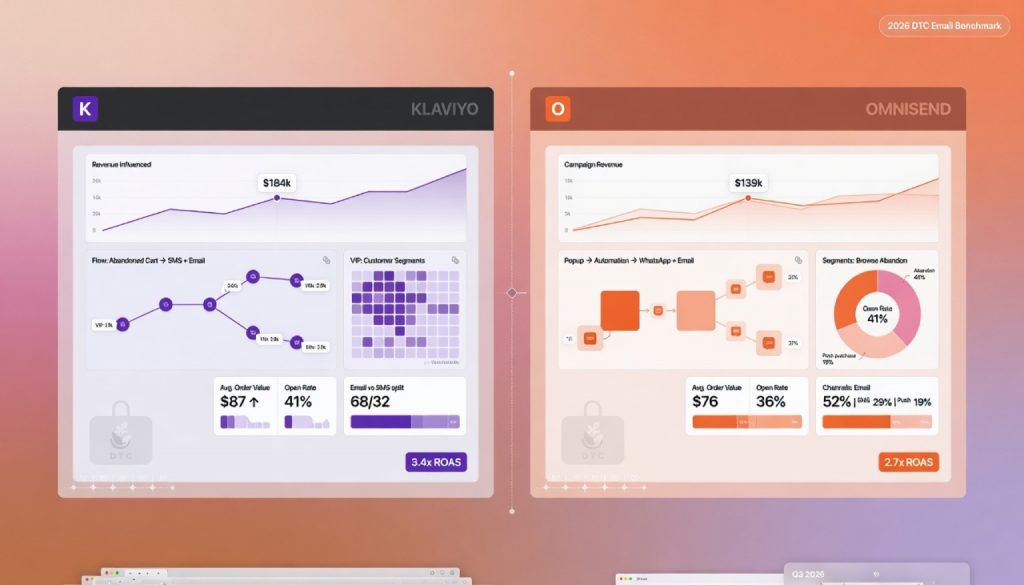
It’s 1am. Sarah is staring at her Klaviyo invoice on the screen. $427 this month. Her Shopify store just crossed 24,000 contacts, and three months ago this line item was $240. Growth is good, but her email marketing costs are climbing faster than revenue. She opens a new tab and types in Omnisend’s pricing page. Same contact volume, almost half the price.
This scene plays out every night somewhere in the DTC ecosystem. In Shopify seller communities, the Klaviyo versus Omnisend debate never stops. Some call Klaviyo the “Salesforce of email marketing,” a platform so powerful you will never outgrow it. Others argue Omnisend is the pragmatic choice, delivering 80% of the value at 50% of the cost.
The truth is not binary. The right answer depends on where your business stands today and where it will be six months from now. Klaviyo and Omnisend are not competing for the same customer at the same stage. They represent two different philosophies about what email marketing should be.
Two Platforms, Two Philosophies
Klaviyo was born from an ad tech background. Its founding team brought experience in user behavior tracking and predictive modeling, and they encoded those values into the product DNA. For Klaviyo, every email should be a calculated touch based on data, not a broadcast blast. This philosophy led to granular customer profiles, complex automation builders, and the predictive analytics features that made it legendary among DTC brands.
Omnisend took a different path. It focused exclusively on ecommerce from day one, refusing to chase SaaS or B2B use cases. That specialization shaped the product into something that feels native to Shopify sellers. Pre-built cart abandonment flows, product recommendation blocks, holiday promotion templates. You open it and start using it. For a seller transitioning from manual email blasts to automation, Omnisend has almost no learning curve.
Neither philosophy is superior in the abstract. But they determine the performance ceiling in different scenarios. Klaviyo rewards sophistication. Omnisend rewards speed.
Klaviyo’s Depth Game
People who use Klaviyo usually have one of two reactions. They are either awed by what it can do, or they are overwhelmed by how much there is to learn. Both reactions are valid.
Klaviyo’s integration with Shopify goes deeper than almost anything else in the ecosystem. It syncs SKU-level browsing and purchase data. It tracks every click, every add-to-cart, every moment of hesitation before a user leaves your site. All of this flows into customer profiles and becomes signals that automation flows can act on.
A typical scenario: A customer browsed your new product three times but did not buy. Her historical average order value is above $80. Her last purchase was exactly 45 days ago. Klaviyo lets you trigger a custom email to this hyper-specific segment, recommending the exact product she viewed with a time-limited discount. This level of granularity is hard to replicate in Omnisend.
In 2025, Klaviyo pushed its AI prediction capabilities to the forefront. Its models estimate each customer’s expected lifetime value, the likely window for their next purchase, and their churn probability. For DTC brands with tens of thousands of active customers, these predictions enable fundamental optimization in resource allocation. You can concentrate marketing spend on high-value customers and intervene early with those at risk of churning.
But capability is never free. Klaviyo’s automation flow builder is powerful, with unlimited branching, conditional logic, and A/B test nodes that can nest infinitely. That also means a new seller facing a blank canvas might not know where to start. Klaviyo’s backend has hundreds of settings. Email templates offer extreme customization freedom. Segment conditions can combine in nearly infinite ways. These are all capabilities, but without dedicated operations staff, many sellers only use a fraction of what they pay for.
Omnisend’s Efficiency Philosophy
Omnisend’s product managers clearly understand one thing: most Shopify sellers do not have a full-time email marketing operator. The founder is often also the customer service rep and the operations lead. They might have 30 minutes a day to spend on email marketing.
Based on this insight, Omnisend took “ready to use” to an extreme. Its automation workflows come pre-built for the most common ecommerce scenarios: welcome series, cart abandonment recovery, post-purchase follow-up, replenishment reminders, birthday campaigns. Each flow is already constructed, with optimized default copy and timing intervals. Sellers just need to add their brand elements and go live.
Another differentiator for Omnisend is native SMS and email integration. In the same automation flow, you can set “if the user does not open the email, send an SMS 24 hours later.” This cross-channel orchestration is a first-class feature in Omnisend, included in standard plans. Klaviyo also supports SMS, but its SMS functionality is essentially a separate paid module with independent pricing logic.
In template design, Omnisend provides extensive ready-to-use templates optimized for ecommerce scenarios. Product recommendation blocks, discount code components, countdown timers are all drag-and-drop elements. A seller with no design background can assemble a professional-looking promotional email in ten minutes.
On segmentation, Omnisend covers the most common ecommerce dimensions: purchase frequency, average order value ranges, product category preferences, engagement levels. For most small and mid-sized sellers, these dimensions are enough to support daily email marketing tactics. It cannot match Klaviyo’s free-form combination of arbitrary dimensions, but it covers 80% of use cases with maybe 20% of the learning cost.
Pricing Logic Behind the Numbers
Pricing models often become the deciding factor when sellers make their final choice. Klaviyo and Omnisend have radically different pricing philosophies, and the gap widens as your contact list grows.
Klaviyo prices based on active profile count, with tiered steps. At the starting level, roughly $45 per month covers around 1,500 contacts. As your list grows, the marginal cost per contact does not decrease linearly. By the time you reach tens of thousands of contacts, many sellers find Klaviyo’s monthly fee occupies a significant portion of their marketing budget. Klaviyo’s logic is straightforward: the revenue you generate using our data capabilities should far exceed the platform fee. That holds true for high AOV, high repeat purchase DTC brands. For sellers with thin margins and low average order values, the ROI calculation is less favorable.
Omnisend’s pricing strategy is more straightforward. It has a free tier supporting 250 contacts and 500 emails per month. This is free without conditions, not a trial. Paid plans charge by contact count, but the overall price curve is much flatter than Klaviyo. The Standard plan includes unlimited email sends and basic SMS credits. The Pro plan adds more SMS credits and advanced reporting. At equivalent contact volumes, Omnisend’s monthly fee is typically half to two-thirds of Klaviyo’s.
Pay attention to how SMS costs are calculated. Omnisend bundles a certain number of free SMS credits in the Pro plan, with overage charged per message. Klaviyo’s SMS is a completely independent billing system, with per-message costs varying by destination country. If your marketing strategy relies heavily on SMS, the total cost difference between the two platforms will be larger than looking at email pricing alone.
One more factor that surfaced in 2026: Klaviyo went public in 2023, and since then pricing pressure has intensified. Post-IPO companies face different growth expectations, and Klaviyo has been gradually adjusting its pricing structure. Some long-time users report price increases at renewal that were not clearly communicated. Omnisend, still privately held, has kept pricing more stable.
| Dimension | Klaviyo | Omnisend |
|---|---|---|
| Pricing Model | Tiered by active profiles | Tiered by contacts, bundled SMS credits |
| Free Tier | Limited free tier (250 contacts) | 250 contacts / 500 emails per month |
| SMS Integration | Separate billing module | Native bundled, free credits in Pro |
| Automation Depth | Unlimited branching, conditions, AI nodes | Pre-built flows, limited custom complexity |
| Data & Analytics | Predictive analytics, CLV models, attribution | Standard ecommerce reports, revenue attribution |
| Shopify Integration | SKU-level deep sync | Standard ecommerce data sync |
| AI Capabilities | Predictive models, smart send time, AI copywriting | Product recommendations, basic AI assist |
| Learning Curve | Steep, requires time investment | Gentle, ready to use out of the box |
This table makes Klaviyo look dominant across the board, but reality is far more nuanced than a feature matrix. There is a vast gap between feature existence and feature utilization. A seller who sends four promotional emails a month plus two automated flows will probably leave most of Klaviyo’s advanced features untouched in the backend. Paying for capabilities you do not use is waste by definition.
Integration Ecosystem: Width vs Depth
Klaviyo’s integration library covers hundreds of tools and platforms. Beyond Shopify, its core stronghold, it has deep integrations with WooCommerce, BigCommerce, and Magento. On the data source side, it can pull in ad spend data from Facebook Ads and Google Ads. It can sync review behaviors from tools like Yotpo and Judge.me. It can bidirectionally connect with loyalty platforms like LoyaltyLion and Smile.io to exchange points and membership tier data. This means Klaviyo’s customer profiles are not just based on email interaction data. They integrate ad exposure, review activity, loyalty status, forming a true 360-degree customer view.
For operationally mature brands with complex tool stacks, this broad integration capability is a core reason to choose Klaviyo. When data from multiple sources flows into one centralized platform, true cross-channel automation becomes possible.
Omnisend’s integration strategy is “ecommerce sufficient.” It covers mainstream ecommerce platforms and the most commonly used auxiliary tools. Shopify, WooCommerce, and BigCommerce are first-class citizens. Review, popup, and form tools have standard integrations. Social ad platforms have basic connections. But if your tool stack involves a CDP, data warehouse, or custom-built CRM, Omnisend’s integration capability will feel limited.
This returns to the core question: what is your operational complexity level? If the answer is “Shopify store plus a few common apps,” Omnisend’s integration ecosystem is completely sufficient. If the answer is “multi-channel retail plus custom data infrastructure plus complex marketing attribution models,” Klaviyo is almost the only choice.
The AI Capability Gap
In 2026, AI is no longer a nice-to-have feature in email marketing platforms. It is a core competitive differentiator. On this dimension, there is a noticeable generation gap between Klaviyo and Omnisend.
Klaviyo’s AI investment is strategic. Its predictive analytics engine calculates multiple forecast metrics for every customer profile: probability distribution of next purchase date, expected customer lifetime value, churn risk score. These predictions can be used directly as segment conditions and automation triggers. In practice, this means you can create a flow that says “when a customer’s churn risk score moves from low to medium, automatically send a retention email with bonus loyalty points.” This kind of prediction-based automation, rather than reaction to historical behavior, pushes marketing from reactive to anticipatory.
Klaviyo’s AI also shows up in send time optimization. It calculates the most likely open window for each recipient and delivers the email during that window. In A/B testing, Klaviyo supports multivariate auto-optimization. The system autonomously decides which version performs better and shifts traffic toward the winner. On the copywriting side, its AI writing assistant can generate subject line and body drafts based on your brand tone and historical high-performing emails.
Omnisend’s AI capabilities made significant progress between 2025 and 2026. It now offers basic product recommendation algorithms, smart send time suggestions, and AI-assisted subject line generation. But in the two high-value areas of predictive analytics and automated strategy optimization, Omnisend is still catching up. Its product recommendations lean more on rules (if they browsed A, recommend B) rather than machine learning models. Send time optimization is closer to “statistical best time slot” than “individual-level prediction.”
For mature teams already making data-driven decisions, Klaviyo’s AI is a real productivity lever. But if a seller has not even gotten basic automation flows running yet, the marginal value of AI prediction models is limited. Get the fundamentals right first, then pursue advanced capabilities. That is probably the more rational path.
iOS Mail Privacy and the 2026 Reality
One factor that reshaped email marketing in 2024 and 2025 was Apple’s Mail Privacy Protection. MPP preloads email content on Apple’s servers, which means open rates for users on iOS Mail are artificially inflated or completely unreliable. By 2026, this is no longer news, but it changed how platforms measure engagement.
Klaviyo adapted by deprioritizing open rate as a primary signal and pushing users toward click rate and conversion rate as more meaningful metrics. Its predictive models also adjusted, relying less on open behavior and more on on-site activity and purchase patterns. For sophisticated users, this transition was manageable.
Omnisend followed a similar path but with less granular messaging. Its reporting still surfaces open rates prominently, which can mislead new users who do not understand the iOS Mail context. The platform does track clicks and conversions accurately, but the dashboard design has not fully adapted to the post-MPP reality.
If your customer base skews heavily toward iOS users (common in North American DTC), you need a platform that helps you navigate this ambiguity. Klaviyo’s education and tooling around MPP is more mature. Omnisend works, but you need to interpret the numbers yourself.
SMS Regulation and North American Compliance
SMS marketing became more regulated in 2025 and 2026, especially in the United States and Canada. The FCC and CRTC tightened rules around consent, opt-in language, and message frequency. Platforms that make SMS easy can also make compliance mistakes easy.
Klaviyo built compliance guardrails into its SMS product. It enforces double opt-in by default for SMS subscribers. It auto-appends required language like opt-out instructions. It tracks consent timestamps and sources, which becomes critical if you ever face an audit. The downside is that Klaviyo’s SMS setup feels more rigid. You cannot just blast messages. You have to follow the structure.
Omnisend’s SMS integration is simpler to use, but that simplicity comes with risk. The platform does support compliant workflows, but it does not enforce them as strictly. If you are not familiar with TCPA and CAN-SPAM requirements, you can accidentally set up a non-compliant flow. Omnisend has documentation on compliance, but it puts more responsibility on the user.
For brands operating in North America, especially those sending high volumes of SMS, compliance is not optional. Fines for violations can be severe. Klaviyo’s more opinionated approach to SMS compliance is an advantage, even if it feels constraining at first.
Real Scenarios, Real Choices
Choosing tools should never start from a feature checklist. It should start from your actual business state today and where you will be in six months.
If you are a DTC brand with tens of thousands of contacts, a dedicated person running email marketing, and a business model that relies heavily on repeat purchase and lifetime value, Klaviyo is almost a no-brainer. Its data depth, predictive capabilities, and automation flexibility can unlock significant revenue growth in the hands of a skilled operator. The premium you pay for Klaviyo is essentially payment for data intelligence. As long as your team can convert that intelligence into higher LTV, the math works.
If you are a Shopify seller doing a few hundred thousand to a couple million dollars a year in revenue, with a small team, tight budget, and limited time to spend on email marketing technicalities, Omnisend is the more rational starting point. It lets you achieve “good enough” email marketing at lower cost and faster onboarding. When your scale and operational maturity hit a certain threshold, you can reevaluate and migrate if needed.
There is also a middle state: your business is growing fast, and your team is just starting to build a marketing system. In this phase, you can consider starting with Omnisend to quickly get baseline automation running, while evaluating whether Klaviyo’s capabilities are something you will need in the next six to twelve months. Migrating tools has a cost, but it is not as high as you might think. Both platforms support contact and historical data import and export.
One more scenario that came up in 2026: multi-brand operators. If you run several Shopify stores under different brands, Klaviyo’s account structure and pricing can get expensive fast. You typically need separate accounts per brand, and each one bills independently. Omnisend allows some level of multi-store management within one account at lower incremental cost. For operators managing a portfolio, this structural difference matters.
The Post-IPO Klaviyo Question
Klaviyo’s 2023 IPO changed something subtle but real. Public companies face different pressures. Revenue growth expectations, margin targets, shareholder returns. Some longtime Klaviyo users noticed a shift in how the company approaches pricing and customer success.
Before the IPO, Klaviyo’s sales and support teams were known for deep consultative engagement. Post-IPO, the experience has become more tiered. High-value accounts still get white-glove treatment. Smaller accounts get routed to self-service resources and community forums. Price increases at renewal have become more common, and the justification often feels generic rather than tied to new value delivered.
This does not make Klaviyo a bad platform. But it does mean you should evaluate it with the understanding that it is now a public company optimizing for different metrics than it was five years ago. Omnisend, still private and bootstrapped, operates with a different set of incentives. It competes on value and retention, not quarterly earnings targets.
A Question With No Universal Answer
Back to that 1am scene. Sarah did not make her decision that night. She spent two weeks listing out her actual use cases: two promotional emails per week, three automation flows (welcome, abandoned cart, replenishment), occasional SMS promotions. Then she asked herself a question: the Klaviyo features I am not using, will I actually use them in the next six months?
If the answer is yes, the extra cost is an investment in future capability. If the answer is probably not, then you are paying for imagined needs rather than real ones.
Tools serve the business, not the other way around. The most expensive email marketing platform is not the one with the highest monthly fee. It is the one you paid for but never fully used. Omnisend will get most Shopify sellers to where they need to be faster and cheaper. Klaviyo will take you further if you have the skill and scale to use what it offers.
The decision is not about which platform is objectively better. It is about which one matches your reality right now. Sarah eventually moved to Omnisend. She saved $200 a month and got her automation running faster than she had in six months on Klaviyo. A year later, when her store crossed $2 million in annual revenue and she hired a marketing manager, she migrated back to Klaviyo. Both decisions were right for their moment.
That is the real answer. The best platform is the one that fits the business you have today, not the business you hope to become someday. Start where you are. Upgrade when it makes sense. Do not pay for a future you are not ready to use yet.
When Migration Makes Sense
Platform migration sounds intimidating, but it happens more often than you might think. The key is knowing when the pain of staying exceeds the cost of switching.
Signs you have outgrown Omnisend: Your segmentation needs are bumping against the platform’s limits. You want to build complex multi-step flows with conditional branching that Omnisend cannot support. You need deeper integration with your data warehouse or CDP. Your team has grown and now includes someone who can actually operate a more sophisticated platform. You are leaving money on the table because you cannot target high-value customers with the precision you need.
Signs Klaviyo is overkill: You are paying for features you have never touched. Your team spends more time wrestling with the interface than actually sending campaigns. Your monthly invoice keeps climbing but your email revenue is flat. You realize you only use three automation flows and two segments, and those could run on any platform. The complexity is slowing you down rather than unlocking new capabilities.
Migration itself is not as painful as it used to be. Both platforms have import tools for contacts, historical data, and basic flow templates. You will lose some historical engagement metrics, but your customer data and purchase history transfer cleanly. The hardest part is usually rebuilding your automation flows in the new platform, which forces you to audit what is actually working and what is just running on autopilot without delivering value.
Many sellers do a phased migration. They move their contact list and basic flows first, then gradually rebuild more complex automations. This spreads the work over weeks instead of trying to replicate everything in one high-stress weekend. If you are moving from Omnisend to Klaviyo, expect to spend time learning the new interface. If you are moving from Klaviyo to Omnisend, expect to simplify your flows and accept some loss in granularity.
The Hidden Costs Beyond the Invoice
When comparing platforms, most sellers focus on the monthly subscription fee. That number is easy to see and easy to compare. But the total cost of ownership includes factors that do not show up on your credit card statement.
Time cost matters. Klaviyo’s learning curve is steep. If you are the founder and you are also doing customer service, product sourcing, and fulfillment, every hour spent learning Klaviyo’s segment builder is an hour not spent on something else. Omnisend’s faster onboarding might mean you get to revenue-generating campaigns two weeks sooner. That time delta has a dollar value.
Opportunity cost matters. If Klaviyo’s capabilities unlock a predictive churn model that saves 5% of at-risk customers, that is revenue you would have lost on a simpler platform. If Omnisend’s SMS integration helps you recover an extra $3,000 per month in abandoned carts, that offsets a lot of subscription cost difference. The platform that costs less per month but delivers less revenue is not actually cheaper.
Migration cost matters if you are likely to switch later. Moving platforms costs time, introduces risk of deliverability issues during transition, and requires retraining your team or agency. If you start on Omnisend knowing you will probably migrate to Klaviyo within a year, factor in that future switching cost. Sometimes paying more now to start on the right platform is cheaper than paying twice.
Support cost matters when things break. Klaviyo’s support has become more tiered post-IPO. If you are on a lower plan, you get routed to docs and community forums more often than direct support tickets. Omnisend’s support is generally responsive across plan tiers, but it has less depth on complex technical integrations. If you have an in-house technical team, this matters less. If you are a solo operator, support quality can make or break your experience.
The Agency and Freelancer Factor
If you work with an agency or freelance email marketer, their platform expertise can tip the decision. Klaviyo has deeper penetration in the professional marketing community. Most ecommerce-focused agencies have Klaviyo-certified specialists. Freelancers on Upwork or Contra who list email marketing skills are far more likely to have Klaviyo experience than Omnisend.
This creates a network effect. If you use Klaviyo, finding skilled help is easier. If you need to hire a contractor to build out a complex abandoned browse flow or set up predictive segments, there are dozens of qualified people you can bring in. Omnisend’s talent pool is shallower. You will find competent operators, but the market is smaller.
On the flip side, this also means Klaviyo specialists charge more. An agency that manages your Klaviyo account might charge $2,000 to $5,000 per month depending on scope. Omnisend management typically costs less because the platform is simpler to operate and the specialists have less leverage in pricing.
If you plan to keep email marketing in-house, this factor does not matter much. If you plan to outsource, factor in the availability and cost of skilled help for each platform.
What 2026 Data Shows
By mid-2026, third-party benchmarking data from ecommerce analytics platforms gives us some signal on real-world performance. These numbers are aggregated and should be taken as directional rather than absolute, but patterns emerge.
Average email revenue per recipient per month: Klaviyo users report a median of $1.84. Omnisend users report $1.52. That gap likely reflects both platform capabilities and the types of businesses using each tool. Klaviyo customers skew toward higher AOV brands with stronger repeat purchase mechanics. Omnisend customers include more early-stage stores still building their customer base.
Automation flow performance: Cart abandonment recovery rates are nearly identical across platforms, around 8-10% conversion from email sent to completed purchase. Welcome series performance shows a slight edge for Klaviyo, with 15% conversion versus 12% for Omnisend, possibly due to better personalization and send-time optimization. Replenishment and win-back flows show larger Klaviyo advantages, likely because its predictive models time these touches more effectively.
Deliverability rates: Both platforms maintain strong sender reputations. Klaviyo’s average inbox placement rate is around 89%. Omnisend is around 87%. This difference is small enough that factors like list hygiene and engagement matter more than platform choice.
SMS performance: Omnisend users send more SMS per contact on average, likely because the bundled credits lower the friction to use the channel. Klaviyo SMS users report higher per-message ROI, possibly because they use SMS more selectively for high-intent moments. Both platforms deliver SMS reliably, but Klaviyo’s compliance tooling reduces the risk of regulatory issues.
The Vertical Question
Some ecommerce verticals have specific needs that favor one platform over the other.
Fashion and apparel brands, especially those with seasonal collections and frequent new arrivals, benefit from Klaviyo’s ability to trigger flows based on browse behavior and product-level engagement. The ability to say “send an email featuring items from the Fall collection that the customer viewed but did not buy” requires the kind of granular data sync and segmentation that Klaviyo handles better.
Consumables and subscription brands, where replenishment timing and churn prediction are critical, also lean Klaviyo. The predictive models for next purchase date and lifetime value are directly applicable to subscription retention strategies.
One-time or infrequent purchase categories like furniture, high-end electronics, or jewelry see less differentiation. If a customer buys once every few years, the value of sophisticated lifecycle automation diminishes. Omnisend’s simpler approach can handle these use cases without the overhead.
Digital products and courses are not Omnisend’s strength. The platform is built for physical ecommerce and does not integrate as cleanly with digital delivery platforms. Klaviyo’s broader integration ecosystem gives it an edge here.
The International Dimension
If you sell internationally, compliance and deliverability in different regions become factors.
Klaviyo has better infrastructure for GDPR compliance in Europe. Its data handling, consent management, and double opt-in workflows are built with European regulations in mind. Omnisend supports GDPR, but the tooling feels more like an add-on than a native capability.
For sellers targeting Asia-Pacific markets, neither platform is perfectly localized, but Klaviyo’s broader integration ecosystem includes more regional payment and logistics platforms. Omnisend’s simpler feature set can actually be an advantage in markets where email marketing norms are less developed and sellers need basic functionality that just works.
SMS internationally is complicated for both platforms. Regulations, carrier relationships, and costs vary wildly by country. Klaviyo’s per-message SMS pricing adapts to regional costs but can get expensive in markets with high carrier fees. Omnisend’s bundled SMS credits do not stretch as far outside North America and Western Europe.
Final Word
The Klaviyo versus Omnisend question is not a puzzle with one correct answer. It is a fit problem. The right platform depends on your revenue scale, team structure, product category, customer behavior, and how much sophistication you can actually operationalize.
If you are doing under $500,000 in annual revenue, have a small team, and need to get email automation running without a steep learning investment, start with Omnisend. You will pay less, move faster, and get to revenue-generating campaigns sooner. The platform will handle your needs for at least a year, often longer.
If you are doing over $2 million annually, have someone dedicated to email marketing, and your business model rewards deep customer insights and precise targeting, Klaviyo’s higher cost is justified. The data capabilities and predictive models will unlock revenue opportunities that simpler platforms cannot access.
The in-between zone, roughly $500,000 to $2 million in annual revenue, is where the decision gets harder. You are big enough that Klaviyo’s capabilities could drive real value, but small enough that the cost hurts. The right call depends on your growth trajectory and whether you have the skills in-house to leverage what Klaviyo offers. If you are scaling fast and plan to hire marketing talent, bias toward Klaviyo. If growth is steady and you want to keep the team lean, Omnisend is probably the better fit.
Remember that choosing a platform is not a permanent commitment. Your business will change. What makes sense today might not make sense two years from now. Pick the tool that solves the problems you have right now, not the problems you imagine you might have someday. Build revenue. Grow your team. When you outgrow the platform, migration is a solvable problem. Paying for unused capabilities while you are still finding product-market fit is the real waste.
Sarah’s story is not unusual. She started on Klaviyo because that is what everyone talked about. She switched to Omnisend when she realized she was paying for a toolkit she did not know how to use. A year later, with a bigger business and a marketing hire, she migrated back to Klaviyo and finally unlocked the value it promised. Both moves were right for their moment. That is the lesson. Match the tool to the business you have, not the business you want to have. Grow into complexity, do not start there.
Related Reading
- Klaviyo vs Omnisend in 2026: Which Email Platform Actually Fits Your Shopify Store
- Klaviyo vs Omnisend: Which Email Platform Actually Earns Its Price Tag?
Stay updated with our latest AI insights