TL;DR
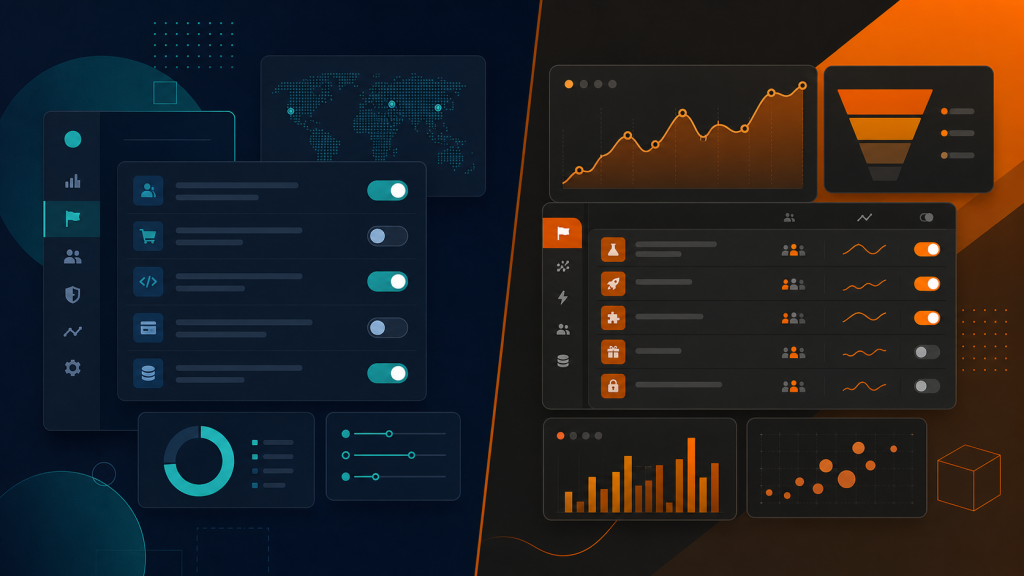
LaunchDarkly is the enterprise-grade feature flag specialist — powerful targeting rules, FedRAMP certification, and rock-solid reliability. PostHog is the all-in-one product platform that bundles feature flags with analytics, A/B testing, and session replay under a generous free tier. If you need complex release orchestration and compliance certifications, go LaunchDarkly. If you want feature flags tightly integrated with product analytics and don’t want to spend $20K+/year, go PostHog.
My pick for most teams in 2026: PostHog, unless you have specific enterprise compliance requirements or need edge computing SDK support that PostHog can’t cover.
What These Tools Actually Are
LaunchDarkly launched in 2014 and essentially created the feature flag category. It does one thing — controlled feature releases — and does it extremely well. The targeting engine handles complex user segmentation, multi-variate flags, flag dependencies, and scheduled rollouts. Its customer base skews heavily toward large enterprises, financial institutions, and healthcare companies that need FedRAMP, SOC 2, and HIPAA certifications.
PostHog took a different path. It started as an open-source product analytics tool in 2020, then steadily added feature flags, A/B testing, session replay, error tracking, and a data warehouse. The philosophy: if you’re already tracking user behavior, why not run experiments and control feature releases from the same platform? One dashboard instead of four separate tools.
Think of LaunchDarkly as a specialty shop that sells the best feature flags money can buy. PostHog is more like a well-stocked general store — each individual product might not be the absolute best in class, but having everything in one place creates real workflow advantages.
Feature Flags and Targeting
LaunchDarkly’s targeting engine is the industry benchmark. You can build rules based on user attributes (geography, device type, subscription tier, custom properties), chain multiple conditions with AND/OR logic, set up percentage rollouts with sticky bucketing, create flag dependencies (Flag B only activates when Flag A is on), and schedule automatic flag state changes. The rule builder also shows you a preview of how many users a change will affect before you commit — a nice safety net for production releases.
PostHog’s flag management is more straightforward. You get user segmentation, percentage rollouts, and multi-variate flags. The targeting rules work fine for most use cases but lack LaunchDarkly’s depth — no flag dependencies, no scheduled state changes, no multi-stage rollout orchestration with automatic rollback.
Where PostHog wins: the flag management UI shows real-time usage data for each flag. You can see which users triggered a flag, what their conversion rates look like, and jump straight into behavior analysis. With LaunchDarkly, you’d need to pipe that data into a separate analytics tool.
Progressive Rollouts and Canary Deployments
Both tools handle gradual rollouts. LaunchDarkly excels in complex scenarios: you can configure multi-stage rollouts (1% for 24 hours → 10% for 48 hours → 50% → full), wire up monitoring integrations that automatically kill a flag if error rates spike, and set approval gates between stages.
PostHog supports percentage-based rollouts and you can manually adjust them over time, but there’s no built-in multi-stage orchestration or automated rollback triggered by metrics. For straightforward canary deployments it works fine. For mission-critical releases at scale, LaunchDarkly gives you more guardrails.
A/B Testing and Experimentation
Here’s where PostHog pulls ahead. Because it’s fundamentally a product analytics platform, experimentation is deeply integrated. You define experiment groups using feature flags, then measure results directly in PostHog — conversion funnels, retention curves, statistical significance. The stats engine supports both Bayesian analysis and sequential testing, and it auto-calculates required sample sizes so you’re not guessing when to call an experiment.
LaunchDarkly added experimentation, but it feels bolted on. The analysis capabilities are shallower, and — the real kicker — experimentation is billed separately based on MAU. If you’re already paying for flag management and then add experimentation MAU costs on top, the bill climbs fast. LaunchDarkly’s advantage here is its integrations with CDPs like mParticle and Segment, letting you sync experiment data to your warehouse.
Monitoring and Observability
LaunchDarkly focuses on operational monitoring: flag request volumes, error rates, evaluation latency, and alerting rules. You can set up automated actions — if a flag’s error rate exceeds a threshold, automatically disable it and notify the team via Slack or PagerDuty. This is exactly what DevOps teams want.
PostHog’s monitoring is user-behavior-oriented. After a flag goes live, you can see user journeys, click patterns, and watch session recordings of users who received a specific flag variant. Product managers love this. But if you’re an SRE looking for a quick “is this flag causing a 500 spike?” dashboard, PostHog makes you work harder for that answer.
SDK Coverage and Edge Support
LaunchDarkly covers nearly every language and runtime you can think of: JavaScript, Python, Java, Go, Rust, Ruby, PHP, .NET, Erlang, Haskell, Lua, plus mobile SDKs for iOS, Android, React Native, Flutter, and Unity. It also runs on edge platforms — Cloudflare Workers, Fastly Compute, Vercel Edge Functions, and Deno Deploy.
PostHog covers the mainstream stack well: JavaScript, React, React Native, Next.js, iOS, Android, Flutter, Python, Node.js, Go, PHP, Ruby, and Java. But if you’re running Rust in production or need flag evaluation at the edge, PostHog doesn’t have you covered yet.
For most teams shipping web and mobile apps with mainstream languages, PostHog’s SDK coverage is perfectly adequate. LaunchDarkly’s breadth matters when you’re a large org with polyglot microservices or heavy edge computing workloads.
Pricing Breakdown
LaunchDarkly
LaunchDarkly restructured pricing in 2025. Here’s how it works now:
- Developer (Free): Unlimited flags and seats, but restricted to development/staging environments. No production use.
- Foundation ($12/month per service connection): Unlimited seats included. Client-side MAU billed at roughly $10 per 1,000 MAU. A team with 5 services and 100K monthly active users pays around $12×5 + $10×100 = $1,060/month.
- Enterprise (Custom): Adds SAML/SCIM, approval workflows, FedRAMP, dedicated support. According to Vendr data, enterprise contracts typically range from $15,000 to $150,000+/year, with a median around $72,000/year based on verified purchases.
The cost math gets uncomfortable fast. Once you add experimentation (separate MAU billing), multiple environments, and high traffic, LaunchDarkly can easily cost a mid-size team $30K-$50K/year.
PostHog
PostHog’s pricing is usage-based and transparent:
- Free tier: 1 million feature flag requests/month. All features included — A/B testing, session replay (5,000 recordings/month free), product analytics (1M events/month free). No seat limits.
- Pay-as-you-go beyond free tier: Feature flags cost $0.0001 per request for the first 1-2M, stepping down to $0.000045 (2-10M), $0.000025 (10-50M), and $0.00001 at 50M+ requests. That’s a 90% volume discount at scale.
- Self-hosted (open source): Deploy on your own infrastructure. You pay only for compute and storage.
For a startup with 50K MAU and local caching enabled, the free tier covers you completely. A growing company with 500K MAU might pay $50-$150/month for flags. And crucially, PostHog never charges per seat — a 10-person team and a 100-person team pay the same.
Real-World Cost Comparison
| Scenario | LaunchDarkly | PostHog |
|---|---|---|
| Startup, 5 devs, 20K MAU | ~$260/mo (Foundation) | $0 (free tier) |
| Mid-size, 30 devs, 200K MAU | ~$2,060/mo + experimentation | ~$100/mo |
| Enterprise, 100+ devs, 2M MAU | $50K-$150K/year | ~$3,000-$5,000/year (cloud) or self-host |
The price gap is massive at every tier. LaunchDarkly’s value proposition has to come from features PostHog can’t match — and for some teams, it genuinely does.
Developer Experience
Local Evaluation and Latency
LaunchDarkly’s server-side SDKs cache flag rules in application memory. Evaluation happens locally in under 1ms with zero network dependency. Flag changes stream to your application in real-time via Server-Sent Events. If LaunchDarkly’s servers go down, your app keeps running on cached rules — graceful degradation by design.
PostHog’s SDKs also support local caching, but the default mode is polling-based (flags refresh on an interval). Real-time streaming isn’t as mature as LaunchDarkly’s implementation. For most applications the difference is negligible, but latency-sensitive services notice it.
Documentation and Community
LaunchDarkly’s docs are thorough — detailed guides, architecture recommendations, compliance playbooks. But it’s closed-source. When you hit an edge case, your options are official support or digging through docs.
PostHog is fully open source with 20,000+ GitHub stars. The community is active, you can read the source code, file issues, and contribute fixes. Documentation is practical and developer-friendly without the corporate polish that sometimes obscures useful information.
Integrations
LaunchDarkly integrates broadly with DevOps tooling: Slack, Jira, Datadog, New Relic, Terraform, GitHub Actions, and its Relay Proxy for air-gapped environments. It also supports the OpenFeature standard, reducing vendor lock-in.
PostHog integrates with product and data tools: Slack, Discord, Zapier, Segment, RudderStack, Snowflake, BigQuery. The DevOps integration story is thinner — no native Terraform provider, no Datadog connector for flag state.
Reliability and SLA
LaunchDarkly advertises 99.99% uptime SLA with global edge nodes. The architecture is designed for high availability — even during a full LaunchDarkly outage, applications continue evaluating flags from local cache.
PostHog Cloud runs on AWS with solid reliability, though its SLA isn’t as aggressive. The self-hosted option gives you full control over availability — deploy it in your own Kubernetes cluster, configure redundancy however you want, and keep flag evaluation entirely within your network.
Feature Comparison Table
| Dimension | LaunchDarkly | PostHog |
|---|---|---|
| Core focus | Feature flag specialist, enterprise governance | All-in-one product platform (analytics + flags + replay + experiments) |
| Targeting engine | Advanced: multi-level rules, flag dependencies, scheduled toggles | Standard: segmentation, percentage rollouts, multi-variate flags |
| A/B testing | Available, billed separately by MAU, basic analysis | Strong, built-in stats engine, funnel integration, included in pricing |
| Monitoring | Flag health: request volume, error rates, latency, auto-kill | User behavior: journeys, session replay, conversion tracking |
| SDK coverage | Extensive: 25+ languages, edge runtimes, game engines | Solid: 15+ SDKs covering mainstream web, mobile, and backend |
| Pricing (small team) | ~$260-$1,000/mo on Foundation | Free for most small teams |
| Pricing (enterprise) | $50K-$150K+/year typical | $3K-$10K/year (cloud) or self-host for infra costs only |
| Compliance | FedRAMP, SOC 2, HIPAA, approval workflows, audit logs | SOC 2, GDPR-compliant, basic role permissions |
| Open source | Closed source; Relay Proxy available for local deployment | Fully open source, self-hostable on Docker/Kubernetes |
| Real-time updates | Streaming (SSE), sub-second propagation | Polling-based with configurable intervals |
| Automated rollback | Yes, metric-triggered kill switches | Manual rollback only |
When to Choose LaunchDarkly
You’re in a regulated industry. If you need FedRAMP authorization (government contracts), HIPAA compliance (healthcare), or financial-grade audit trails, LaunchDarkly is currently the only feature flag tool with FedRAMP certification. This alone can be the deciding factor.
You need complex release orchestration. Multi-stage rollouts with automated gates, flag dependencies across services, scheduled activations, and approval workflows before production changes — LaunchDarkly’s strategy engine handles all of this natively.
You run a polyglot infrastructure at the edge. If your stack includes Rust, Erlang, or Lua, or you’re evaluating flags on Cloudflare Workers and Fastly Compute, LaunchDarkly’s SDK coverage is unmatched.
Reliability is non-negotiable. The 99.99% SLA, global edge deployment, and battle-tested graceful degradation give peace of mind for services where a flag evaluation failure means lost revenue.
When to Choose PostHog
You’re a startup or growing team watching costs. The free tier covers most early-stage companies entirely. No seat fees means your whole team gets access without budget negotiations.
You want flags and analytics in one place. The real power of PostHog is seeing what happens after a flag goes live — user behavior, conversion impact, session recordings — without switching tools or building data pipelines.
You value open source and data ownership. Self-host PostHog, keep all data on your infrastructure, and never worry about a vendor pricing change or acquisition disrupting your workflow.
A/B testing matters more than release orchestration. PostHog’s experimentation engine is genuinely better than LaunchDarkly’s, and it’s included in the base price. If running controlled experiments is your primary use case, PostHog delivers more for less.
You use mainstream technology. JavaScript, Python, Go, React, iOS, Android — PostHog’s SDKs cover the stack most teams actually use.
Common Mistakes to Avoid
Don’t pick LaunchDarkly just because big companies use it. If you’re a 10-person team paying $15K/year for feature flags, that money almost certainly creates more value invested in product development or growth.
Don’t pick PostHog just because it’s free. At very high traffic volumes (millions of MAU with heavy flag evaluations), PostHog’s usage-based pricing can actually exceed LaunchDarkly’s enterprise pricing. Run the numbers for your actual traffic patterns.
Don’t build your own. I’ve seen this mistake repeatedly: teams think “we’ll just add an if-statement and a database row.” Six months later they have unmaintainable spaghetti, no audit trail, no gradual rollout capability, and they’ve spent more engineering hours than a year of tool subscription would cost.
2026 Market Trends
A few patterns worth noting as you make this decision:
Free tiers keep expanding. PostHog, Statsig, Flagsmith, and even LaunchDarkly’s Developer plan have become increasingly generous. Vendors are betting on habit formation — get teams hooked during early growth, convert them to paid as they scale.
Everything is becoming a platform. Pure feature flag tools are adding analytics. Analytics tools are adding flags. PostHog added session replay and error tracking. LaunchDarkly added experimentation. Statsig went warehouse-native. The standalone feature flag tool is a shrinking category.
Edge-first architecture matters. With more applications running on Cloudflare, Vercel, and Fastly, flag evaluation at the edge — not the origin server — is becoming a baseline requirement rather than a nice-to-have.
OpenFeature reduces lock-in. The OpenFeature standard provides a unified API across flag providers. LaunchDarkly, Flagsmith, and Split already support it. This makes switching providers less painful, which means your initial choice is less of a long-term commitment than it used to be.
The Verdict
For most teams in 2026, PostHog is the better default choice. The combination of generous free tier, no seat-based pricing, integrated analytics and experimentation, and full open-source availability makes it hard to beat on value. You get 80% of LaunchDarkly’s flag management capability plus a full product analytics suite at a fraction of the cost.
LaunchDarkly earns its premium when you genuinely need what it offers: FedRAMP certification, complex multi-stage release orchestration with automated rollback, edge SDK coverage for exotic runtimes, or a 99.99% SLA backed by enterprise support contracts. If those requirements are real for your organization, LaunchDarkly delivers and the cost is justified.
Bottom line: start with PostHog unless you have a specific, concrete reason to need LaunchDarkly. You can always migrate later — especially with OpenFeature making provider switches less painful than they used to be.
Related Reading
- LaunchDarkly vs PostHog Feature Flags: Which One Fits Your Team in 2026?
- LaunchDarkly vs PostHog vs Flagsmith vs DevCycle: Which Feature Flag Tool Fits Your Team in 2026?
Stay updated with our latest AI insights