Why Feature Flags Matter More Than Ever
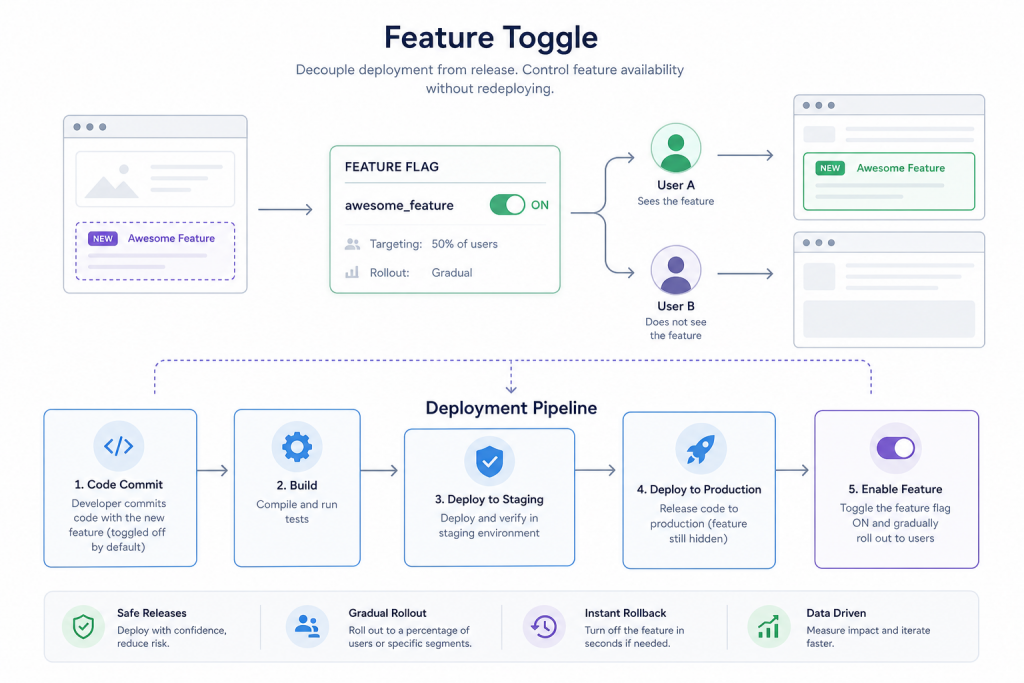
Your PM walks over the day before a release and asks if you can roll out the new checkout flow to 10% of users first. Or a critical bug surfaces in production and you need an instant kill switch without redeploying. Feature flags solve both problems by separating code deployment from feature delivery. Ship code whenever you want. Control who sees what through configuration alone.
The feature flag market in 2026 looks different from what it was three years ago. LaunchDarkly still dominates enterprise budgets. PostHog is winning startups by bundling flags for free alongside product analytics. Flagsmith attracts teams that refuse to send evaluation data to third parties. DevCycle carved out a niche with OpenFeature-native SDKs and edge-based evaluation that shaves latency down to single-digit milliseconds.
I spent two weeks running all four platforms against a real production workload — integrating SDKs, stress-testing targeting rules, comparing dashboards, and calculating actual invoices. Here’s what I found.
Quick Positioning Guide
Before diving into details, here’s a snapshot of where each tool sits:
| Tool | Core Identity | Best Fit |
|---|---|---|
| LaunchDarkly | Enterprise release governance platform | Teams of 50+ engineers with compliance needs |
| PostHog | Full-stack product analytics with free flags | Early-stage SaaS wanting analytics + flags in one place |
| Flagsmith | Open-source, self-hostable feature flags | Teams with data sovereignty requirements or tight budgets |
| DevCycle | OpenFeature-native, edge-evaluated performance | Engineering-heavy teams that hate vendor lock-in |
LaunchDarkly: The Enterprise Benchmark
LaunchDarkly has been in the feature flag business since 2014. Its customer list reads like a Fortune 500 directory — IBM, Atlassian, GoDaddy, and hundreds more. That pedigree comes with genuine advantages and a matching price tag.
What Makes It Stand Out
Release governance is where LaunchDarkly pulls ahead of everyone else. You can enforce approval workflows — production flag changes require a tech lead sign-off, while staging stays open for anyone. For teams in finance, healthcare, or any regulated industry, this is table stakes.
Flag lifecycle management tracks every flag’s status: active, stale, ready to archive. When your codebase accumulates 200+ flags (and it will), knowing which ones are dead weight is worth its weight in gold.
Built-in experimentation lets you run A/B tests directly on flag variants. No need to pipe data into a separate tool to measure whether variant B actually improves conversion rates.
Where It Hurts
The pricing model stings. Foundation plans start at $12/month per service connection plus $10/month per 1,000 client-side MAUs. A 10-person team serving 100,000 monthly active users can easily hit $1,000–$3,000 per month. Enterprise tiers require a sales conversation.
Verdict
LaunchDarkly earns its price when your organization genuinely needs audit trails, role-based approval workflows, and lifecycle tracking at scale. If those words sound like overkill, you’re probably paying for features that serve someone else’s compliance department.
PostHog: The "Flags Are Free" Strategy
PostHog plays a clever game. Feature flags cost almost nothing — 1 million flag requests per month are free, and overages run $0.0001 per request. The real revenue comes from product analytics, session replay, and A/B testing.
What Makes It Stand Out
If you already use PostHog for analytics, flags are essentially a bonus. The tight integration means you can answer questions like “what’s the retention rate for users who saw the new onboarding flow?” without stitching data between platforms.
The flag engine itself is solid: percentage rollouts, user property targeting, multivariate flags, and local evaluation to reduce network latency. For a tool that’s technically free, the feature set punches above its weight.
Where It Hurts
Flag management lacks the governance polish of dedicated tools. There’s no approval workflow, no lifecycle tracking, and no granular RBAC. Managing 30 flags feels fine. Managing 300 flags in PostHog’s UI feels like navigating a spreadsheet with no filters.
SDK initialization requires fetching all flag configurations upfront, which means cold-start times grow linearly with your flag count. Not a problem at 20 flags. Noticeable at 200.
Verdict
PostHog is the obvious pick for early-stage startups that want analytics, experimentation, and feature flags under one roof without paying separately for each. Once your flag count climbs past 100, you’ll start feeling the management friction.
Flagsmith: Open Source and Self-Hosted
Flagsmith is the only tool here that’s genuinely open source under a BSD 3-Clause license. You can deploy the entire stack on your own infrastructure, and not a single byte of evaluation data leaves your network.
What Makes It Stand Out
Data sovereignty is Flagsmith’s killer argument. For organizations bound by GDPR, HIPAA, or government data residency requirements, self-hosting is non-negotiable. Flagsmith delivers the full feature set — flags, remote config, user segments, percentage rollouts — without forcing you into a SaaS model.
The cloud-hosted version is also priced aggressively: a free tier supports 50,000 MAU, and paid plans start at $45/month. Compared to LaunchDarkly’s pricing, that’s pocket change.
Where It Hurts
Self-hosting means you own the ops burden. PostgreSQL, Redis, Celery workers, backups, upgrades, high-availability configurations — all on you. Teams without dedicated DevOps staff often discover the hidden cost of “free” open-source software exceeds what they’d pay for a managed service.
SDK coverage is narrower than LaunchDarkly’s. Mainstream languages and frameworks are well-supported, but niche platforms might require custom wrappers around the REST API.
Verdict
Flagsmith is the clear winner when data sovereignty is a hard requirement. It’s also a smart choice for budget-constrained teams with strong DevOps capabilities. Just don’t underestimate the operational overhead of running your own infrastructure.
DevCycle: Built for Performance and Portability
DevCycle is the youngest platform in this comparison but arguably the most technically opinionated. Its pitch rests on three pillars: OpenFeature-native SDKs, edge-based flag evaluation, and a Git-centric workflow.
What Makes It Stand Out
OpenFeature compliance means your application code stays vendor-neutral. Want to switch providers later? Swap the provider configuration and move on. No SDK migration, no code changes. For teams burned by vendor lock-in in the past, this matters.
Edge evaluation delivers flag results in 1–5ms because computation happens at CDN edge nodes rather than round-tripping to a central server. For latency-sensitive workloads — gaming backends, real-time communication, high-frequency trading systems — that performance gap is material.
Pricing simplicity also stands out. Plans are MAU-based with no per-seat charges, and every plan includes all features. No artificial feature walls between tiers. Free tier covers 1,000 MAU, Pro starts at $20/month for 25,000 MAU.
Where It Hurts
Community size is noticeably smaller. When you hit an edge case, Stack Overflow won’t have the answer. You’re relying on official Discord and documentation, which are solid but limited compared to LaunchDarkly’s decade of accumulated community knowledge.
The integration ecosystem covers mainstream tools (Datadog, GitHub, Slack) but lacks the long tail of niche integrations that LaunchDarkly offers out of the box.
Verdict
DevCycle is the right choice for engineering-focused teams that prioritize SDK performance, standards compliance, and freedom from vendor lock-in. Accept the tradeoff of a smaller community and leaner ecosystem.
Pricing Breakdown: A Real-World Scenario
Let’s model a concrete scenario: 15-person engineering team, 50,000 MAU, 30 active feature flags.
| Tool | Estimated Monthly Cost | Billing Model |
|---|---|---|
| LaunchDarkly Foundation | $500–$700 | Per service connection + MAU tiers |
| PostHog | $0 (within free tier) | 1M flag requests/month free |
| Flagsmith Cloud | $45–$180 | MAU-based tiers |
| DevCycle Pro | $20–$80 | MAU-based, unlimited seats |
At 1 million MAU, the picture shifts dramatically. LaunchDarkly could reach $3,000+/month. PostHog stays around $100/month in flag request fees. Self-hosted Flagsmith costs only server infrastructure. DevCycle at that scale requires an enterprise conversation.
SDK and Integration Comparison
| Dimension | LaunchDarkly | PostHog | Flagsmith | DevCycle |
|---|---|---|---|---|
| SDK Languages | 25+ | 15+ | 18+ | 12+ |
| OpenFeature Support | Yes | Yes | Yes | Native |
| CI/CD Integration | GitHub, GitLab, Bitbucket | GitHub | GitHub, GitLab | GitHub (Git-native) |
| Observability | Datadog, Honeycomb | Built-in | Datadog, Prometheus | Datadog, custom |
| Slack Notifications | Yes | Yes | Yes | Yes |
LaunchDarkly wins on breadth. PostHog wins on depth within its own platform. Flagsmith and DevCycle cover the mainstream and leave the long tail to their REST APIs.
Picking the Right Tool for Your Stage
There’s no single best feature flag platform. The right choice depends on where your team sits today.
Early-stage startup (5–20 engineers, seed to Series A): Go with PostHog. The price is right (free), the feature set covers what you need, and you get product analytics included. Migrate later when flag management becomes a bottleneck.
Mid-stage team (20–50 engineers, Series B and beyond): Choose between DevCycle and Flagsmith Cloud. DevCycle suits engineering-first teams that care about SDK performance and standards. Flagsmith suits cost-conscious teams or those with emerging data residency requirements.
Enterprise (50+ engineers, compliance requirements): LaunchDarkly. Approval workflows, lifecycle tracking, enterprise security features, and SOC 2 compliance justify the cost when regulators are watching.
Hard data sovereignty mandate: Flagsmith self-hosted. No other option gives you full control over where flag evaluation data lives.
FAQ
Do feature flags slow down my application?
It depends on how evaluation works. Local evaluation (used by PostHog’s local mode and DevCycle’s edge nodes) adds near-zero latency. Remote evaluation requires a network call, typically adding 10–50ms. Negligible for most web apps, but worth measuring for real-time systems.
How do I prevent flag debt from piling up?
Every team accumulates stale flags over time. LaunchDarkly’s lifecycle tracking automates the detection of dead flags. With other tools, enforce hygiene through process: assign an expiry date to every flag, schedule monthly flag reviews, and remove flags within one sprint of a completed rollout.
Is OpenFeature worth prioritizing?
If avoiding vendor lock-in ranks high on your priorities, yes. OpenFeature decouples your business logic from any specific SDK, making provider switches a configuration change rather than a code migration. If you’re happy with your current tool and don’t plan to switch, it’s nice-to-have rather than essential.
What does self-hosting Flagsmith actually require?
At minimum: one server with 2 CPU cores and 4GB RAM running Docker Compose with PostgreSQL, Redis, the Flagsmith API, and the dashboard frontend. Ongoing maintenance involves database backups and version upgrades, roughly 2–4 hours per month. High-availability setups need Kubernetes, which doubles the ops investment.
Can PostHog’s flags compete with dedicated feature flag tools?
On core functionality — percentage rollouts, user targeting, multivariate flags — yes. The gap shows up in governance: no approval workflows, no flag lifecycle tracking, no fine-grained RBAC. Works great under 30 flags. Starts creaking past 100.
What happens if my feature flag service goes down?
All four tools handle this through SDK-level caching. SDKs store the last known flag state locally, so a service outage doesn’t crash your app. Users continue seeing their most recently evaluated flag values until the service recovers. The risk window is new users or new flags that haven’t been cached yet.
Which tool has the fastest SDK?
DevCycle leads here with edge-based evaluation clocking 1–5ms response times. LaunchDarkly’s streaming architecture keeps local state fresh with minimal latency. PostHog and Flagsmith fall in the 10–50ms range for remote evaluation, though both offer local evaluation modes that close the gap.
Final Thoughts
Choosing a feature flag tool comes down to three tradeoffs: capability depth, cost, and control. LaunchDarkly gives you the most features at the highest price. PostHog costs the least but caps out on management sophistication. Flagsmith hands you maximum control at the expense of operational complexity. DevCycle delivers top-tier performance and portability while its ecosystem continues maturing.
Figure out your team size, your compliance posture, and your budget tolerance first. Then match those constraints to the tool that fits. Paying for capabilities you’ll never use is just subsidizing someone else’s requirements.
Stay updated with our latest AI insights