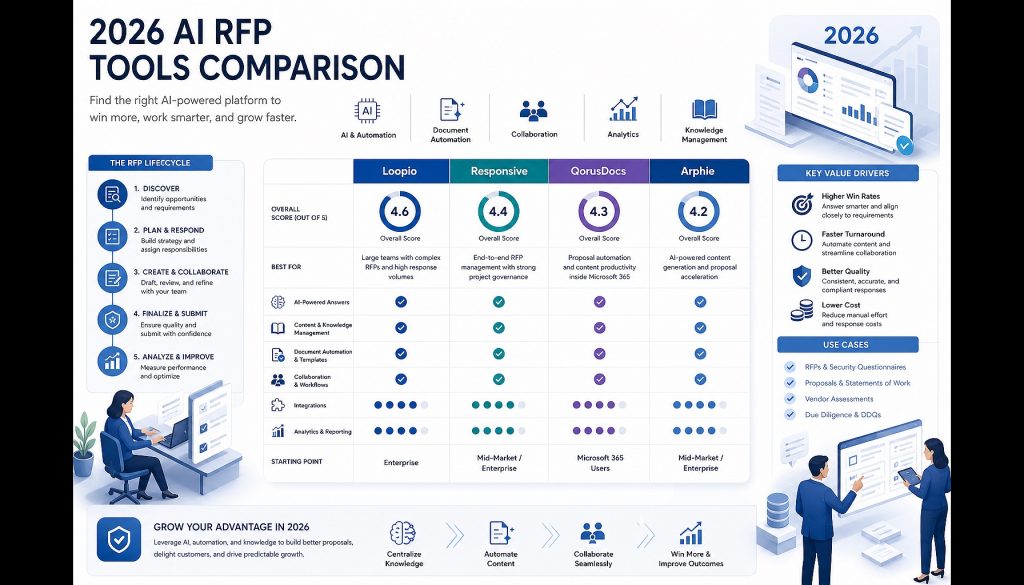
Every AI RFP platform in 2026 promises faster drafts, smarter automation, and higher win rates. Strip away the marketing and you’ll find four fundamentally different products solving fundamentally different problems. Pick the wrong one and you’ll spend six months forcing a content library tool to act like an automation engine — or vice versa.
Here’s the shortcut: Loopio is a trusted content system. Responsive is an end-to-end automation platform. QorusDocs is a Microsoft-native proposal workbench. Arphie is a knowledge-agent layer with source traceability. They overlap on surface features, but their architectural bets diverge sharply.
This guide breaks down where each tool genuinely excels, where it falls short, and how to match the right platform to what your proposal team actually needs.
The Core Problem: These Tools Look Similar But Aren’t
Walk through four demo calls and you’ll hear the same buzzwords — AI drafting, knowledge base, collaboration, compliance. The confusion is understandable. But the products diverge on a deeper question: what do they treat as the primary asset?
- Loopio treats your answer library as the core asset. AI exists to keep it clean, relevant, and reusable.
- Responsive treats the response workflow as the core asset. AI exists to automate intake, routing, drafting, and review.
- QorusDocs treats the proposal document as the core asset. AI exists to pull approved content into polished Word/PowerPoint deliverables.
- Arphie treats connected organizational knowledge as the core asset. AI agents exist to synthesize answers from live sources with full traceability.
Once you see this distinction, the buying decision gets much clearer.
Quick Comparison Table
| Dimension | Loopio | Responsive | QorusDocs | Arphie |
|---|---|---|---|---|
| Core positioning | Response management + trusted content library | SRM platform + AI automation engine | Proposal/RFP workflow in Microsoft stack | Knowledge activation + AI response agents |
| Primary narrative | Trusted content, context-aware AI, collaboration | AI-driven response management, AI agents, 80% faster | Business case + proposals, brand-approved content | Knowledge agents, confidence scores, source-backed answers |
| Strongest scenario | Building long-term reusable answer assets | Maximizing intake-to-output automation | Deep Microsoft 365 organizations | AI responses grounded in traceable, connected sources |
| AI approach | Library-grounded generation + content hygiene | Agent-driven workflow automation | Smart automation within proposal templates | Grounded AI drafting + live knowledge sync |
| Best fit | Mature proposal teams with large content libraries | High-volume response teams wanting platform-level automation | Professional services, legal, consulting on Microsoft 365 | Teams redesigning response workflows around modern AI |
| Biggest gap | Less aggressive on agent-style automation | Higher governance overhead to manage well | Advantage weakens outside Microsoft ecosystem | Newer platform; steeper adoption curve for traditional teams |
Loopio: The Content Library That Compounds Over Time
Loopio’s bet is straightforward and hard to argue with: without a trusted content library, even the best AI just amplifies existing chaos. Every response your team completes should make the next one easier. That only works if answers are captured, validated, tagged, and retrievable.
Where Loopio Wins
Long-term answer asset building. If your team handles RFPs, RFIs, security questionnaires, and DDQs, Loopio’s library-first approach means every completed response feeds back into a growing, curated knowledge base. The AI generates drafts grounded in your best historical answers — not generic LLM output.
Team collaboration. SME routing, review workflows, and permission controls are mature. For organizations where five different subject-matter experts touch a single RFP, Loopio’s collaboration layer is genuinely strong.
Content governance. Answer freshness tracking, duplicate detection, and library cleanup tools keep content from rotting. This matters more than most teams realize until they’re two years in with 4,000 stale entries.
Where Loopio Falls Short
If your priority is aggressive end-to-end automation — minimal human touch from intake through final output — Loopio’s approach is more conservative than Responsive or Arphie. It’s built around human-in-the-loop confidence, not lights-out processing.
Best For
Mature proposal teams (50+ RFPs/year) that already have or want to build a high-quality answer library as a strategic asset.
Responsive: The Automation Engine for High-Volume Teams
Responsive (formerly RFPIO) positions itself as a full strategic response management platform. The emphasis is on AI agents that automate intake, analysis, assignment, drafting, and output — not just one slice of the workflow.
Where Responsive Wins
End-to-end automation. From ingesting an RFP document, parsing questions, routing to the right responders, generating first drafts, to assembling final output — Responsive pushes automation further down the pipeline than most competitors. For teams processing hundreds of responses annually, this matters.
Platform maturity. With 2,000+ enterprise teams on the platform, the SRM workflows are battle-tested. Project management, deadline tracking, multi-stakeholder coordination, and analytics are all built in rather than bolted on.
Scalability. If your response volume is growing and you need the tool to handle more without proportionally growing headcount, Responsive’s architecture is designed for that trajectory.
Where Responsive Falls Short
Platform power comes with governance overhead. You need clear processes, content ownership, and admin discipline — otherwise you end up with powerful automation running on messy foundations. Teams without strong operational discipline may find the platform overwhelming rather than liberating.
Best For
High-volume response teams (100+ responses/year) that want platform-level automation and have the operational maturity to govern it.
QorusDocs: The Microsoft-Native Proposal Workbench
QorusDocs doesn’t try to be the flashiest AI platform. Instead, it solves a very specific problem exceptionally well: building proposals, RFP responses, and business cases inside the Microsoft 365 environment where your team already works.
Where QorusDocs Wins
Microsoft ecosystem integration. If your team lives in Word, PowerPoint, SharePoint, and Teams, QorusDocs doesn’t ask you to change. It layers proposal automation directly into those tools. For adoption, this is enormous — you’re not fighting workflow inertia.
Brand-controlled content. Approved templates, branded content blocks, and style enforcement ensure that every proposal going out meets corporate standards. For professional services firms where presentation quality directly impacts win rates, this is a genuine differentiator.
Proposal workflow completeness. Business cases, pricing tables, executive summaries, and compliance sections all flow through one coordinated workspace. It’s not just an RFP answer tool — it’s a full proposal production system.
Where QorusDocs Falls Short
Step outside the Microsoft ecosystem and the core value proposition weakens significantly. If your team uses Google Workspace, Notion, or other collaboration tools as the primary environment, QorusDocs loses its strongest advantage.
Best For
Professional services firms, legal teams, consulting organizations, and enterprise sales teams deeply embedded in Microsoft 365.
Arphie: Knowledge Agents With Source Traceability
Arphie represents the newest architectural approach in this space. Rather than starting with a static content library or a workflow engine, it starts with live connections to your organization’s knowledge sources — Google Drive, SharePoint, Confluence, Notion — and deploys AI agents that synthesize answers with full source visibility.
Where Arphie Wins
Source traceability. Every AI-generated answer shows exactly what it drew from, with confidence scores. For teams where compliance, audit trails, or simply “why did the AI say this?” matters, this is a meaningful advance over black-box generation.
Live knowledge connections. Instead of maintaining a separate content library that drifts out of sync, Arphie connects directly to where your organization already stores knowledge. Updates propagate without manual re-importing.
Modern AI workflow design. If your team is already thinking about AI governance, RAG architecture, and responsible AI deployment, Arphie’s approach aligns with that mindset. It’s built for organizations that want to understand and control their AI layer, not just use it.
Where Arphie Falls Short
For traditional proposal teams accustomed to established RFP platforms, Arphie requires a mental model shift. It’s not a drop-in replacement for legacy tools — it’s a different way of thinking about response generation. Adoption costs are higher for teams not already on board with AI-native workflows.
Best For
Forward-looking response teams that prioritize AI transparency, source-grounded answers, and modern knowledge architecture.
How to Choose: Match the Tool to Your Biggest Gap
The right choice depends on what your team lacks most — not which product has the longest feature list.
Choose Loopio if your biggest gap is content quality
Your team generates answers constantly but they never compound into a reusable asset. Knowledge walks out the door when people leave. SMEs answer the same questions repeatedly because nobody can find prior responses. Loopio solves the knowledge retention problem.
Choose Responsive if your biggest gap is workflow automation
Your team is drowning in volume. The bottleneck isn’t content quality — it’s the sheer operational overhead of intake, routing, tracking, and assembly. You need a platform that can handle more responses without proportionally more people. Responsive solves the throughput problem.
Choose QorusDocs if your biggest gap is ecosystem fit
Your team tried other tools but adoption failed because they pulled people away from Word and PowerPoint. Proposals still get assembled manually in Office documents regardless of what platform you buy. QorusDocs solves the adoption problem by meeting teams where they work.
Choose Arphie if your biggest gap is AI trust and traceability
Your team is ready for AI-assisted response generation but needs to know where answers come from, how confident the system is, and what sources informed each draft. You want connected knowledge, not a static library. Arphie solves the AI governance problem.
The Question Most Teams Get Wrong
Most evaluation teams ask: “Which tool generates the best first drafts?” That’s the wrong primary question. First-draft quality converges quickly across platforms because they all use similar underlying models.
The better questions are:
- Does our answer quality improve over time? (content library maturity)
- Does our per-response cost go down as volume grows? (automation depth)
- Can our team actually adopt this without changing tools? (ecosystem fit)
- Do we trust and understand what the AI produces? (traceability and governance)
RFP tools that only speed up drafting leave the harder problems — knowledge governance, SME collaboration, approval workflows, and long-term content compounding — unsolved. The winners in 2026 are platforms that treat the response process as an organizational system, not just a text generation task.
Final Verdict
Loopio wins on trusted content and team collaboration. Responsive wins on end-to-end automation depth. QorusDocs wins on Microsoft-native proposal workflows. Arphie wins on knowledge agents and AI traceability.
There’s no universal best choice — only the best fit for where your organization is today and where it needs to go. Start by identifying which of the four gaps (content quality, automation, ecosystem fit, or AI governance) hurts most, then evaluate the platform built to solve that specific problem first.
FAQ
What’s the biggest difference between Loopio and Responsive?
Loopio emphasizes building a trusted content library with context-aware AI generation and strong team collaboration. Responsive emphasizes AI agents that automate the full response management workflow from intake through output. Loopio optimizes for answer quality over time; Responsive optimizes for processing speed and scale.
Which teams benefit most from QorusDocs?
Professional services firms, legal teams, consulting organizations, and enterprise sales teams that work primarily in Microsoft 365. If your proposal process revolves around Word templates, PowerPoint decks, and SharePoint collaboration, QorusDocs has a natural ecosystem advantage.
Why is Arphie getting attention in 2026?
Arphie reframes RFP response as a knowledge-agent problem rather than a content-library problem. Its emphasis on live connectors, source visibility, confidence scores, and traceable AI answers aligns with how organizations increasingly think about responsible AI deployment. It represents a generational shift in approach.
What should I evaluate first when choosing an AI RFP tool?
Start with your team’s biggest operational pain point. If it’s content quality and reuse, evaluate Loopio first. If it’s workflow volume and automation, look at Responsive. If it’s adoption friction in a Microsoft environment, consider QorusDocs. If it’s AI trust and knowledge architecture, start with Arphie.
What’s the most common mistake teams make when buying RFP software?
Choosing based on impressive AI draft demos without evaluating content governance, SME collaboration, approval workflows, and long-term knowledge compounding. Draft speed is table stakes in 2026 — the real differentiators are whether the tool makes your organization smarter over time.
Related Reading
- Cursor vs Claude Code 2026: Which AI Coding Tool Should Developers Actually Choose?
- Perplexity Pro vs Gemini Deep Research: Same $20/Month, 30x Difference in Research Quota
Stay updated with our latest AI insights