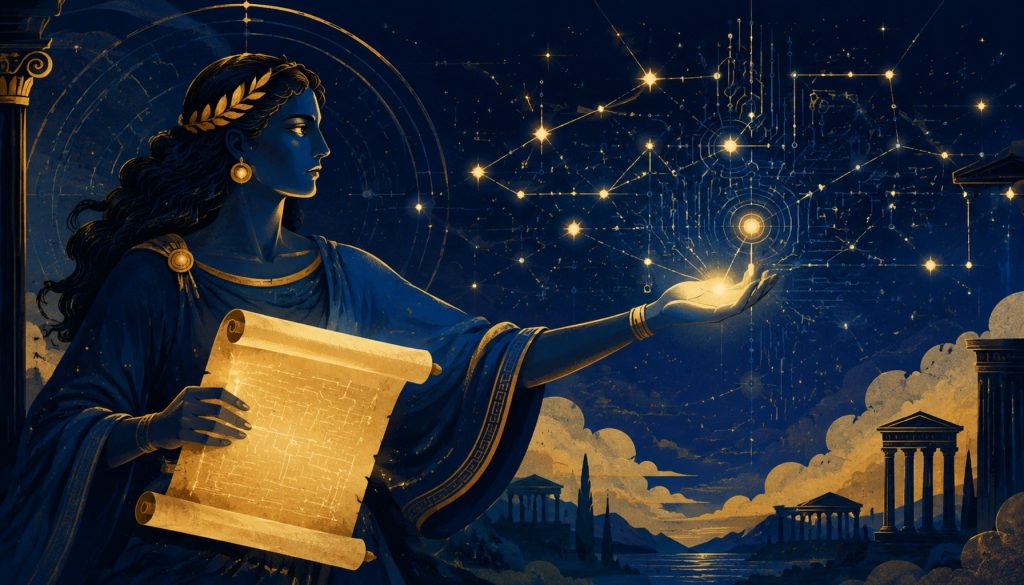
Don’t laugh yet.
Imagine someone with zero knowledge of modern technology watching you speak into thin air. Your screen starts writing, drawing, translating, editing video, executing commands.
How would they make sense of it?
Probably not: “Oh, you’re calling an API.”
More likely: “This person knows magic.”
I’ve been thinking about mythology differently lately.
We’ve always treated it as ancient imagination run wild. Pure fantasy from people with too much time and not enough science.
But what if that’s not the whole story?
What if mythology wasn’t just made up? What if it was ancient people trying to document something more advanced than they could fully grasp, so they packaged it into stories they could remember?
In other words: they saw it, didn’t completely understand it, but the impression stuck.
So it became myth.
The Most Interesting Thing About Myths Isn’t the Magic, It’s the Access Hierarchy
Look closely at mythology. It’s not just about flying and shapeshifting.
The pattern that shows up again and again is this: some people can do things, others can’t. Some people know the rules. Others just know not to touch. Some people wave an artifact around and get results. Others pray for a lifetime and never get past the door.
Sound familiar?
That’s exactly how you feel the first time you encounter a complex system.
You know it’s powerful. You know other people are already doing incredible things with it. But you open it up and the interface looks like hieroglyphics. The buttons play hide and seek.
So maybe the real through-line in mythology isn’t the flashy special effects.
It’s something much more recognizable: some people figured out how it works, and everyone else is still standing outside trying to guess.
Spells Might Not Be Mysticism, They Might Be Leftover Instructions
We look at ancient people chanting spells, drawing symbols, performing rituals, and our first reaction is: superstition.
But think about it differently.
If a civilization once had sophisticated technology, then lost it, lost the theory, lost the equipment, kept only fragments of memory, how would the next generation preserve what remained?
They wouldn’t write academic papers. They couldn’t draw system diagrams.
They’d pass it down orally.
And over time, things would drift.
Precise operational commands would turn into incantations. Specialized equipment would become sacred artifacts. Standard procedures would become rituals. Safety protocols would become taboos.
This isn’t far-fetched.
Imagine all servers vanished tomorrow. Three generations later, how would your descendants describe ChatGPT?
Probably like this:
“Long ago there was a divine tool. You spoke to it, and it would write for you, advise you, fix your code.”
“But not everyone could use it. You had to speak in a special way.”
“Those who knew how could do the work of ten people. Those who didn’t wondered if it was haunted.”
That already sounds like mythology.
Gods Might Not Be “Divine”, They Might Just Be People Who Had the Manual
Follow this thread and a lot of things click into place.
Look at the gods in most mythologies. They’re not just strong.
They usually have: knowledge, tools, status, position, rules, and access to a system everyone else is locked out of.
That’s interesting.
Because it doesn’t sound like raw power.
It sounds like they have the documentation.
Everyone else sees thunder. They know how to call it. Everyone else sees fire. They know where it comes from. Everyone else thinks it’s fate. They know there’s a mechanism underneath.
Ancient people would absolutely see someone like that as divine.
In other words, what we call divine power might not have been supernatural at all.
It might just have been: they knew how to operate it, and you didn’t.
Chinese Mythology Sometimes Reads Like an Org Chart
This feeling gets even sharper with Chinese mythology.
Greek gods act human. They argue, scheme, let emotions drive them into chaos.
Chinese mythology is different.
The upper realm in Chinese mythology tends to look like this:
There’s a heavenly court. There are ranks. There are bureaucratic positions. There are laws. There are promotions. There are punishments.
Honestly, the more you read it, the more it resembles an organizational structure.
Cultivation, too, often feels oddly familiar.
Like training. Like filtering. Like evaluation. Like climbing a ladder one rung at a time.
Tribulation? In a way, it’s an ancient stress test.
Ascension? The system just granted you higher permissions.
Getting banished to the mortal realm? That’s basically: account downgraded.
Translate it this way and mythology stops floating. It starts to feel like lived experience that got retold, exaggerated, and mystified.
The Real Draw of Mythology Isn’t “Gods Are Powerful”, It’s “How Do They Know How to Do That?”
Most people read mythology for the thrill.
I think the real magnetism is something quieter.
It’s that flicker of confusion.
Why can they do this? How do they know? How do they control these forces?
That feeling is very modern.
The first time you see someone chain together AI, automation, workflows, and tooling into something that just runs, you have the same reaction.
Out loud you say: “They’re good with tools.”
Inside you’re thinking: “Wait, you can do that?”
Mythology might have captured exactly that feeling.
Not worship of miracles falling from the sky.
But the shock of encountering a capability you haven’t figured out yet, that moment of “holy shit, it can work like that?”
Why Do People Today Suddenly Feel Like Mythology Resembles AI?
Because the world is starting to look the same way.
Some people can now do what used to take a whole team.
One sentence generates content, images, code, workflows.
String together ingestion, logic, generation, and publishing, and a lot of things just start running on their own.
And other people?
They know these tools are powerful. They installed a few. They tried them twice. Then… yeah, better close that.
There’s a gap.
But it’s not necessarily a talent gap.
Most of the time it’s just: some people started earlier, others haven’t found the entry point yet. Some people already know how to tune the system, others are still hunting for the manual.
So you hear descriptions today that sound pulled straight from myth:
“He’s good at tuning.”
“He has a system.”
“He says one thing and everything just works.”
That’s the modern version of “this person knows a bit of the immortal arts.”
The Interesting Part Might Not Be the Tech, It’s the Fog Around It
Most things look mystical when you don’t understand them yet.
From a distance you assume the other person has some special gift, or they hit some stroke of luck ordinary people never get.
But when you get close, you often discover something slightly disappointing:
There’s no secret. They just started messing with it earlier than you did.
Talent differences exist. But most of the time, that sense of mystery has a shorter shelf life than you think.
Every Era Seems to Go Through This
Whenever something new shows up, it seems to follow the same arc.
At first, only a few people use it. Everyone else watches from a distance and thinks it’s mystical.
After a while, more people use it. It starts to feel… normal.
Then nobody thinks it’s mystical anymore. It’s just part of daily life.
Mythology might have worked the same way. The things that seemed impossible at the time just never made it to the “becomes mundane” stage.
The future won’t look like mythology because of the technology itself. It’ll look like mythology during that brief window when the tech first appears and nobody can quite explain what it is yet.
Every era has that window. Something appears. People see it but don’t fully grasp it. They write it down, but not quite accurately.
Later the fog clears. The story stays a story.
But when you look back, you realize, oh, that’s what it actually was.
Related reading
- The People Who Know How to Build Agent Workflows Are Becoming the Most Valuable Employees in Their Companies
- The 3 AI Tool Stacks Knowledge Workers Should Actually Invest In (2026)
- Big Tech AI Agents vs Open Source: Who Really Owns Your Data in 2026?
Stay updated with our latest AI insights