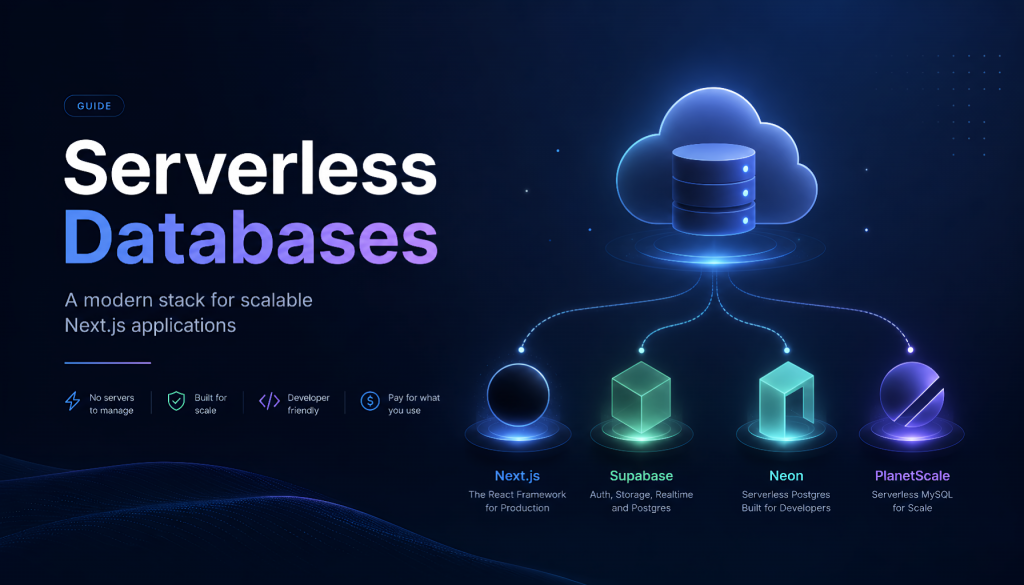
Next.js 14’s App Router pushed server-side rendering further than ever, but it also surfaced a new problem: picking the right database. Traditional RDS instances burn money on idle hours, struggle with connection pool limits under serverless functions, and cold-start like they’re booting Windows 98. Serverless databases promise pay-per-use billing, elastic scaling, and edge-friendly architectures. The catch? There are too many options, and their marketing pitches all blur together.
This article breaks down five mainstream choices with real-world benchmarks on cold-start latency, edge deployment compatibility, pricing transparency, and ecosystem maturity. If you’re building a B2B SaaS on Next.js and deploying to Vercel (or similar), this comparison should save you a few weekends of research.
Supabase: The Full-Stack BaaS Built on Postgres
Supabase is not just a database. It’s a complete Backend-as-a-Service layer that bundles Postgres with authentication, file storage, realtime subscriptions, and Edge Functions. Think of it as the open-source Firebase alternative that actually gives you a real relational database underneath.
What makes it compelling for SaaS teams:
Postgres ships with enterprise-grade features out of the box. Row Level Security (RLS) lets you enforce multi-tenant data isolation at the database layer instead of littering your application code with permission checks. PostGIS handles geospatial queries. Full-text search eliminates the need for a separate Elasticsearch cluster in most cases. JSON columns give you document-store flexibility without abandoning SQL.
Authentication comes built in. Email/password, OAuth providers (Google, GitHub, Azure AD), and Magic Links all work without writing custom auth logic. For a B2B SaaS, this means you can ship a working login flow in an afternoon instead of spending a sprint integrating Auth0 or Clerk.
Realtime subscriptions push database changes to connected clients automatically. If you’re building a collaborative tool where User A’s edits need to appear on User B’s screen instantly, Supabase handles the WebSocket plumbing for you.
Edge Functions run on Deno with cold starts under 50ms. They deploy to Cloudflare’s network, so your serverless logic sits close to users globally.
Where it fits: Full-stack Next.js projects that need auth, storage, and realtime in one vendor. A five-person team building a collaboration SaaS can go from zero to production backend in a week. Solo founders shipping MVPs benefit from the generous free tier covering auth for 50,000 monthly active users.
Pricing: The free tier includes 500MB database storage, 1GB file storage, and 50K MAU. Pro starts at $25/month for 8GB database and 100GB storage. Team and Enterprise tiers scale from there.
The free tier is the most generous in this comparison. However, the jump to $25/month can feel steep if all you need is a database, since you’re paying for auth infrastructure, storage buckets, and Functions capacity whether you use them or not.
Watch out for: Supabase’s Postgres instance is not “true serverless” in the Neon sense. It’s a managed instance that hibernates on inactivity. Free-tier projects pause after 7 days without traffic, and the first request after hibernation takes 5 to 10 seconds to wake the instance. That cold-start penalty matters for low-traffic internal tools and staging environments.
Neon: Storage-Compute Separation Done Right
Neon focuses on one thing: making Postgres serverless at the architecture level. Storage lives on S3-compatible object storage. Compute spins up on demand and scales independently. This separation enables two killer features: true pay-for-what-you-use billing and instant database branching.
What makes it compelling for SaaS teams:
The serverless architecture means zero cost during zero activity. Compute hibernates automatically, and cold-start latency sits around 500ms to 1 second. For a B2B SaaS with predictable business-hours traffic, this translates to significant savings compared to always-on RDS instances burning money overnight and on weekends.
Database branching is the standout feature. Every pull request can get its own isolated database branch, created in milliseconds using copy-on-write. This integrates seamlessly with Vercel’s preview deployments. Your staging environment gets a full copy of production data (or a sanitized subset) without duplicating storage costs. When the PR merges, the branch disappears. Development teams that have struggled with shared staging databases will immediately appreciate this workflow.
Connection pooling handles tens of thousands of concurrent connections without external tools like PgBouncer. This matters for Next.js on Vercel, where each serverless function invocation opens its own database connection.
Time Travel provides point-in-time recovery with 7 days of history on the free tier and 30 days on paid plans. If a bad migration corrupts data at 3pm, you can restore to 2:59pm without touching backups.
Where it fits: Next.js projects deployed on Vercel that need per-PR preview databases. Teams with spiky traffic patterns (a news aggregator that’s quiet most of the day but spikes 100x during breaking events). Any project where the Postgres bill needs to correlate directly with actual usage.
Pricing: Free includes 0.5GB storage and 191 compute-hours per month (roughly 6 hours per day). Launch is $19/month for 10GB and 300 compute-hours. Scale starts at $69/month with usage-based billing.
The billing model rewards intermittent usage. A B2B tool used 10 hours per day, 5 days per week, stays well within the Launch tier. But 24/7 high-throughput workloads can rack up compute charges that exceed a fixed-price RDS instance.
Watch out for: Cold-start latency of 500ms to 1s is slower than Supabase’s always-warm instances (when not hibernated). For latency-sensitive API endpoints that serve the first request of the day, this gap matters. Neon is database-only. No auth, no storage, no realtime. You’ll integrate those separately.
PlanetScale: MySQL with Git-Style Schema Management
PlanetScale runs on Vitess, the same MySQL sharding framework that YouTube uses to serve billions of users. Its core promise: schema changes should be as safe and reviewable as code deployments. No more 3am maintenance windows. No more crossed fingers during ALTER TABLE on a production database with 50 million rows.
What makes it compelling for SaaS teams:
Non-blocking schema changes run in the background without locking tables. Adding a column to a 100-million-row table happens while production traffic continues uninterrupted. For B2B SaaS products where downtime means SLA violations and angry enterprise customers, this alone justifies the choice.
Deploy Requests bring the pull-request workflow to database schemas. A developer creates a branch, modifies the schema, tests against realistic data, then opens a Deploy Request for team review. After approval, the change rolls out to production with automatic rollback capability. Schema changes become auditable, reversible, and collaborative instead of a solo DBA ritual.
Automatic horizontal sharding kicks in as data grows past single-node capacity. The application layer doesn’t need to know about sharding topology. PlanetScale handles routing transparently. For a SaaS that starts with 10,000 rows and grows to 100 million, you never hit a “rewrite everything for sharding” cliff.
Where it fits: Teams of 5+ engineers working on a Next.js SaaS where schema changes happen weekly. Products expecting significant data growth over 12 to 24 months. Organizations that need audit trails on infrastructure changes for SOC 2 or similar compliance frameworks.
Pricing: The Hobby tier (restored in 2024 after backlash over its removal) offers 5GB storage with 1 billion row reads and 10 million row writes per month for free. Scaler starts at $39/month with usage-based billing beyond included limits. Enterprise requires custom contracts.
The free tier is more restrictive than competitors. You get only one production branch and no access to Deploy Requests. Teams that need the branching workflow must commit to Scaler at minimum.
Watch out for: PlanetScale is MySQL, not Postgres. No Row Level Security. No PostGIS. No advanced JSON path queries. If your ORM or query patterns depend on Postgres-specific features, PlanetScale is not an option. In April 2026, PlanetScale dropped support for foreign key constraints, arguing they’re incompatible with distributed sharding. This is a real trade-off for applications that rely on referential integrity at the database layer. You’ll need to enforce relationships in application code instead.
Turso: SQLite at the Edge, Globally Distributed
Turso takes the most unconventional approach in this list. It’s built on libSQL (a fork of SQLite) and distributes database replicas to edge locations worldwide. The result: single-digit millisecond read latency for users regardless of geography.
What makes it compelling for SaaS teams:
Read latency under 10ms anywhere in the world changes the user experience fundamentally. A collaboration tool with users in New York, London, and Tokyo serves queries from the nearest edge replica instead of routing every request back to us-east-1. The 200ms round-trip to a centralized database disappears.
The embedded development workflow means local development uses a plain SQLite file. No Docker containers, no local Postgres instances, no “works on my machine” database configuration drift. Deploy to Turso and data syncs automatically.
Database-per-tenant architecture becomes trivial. Each customer gets an isolated database instance with zero cross-contamination risk. For B2B SaaS products selling to enterprises with strict data residency requirements, this isolation model simplifies compliance conversations considerably.
Pricing scales with database count rather than storage or compute hours. If your SaaS has 300 enterprise customers each with their own database, Turso’s model stays predictable. The same architecture on Neon or Supabase would require per-tenant storage accounting.
Where it fits: Global B2B SaaS products where users are distributed across continents and read-heavy workloads dominate. Multi-tenant applications that need physical data isolation per customer. Edge-first architectures running on Cloudflare Workers or Deno Deploy.
Pricing: Starter is free with 8GB total storage, 1 edge location, and up to 500 databases. Scaler is $29/month with additional locations at $10 each. Enterprise pricing is custom.
The free tier is surprisingly generous for multi-tenant use cases. 500 databases at no cost covers a substantial customer base before you hit the paid tier.
Watch out for: SQLite’s ecosystem is smaller than Postgres or MySQL. No geospatial extensions. No built-in full-text search (you’ll need a separate service). ORM support is growing but still lags behind Postgres adapters. Write operations replicate to all edge nodes, so cross-region write latency is higher than single-region alternatives. Turso works best for read-heavy, write-light workloads.
Firestore: NoSQL with Mature Mobile and Offline Support
Firebase’s Firestore is Google’s NoSQL document database. It’s not SQL, which makes it an outlier in this comparison, but its deep integration with Next.js, mature SDK ecosystem, and offline-first architecture earn it a spot.
What makes it compelling for SaaS teams:
Realtime synchronization pushes data changes to all connected clients with no custom WebSocket code. For products that blend web (Next.js) and mobile (React Native) clients, Firestore provides a single data layer that works identically across platforms.
Offline support caches data locally and syncs when connectivity returns. For field-service SaaS products where users operate in poor network conditions (warehouses, construction sites, rural areas), this resilience is table stakes.
The ecosystem covers authentication, storage, analytics, crash reporting, and A/B testing under one console. Google’s infrastructure handles scaling automatically with no capacity planning.
Sub-100ms cold starts mean serverless function invocations never wait for database warmup.
Where it fits: Cross-platform products (web + mobile) that need offline capability. Rapid prototyping where the data model is still evolving weekly and SQL migrations would slow iteration speed. Teams already invested in Google Cloud Platform.
Pricing: The Spark plan (free) includes 1GB storage, 50K reads per day, and 20K writes per day. Blaze (pay-as-you-go) charges $0.18/GB storage per month, $0.06 per 100K reads, and $0.18 per 100K writes.
Read/write pricing requires careful query optimization. An unindexed query that scans thousands of documents burns through daily limits fast. Budget alerts are essential.
Watch out for: No JOINs. No cross-document transactions (with limited exceptions). No complex aggregation queries. If your B2B SaaS has relational data models with many-to-many relationships, Firestore forces you into denormalization patterns that increase write complexity and storage costs. Vendor lock-in is severe. Firestore’s data format, query API, and security rules are all proprietary. Migrating to Postgres later means rewriting data access layers from scratch, not just changing a connection string.
Head-to-Head Comparison
| Database | Type | Cold Start | Edge Deploy | Free Tier | Best For |
|---|---|---|---|---|---|
| Supabase | Postgres (BaaS) | 5-10s (wake) | No | 500MB + 50K MAU | Full-stack Next.js with auth + realtime |
| Neon | Postgres (Serverless) | 500ms-1s | Yes (read replicas) | 0.5GB + 191h/mo | Vercel deploys, spiky traffic |
| PlanetScale | MySQL (Serverless) | < 1s | No | 5GB + limited branches | Frequent schema changes, team workflows |
| Turso | SQLite (Edge) | < 100ms | Yes (global) | 8GB + 500 databases | Global users, multi-tenant isolation |
| Firestore | NoSQL (BaaS) | < 100ms | Yes | 1GB + 50K reads/day | Mobile + offline, rapid prototyping |
Decision Framework
Solo founder building an MVP: Supabase. Auth, database, and storage in one vendor means you ship features instead of gluing services together. The free tier lasts longer than most MVPs need to find product-market fit.
Deploying on Vercel with preview environments: Neon. Database branching per PR eliminates shared-staging conflicts and gives every preview deployment its own isolated data. The developer experience integration is unmatched.
Engineering team with frequent schema evolution: PlanetScale. Deploy Requests turn risky ALTER TABLE operations into reviewable, reversible workflows. Your on-call engineer sleeps better.
Global product, users on multiple continents: Turso. Edge-distributed read replicas cut query latency from 200ms to under 10ms. For SaaS products where perceived speed drives retention, this difference compounds.
Cross-platform with offline requirements: Firestore. Local caching and automatic sync solve connectivity challenges that would take months to build on top of a SQL database.
Existing Postgres expertise, minimal learning curve: Neon or Supabase. Both run standard Postgres. Your existing queries, ORMs, and mental models transfer directly.
Common Misconceptions
“Serverless databases always cost less than RDS.” Not for sustained high-throughput workloads. If your SaaS runs 24/7 with consistent traffic, Neon’s compute-hour billing or PlanetScale’s row-read charges can exceed a reserved RDS instance. Serverless pricing wins when traffic is unpredictable or concentrated in business hours.
“Edge databases guarantee low latency.” Only for reads. Write operations still need to propagate to the primary node and replicate across regions. Turso’s edge replicas serve reads in under 10ms, but writes to a globally-distributed dataset incur replication delay. Design for read-heavy patterns if you pick an edge database.
“Free tiers are free forever.” Hidden constraints bite in production. Supabase hibernates after 7 days of inactivity. PlanetScale’s free plan blocks the branching workflow that makes it worthwhile. Neon caps compute at 191 hours monthly, which means your database sleeps 18 hours a day. Calculate your actual usage pattern before committing to a free-tier architecture.
The Bottom Line
There is no universal best choice. The right database depends on your team size, deployment target, user geography, and traffic pattern.
For most early-stage B2B SaaS teams deploying Next.js on Vercel, start with Neon or Supabase. Both give you Postgres with minimal configuration, reasonable free tiers, and clear upgrade paths. When you hit specific scaling challenges (global latency, schema management complexity, multi-tenant isolation), you’ll know which specialized option to migrate toward.
One final note: don’t over-optimize at the start. The cost of migrating databases later is lower than the cost of spending weeks evaluating options before you have paying customers. Ship first. Optimize when the data tells you where the bottleneck is.
Related Reading
- Choosing a Database for Your Next.js Project: Supabase vs Neon vs PlanetScale vs Turso (2026)
- Supabase vs Neon: Which Serverless Postgres Should You Choose in 2026?
Stay updated with our latest AI insights