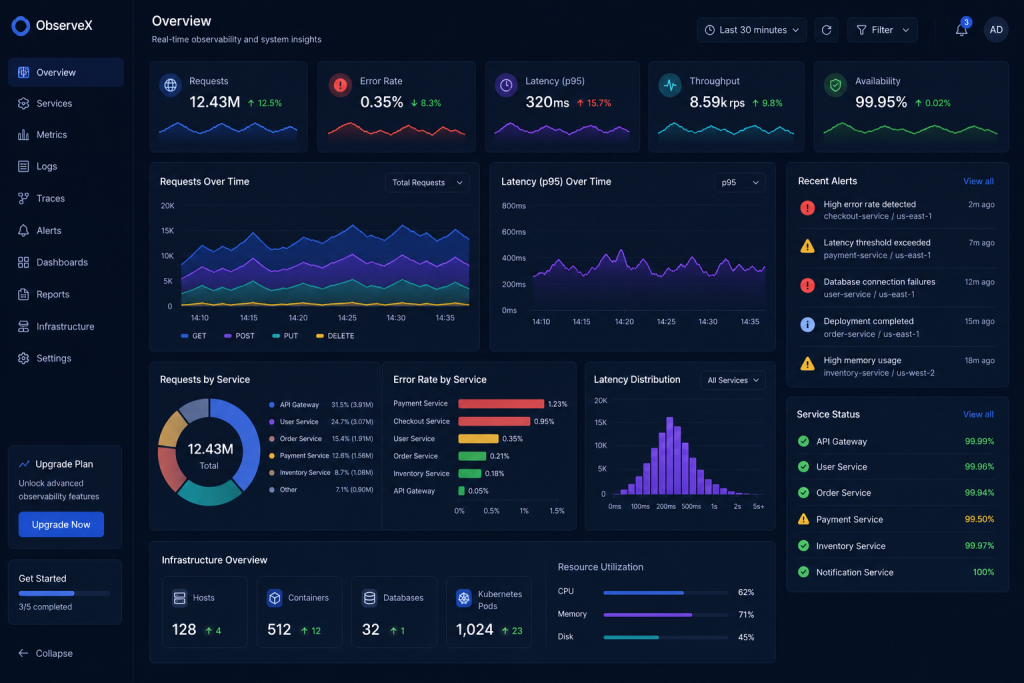
Ever opened your Datadog bill at month’s end and found it 30% higher than last month—even though your team size didn’t change?
You’re not alone. Datadog’s per-host pricing model becomes a bottomless pit when you hit containerization. Spin up another microservice, scale another Pod, and watch your bill climb. OpenObserve ran tests in January 2026 and found teams migrating from Datadog to open-source solutions cut costs by 90% for the same 16-service environment.
More teams are seriously hunting for alternatives. But with dozens of observability tools out there, choice paralysis is real.
This guide narrows it down to four contenders: SigNoz, Grafana Cloud, New Relic, and Better Stack. We’ll break down pricing, features, deployment models, and use cases so you can skip the trial-and-error phase.
Observability is the ability to infer a system’s internal state from its external outputs—logs, metrics, and traces. Unlike traditional monitoring that watches predefined metrics, observability lets you debug unknown failure modes. According to Gartner’s 2025 report, over 70% of enterprises will treat observability as core infrastructure by 2026.
Why Teams Are Leaving Datadog
Before diving into alternatives, let’s clarify the pain points. Based on 2026 community feedback and comparison posts, teams leave Datadog for three main reasons:
Billing is a black box. Datadog has 30+ line items. APM charges per host (Pro at $36/month/host), logs by GB, custom metrics separately. You think you’ve enabled three features, then month-end hits and surprise charges appear everywhere.
Container costs spiral out of control. Per-host pricing meets Kubernetes badly—every Node counts as a host, and horizontal scaling multiplies your bill. One traffic spike can double your monthly cost.
Vendor lock-in. Datadog uses proprietary data formats and query languages. Migration costs are high. The deeper you go, the harder it is to leave. Dashboards, alert rules—you’d have to rebuild everything.
If price is your main issue (first two points), open-source solutions and usage-based SaaS are worth exploring. If lock-in worries you (third point), prioritize tools with OpenTelemetry support.
Quick Comparison Table
| Dimension | SigNoz | Grafana Cloud | New Relic | Better Stack |
|---|---|---|---|---|
| Positioning | Open-source full-stack observability | Composable LGTM stack | Enterprise APM platform | Logs + Uptime monitoring |
| Deployment | Self-hosted / Cloud | Self-hosted / Cloud | SaaS only | SaaS only |
| Pricing Model | By data volume | By data volume | By users + data | By data volume |
| OpenTelemetry | Native support | Supported | Supported | Partial support |
| Free Tier | Community edition fully free | Generous free tier | 100GB/month free | Limited free tier |
| Best For | Mid-size teams with ops capacity | Teams already using Prometheus | Large enterprises | Small teams / indie devs |
SigNoz: The Open-Source All-Rounder
SigNoz is the only fully open-source (Apache 2.0) full-stack observability platform in this group. Logs, metrics, and traces live in one interface, backed by ClickHouse for fast queries.
Cost savings are obvious. Self-hosted version is free—you only pay for servers and storage. Teams processing 50GB+ logs daily report 70-90% savings versus Datadog. SigNoz Cloud pricing is transparent too: usage-based with no hidden add-ons.
Technically, SigNoz built around OpenTelemetry from day one, not a bolted-on adapter later. Standard OTel SDKs integrate cleanly. If you switch platforms later, you won’t need to modify business code.
But there are gotchas. Self-hosting means maintaining ClickHouse clusters yourself—small teams can’t handle that ops burden. ClickHouse needs resources; plan for at least three 8C16G machines for stability. Integration count doesn’t match Datadog’s 700+. SigNoz relies mainly on OTel community integrations, and some middleware dashboards require manual setup.
Choose SigNoz if: You have 1-2 DevOps engineers, high log volumes, cost sensitivity, and you’re comfortable managing infrastructure.
Grafana Cloud: The Natural Upgrade for Prometheus Users
Already running Prometheus + Grafana? Grafana Cloud is the smoothest upgrade path. It bundles Prometheus (metrics), Loki (logs), Tempo (traces), and Grafana (visualization) as a managed service. No more maintaining this entire stack yourself.
Core selling point is flexibility. Only 11 billing items (Datadog has 30), and pricing structure is simpler. You can enable components on-demand—just metrics monitoring means just Prometheus; add Loki later if you need logs. You don’t pay for unused features.
The free tier is generous: 10,000 metric series, 50GB logs, 50GB traces. Small teams might never pay.
The tradeoff is learning curve. Grafana dashboard flexibility comes at a cost—you need to learn PromQL, LogQL, and other query languages. Datadog’s out-of-box experience requires more upfront investment here. Alert configuration is also fragmented; metric alerts and log alerts are separate systems, not as unified as Datadog.
Choose Grafana Cloud if: You’re already using the Prometheus/Grafana open-source stack, or your DevOps team values maximum flexibility over ease-of-use.
New Relic: The Enterprise Safe Bet
New Relic made a major pivot in 2020—switched from per-host pricing to “per user + data volume” and added 100GB free data ingest monthly. This move let them regain footing in the enterprise market.
Strength is breadth and maturity. APM, infrastructure monitoring, logs, browser monitoring, mobile monitoring, serverless monitoring—every observability use case you can think of is covered. Each module has been refined for years with solid stability and feature depth. New Relic AI made good progress in 2026; anomaly detection and root cause analysis genuinely help large-scale incident response.
But pricing has its own traps. While not per-host anymore, it’s now per “full platform user”—$549/month (Standard) or $849/month (Pro) per person. Ten engineers needing New Relic access means $5,490-$8,490/month in user fees alone, before data overage charges. As SigNoz noted in a comparison post: New Relic essentially “swapped one complex billing model for another.” That’s competitor framing, but it hits a real point—New Relic isn’t cheap for small teams.
Choose New Relic if: You have 50+ engineers, need enterprise-grade SLAs and compliance support, budget isn’t tight, and you want one platform for all observability needs.
Better Stack: Simplicity Taken to the Extreme
Better Stack (formerly Logtail + Better Uptime) took a different path. It doesn’t chase feature breadth—it does two things extremely well: log management and uptime monitoring.
Onboarding experience is probably the best of the four. Sign up, ingest logs in minutes, clean interface, no query language to learn. Log search is fast (columnar storage underneath). For “I just need to quickly search logs” scenarios, the experience beats Datadog and Grafana. Uptime monitoring and incident management are solid too, with Slack, PagerDuty, SMS notifications and a nice status page.
Shortcomings are clear: it’s not a full observability platform. No APM, no tracing. Want to see how a request flows through microservices or analyze slow query root causes? Better Stack can’t help. Metrics monitoring is basic too, with no support for custom metrics or complex aggregations.
Choose Better Stack if: You’re a team under 10 people or an indie dev, mainly need log search and website uptime monitoring, and don’t need APM.
Real-World Cost Scenario: 50 Hosts + 100GB Logs/Day
Pricing pages mean nothing without real numbers. Let’s model a mid-size team: 50 hosts, 100GB daily logs, APM and basic alerting needed.
Datadog (baseline): APM Pro at $36/host = $1,800/month for hosts. Logs at $0.10/GB ingested and $1.70/million events indexed (assuming 15-day retention) adds ~$3,000/month. Total around $4,800/month or $57,600/year.
SigNoz Cloud: Usage-based pricing roughly $0.30/GB logs + $0.10/GB traces. Assuming 100GB logs + 20GB traces/day = $1,080/month or ~$13,000/year. Savings: 77%.
Grafana Cloud: Logs at $0.50/GB, metrics around $0.15/series. For 100GB logs + 5,000 active series = $1,500-2,000/month or $18,000-24,000/year. Savings: 58-68%.
New Relic: 10 full platform users at $549/month = $5,490 + data overages (100GB included free, overage at $0.30/GB). Roughly $6,000-7,000/month or $72,000-84,000/year. Actually more expensive than Datadog.
Better Stack: Logs at $0.20/GB. 100GB/day = $600/month or $7,200/year. But this doesn’t include APM—you’d need another tool.
For this specific scenario, SigNoz offers the best value, Grafana Cloud balances cost and features, New Relic costs the most, and Better Stack only works if you don’t need APM.
How to Decide
Data Privacy and Control
If you’re building fintech, healthcare, or anything with sensitive data, self-hosted options (SigNoz, Grafana Cloud) give you more control.
Team Collaboration Model
- SigNoz: Best for cost-conscious teams with DevOps skills
- Grafana Cloud: Best for existing Prometheus users and flexibility seekers
- New Relic: Best for large enterprises needing full-stack observability with enterprise support
- Better Stack: Best for small teams needing logs + uptime, not full observability
Migration Path
If you’re leaving Datadog, the easiest migration is to a tool with strong OpenTelemetry support (SigNoz, Grafana Cloud). You can reuse existing OTel instrumentation and won’t need to rewrite telemetry code.
FAQ
What’s the cheapest observability tool for startups?
Better Stack if you only need logs and uptime monitoring ($7,200/year for 100GB/day logs). SigNoz self-hosted if you need full observability and have DevOps capacity (server costs only, ~$3,000-5,000/year).
Can I use Grafana Cloud without Prometheus experience?
Yes, but expect a learning curve. Grafana’s flexibility requires understanding PromQL and LogQL. If you want minimal setup, Better Stack or New Relic are easier.
Does New Relic’s free tier actually work for small teams?
The 100GB/month free data ingest is real, but one full platform user is required ($549/month minimum). So it’s not truly “free” for production use.
Is SigNoz production-ready in 2026?
Yes. Multiple teams run SigNoz in production. The self-hosted version requires solid ops skills for ClickHouse management. If that’s a concern, SigNoz Cloud removes the operational burden.
Should I stick with Datadog?
If budget isn’t an issue and your team is deeply integrated (hundreds of dashboards, complex alert rules, tight integration with your stack), migration cost might outweigh savings. But if you’re early in your Datadog adoption or costs are becoming unsustainable, 2026 alternatives are genuinely competitive.
Related Reading
- Datadog vs Grafana Cloud vs New Relic vs Better Stack: Which Observability Platform Fits Your Team in 2026?
- Best Datadog Alternatives for 2026: SigNoz, Grafana Cloud, New Relic, and Better Stack Compared
Stay updated with our latest AI insights