Five million weekly active users on Codex. Over a million of them aren’t even writing code. On July 9, 2026, OpenAI stopped pretending that AI assistants are just chatbots and shipped the thing everyone’s been waiting for: an agent that delivers finished work.
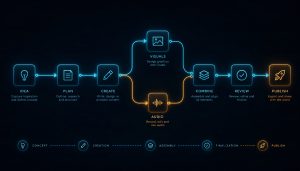
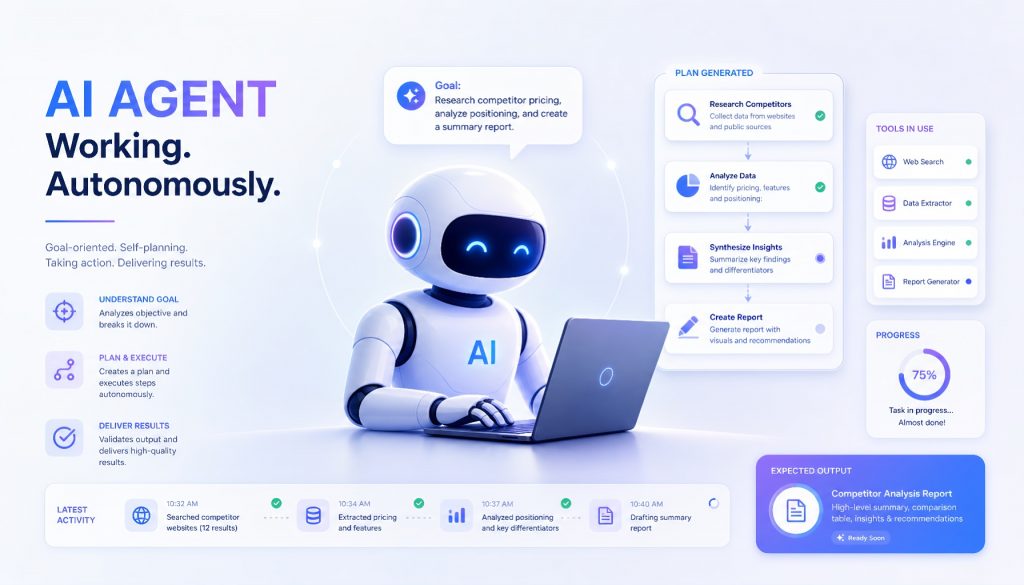
The product is called ChatGPT Work. You hand it a goal, it connects to your existing tools, breaks the task into steps, works autonomously for hours, and returns not a text response but a completed spreadsheet, slide deck, document, or shareable web app. The same day, GPT-5.6 went live, Codex Desktop merged into the main ChatGPT application, and the standalone Atlas browser began its quiet sunset.
This isn’t a feature update. It’s a convergence event. And it raises uncomfortable questions for every B2B SaaS company that sells productivity tools.
The Output Problem Finally Got Fixed
For two years, the AI industry lived with an awkward mismatch. Models kept getting smarter. Benchmarks kept falling. But the user experience barely changed. You asked ChatGPT a question, you got text. You asked for analysis, you got text. You asked for a project plan, you got text.
Text is AI’s default output format. But work products aren’t text.
A market analysis is a slide deck with charts. A project schedule is a Gantt chart. A competitive review is a multi-dimensional comparison table. What professionals need isn’t an AI that says “consider analyzing across these five dimensions.” They need the analysis already done, data already populated, formatting already handled.
ChatGPT Work skips the advisory phase entirely. It goes straight to delivering finished artifacts. OpenAI’s own product page puts it bluntly: you provide an outcome, and the system figures out how to get there with minimal prompting, adjusting its approach as the work unfolds.
In practical terms, this means you say “build me a Q3 competitive analysis covering these five companies” and then go do something else. When you come back, there’s a polished deliverable waiting.
A Product Born From User Misbehavior
Here’s the origin story that matters. Codex was designed for software developers. That was the intended audience, the marketing angle, the pricing model. Then a million non-technical users showed up and started using it for research, reports, and data processing.
When users find unintended uses for your product, you have two options: push them back into the intended lane, or pave the road they’re already driving on. OpenAI paved the road.
ChatGPT Work exists because of user behavior, not because of a product roadmap brainstorm. This is a pattern worth watching. The most successful AI products over the next few years will likely emerge the same way: companies observing how people actually misuse their tools, then building official products around those behaviors.
The Atlas Browser Is Dead. That Tells You Something.
A piece of news that flew under most radars: OpenAI is phasing out Atlas, its standalone AI browser that launched earlier this year.
When Atlas shipped, the assumption was that OpenAI wanted to challenge Chrome with an AI-native browser. The reality lasted less than six months. Atlas is now being folded back into ChatGPT Desktop as a built-in capability.
The product logic here deserves attention. An AI agent doesn’t need a dedicated browser. It needs browsing as one capability among many, embedded inside a unified assistant shell. The browser becomes a tool the agent uses, not a container the agent lives inside.
This has direct implications for startups building AI browsers. If OpenAI, with its engineering depth and distribution advantages, couldn’t sustain a standalone AI browser as a product category, that thesis is probably dead. Teams in this space need to pivot toward becoming capabilities that agents consume, rather than standalone applications that consumers launch.
The durable pattern is becoming clear: agents embed browsing. Browsers don’t embed agents.
1,400 Connectors and the Integration Arms Race
ChatGPT Work connects to over 1,400 plugins spanning calendars, email, documents, spreadsheets, project management platforms, CRMs, and databases. You mention an app with @, and Work pulls data from it. It can cross-reference your Salesforce pipeline with Google Calendar meeting notes and generate a client communication summary without you touching either system.
This reveals something critical about the economics of AI agents: an agent’s value isn’t determined by how smart it is. It’s determined by how many of your systems it can access.
OpenAI promotes the plugin count as a headline metric for good reason. In the agent era, integration depth equals product strength. Whoever connects to more systems, whoever can pull richer context from your daily workflow, builds the more useful agent.
This creates a familiar dynamic. We’ve seen integration moats before in the SaaS world. Salesforce, HubSpot, and Slack all grew partly by becoming integration hubs that were too connected to rip out. OpenAI is running the same playbook, but the stakes are higher because an agent with access to your email, calendar, file system, and CRM simultaneously creates an exponentially larger attack surface.
| Factor | Traditional SaaS Integration | Agent-Era Integration |
|---|---|---|
| Data access scope | Single app context | Cross-app, full workflow |
| Autonomy level | User-triggered actions | Self-directed multi-step tasks |
| Security surface | API permissions per app | Compound permissions across systems |
| Vendor lock-in mechanism | Data gravity | Context accumulation |
| Switching cost driver | Migration effort | Retraining the agent on your patterns |
The security implications here are non-trivial. Enterprise security teams are used to evaluating risk per integration. An agent that chains ten integrations together in a single task creates compounding risk that existing frameworks don’t model well.
The Pricing Signal You Shouldn’t Ignore
OpenAI didn’t put ChatGPT Work on a simple subscription tier. They introduced usage-based metering. You pay based on compute consumed: longer tasks, more plugin calls, and larger data volumes all increase the bill.
This pricing choice reveals OpenAI’s internal assumption about usage variance. Some users will run one simple report per week. Others will have Work processing complex projects for hours daily. A flat subscription would either overcharge light users or subsidize heavy ones without constraint.
For enterprise procurement teams, though, usage-based pricing means unpredictable costs. Budgeting becomes harder. This could slow enterprise adoption in the short term, especially at organizations that require annual budget commitments before deploying new tools.
The counter-argument is that usage-based pricing aligns cost with value delivered. If Work saves 40 hours of analyst time in a month, the metered cost is easy to justify. But justifying variable costs requires different internal processes than justifying a $200/seat/month line item. Procurement habits change slower than technology.
What This Means for B2B SaaS Companies
If you build productivity software, July 9 should be circled on your calendar. Not because ChatGPT Work is going to kill your product tomorrow, but because it reshapes the competitive environment in three specific ways.
First, the “AI copilot” feature you shipped last quarter is no longer a differentiator. Every SaaS product added AI text generation in 2024 and 2025. That’s now table stakes. The new bar is agent-level task completion, where the AI doesn’t suggest next steps but executes them across systems. If your AI feature still requires the user to copy-paste its output somewhere else, you’re already behind.
Second, your product might become a connector rather than a destination. When an agent can pull data from your tool, transform it, and push results to another tool without the user ever opening your UI, your application becomes infrastructure. That’s not necessarily bad for revenue, but it changes your relationship with the user. You’re no longer the interface they interact with. You’re a data source an agent queries.
Third, the integration catalog becomes existential. If ChatGPT Work connects to your competitor but not to you, customers will switch to whichever tool the agent supports. Being absent from the plugin directory is like being absent from the app store in 2012. You technically still exist, but you’re invisible to the fastest-growing distribution channel.
The Real Skill Gap Ahead
Before ChatGPT Work, getting AI to actually help required real skill. You needed to understand prompt engineering principles, know how to decompose tasks, judge output quality, and manually convert AI text into final deliverables. Most people gave up at step two.
Work compresses that entire sequence. No prompt expertise needed. No manual task decomposition. No format conversion between AI output and final artifact. You state a goal, you receive a finished product.
But compression isn’t elimination. You still need to know which goals are worth pursuing. You still need to evaluate whether the output meets your quality bar. You still need to decide when to intervene and redirect. The judgment threshold hasn’t dropped. Only the execution threshold hit the floor.
This points to a shift that’s been forming for a while. The scarce resource in an AI-saturated environment isn’t the ability to operate tools. It’s the ability to define what’s worth building. Strategy, taste, and domain expertise become more valuable precisely because execution becomes cheaper.
The Question Nobody Wants to Answer
OpenAI made the tense shift official. Agents aren’t future tense anymore. They’re present tense.
But here’s the uncomfortable follow-up: when everyone has access to the same agent producing the same quality of output, where does competitive advantage live?
It’s not in execution speed. The agent handles that. It’s not in tool proficiency. The agent abstracts that away. It’s not even in information access, because the agent can reach the same 1,400 data sources for your competitor that it reaches for you.
What remains is judgment. Knowing which question to ask. Recognizing when the output is wrong in ways that look right. Understanding your market deeply enough to spot what the agent missed.
That’s a harder skill to hire for than “proficient in Excel” or “strong with AI tools.” And it’s a harder skill to train. No certification program teaches taste. No bootcamp produces strategic intuition.
The companies that win in this environment won’t be the fastest adopters of agent technology. They’ll be the ones with the clearest sense of what they’re trying to accomplish and the judgment to know when the agent got it right.
Tools are converging. The differentiation that matters is upstream of the tool.
Related Reading
- ChatGPT Work: OpenAI Agents Now Deliver Finished Work, Not Chat Replies
- ChatGPT Work Is OpenAI Bet That AI Should Deliver Finished Work, Not Just Advice
Stay updated with our latest AI insights