PagerDuty works great, but it’s insanely expensive.
A 30-person engineering team on Business plan pays $41/person/month—$14,760 annually before adding AIOps, Event Intelligence and other add-ons. Many teams use it for 2-3 years before realizing: the features they actually use might only justify 40% of the bill.
On Reddit’s r/devops, complaints appear regularly: “PagerDuty is insanely expensive for the value they actually offer.” This isn’t isolated—a 100-person tech department head calculated that PagerDuty’s annual cost could hire half a junior SRE. Since 2025, two major events shook the incident management market: Atlassian announced Opsgenie’s discontinuation (no new purchases after June 4, 2025), and FireHydrant acquired Blameless completing integration. The market landscape is reshuffling—now is the best time to reevaluate your choices.
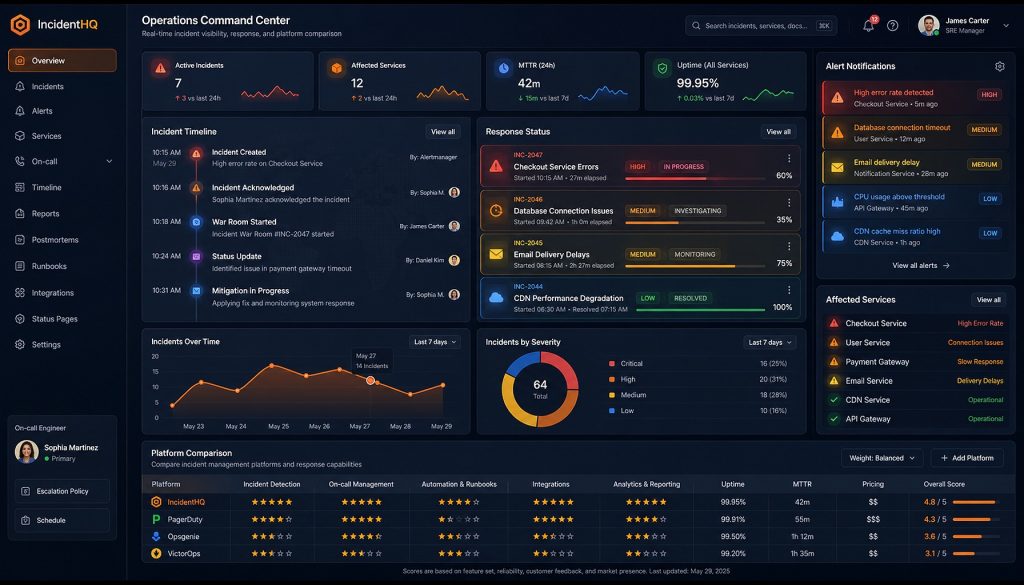
This article won’t give wishy-washy “each has pros and cons” conclusions. I’ll dissect 5 mainstream PagerDuty alternatives across pricing, core features, integration ecosystem, and onboarding experience, concluding with clear selection guidance.
Why Look for PagerDuty Alternatives?
Honestly, PagerDuty’s product capability isn’t problematic. Its issues lie in three areas:
First, suffocating pricing model. Professional plan at $21/person/month seems reasonable until you discover core features are locked in Business ($41/person/month) or Digital Operations (contact sales). Event Intelligence, AIOps, Change Events—features that genuinely reduce alert fatigue—all cost extra. A 50-person team upgrading from Professional to Business + AIOps sees annual fees jump from $12,600 straight to $30,000+. This isn’t upgrading, it’s hostage-taking. More frustratingly, monthly payment costs nearly 30% more than annual—Professional monthly is $29/person/month, Business monthly $49/person/month. Want to trial for two months? Pay the premium first.
Second, product bloat. PagerDuty has aggressively expanded categories—Process Automation, Customer Service Ops, Status Page—but core on-call scheduling and alert routing experience hasn’t noticeably improved. Setting up one schedule rule requires clicking through 5-6 pages, initial configuration often takes 1-2 weeks. One G2 user’s review nailed it: “Complexity of initial set-up is a major pain point.”
Third, missing Slack-native experience. It’s 2026, and most engineering teams’ communication hub is Slack. While PagerDuty has Slack integration, it’s essentially “independent platform + notification push” mode. You can’t complete incident declaration, escalation, coordination, and post-mortem entirely in Slack. Meanwhile newcomers like incident.io and Rootly were built around Slack from day one.
Simply put, PagerDuty’s problem isn’t “doesn’t work,” but “value proposition increasingly weak.” The market now has cheaper, more modern, workflow-native choices.
5 Best PagerDuty Alternatives Deep Comparison
1. incident.io — Modern Slack-Native Choice
incident.io is the most watched newcomer in this wave of incident management tools. Founded in 2021, by 2026 it’s secured notable mid-to-large clients (including Etsy, Skyscanner, HashiCorp). Its core selling point is simple: entire incident lifecycle completes inside Slack.
Pricing: Team plan $19/person/month, adding On-Call brings actual cost to ~$31/person/month. Pro plan $45/person/month (includes AI SRE assistant). Compared to PagerDuty Business at $41/person/month, incident.io’s Team+On-Call combo is ~25% cheaper with more comprehensive features.
Core strengths:
- Slack-first architecture: Declare incidents, pull people in, escalate, update status, write post-mortems—all in Slack channels. No platform switching.
- Catalog functionality: Model your services, teams, dependencies as a graph; when incidents occur, automatically correlate affected services and on-call owners.
- AI-driven post-mortems: Auto-generates post-mortem drafts from Slack conversations and timelines, saving 2-3 hours of manual compilation.
- Built-in Status Page: No need to separately purchase Statuspage or Instatus.
Integration ecosystem: Supports Datadog, Grafana, Prometheus, PagerDuty (yes, can supplement PagerDuty), Jira, Linear, GitHub, Opsgenie and 40+ integrations.
Shortcomings:
- On-Call only launched in 2023, less mature than PagerDuty in scheduling complexity (multi-layer escalation, timezone rotation).
- Microsoft Teams support weaker than Slack. If your team primarily uses Teams, this isn’t optimal.
- Pricing transparency mediocre—website doesn’t directly display complete pricing, requires sales contact.
Best for: Slack-first mid-size teams (20-150 people) wanting all-in-one incident response + on-call, willing to pay premium for modern UX. Real case: A SaaS company with 45-person engineering team migrated from PagerDuty Business to incident.io Team+On-Call, monthly cost dropped from $1,845 to $1,395 while MTTR decreased 35%—because engineers no longer switched between Slack and PagerDuty.
2. Opsgenie — Stable Atlassian Ecosystem Choice
Start with crucial fact: Atlassian stopped Opsgenie new purchases in June 2025, End of Support date is April 5, 2027. This means Opsgenie is in “maintenance mode” with no major feature updates coming. Atlassian’s official recommendation is migrating to Jira Service Management (JSM).
But for existing users, Opsgenie remains usable in 2026, and if you’re deeply embedded in Atlassian ecosystem, JSM’s on-call functionality is essentially Opsgenie’s continuation.
Pricing: Essentials $9/person/month, Standard $29/person/month. This is one of the market’s highest value tiers. Essentials at $9/person/month includes basic on-call scheduling, alert routing, integrations—sufficient for small teams.
Core strengths:
- Deep Atlassian integration: Seamless with Jira, Confluence, Bitbucket, Statuspage. Incidents auto-create Jira tickets, post-mortems sync to Confluence.
- Alert routing rule engine: Supports multi-condition filtering, deduplication, grouping—rule complexity matches PagerDuty.
- Mature scheduling system: Multi-layer escalation, shift coverage, timezone auto-adaptation—has everything PagerDuty has.
- Clear price advantage: $9/person/month Essentials is 43% of PagerDuty Professional’s price.
Integration ecosystem: 200+ integrations covering all mainstream monitoring (Datadog, New Relic, Grafana, Prometheus, Zabbix), communication (Slack, Teams), ticketing (Jira, ServiceNow).
Shortcomings:
- Product approaching EOL. While usable until April 2027, no new features coming. Not recommended for new teams.
- JSM migration has pitfalls. Atlassian provides automated migration tools, but user feedback shows incomplete format compatibility, complex rules need manual rebuild.
- Weak standalone incident response capability. It’s essentially alerting + on-call tool, doesn’t cover complete incident lifecycle like incident.io/Rootly.
- Dated UI with no significant updates in recent years.
Best for: Teams already deeply using Atlassian ecosystem (Jira + Confluence) can directly migrate to JSM. If you’re a new user, not recommended to start now.
3. Rootly — Automation-Driven Newcomer
Rootly is another Slack-native incident management tool, but its differentiation from incident.io lies in: extreme emphasis on automation and workflow orchestration. If incident.io is “making people handle incidents more efficiently in Slack,” Rootly is “having machines automatically handle 80% of repetitive incident operations.”
Pricing: Essentials $20/person/month (Incident Response or On-Call each standalone), Scale plan requires sales contact. 50-person team’s IR + On-Call combo runs ~$24,000 annually (list price), typically negotiable to 15-25% discount through procurement platforms like Vendr.
Core strengths:
- Workflow automation engine: Rootly’s biggest differentiator. You can define: when P1 incident declared, auto-create Slack channel, pull on-call engineers, create Jira ticket, notify management, start Zoom bridge—entirely zero-touch.
- AI SRE capability: Through AI Labs, Rootly released SRE-specific benchmarks; its AI assistant auto-analyzes alert patterns, recommends root causes, generates post-mortem drafts.
- Deep Slack integration: Similar Slack-first experience to incident.io, incident full lifecycle completes in Slack.
- Flexible On-Call: Standalone On-Call product launched 2024, supports multi-timezone rotation, auto-schedule generation.
Integration ecosystem: Datadog, Grafana, Prometheus, New Relic, PagerDuty, Jira, Linear, GitHub, GitLab, Slack, Teams, Zoom and 50+ integrations.
Shortcomings:
- Steep learning curve. Powerful workflow automation requires time to configure. Team feedback: initial setup typically needs 1-2 weeks to reach “automation actually running” state.
- Relatively young On-Call product. Only launched standalone in 2024, less polished than PagerDuty in edge-case schedule rule handling.
- Insufficient pricing transparency. Scale plan requires sales contact, final price heavily influenced by contract length and user count.
Best for: Medium-large teams (30-200 people) with high incident frequency, many repetitive operations, wanting automation to drastically reduce MTTR. If your team handles 5+ incidents weekly, Rootly’s automation ROI becomes very obvious.
4. FireHydrant — Enterprise-Grade Reliability Platform
FireHydrant pursues “full-stack reliability platform” approach. After acquiring Blameless in August 2024, it integrated incident response, SLO management, post-mortems, status pages into one platform. Clear positioning: provide end-to-end reliability solution for 100+ person engineering organizations.
Pricing: Starter $20/person/month, Advanced $44/person/month. Annual contracts start around $9,600 (G2 data). Enterprise plan requires sales contact. Not cheap, but considering it covers incident response + SLO + status page + post-mortem + runbooks, actually more economical than PagerDuty Business + Statuspage + third-party SLO tool combination.
Core strengths:
- Runbooks system: FireHydrant’s most underrated feature. You can predefine standard operating procedures for different incident types, auto-execute corresponding runbook when incidents trigger. For scenarios like “database primary-replica failover,” runbooks ensure consistent execution steps every time, reducing human error.
- Built-in Status Page: No need to separately buy Statuspage or Instatus. Supports public and internal views.
- SLO management (Blameless integration): Acquired complete SLO tracking + error budget management capability from Blameless acquisition.
- Signals (On-Call): Alerting product launched 2024, charges by alert volume not headcount—more favorable for teams with high alert volume but few responders.
Integration ecosystem: Datadog, New Relic, Grafana, AWS CloudWatch, Prometheus, Slack, Teams, Jira, Linear, GitHub, PagerDuty, Statuspage and 60+ integrations.
Shortcomings:
- High product complexity. Comprehensive features come at cost of high onboarding barrier. Team feedback: requires 2-4 weeks to complete initial configuration and process mapping.
- Slack integration not as deep as incident.io/Rootly. FireHydrant’s main interface is standalone web UI, Slack more for notifications and quick actions.
- Post-mortem still integrating. Less than two years since Blameless acquisition, PIR (Post-Incident Review) functionality still has optimization room.
- Not cost-effective for small teams. If you only need on-call + alerting, Starter $20/person/month doesn’t buy full functionality.
Best for: Large engineering organizations (100+ people) needing all-in-one reliability platform (beyond just incident management), willing to invest time in deep configuration. Especially suitable for teams already practicing SLOs but with fragmented tooling.
5. Squadcast — Value Champion
Squadcast (acquired by SolarWinds in 2024, now SolarWinds IT Incident Response) is the lowest priced among these five tools. Its positioning is clear: provide 80% of PagerDuty’s core features, charge only 30-50% of the price.
Pricing: Free plan $0 (up to 5 users), Pro $9/person/month, Premium $16/person/month, Enterprise $21/person/month (all annual pricing). This pricing structure is eye-opening—Enterprise at $21/person/month matches PagerDuty Professional’s price but delivers Business-level features.
Core strengths:
- Price crushing: 30-person team, PagerDuty Business annual fee $14,760; Squadcast Enterprise annual fee $7,560. The $7,200 savings could buy a year of Datadog standard plan.
- Feature-complete: On-call scheduling, alert routing, escalation policies, incident response, SLO tracking, post-mortems, status page—all built-in. No PagerDuty-style à la carte pricing for each feature.
- Event Intelligence (no extra charge): Alert deduplication, grouping, suppression—features requiring PagerDuty AIOps add-on are included in Squadcast Premium.
- Migration-friendly: Provides PagerDuty one-click import tool, schedules, integrations, user data can migrate directly.
Integration ecosystem: Datadog, Grafana, Prometheus, New Relic, AWS CloudWatch, Slack, Teams, Jira, ServiceNow, Zendesk and 100+ integrations.
Shortcomings:
- Low brand recognition. Post-SolarWinds acquisition, brand positioning somewhat ambiguous (SolarWinds brand doesn’t add points in SRE circles).
- Weak Slack-native capability. It’s an independent platform model, Slack only notification channel. If you want Slack-first experience, this isn’t the right choice.
- AI/automation capabilities behind. Compared to incident.io and Rootly’s AI-driven post-mortems and auto root cause analysis, Squadcast’s intelligence level is noticeably lower.
- Mediocre UI/UX. Functional but won’t make you think “really well designed.” Mobile app reviews are average.
Best for: Budget-sensitive small-medium teams (5-50 people) needing complete incident management functionality without PagerDuty’s price tag. Especially suitable for teams migrating from PagerDuty whose primary needs are on-call + alerting.
Selection Decision: Choose Based on Team Context
Choosing incident management tools shouldn’t start from “most features” but from your team’s actual situation. Here’s a clear decision framework:
By team size:
| Team Size | First Choice | Second Choice | Rationale |
|---|---|---|---|
| < 20 people | Squadcast Pro ($9) | Opsgenie→JSM | Cheap and sufficient, no complex automation needed |
| 20-100 people | incident.io | Rootly | Slack-native efficiency gains clear, automation ROI emerges |
| > 100 people | FireHydrant | incident.io Pro | Need SLO + runbooks + enterprise auditing |
By core requirement:
- “I just want to save money” → Squadcast Enterprise ($21/person/month), features match PagerDuty Business, price cut in half.
- “Our team lives in Slack” → incident.io or Rootly. Former has better UX, latter stronger automation.
- “We’re heavy Atlassian users” → Migrate directly to Jira Service Management, Opsgenie functionality already built-in.
- “I need complete reliability platform” → FireHydrant, one platform handles incident + SLO + status page + runbooks.
- “I want strongest AI and automation” → Rootly (workflow automation) or incident.io Pro (AI SRE assistant).
Pitfall avoidance:
- Don’t purchase Opsgenie now. It EOLs April 2027, you’ll inevitably migrate again.
- Don’t just look at unit price. PagerDuty’s $21/person/month Professional lacks too many key features, realistically you’ll likely upgrade to $41 Business.
- Contract negotiation has room. incident.io, Rootly, FireHydrant typically negotiable to 15-25% discounts through procurement platforms like Vendr. Annual payment ~20% cheaper than monthly.
Summary
If I had to give one direct recommendation:
Most Slack-first mid-size teams, choose incident.io. It has the best product experience among these tools, unmatched Slack integration depth, and On-Call product maturing rapidly. $31/person/month (Team + On-Call) is 25% cheaper than PagerDuty Business with noticeably better experience.
Budget-constrained or simple-requirement small teams, choose Squadcast. $9-21/person/month price range covers 90% of on-call and alerting needs, money saved can invest in monitoring tools.
Large organizations needing full-stack solution, choose FireHydrant. Though high onboarding cost, the all-in-one experience of incident + SLO + runbooks + status page is more manageable long-term than cobbling multiple tools.
PagerDuty isn’t a bad product, but in 2026’s competitive landscape, its pricing strategy makes willing purchase increasingly difficult. Better options exist—evaluate while contracts expire and your team might save significant annual expenses.
Stay updated with our latest AI insights