Picture a civilian analyst inside the Department of Defense. Every day she works through stacks of policy memos, logistics reports, procurement addenda, and administrative briefs. Like most people who deal with paperwork for a living, she has, at some point, wondered whether a chatbot could help her think through the messier documents. And like most people who work with sensitive information for a living, she has never actually tried it. Pasting even an unclassified purchase order into a consumer AI product would cross a line the agency takes seriously. So she closes the browser tab and keeps reading manually, page by page.
That gap between what employees clearly want and what they are allowed to do closed on August 31, 2026.
On that day, the Department of Defense (recently renamed the Department of War) added OpenAI’s ChatGPT Mil and Starshield AI’s Grok for Government to GenAI.mil, its internal generative AI platform. According to the Department’s official announcement, ChatGPT Mil is accredited for Controlled Unclassified Information at Impact Level 5, engineered for the roughly 3 million uniformed and civilian personnel across the Joint Force. The core experience is chat, files, projects, and custom GPTs. More features will follow.
This is a piece of news that reads bigger the longer you sit with it. Not because a chatbot arrived on a government network, but because of the shape of the arrangement. The world’s most consequential single buyer of technology is telling the entire industry how it plans to buy AI for the next decade. And it is not planning to marry a vendor.
One platform, three brains
Rewind to last December. When GenAI.mil first went live, the platform shipped with a single model behind it: Google Gemini. That was unremarkable at the time. Large organizations traditionally sign one big contract, integrate one system, and simplify their lives by narrowing choices. Anything else looks like operational overhead.
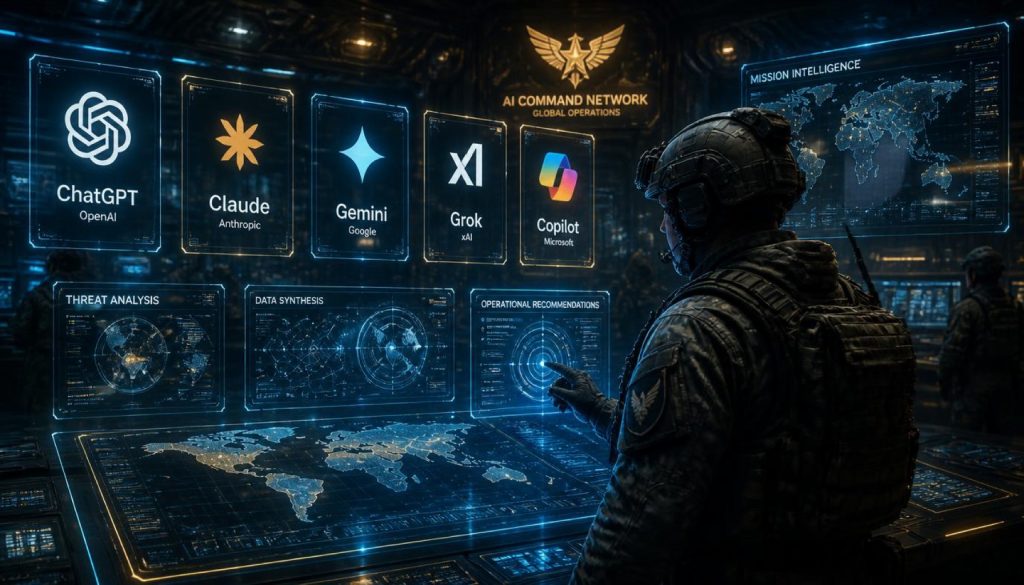
Barely eight months later, the picture is different. GenAI.mil now runs three separate frontier models from three fiercely competing companies: Gemini from Google, ChatGPT Mil from OpenAI, and Grok for Government from Elon Musk’s xAI, packaged through the Starshield AI defense arm. Three technology stacks, three teams, three sets of tradeoffs, all sitting inside the same secure wrapper, available to the same users.
Why not stick with Gemini? TechCrunch reported the Department’s reasoning almost verbatim: eliminate vendor lock-in, and encourage a broader American AI ecosystem.
Vendor lock-in has been a boring topic in enterprise IT for thirty years. Switch ERPs, migrate a database, endure some pain. But generative AI shifts the stakes. If you build the knowledge-work fabric of an entire institution on top of one model, and that model falls behind, or its owner changes pricing, or its safety posture shifts, you are no longer swapping a database. You are rebuilding how hundreds of thousands of people think through documents. The Pentagon appears to have looked at that risk and decided that owning the platform, not the model, was the right level of abstraction.
GenAI.mil is now, in effect, an app store for foundation models. Underneath sits identity, access control, audit, and compliance. Above it, models plug in. When a better one emerges, or a current one drifts, the department changes an entry, not a policy.
What IL5 actually means
The single most important detail in the announcement is the acronym almost nobody outside government contracting will recognize: IL5.
Impact Level 5 is a rung on the Department of Defense’s cloud security hierarchy. Passing it means a system is cleared to process Controlled Unclassified Information. CUI is not classified. It is also not something you want floating through consumer AI apps. Most of what a defense department actually produces day to day (planning documents, procurement records, force readiness data, HR files, policy interpretations) falls into that bucket.
That is precisely the terrain ChatGPT Mil is aimed at. The department’s own description of the workload is document-heavy unclassified work: planning, policy, logistics, administration. Nothing about targeting or intelligence exploitation. This is the boring middle of a giant institution, where the largest gains in throughput actually live.
Consider the arithmetic. Three million personnel. Most of them are not launching munitions. They are writing, editing, summarizing, and coordinating. If a compliant AI assistant recovers even a modest slice of their day, the aggregate output moves visibly at the scale of the federal budget.
The IL5 accreditation is also a shot across the industry’s bow. Model quality is now table stakes. To sell into serious government workloads, a vendor has to survive an unglamorous grind of data residency reviews, access logging, encryption profiles, tenancy isolation, and audit hooks. OpenAI cleared that bar. Whatever people think of the company’s consumer strategy, its enterprise team spent the last two years building the infrastructure that lets a chatbot sit on a Pentagon network.
From pilot to procurement doctrine
The department frames this launch as the adoption phase of an enterprise partnership OpenAI and DoD established in 2025. That word “adoption” is doing work. In federal AI, most projects die between pilot and production. They stall in pilot forever, or they graduate to a small operational carveout that never scales. Getting from a 2025 memorandum to a 300-million-person rollout in a year, in this environment, is unusually fast.
The initiative runs through the Chief Digital and AI Office. It is explicitly linked to the White House’s AI Action Plan. This is not a subordinate command’s side project. It is a coordinated push, with political backing, that touches every branch and every function.
Pull the strands together and you can see the shape of a procurement doctrine. The department is standardizing on four principles, whether or not it uses those words.
The first is platform primacy. Do not stand up a new stack every time a new model arrives. Build one secure environment, and let models compete for placement inside it. This changes the marginal cost of adding an AI vendor from painful to trivial.
The second is multi-model by default. Never all-in on one supplier. Gemini, ChatGPT Mil, and Grok live side by side. Whichever performs best on a workload wins that workload. If one falls behind, the traffic mix quietly shifts. The user does not need to know or care.
The third is compliance first. Nothing lands on the platform until it passes the accreditation. IL5 is the gate. If you cannot get there, you do not get in. This is why the Grok for Government path through Starshield AI matters. Grok arrived via a defense-grade sponsor, not through a bolt-on.
The fourth is controlled openness. As NOTUS reported, part of the rationale for adding Grok was practical: employees were going to try these tools anyway. Better to give them a sanctioned option than to leak data through personal accounts. That kind of realism about human behavior is rare in institutional IT policy.
What this changes for everyone downstream
You might reasonably wonder what any of this has to do with a startup, a mid-market IT team, or a solo developer. More than you would think.
The Pentagon is a market maker. When it locks in a purchasing pattern, other federal agencies follow. State governments, health systems, banks, and insurance carriers watch federal precedent and reuse the framework. IL5-style expectations will show up in enterprise RFPs before the end of next year, even from buyers who have no direct connection to defense. The definition of “AI-ready vendor” is being rewritten in public.
For AI companies, the message is direct. Benchmarks alone will not close deals of this size. The winners are the ones who can produce a coherent enterprise offering: audit logs, tenant isolation, admin controls, data residency guarantees, custom model containers. The parts of the product that never appear in a demo are becoming the parts that decide the contract.
For enterprise buyers, the Pentagon just handed you a reference architecture. The pattern is portable. You do not need a national security clearance to build a secure gateway that fronts multiple frontier models with identity, logging, and per-team access rules. That gives you leverage. Every vendor knows you can shift traffic. Nobody has a captive account.
For developers and platform builders, an interesting layer is expanding. Model routing, cost-aware fallback, evaluation harnesses, multi-model prompt adapters, unified observability across chat providers. This is not the glamour end of AI. It is where a lot of the durable work sits. When large buyers standardize on plural-model deployments, the middleware becomes the product.
The quieter competition underneath
Look at the specific combination on the platform. Gemini from Google. ChatGPT Mil from OpenAI. Grok for Government, delivered through Starshield AI, whose lineage traces back to xAI and to SpaceX’s Starshield defense unit. Three companies that spend most of their public energy going after each other now share a single government dashboard.
The interesting part is what that does to their behavior. On a shared platform, comparisons become continuous. A user picks whichever model handles the current task best. Nobody has to publish a benchmark. Millions of small choices reveal, in aggregate, which product is actually better at which slice of real work. That is a harsher and more honest form of competition than press releases.
It also relocates the strategic center of gravity. Consumer AI is a switching-cost desert. A user changes chatbot apps on a whim. Enterprise and government AI is the opposite. Once a model is placed inside a compliant platform used by millions of employees, moving it out takes months and political capital. If you are xAI, you cannot afford to be absent from GenAI.mil, even if your consumer share is a rounding error against ChatGPT. Being on the platform is the whole point. That is why the Starshield AI route existed.
Reverse the frame and you see the risk. AI vendors who fail to get accredited into this kind of platform will find themselves locked out of a category of revenue that is only going to grow. The consumer story might still be exciting. The commercial center of the industry is quietly relocating to procurement offices.
A pattern named out loud
Come back to the analyst at her desk. She opens GenAI.mil. Three model choices, one login, an IL5 boundary around everything she types. She drafts a policy memo. She summarizes a stack of contract addenda. She uses different models for different tasks without thinking much about it, the way anyone uses different apps.
That mundane experience is what a procurement doctrine looks like from the ground floor. Generative AI has moved out of pilot status and into the core productivity layer of the American federal government, on the same footing as identity systems, email, and secure file sharing. The equipment ships from three competing vendors on purpose.
If you are watching the AI industry from the outside, the takeaway is not really about which model won today. It is that the buyer with the biggest checkbook has now stated, in operational form, what it will pay for. Platform architecture. Multi-model design. Compliance up front. No lock-in.
If you sell AI, that is your spec sheet.
If you buy AI, that is your template.
The window when the market rewarded companies for having the flashiest chatbot is closing. The window for companies that can survive an IL5 review is opening. Those are not the same skill sets, and the winners of the second window will not always be the winners of the first.
The Pentagon just made that transition legible.
Related reading
- Shopify Agentic Storefronts Put Your Products Inside ChatGPT: What It Means for Ecommerce Distribution in 2026
- ChatGPT Work Is Here: What Happens When AI Agents Become Actual Products
- Which AI Data Analysis Tool Actually Works: Julius AI, ChatGPT, Noteable, and Rows Tested in 2026
- Which AI Search Tool Actually Works? Perplexity vs ChatGPT Search vs Kimi vs Metaso in 2026
- AI Translation Tools 2026: DeepL vs Google Translate vs ChatGPT vs Kimi
Stay updated with our latest AI insights

