Your biggest customer just asked for your SOC 2 report. Sales is breathing down your neck. You need a compliance automation platform, and you need it yesterday.
Two names keep coming up: Vanta and Secureframe. Both automate evidence collection, monitor controls continuously, and connect you with auditors. But they solve the same problem in fundamentally different ways — and picking the wrong one costs you months and tens of thousands of dollars.
Here’s the short version before we get into details.
The Verdict Up Front
Choose Vanta if you have an experienced security team, a complex tech stack, and you need audit-readiness in 2-4 weeks. You’re comfortable being self-directed and can stomach unpredictable renewal pricing.
Choose Secureframe if your security team is small (or nonexistent), you want expert guidance from former auditors, you care about long-term cost predictability, or you have government compliance requirements like CMMC.
One line: Vanta is the fast self-serve option. Secureframe is the guided, predictable-cost option.
Now let’s break down why.
Pricing: Year One Doesn’t Tell the Full Story
Neither platform publishes pricing publicly. Based on market data and user reports from 2026, here’s what you’re looking at:
| Vanta | Secureframe | |
|---|---|---|
| Starting price | ~$10,000/year | ~$7,500/year |
| 50-person team, single framework | $14,000-20,000/year | $14,000-20,000/year |
| Year-one discounts | Aggressive (50-70% off) | Moderate |
| Renewal increases | Unpredictable (40-100% reported) | Predictable (5-10%/year) |
Here’s the thing most comparison articles won’t tell you: Vanta’s first-year price is almost always cheaper. They discount heavily to win deals. But users consistently report renewal shock — increases of 40% to 100% with little negotiating room.
Secureframe’s renewals typically land between 5-10%. You can budget for it.
If you’re signing a one-year contract to solve an immediate SOC 2 need, Vanta’s first-year pricing wins. If you’re thinking in three-year terms, do the math on Secureframe’s predictable increases versus Vanta’s unpredictable ones. The total cost of ownership often favors Secureframe over a multi-year period.
Integrations: Where Your Evidence Actually Comes From
The whole point of compliance automation is that it pulls evidence from your existing tools instead of you screenshotting everything manually. More integrations means less manual work during audits.
Vanta: 400+ native integrations. AWS, Azure, GCP, GitHub, Jira, Slack, Datadog, CrowdStrike, Snowflake, Workday, BambooHR, Gusto, Rippling — basically every mainstream SaaS tool you’d expect.
Secureframe: 300+ integrations. Covers all the major platforms, but has gaps in long-tail tools.
This matters more than it sounds. If you’re running a stack with niche monitoring tools, specialized HR platforms, or less common cloud services, Vanta is more likely to pull evidence automatically. With Secureframe, you might end up uploading screenshots manually for those gaps — which adds up to real time during continuous monitoring.
For teams with a standard AWS/GitHub/Slack stack, both platforms cover you fine. The integration gap only becomes painful with complex or unusual tooling.
Framework Coverage: Secureframe Goes Wider
Vanta supports 35+ compliance frameworks: SOC 2, ISO 27001, HIPAA, PCI DSS, GDPR, FedRAMP, and more.
Secureframe supports 40+ frameworks and has a clear edge in government and defense compliance: CMMC, GovRAMP, TX-RAMP, and StateRAMP with end-to-end certification workflows.
If your customers include government agencies or defense contractors, Secureframe is essentially your only serious option among compliance automation platforms. Vanta has some government framework support, but it doesn’t go as deep.
Cross-Framework Mapping
Secureframe has a genuinely useful feature here: when you complete SOC 2 and then start ISO 27001, roughly 60% of your evidence maps directly across. You don’t re-collect it. For companies that need multiple certifications — and most growing B2B SaaS companies eventually do — this eliminates a massive amount of duplicate work.
Vanta offers similar cross-mapping capabilities, but Secureframe’s implementation gets better user reviews for accuracy and completeness.
AI Features: Vanta Is More Aggressive
Vanta’s AI Agent 2.0 (launched in late 2025) does three things that matter:
- Auto-generates audit-grade security policies based on your actual infrastructure
- Fills security questionnaires using your compliance data as context
- Proactively flags risk items before they become audit findings
Secureframe’s AI is more conservative — it helps with search, surfaces suggestions, and assists with documentation, but doesn’t attempt the “autopilot” approach Vanta takes.
Here’s my honest take: AI shouldn’t be your primary decision factor for a compliance platform in 2026. It’s nice to have, but what actually determines your day-to-day experience is evidence collection coverage, auditor communication, and maintenance workload. AI-generated policy documents still need human review. AI-filled questionnaires still need a security engineer to verify the answers aren’t hallucinated.
If you’re choosing between these two platforms primarily because of AI features, you’re optimizing for the wrong thing.
Support and User Experience: The Biggest Difference
This is where the two platforms diverge most sharply — and where most teams should focus their decision.
Vanta: Self-Serve by Design
Vanta’s platform is well-designed with solid documentation. You can figure most things out on your own. But when you hit a compliance question that isn’t about the platform itself — “Is this control appropriate for a 15-person startup?” or “Will an auditor accept this evidence format?” — you’re largely on your own.
This works great if you have a security team that’s been through audits before.
Secureframe: Built-In Compliance Experts
Secureframe includes access to compliance specialists who are former auditors. They answer qualitative questions about your specific situation. Multiple user reviews cite this as their primary reason for choosing Secureframe over Vanta.
When you don’t have a dedicated security person — which is reality for most startups under 100 employees — having someone who can tell you “that policy is overkill for your stage” or “an auditor will flag this gap” saves weeks of guessing.
What the Review Scores Say
| Platform | G2 Rating | G2 Reviews | Capterra Rating |
|---|---|---|---|
| Vanta | 4.6/5 | 2,300+ | 4.2/5 |
| Secureframe | 4.7/5 | 789+ | 4.8/5 |
Vanta has significantly more reviews (it’s the market leader by install base), but Secureframe consistently scores higher on satisfaction, particularly for support quality.
Time to Audit-Readiness
Vanta: 2-4 weeks. This is one of its biggest selling points. If you have a contract that’s blocked on SOC 2 compliance, Vanta’s speed advantage is real and measurable.
Secureframe: 4-8 weeks. Slower, but the guided process tends to produce more thorough results. You’re less likely to have gaps that surface during the actual audit.
Important caveat: These are audit-readiness timelines, not “report in hand” timelines. SOC 2 Type 2 requires a minimum 3-6 month observation period regardless of which platform you use. Nobody skips that.
If your timeline pressure is “we need to show something to a prospect next month,” Vanta’s speed wins. If your timeline is “we need our Type 2 report by Q4,” both platforms get you there comfortably.
When Neither Platform Is Right
Before you commit $10K+ to either platform, make sure compliance automation is actually what you need:
If your core problem is financial close and consolidation — you want Planful or Oracle EPM, not a compliance platform.
If you’re under 20 people, only need SOC 2, and budget is tight — look at Sprinto or Drata first. Their entry-level pricing is more startup-friendly, and for a straightforward SOC 2 at a small company, you don’t necessarily need Vanta or Secureframe’s full feature set.
If you’re currently managing compliance in spreadsheets and it’s working fine — don’t rush to buy a platform. Compliance automation amplifies whatever process you already have. If your process is messy, the platform makes the mess more visible; it doesn’t fix it. Get your controls documented and your evidence collection process working manually first.
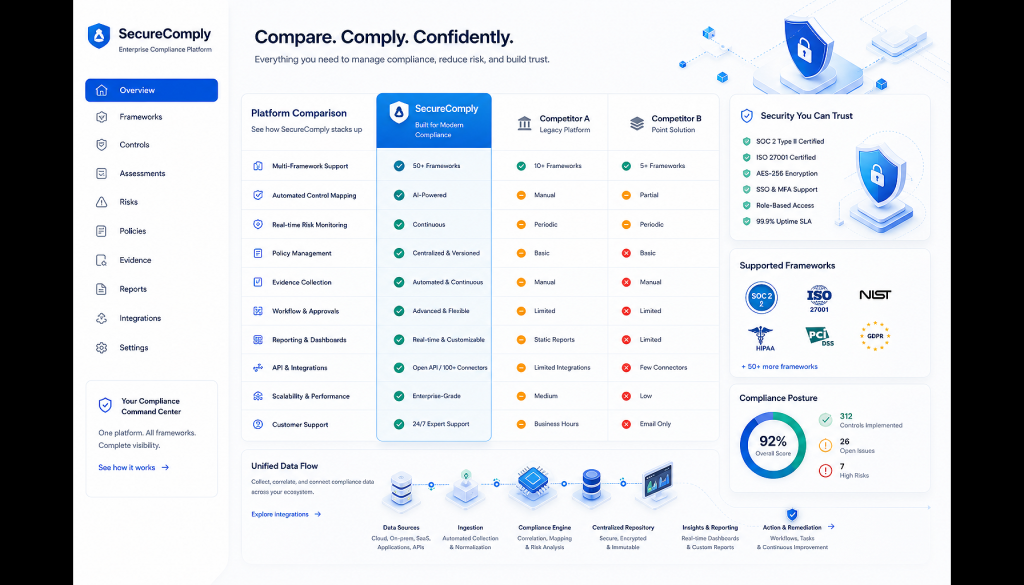
Head-to-Head Comparison Table
| Dimension | Vanta | Secureframe |
|---|---|---|
| Audit-readiness speed | 2-4 weeks | 4-8 weeks |
| Starting price | ~$10,000/year | ~$7,500/year |
| Renewal increases | Unpredictable (40-100%) | Predictable (5-10%) |
| Native integrations | 400+ | 300+ |
| Frameworks supported | 35+ | 40+ |
| Government compliance | Available, not deep | Strong (CMMC end-to-end) |
| AI capabilities | Aggressive (Agent 2.0) | Conservative |
| Expert support | Self-serve focused | Built-in former auditors |
| Best for | Experienced security teams | Teams without dedicated security |
| G2 rating | 4.6 (2,300+ reviews) | 4.7 (789+ reviews) |
Decision Tree: Which One Fits Your Situation?
Go with Vanta if:
- You have at least one person who’s been through a SOC 2 audit before
- Your tech stack includes 20+ SaaS tools that need evidence collection
- You need audit-readiness in under a month
- You’re okay with potential renewal price increases
- You value platform speed and AI automation over hand-holding
Go with Secureframe if:
- You don’t have a dedicated security or compliance person
- You need government compliance (CMMC, StateRAMP, GovRAMP)
- Predictable long-term costs matter more than first-year savings
- You want someone to tell you when your controls are sufficient (not just whether they exist)
- You’re planning to add multiple frameworks over the next 2-3 years
Frequently Asked Questions
Can I switch from one to the other later?
Yes, but it’s painful. Expect 4-8 weeks of migration work, re-mapping controls, and re-connecting integrations. The compliance data doesn’t port cleanly between platforms. Switching during an active audit cycle is especially messy. Pick carefully upfront.
Do I still need an auditor with either platform?
Yes. Both platforms prepare you for the audit and connect you with auditor partners, but neither replaces the audit itself. SOC 2 reports still require an independent CPA firm. Both Vanta and Secureframe have auditor partner networks with pre-negotiated rates.
What about Drata?
Drata is the third major player in this space. It positions between Vanta and Secureframe on most dimensions. If you’ve already narrowed your choice to Vanta vs Secureframe specifically, you’ve likely already considered and ruled out Drata. If not, it’s worth a look — especially if you value UI design and are price-sensitive.
How long does the full SOC 2 process take?
From zero to Type 2 report: typically 6-9 months minimum. The platform gets you audit-ready in weeks, but Type 2 requires a 3-6 month observation window where your controls are running and being monitored. Type 1 (point-in-time) can be done faster — roughly 2-4 months total.
Is the pricing negotiable?
Always. Both platforms offer discounts for multi-year commits, startup programs, and end-of-quarter deals. Vanta’s startup program offers significant discounts for companies under a certain headcount or funding stage. Secureframe runs similar programs. Never pay list price without asking.
Final Thought
A compliance platform is an accelerator, not a solution. What actually determines whether your audit goes smoothly is internal process discipline, data quality, and team follow-through. The best platform in the world can’t fix a team that doesn’t assign control owners or lets evidence collection lapse for months.
Pick the platform that matches your team’s maturity level. If you’ve got the security chops, Vanta’s speed and automation let you move fast. If you’re building your compliance practice from scratch, Secureframe’s expert guidance keeps you from making expensive mistakes early on.
Either way, you’re going to pass your audit. The question is just how much it costs you in time, money, and frustration along the way.
Stay updated with our latest AI insights