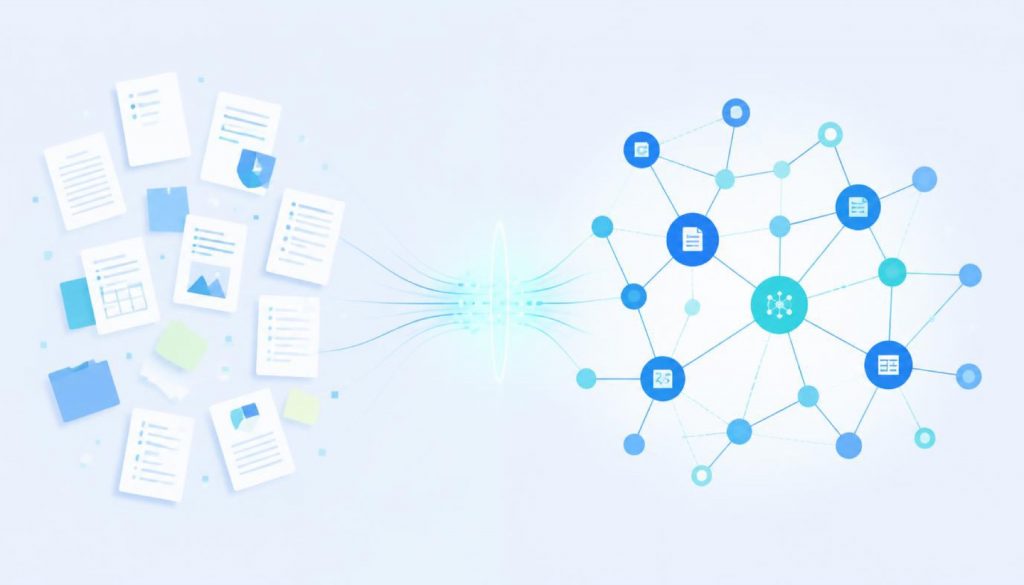
There’s a problem almost every team hits once it reaches a certain size.
A new hire’s first day: HR drops a folder link in their chat. Inside sits three years of company policies, seven or eight versions of the operations manual, and a pile of FAQs that may or may not still be accurate. They spend two hours reading. Their first real question still goes to a veteran colleague: “Which expense form do I fill out?”
The colleague, without looking up, pastes a link back. “Just look it up yourself.” The link opens a 200-page PDF.
This isn’t a productivity problem. It’s a problem with how knowledge exists. Documents sit there quietly. Nobody asks them anything, so they never speak.
WeKnora: a knowledge platform that grew out of the WeChat ecosystem
WeKnora’s project description is a single sentence: turn raw documents into queryable RAG, autonomously reasoning agents, and self-maintaining wikis.
That sounds broad, but the three things hang together logically.
The first is quick Q&A. Upload documents, ask questions in plain language, get answers with citations back to the source. That’s baseline RAG. Nearly every platform in this category offers it.
The second is autonomous reasoning on complex tasks. WeKnora uses a ReAct-pattern agent that can decide on its own whether to search the web, call an external tool, or chain multiple steps together. You don’t have to break the problem down for it. Ask “summarize competitor activity over the last three months” and it searches, organizes, and writes the report itself. Every tool call, every intermediate result, shows up in the logs.
The third is wiki mode. This is where WeKnora does something most others don’t. The agent distills source documents into structured wiki pages, links those pages together, and keeps them updated as the underlying documents change. For teams whose documentation is large and constantly shifting, that cuts a lot of manual maintenance work.
The Tencent connections are practical too. Feishu, Notion, and Yuque can sync automatically as data sources. WeChat Work, Feishu, Slack, and Telegram can all be wired up to host a Q&A bot directly, with no separate interface to build. The platform handles more than ten document formats: PDF, Word, images, Excel, and more.
The codebase is Go. The README and code comments come in Chinese, English, Japanese, and Korean. Someone clearly put thought into reaching an international audience.
License is MIT. No deployment restrictions, no commercial strings attached.
—
RAGFlow: treating document parsing as the core problem
If WeKnora starts from “get knowledge moving,” RAGFlow starts from “read the document correctly first.”
RAGFlow comes from infiniflow, and its central bet is that most RAG systems underperform not because of retrieval algorithms but because the parsing stage already went wrong. Tables get broken apart. Text inside images doesn’t get extracted. Paragraphs get cut at odd boundaries. By the time retrieval runs, those errors are baked in and can’t be undone.
To address that, RAGFlow puts serious work into document processing. It offers multiple chunking templates tuned to different document types, such as research papers, contracts, and FAQ lists, each with a different parsing strategy. It supports MinerU and Docling as parsing backends, both of which have solid reputations for handling academic documents and complex layouts.
On the retrieval side, RAGFlow does hybrid search (vector plus keyword), and it surfaces cited passages alongside answers so users can trace where an answer came from. Some people pick RAGFlow specifically for that citation tracking.
For data sources, it connects to Confluence, S3, Notion, Discord, and Google Drive. Agent capabilities have been catching up since 2025. MCP support is in, and memory has been added.
RAGFlow sits at the top of the GitHub star rankings among tools in this category. The community is active, updates are steady. License is Apache-2.0, friendly for commercial use.
For teams dealing with inconsistent document quality, or heavy PDF report workloads, RAGFlow is worth a serious look.
—
Dify: an application development platform, not just a knowledge base
Dify has staked out further territory than the others. It doesn’t call itself a “RAG tool.” It calls itself an “LLM application development platform.” Knowledge base and RAG are components of what it does, not the whole story.
Open-sourced in May 2023, it crossed 100,000 GitHub stars in June 2025 and broke into the top 100 open-source projects globally. That number reflects real market adoption.
Dify’s main draw is visual workflow editing. You drag and drop to build AI pipelines, chaining together document retrieval, model calls, conditional logic, and external API calls, all without writing code. For teams that want to ship a working prototype fast and don’t want to touch the underlying machinery, the barrier is low.
Knowledge base is one module within Dify. You can upload documents, configure chunking, run hybrid retrieval, then wire it into a workflow or a conversational app. The quality is solid, though the depth of document parsing isn’t at the same level as a dedicated RAG tool like RAGFlow. That’s just not where Dify puts its weight.
Dify ships with 50+ built-in tools for agent calls and supports hundreds of models, covering the major commercial and open-source options. There’s a complete LLMOps module for monitoring, annotation, and iteration in production.
License is a modified Apache. Cloud-hosted SaaS resale requires a separate arrangement, but self-hosted use is open.
—
FastGPT: the steady option in the Chinese developer community
FastGPT has a loyal following among Chinese developers. Its strengths are straightforward deployment, direct features, and good Chinese documentation.
It offers visual workflow editing where you drag together nodes, such as knowledge base retrieval, model calls, and user input handling, into a custom conversation application. It supports querying multiple knowledge bases at once within a single conversation, which comes in handy when your information is spread across different domains.
Supported document formats cover the common ones: txt, md, HTML, PDF, Word, PPT, CSV, Excel, plus bulk import from URLs. Retrieval supports hybrid mode and reranking.
The debugging tools are more thorough than most. You can test an individual knowledge base’s retrieval in isolation, see exactly which passages got cited in a conversation, get full call logs, and step through workflows node by node in Debug mode. For engineers who need to tune retrieval parameters repeatedly, this saves real time.
FastGPT supports bidirectional MCP and provides an OpenAPI for connecting external systems. On the ops side, it handles shareable links, iframe embedding, and conversation record management, enough for both internal and external deployments.
License is the FastGPT Open Source License. Personal use and commercial backend services are permitted; building a SaaS product on top of it and selling that is not.
—
AnythingLLM: local first, privacy as a hard requirement
AnythingLLM comes from a different starting point than the others. It fits a specific kind of user: someone who doesn’t want any data touching a cloud service and wants a private knowledge assistant running entirely on their own machine.
It runs locally, connects to local inference services like Ollama, and the entire data path can stay inside a private network. For high-sensitivity environments, such as law firms, healthcare organizations, and enterprises with security compliance requirements, this isn’t a nice-to-have. It’s the baseline.
The workspace model is intuitive. Different document collections go into different workspaces, each with its own conversation history and retrieval scope. Teams can segment access by permission. Upload documents, ask questions, the flow is smooth.
Compared to the others, AnythingLLM is lighter on advanced workflow features and complex agent orchestration. It’s closer to a “turn your documents into a conversation partner” tool than a process automation platform.
License is MIT. No restrictions on local deployment.
—
Five platforms side by side
| Platform | GitHub Stars | Core focus | Agent capability | License | Best fit |
|---|---|---|---|---|---|
| WeKnora | 30k+ | RAG + Wiki + IM integration | ReAct, MCP support | MIT | Tencent-ecosystem teams; self-maintaining wiki |
| RAGFlow | Top tier | Deep document parsing + retrieval | Yes, with memory | Apache-2.0 | High document quality requirements |
| Dify | 100k+ | LLM application platform | Richest toolchain | Modified Apache | Full AI application workflows |
| FastGPT | 10k+ range | Knowledge base + workflow | Bidirectional MCP | Custom license | Chinese-first teams; strong debugging needs |
| AnythingLLM | 10k+ range | Local private deployment | Basic | MIT | Data must stay on-premise |
This table is a starting point, not a verdict. The practical details matter too: which vector database to run, how flexible the model integration is, whether the document processing concurrency can handle your actual load. You need to run your own documents through a candidate before you know.
—
Which one fits your situation
The answer usually isn’t complicated once you know where the pain is.
If your documents live in Feishu or Tencent products and you want to surface answers inside WeChat Work: WeKnora’s data source sync and IM integration are ready out of the box. The self-maintaining wiki is also useful for teams whose docs change constantly.
If your documents are complex, with lots of scanned files or PDFs packed with tables and charts, RAGFlow’s parsing has been specifically optimized for this. In that narrow scenario, it’s more reliable than the others.
If you’re building something beyond a Q&A bot and want AI embedded into business workflows: Dify’s visual workflow editor and toolchain are the most complete of the group. The path from prototype to production has full LLMOps support.
If your team works primarily in Chinese and you want straightforward setup with well-maintained Chinese documentation: FastGPT has put in the time there. The debugging tools are detailed. Good fit for an engineering team that needs to ship fast.
If data cannot leave your local network and privacy is a hard constraint: AnythingLLM has the cleanest private deployment story. Its pairing with local inference tools like Ollama is mature.
—
The fact that these projects each went a different direction reflects something real: RAG as a problem isn’t solved. Document parsing is hard. Retrieval accuracy is hard. Agent reliability is hard. Compliance and privacy are hard. No platform is best on all of them.
Given that, the logic for picking a tool is simple enough: find the thing that’s causing you the most pain, and pick the platform that treats that specific problem as its core.
Back to that new hire and the 200-page PDF. If they could just ask a question, get an accurate answer, and trace it back to the source, the experience would be completely different. The technology to do this exists. What’s left is picking a path, and deciding whether to actually wire it in.
Related reading
- Xiaomi MiMo-V2.6 Scores 46: Open-Source AI at ¥0.02
- Budibase vs Appsmith vs ToolJet: Which Open-Source Low-Code Platform Fits Your Internal Tools
- AI Workflow Automation Tools Compared: Gumloop vs Zapier AI vs n8n AI vs Make AI in 2026
- The 3 AI Tool Stacks Knowledge Workers Should Actually Invest In (2026)
- Notion AI vs Guru vs Rovo vs Slab: Which AI Knowledge Management Tool Fits Your Team in 2026
Stay updated with our latest AI insights