Cloud security teams have a shared frustration right now: too many alerts, not enough context, and way too many dashboards that don’t talk to each other.
You’ve probably lived this. One tool handles cloud posture. Another covers workloads. A third manages identity permissions. Each generates its own flood of findings. None of them can tell you whether a specific alert actually matters or if it’s just noise.
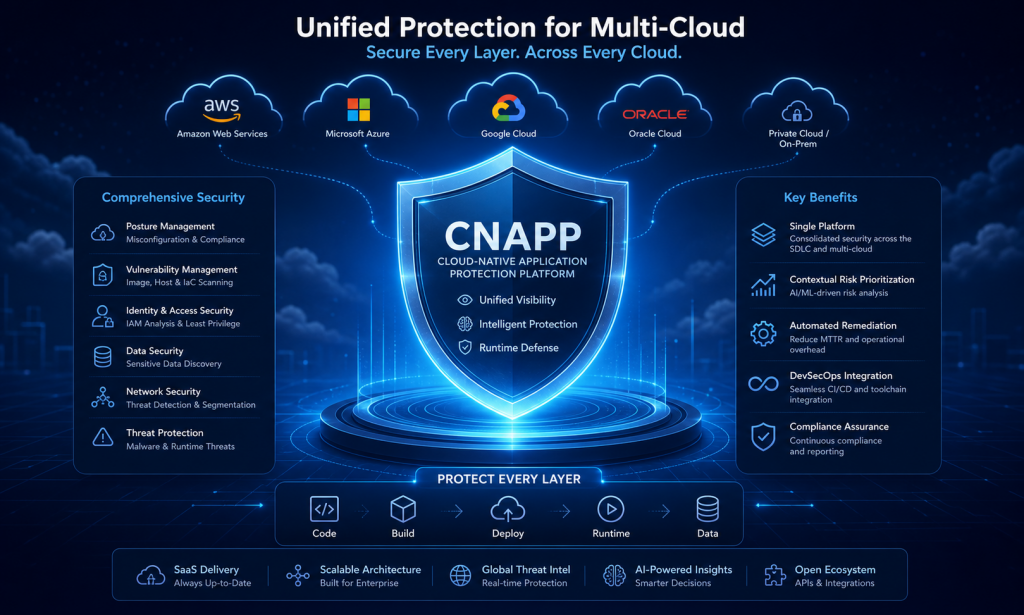
That’s the problem CNAPP (Cloud-Native Application Protection Platform) was supposed to fix. One platform. Cloud config, workload protection, identity risk, container security — all wired together so you can see real attack paths instead of isolated data points.
The category has matured fast through 2025 and into 2026. Wiz, Orca, Lacework, and Prisma Cloud all claim the CNAPP crown. They all promise unified visibility. But they solve the problem in fundamentally different ways, and picking the wrong one costs you six figures and twelve months of migration pain.
This isn’t a feature checklist comparison. We’re breaking down these four platforms across the five dimensions that actually drive buying decisions: deployment model, alert quality, runtime protection, multi-cloud coverage, and pricing.
The Short Version
Before we get into the details, here’s where each platform lands:
- Wiz — Fastest time to value, best attack path visualization. Built for teams that need a full risk picture across multi-cloud environments without touching workloads. Runtime is still catching up.
- Orca — Zero-impact scanning via disk snapshots. Similar philosophy to Wiz (agentless-first), strong for teams that absolutely cannot tolerate performance overhead. Also weak on runtime.
- Lacework — Behavioral anomaly detection through its Polygraph engine. The only one here with native runtime analysis as a core strength rather than a bolt-on. UI is rougher around the edges.
- Prisma Cloud — The most complete feature set from code scanning through runtime enforcement. But it’s complex to deploy, steep to learn, and the credit-based pricing makes budgeting unpredictable. Best fit for existing Palo Alto shops.
Deployment: How Fast Can You Get Results?
This is where most evaluations start — how long before you see something useful, and what do you have to install?
Wiz connects through cloud provider APIs. You authenticate your AWS, Azure, or GCP accounts, and initial findings start appearing within minutes. No agents on workloads. The entire value proposition is built around this frictionless onboarding. In late 2025, Wiz shipped an optional runtime sensor, but the core product remains agentless.
Orca is also agentless, but the mechanism is different. SideScanning reads disk snapshots from your cloud provider’s storage layer, then analyzes them externally. The upside: literally zero performance impact on running workloads. The downside: you’re scanning point-in-time snapshots, not live systems. There’s inherent latency between a change happening and Orca detecting it.
Lacework requires a lightweight agent on your workloads. That’s the tradeoff for its runtime behavioral analysis — you can’t detect process anomalies without something running alongside the process. Deployment takes longer (days to weeks for large environments), and you carry ongoing agent maintenance overhead.
Prisma Cloud offers both models. Agentless CSPM scanning for posture management, plus agent-based Defender for runtime protection. This gives you maximum flexibility but also maximum complexity. Most teams need a dedicated person managing the Prisma deployment.
Bottom line: Need results by tomorrow? Wiz or Orca. Need runtime visibility and willing to invest in deployment? Lacework or Prisma Cloud.
Alert Quality and Attack Path Analysis
The number one complaint security teams have about cloud security tools isn’t missing coverage — it’s alert fatigue. Thousands of findings, no way to prioritize, no context connecting them.
Wiz built its reputation on the Security Graph. Instead of showing you isolated findings (“this S3 bucket is public”), it connects the dots: “this public S3 bucket is linked to an EC2 instance running a critical CVE, and that instance has an IAM role with admin privileges.” That chain — from exposure to vulnerability to excessive permission — is what makes a finding urgent versus ignorable.
In practice, Wiz’s attack path visualization is the best in class right now. Multiple independent analyst reports (Gartner, GigaOm) cite this as its primary differentiator. Teams report reducing actionable alerts from thousands to dozens after switching from legacy tools.
Orca has attack path capabilities too, and they’re solid. But community feedback and analyst comparisons consistently put it slightly behind Wiz in terms of path visualization clarity and risk prioritization accuracy. The gap has narrowed through 2025, but it’s still there.
Lacework takes a completely different approach with Polygraph. Rather than static graph analysis, it uses machine learning to establish behavioral baselines and then flags deviations. It catches things like “this service account just accessed a resource it’s never touched before” or “this container spawned an unexpected process.” This is genuinely useful for detecting lateral movement and insider threats that static scanners miss entirely.
The tradeoff: Lacework is weaker at static vulnerability prioritization. If your primary need is “show me which CVEs to patch first based on reachability,” Wiz or Orca will serve you better.
Prisma Cloud has all the capabilities — graph analysis, vulnerability prioritization, behavioral detection. The problem users consistently report is alert volume. Out of the box, Prisma generates a lot of noise, and it takes significant tuning to get signal-to-noise ratio to a useful level. Teams with dedicated security engineering resources can make it work; lean teams often drown.
Runtime Protection: Where the Biggest Gaps Live
This is the dimension with the widest variance between these four platforms.
Wiz added runtime detection through Wiz Sensor in late 2025. It works — basic threat detection, container monitoring, process-level visibility. But it’s still a young capability. Teams that adopted Wiz specifically for its agentless model may resist deploying sensors, and the runtime detection depth doesn’t yet match purpose-built CWPP solutions.
Orca has no meaningful runtime protection. SideScanning is inherently a periodic assessment, not continuous monitoring. If a cryptominer starts running in your container at 2 AM, Orca won’t know until the next snapshot scan. For teams whose threat model requires catching active exploitation in real time, this is a hard gap.
Lacework built its platform around runtime behavioral analysis from the start. The agent monitors process execution, network connections, file system changes, and DNS queries — then applies Polygraph’s ML models to detect anomalies. This isn’t just signature matching; it catches novel attack patterns that haven’t been seen before. For CWPP use cases, this is real differentiated value.
Prisma Cloud has the most mature runtime protection in this group. It covers containers, serverless functions, and traditional hosts with real-time enforcement (not just detection) and forensic capabilities. If your compliance requirements mandate runtime blocking of known-bad behaviors, or you need detailed forensic data for incident response, Prisma Cloud is currently the only one of these four that can deliver.
Bottom line: If runtime is a hard requirement, the ranking is clear: Prisma Cloud > Lacework > Wiz > Orca. If you only need posture management and vulnerability scanning, runtime is optional.
Multi-Cloud and Container Coverage
| Platform | AWS | Azure | GCP | OCI | Alibaba Cloud | Kubernetes Depth |
|---|---|---|---|---|---|---|
| Wiz | ✅ | ✅ | ✅ | ✅ | ✅ | Strong |
| Orca | ✅ | ✅ | ✅ | Partial | ✅ | Good |
| Lacework | ✅ | ✅ | ✅ | ❌ | ❌ | Moderate |
| Prisma Cloud | ✅ | ✅ | ✅ | ✅ | ✅ | Deepest |
Wiz covers the broadest set of cloud providers including Oracle Cloud and Alibaba Cloud. Its Kubernetes support handles EKS, AKS, GKE, and self-managed clusters with good depth.
Orca is close to Wiz on major clouds but has weaker OCI coverage. Kubernetes scanning is competent but less granular than Wiz or Prisma Cloud.
Lacework sticks to the big three (AWS, Azure, GCP). If you run workloads on Oracle Cloud or any regional cloud providers, Lacework won’t cover them. Its Kubernetes integration works but lacks the depth of Wiz’s or Prisma’s.
Prisma Cloud leads on container security depth — unsurprising given Palo Alto’s acquisition of Twistlock (one of the original container security platforms). It scans container images in CI/CD pipelines, monitors running containers, and provides Kubernetes admission control. If container and Kubernetes security is your primary concern, Prisma Cloud offers the most comprehensive coverage.
Bottom line: For multi-cloud breadth, Wiz and Prisma Cloud tie. For container/Kubernetes depth, Prisma Cloud leads. If you’re AWS + Azure only, all four are sufficient.
Pricing: The Conversation Nobody Wants to Have
Cloud security pricing is famously opaque. Here’s what we can piece together from public data, community reports, and vendor disclosures.
| Platform | Entry Point | Typical Mid-Market | Enterprise (1000+ workloads) | Model |
|---|---|---|---|---|
| Wiz | ~$24K/year (Essential, 100 workloads) | $80K–$150K/year | $200K–$500K+ | Per-workload |
| Orca | ~$70K/year (minimum commit) | $90K–$180K/year | $200K–$400K+ | Per-asset |
| Lacework | ~$5K/year | $25K–$60K/year | $100K–$250K | Per-workload |
| Prisma Cloud | Credit-based (varies) | $80K–$150K/year | $150K–$500K+ | Credits per module |
Wiz prices per workload with tiered plans (Essential, Business, Enterprise). The model is straightforward to understand, though not cheap. At scale, costs climb quickly — large enterprises routinely spend $200K+ annually.
Orca requires enterprise-level commitment from the start. Minimum contracts typically begin around $70K/year. There’s less public pricing data available, but anecdotally, sales teams have more negotiation flexibility than Wiz on multi-year deals.
Lacework has the lowest barrier to entry at roughly $5K/year for smaller deployments. They offer free trials and more accessible pricing tiers. For security teams with limited budgets who need to prove value before requesting more funding, this is significant.
Prisma Cloud uses a credit-based system where each security module (CSPM, CWPP, CIEM, etc.) consumes credits at different rates. In theory this offers flexibility — you pay for what you use. In practice, teams consistently report difficulty predicting annual spend, and it’s easy to exceed budgets when enabling new modules. Existing Palo Alto customers typically get better pricing through bundle deals.
Matching Platform to Team
| Your Situation | Best Fit | Why |
|---|---|---|
| Multi-cloud team needing unified risk visibility fast | Wiz | Fastest deployment, best attack path visualization |
| Hard requirement for zero performance impact on workloads | Orca | SideScanning has literally zero workload overhead |
| Need runtime behavioral detection, moderate budget | Lacework | Polygraph is genuinely differentiated for anomaly detection |
| Already in Palo Alto ecosystem, need full lifecycle coverage | Prisma Cloud | Best total feature coverage, better pricing for existing customers |
| Security team under 5 people, need an accessible starting point | Lacework | Lowest entry price, fastest to become self-sufficient |
| Compliance mandates runtime enforcement + forensics | Prisma Cloud | Only platform with mature runtime blocking and forensic capture |
| Running POC to compare against Wiz | Orca | Most similar architecture, useful as competitive benchmark |
What About Consolidation?
Worth noting: Google completed its $32 billion acquisition of Wiz in early 2026. The long-term implications for multi-cloud neutrality are still playing out. Wiz maintains it will stay cloud-agnostic, but if you’re making a 3-year commitment, it’s a factor worth tracking.
Similarly, Lacework merged with Fortinet’s cloud security assets in 2025, which expanded its enterprise distribution but raised questions about long-term product direction for some existing customers.
The CNAPP market is consolidating fast. Whoever you choose today, build your evaluation around data portability and API access — you may need to migrate faster than you expect.
Final Take
There’s no universal “best CNAPP.” The right choice depends on what you actually need:
Want to see everything clearly? Wiz gives you the best risk visualization across multi-cloud environments, faster than anyone else.
Need zero-touch scanning with no workload impact? Orca’s SideScanning delivers comprehensive assessment without touching your production systems.
Need to catch active threats, not just misconfigurations? Lacework’s behavioral analysis spots anomalies that static scanners miss, at a price point that doesn’t require board approval.
Need everything from shift-left to runtime enforcement? Prisma Cloud is the only platform here that covers the full lifecycle — but you’ll need the team to manage it.
The real question isn’t “which is best” — it’s whether you need to see your risk or stop your risk. For visibility, go Wiz or Orca. For active protection, go Lacework or Prisma Cloud. And whatever you pick, get a 30-day POC with your actual workloads before signing anything. Demos lie; your environment doesn’t.
Related Reading
- On-Device AI Is Eating Cloud Inference From the Inside Out
- The FinOps Revolution: How AI Is Reshaping Cloud Cost Management in 2026
Stay updated with our latest AI insights