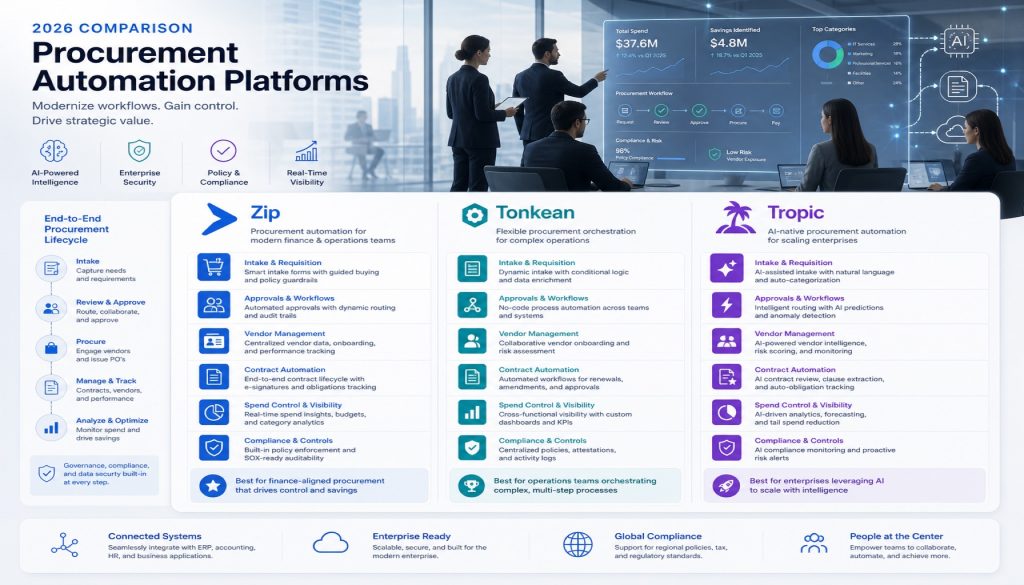
Here’s the short version: Zip is built for large enterprises with complex, multi-team approval workflows. Tonkean is designed for compliance-driven process orchestration. Tropic specializes in SaaS purchasing and renewal management. They solve different problems, so the right choice depends entirely on where your procurement pain actually lives.
Procurement automation — sometimes called Intake-to-Procure — is one of the highest-ROI enterprise software categories in 2026. Replacing email-based approvals with structured automated workflows typically cuts procurement cycle times by 40–60% and eliminates a significant chunk of maverick spend.
But the products in this space have diverged sharply. Picking the wrong one doesn’t just waste budget — it means workflows that never get adopted.
Platform Positioning at a Glance
| Zip | Tonkean | Tropic | |
|---|---|---|---|
| Core strength | Enterprise procurement hub | No-code compliance orchestration | SaaS spend management |
| Best for | Multi-team parallel approvals | Regulated industries, process iteration | SaaS inventory & renewal negotiation |
| Target company size | 500+ employees | Mid-to-large enterprise | Companies with $500K+ annual SaaS spend |
| AI focus | Approval intelligence & anomaly detection | Agentic workflow automation | Pricing benchmarks & cost optimization |
| Implementation time | 2–4 months | 1–3 months | 2–4 weeks |
How Each Platform Works
Zip: The Enterprise Procurement Command Center
Zip’s core value proposition is routing a single procurement request simultaneously to procurement, legal, IT security, and finance — each review track progressing independently with full audit trails. When approvals clear, Zip auto-generates purchase orders and writes back to your ERP without manual data entry.
The intake experience uses guided form builders with natural language input, so any employee can submit a request without procurement training. On the AI side, Zip handles auto-fill suggestions, intelligent routing recommendations, and anomaly detection to flag unusual requests before they waste reviewers’ time.
If your organization processes hundreds or thousands of procurement requests per month across multiple stakeholder teams, Zip is purpose-built for that complexity.
Tonkean: Compliance-First Process Orchestration
Tonkean approaches procurement differently. Rather than being a procurement tool that handles compliance, it’s a process orchestration platform that excels at procurement use cases — especially where legal, IT security, and regulatory reviews are the primary source of complexity.
The standout feature is its no-code Agentic workflow builder. Procurement operations teams can design, test, and iterate on approval flows without engineering support. When regulations change (a constant in financial services, healthcare, and government), your ops team adjusts the workflow the same day.
Intake happens natively in Slack, Microsoft Teams, or email. Employees submit requests inside tools they already use daily, which drives significantly higher adoption rates than forcing people into yet another portal.
For organizations where compliance requirements shift frequently and procurement ops needs autonomy to iterate, Tonkean removes the engineering bottleneck entirely.
Tropic: The SaaS Procurement Specialist
Tropic zeroes in on a specific, expensive problem: SaaS spend that’s grown beyond what finance teams can track manually.
The platform provides SaaS inventory management, usage tracking, renewal calendars, and pricing benchmarks drawn from thousands of real contracts. You can see exactly which tools are underused, which renewals are approaching, and what peer companies are paying for the same software.
Tropic’s unique differentiator is its managed negotiation service. Instead of your team spending weeks going back and forth with vendors on renewal pricing, Tropic’s professional negotiators handle it — and they charge based on actual savings delivered. For companies spending over $500K annually on SaaS, the ROI is typically immediate and measurable.
Pricing: All Enterprise, Different Scales
None of these platforms publish pricing pages. All require custom quotes. But market data gives us working ranges:
Zip — $100,000–$500,000+ per year. Priced by employee count and workflow volume. Aimed at enterprises with 500+ employees.
Tonkean — $60,000–$300,000+ per year. Priced by process volume and user count. Targets mid-to-large enterprises.
Tropic — $30,000–$120,000 per year for the platform. Managed negotiation services charge a percentage of savings achieved. Best ROI threshold is $500K+ in annual SaaS spend.
Tropic has the lowest entry point, though total cost scales with your SaaS footprint. Zip costs the most upfront, but for large enterprises, compressing a 3-week procurement cycle to 3 days generates labor cost savings that dwarf the software fee.
Head-to-Head: Key Capability Comparison
Intake & Request Submission
- Zip: Guided form builder with NLP input. Universal — handles hardware, services, and software requests equally well.
- Tonkean: Native Slack/Teams/email intake. Lowest friction for employees, highest adoption rates.
- Tropic: Vendor-type-specific forms optimized for software purchasing.
Verdict: If your procurement requests span hardware, services, and software, Zip’s versatility wins. If maximizing employee adoption is priority one, Tonkean’s conversational intake is unmatched. If you only care about SaaS, Tropic is sufficient.
Approval Routing & Workflow Complexity
- Zip: Parallel multi-track approvals out of the box. Procurement, legal, IT security, and finance reviews run simultaneously with full visibility.
- Tonkean: Equally capable of complex routing through its workflow builder, but requires more upfront configuration. The tradeoff: your ops team owns the logic entirely.
- Tropic: Linear approval flows suited to standardized SaaS purchasing. Not designed for complex multi-team crossover scenarios.
ERP Integration Depth
- Zip: Deepest ERP integration. Auto-creates POs, syncs back to ERP post-approval.
- Tonkean: Configurable but requires more setup effort.
- Tropic: Limited ERP integration — focused on SaaS contracts rather than traditional purchase orders.
AI & Automation
- Zip: Form auto-fill, routing suggestions, spend anomaly detection.
- Tonkean: The Agentic workflow builder itself is AI-driven, capable of autonomous process orchestration.
- Tropic: AI focused on pricing intelligence — benchmarks, cost optimization recommendations, and savings predictions.
Three different AI strategies: Zip automates approvals, Tonkean automates process design, Tropic automates cost intelligence.
SaaS Management
This is Tropic’s home turf. SaaS inventory, usage analytics, renewal calendars, and vendor pricing benchmarks — capabilities that Zip and Tonkean simply haven’t built to the same depth.
Combined with managed negotiation, Tropic offers a complete SaaS lifecycle management solution that the other two platforms don’t attempt to replicate.
Decision Framework: Match Your Pain Point
Choose Zip if:
- You have 500+ employees with high procurement volume
- Requests require parallel approvals from procurement, legal, IT, and finance
- Deep ERP integration is non-negotiable (auto-PO generation, no manual data re-entry)
- You process hundreds to thousands of requests monthly
- Budget is available and you want end-to-end procurement automation
Choose Tonkean if:
- Compliance, legal, and IT security reviews are your primary procurement complexity
- Your procurement ops team needs to iterate on workflows without engineering dependencies
- You operate in regulated industries (financial services, healthcare, government) with frequently changing requirements
- Slack/Teams native intake is important for employee adoption
- You need cross-functional process orchestration beyond just procurement
Choose Tropic if:
- SaaS spend is your main procurement headache
- Annual SaaS expenditure exceeds $500K and renewal management is critical
- You want professional negotiators handling vendor conversations
- Your procurement workflows are relatively straightforward — no complex multi-team approvals
- You want fast time-to-value and plan to start with SaaS as your first automation win
Can You Combine Them?
Yes — and some large enterprises do. A common pairing is Zip for general procurement orchestration plus Tropic for dedicated SaaS management. The platforms solve different problems with minimal overlap, so running both can make sense if you have distinct pain points in each area.
What About Smaller Companies?
Honestly, companies under 200 employees probably don’t need any of these. The pricing and feature depth targets mid-to-large enterprises. For smaller teams, lighter solutions like Procurify, a Jira-based approval workflow, or even a well-structured Google Forms process will cover your needs at a fraction of the cost.
Implementation & Time to Value
- Zip: 2–4 months. ERP integration and multi-team workflow configuration take time.
- Tonkean: 1–3 months. Depends on process complexity, but no-code design accelerates iteration.
- Tropic: 2–4 weeks for SaaS inventory and basic workflow. The fastest path to production.
Calculating ROI
Procurement automation ROI typically comes from three sources:
- Labor savings from shorter procurement cycles (fewer hours spent chasing approvals)
- Risk reduction from consistent compliance (avoiding regulatory fines and audit failures)
- Direct cost savings from better negotiation leverage and spend visibility
Tropic’s ROI is the easiest to quantify — negotiated savings are hard dollars. Zip and Tonkean deliver ROI primarily through efficiency gains and risk mitigation, which are real but harder to put a single number on.
The Bottom Line
These three platforms represent three distinct philosophies about procurement automation:
- Zip says: “We’ll be your procurement operating system — route everything through us.”
- Tonkean says: “We’ll let your ops team build exactly the process they need, no engineers required.”
- Tropic says: “We’ll manage your SaaS spend and negotiate better deals for you.”
Start with your biggest pain point. If it’s approval chaos across multiple teams, evaluate Zip. If it’s compliance complexity that changes faster than engineering can keep up, look at Tonkean. If it’s SaaS renewals bleeding money quietly, Tropic will show ROI fastest.
The worst decision is picking a platform that solves a problem you don’t actually have.
Related Reading
- BILL vs Tipalti vs Vic.ai vs Stampli: AP Automation Comparison 2026
- Vanta vs Secureframe: Which Compliance Platform Actually Fits Your Team in 2026?
Stay updated with our latest AI insights

相关文章