Contentful’s Lite plan starts at $300/month, and Enterprise fees easily reach six figures annually. If your project isn’t at that scale yet, or you simply don’t want to be throttled by API call limits and locale counts, it’s time to look elsewhere.
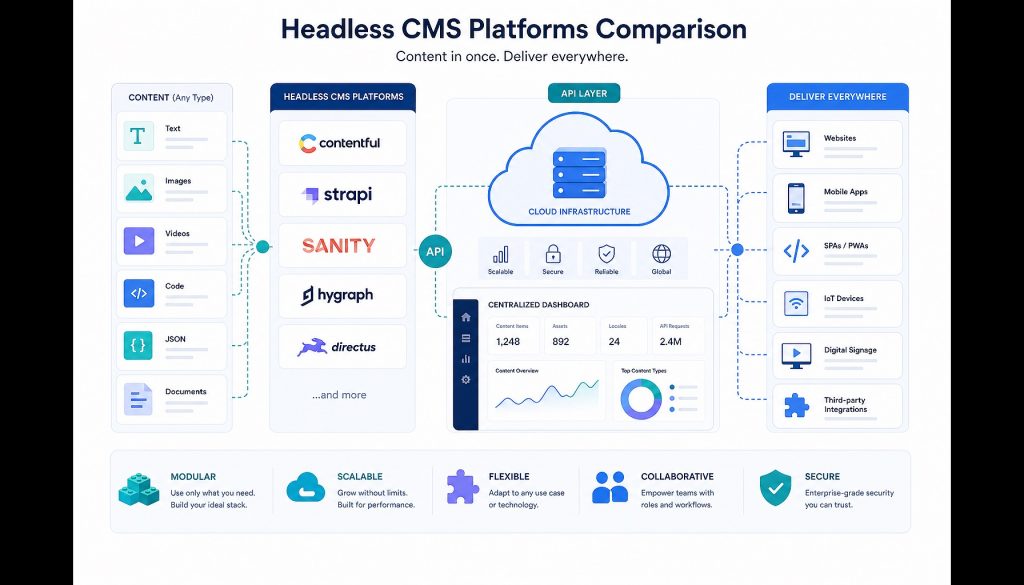
This article puts five mainstream Contentful alternatives side by side: Sanity, Strapi, Hygraph, Payload CMS, and Directus. I’ve checked their latest 2026 pricing and broken down features, costs, and use cases for each.
Quick Comparison Table
| Dimension | Sanity | Strapi | Hygraph | Payload CMS | Directus |
|---|---|---|---|---|---|
| Type | Hosted SaaS | Open-source + optional cloud | Hosted SaaS | Open-source + optional cloud | Open-source + optional cloud |
| Open Source License | No (Studio open, Content Lake closed) | MIT | No | MIT | BSL (free if revenue <$5M) |
| Free Tier | 20 seats / 10K docs / 100K API | Self-hosted free; Cloud has Free Plan | 3 users / 1K entries / 500K API | Self-hosted completely free | Self-hosted free (if eligible); Core $0 |
| Paid Starting Price | $15/seat/month (Growth) | $15/month (Cloud Essential) | $199/month (Growth) | $35/month (Cloud Standard) | $499/month (Team) |
| API Types | GROQ + GraphQL | REST + GraphQL | GraphQL native | REST + GraphQL | REST + GraphQL + WebSocket |
| Self-Hosting | Not supported | Supported | Not supported | Supported | Supported |
| Database | Proprietary Content Lake | PostgreSQL / MySQL / SQLite | Proprietary | MongoDB / PostgreSQL | PostgreSQL / MySQL / SQLite / MS SQL etc. |
| Real-time Collaboration | Built-in (Google Docs-like) | No | No | No | No |
| Primary Tech Stack | React + TypeScript | Node.js + Koa | — | TypeScript + Next.js | Node.js + Vue.js |
Deep Dive
Sanity: Best Content Collaboration Experience
Sanity’s core selling point is real-time collaboration. Multiple people can edit the same document simultaneously, with cursors following each other like in Google Docs. GROQ query language is more flexible than GraphQL and more concise to write, but it has a steeper learning curve.
Pricing Details (verified May 2026):
- Free: 20 seats, 2 datasets, 500K CDN API requests/month, 10 GB bandwidth
- Growth: $15/seat/month (about $12/seat/month annual), 5 datasets, 1M API requests/month, 100 GB bandwidth
- Enterprise: Custom quote, includes SSO, SLA, dedicated support
Pros:
- Free tier gives 20 seats—enough for small teams for a long time
- Studio completely customizable with React, UI can be modified however you want
- Real-time collaboration is best-in-class among all headless CMSs
- Per-seat pricing makes it cost-effective for high-traffic projects with few editors
Cons:
- Content Lake is closed-source, data isn’t in your hands
- No self-hosting option, not suitable for teams requiring data sovereignty
- SSO requires Enterprise or a $1,399/month add-on to Growth
- Editorial headcount snowballs cost ($15/seat/month × 20 people = $300/month)
Strapi: Largest Open-Source Community, Most Mature Ecosystem
Strapi is a veteran open-source headless CMS with the highest GitHub star count in its category. Self-hosting is completely free, or you can use Strapi Cloud for convenience. Late 2025 saw the launch of a $15/month Essential plan and a free cloud tier, significantly lowering the barrier to entry.
Pricing Details (latest 2026):
- Self-hosted: $0 (you only pay server costs)
- Cloud Free: free with limitations
- Cloud Essential: $15/month (annual) / $18/month (monthly)
- Cloud Pro: $99/month
- Enterprise: Custom quote (includes SSO, audit logs, premium support)
Pros:
- MIT open source, code fully transparent, modify anything you want
- Rich plugin ecosystem (Shopify, BigCommerce, Cloudinary official integrations)
- Admin Panel friendly for non-technical users
- Self-hosting has zero software fees
Cons:
- Self-hosting means you handle security patches yourself (5 CVEs disclosed in one week in May 2026)
- Performance tuning for large projects requires experience
- Minimal real-time collaboration capabilities
- Strapi 5 breaking changes made v4 migrations painful
Hygraph: GraphQL-Native + Content Federation
Hygraph (formerly GraphCMS) has a unique capability: “content federation”—querying multiple data sources through a single GraphQL endpoint. Your product data is in Shopify, user profiles in your CRM, content in Hygraph—one query gets it all.
Pricing Details (2026 website):
- Hobby: free, 3 users, 1K entries, 500K API requests, 2 locales
- Growth: $199/month, 10 users, 10K entries, 1M API requests, 3 locales
- Enterprise: Custom quote, includes SSO, dedicated infrastructure, custom SLA
Pros:
- GraphQL native, schema auto-generated, frontend devs write queries smoothly
- Content federation is unique, multi-source integration without extra middleware
- Unlimited asset storage (all plans)
- Version control and staged content releases
Cons:
- Not open-source, can’t self-host
- $199/month starting price is high compared to competitors
- Free tier’s 3 users + 1K entries basically limits it to demos
- Scheduled publishing and custom workflows require Enterprise
- Learning curve for teams unfamiliar with GraphQL
Payload CMS: Ultimate Tool for TypeScript Developers
Payload is the fastest-growing open-source CMS in recent years. It embeds directly into Next.js’s /app directory, schemas are written in code with auto-generated type inference, and frontend/backend deploy from the same repo. After Figma’s 2025 acquisition, Cloud service is adjusting, but self-hosting remains the primary path.
Pricing Details (2026):
- Self-hosted: $0, MIT open-source, no seat limits, no API call fees
- Cloud Standard: $35/month (512MB RAM, 3GB database, 30GB file storage)
- Cloud Pro: $199/month (dedicated cluster, 30GB database, 150GB file storage)
- Enterprise: Custom quote (SSO, audit logs, AI features, advanced publishing workflows)
Pros:
- Pure TypeScript, configuration-as-code, seamless Next.js integration
- Self-hosting has zero restrictions—no seat fees, no API fees, no locale limits
- Built-in authentication system and field-level permission control
- Supports both MongoDB and PostgreSQL
- $35/month cloud hosting is extremely competitive
Cons:
- Smaller community than Strapi, fewer third-party plugins
- Pure code configuration, non-developers can’t use the admin
- Admin UI not very friendly for content editors
- Post-Figma acquisition, Cloud service direction uncertain
Directus: Wrapping Your Existing Database with a Management Layer
Directus takes a different approach from other CMSs: it doesn’t create a new database, but connects to your existing SQL database and auto-generates API and admin interface. Got a PostgreSQL that’s been running for years? Install Directus and you’re set.
Pricing Details (post-v12 2026 pricing):
- Open Innovation Grant: completely free (self-hosted) for organizations with <$5M revenue, <50 employees
- Core: $0/month, 3 seats, 25 collections, 5 Flows, AI assistant (Cloud hosting +$99/month)
- Team: $499/month (annual) / $599/month (monthly), 10 SSO seats, 50 collections, 20 Flows
- Enterprise: Custom quote, dedicated infrastructure
Pros:
- Connects to existing databases, no forced data migration
- Supports most SQL database types (PostgreSQL, MySQL, SQLite, MS SQL, CockroachDB, MariaDB)
- Field-level RBAC permissions, very granular
- All three API types: REST + GraphQL + WebSocket
- Built-in Flow automation engine (like a simpler n8n)
- Open Innovation Grant is genuinely free for small teams
Cons:
- BSL license isn’t traditional open source (revenue >$5M requires payment)
- New pricing eliminated $15/month Starter, Core to Team jump is huge ($0 → $499)
- Extension marketplace smaller than Strapi’s
- Performance degrades with very large datasets
- Learning curve for non-technical users
Selection Guide: Choose Based on Your Situation
By Team Size
1-3 independent developers / side projects:
- First choice: Payload CMS self-hosted ($0, full TypeScript stack)
- Or Sanity Free (20 seats free, zero ops)
5-15 person small-to-medium teams:
- Strong technical team → Strapi or Payload self-hosted
- Need collaboration experience → Sanity Growth ($75-225/month)
- Have existing database → Directus (Grant free or Cloud $99/month)
20+ person enterprise teams:
- Multi-source integration needs → Hygraph Enterprise
- Need SSO + compliance → Contentful or Sanity Enterprise
- Limited budget but many people → Strapi Enterprise self-hosted
By Tech Stack
| Your Stack | Recommended CMS | Reason |
|---|---|---|
| Next.js + TypeScript | Payload CMS | Same-repo deploy, type-safe |
| React + JAMstack | Sanity | Studio written in React, flexible GROQ queries |
| Node.js generic | Strapi | Largest ecosystem, most plugins |
| GraphQL power users | Hygraph | Native GraphQL, content federation |
| Existing SQL database | Directus | Zero migration cost, direct connection |
By Budget
Zero budget (only server costs):
- Payload self-hosted → runs on a $5/month VPS
- Strapi self-hosted → same
- Directus self-hosted (if Grant eligible)
$100-300/month:
- Sanity Growth 5-15 seats
- Strapi Cloud Pro
- Hygraph Growth (just at the threshold)
$500+/month:
- At this budget, even Contentful is back on the table
- Or Hygraph / Directus Team for more granular permission control
Practical Migration Advice from Contentful
Once you’ve decided to switch, migration is where the real challenges lie. Some lessons learned:
Don’t use the UI for content export—use the API for batch pulling. Contentful’s Content Management API supports bulk export of all entries and assets. Write a script to pull down the JSON, then transform it to match your target CMS’s schema format. Sanity has an official @sanity/import CLI, Strapi and Payload use REST API for batch writes.
Rich Text fields are the biggest headache. Contentful’s Rich Text stores a custom JSON structure, neither standard Markdown nor HTML. Migrating to Strapi requires converting to Blocks format, to Sanity requires Portable Text. Write dedicated conversion functions—don’t try manual edits.
Pay special attention to multilingual content. Contentful’s locales are field-level (one entry stores all language versions), while Strapi and Payload default to entry-level (one record per language). Migration requires splitting. Sanity’s approach is similar to Contentful—field-level i18n with lowest migration cost.
List all webhooks and integrations upfront. Document all webhooks and third-party integrations configured in Contentful (Vercel deploy hooks, Algolia index sync, etc.) and verify the target CMS can handle them. Strapi and Payload have flexible webhook configs, Sanity has GROQ-powered webhooks with conditional triggers, Hygraph also supports them but with different configuration.
Test with a small project first. Don’t migrate your entire site at once. Pick a blog or landing page to migrate first, run it for two weeks to identify workflow or deployment blockers, then decide on full migration.
Final Thoughts
Contentful’s premium pricing isn’t without reason—its content modeling, multi-environment management, and CDN distribution are genuinely mature. But 2026 alternatives aren’t just “good enough” anymore. Payload actually exceeds Contentful in developer experience, Sanity’s collaboration capabilities are something Contentful lacks, and Strapi’s open-source ecosystem gives you complete control.
Don’t obsess over “which is best.” Figure out what your team needs most: development efficiency, collaboration experience, data sovereignty, or cost control—and the answer becomes obvious.
Related Reading
- Contentful Alternatives 2026: Sanity vs Strapi vs Hygraph vs Payload vs Directus
- 5 Contentful Alternatives Worth Switching To in 2026
Stay updated with our latest AI insights