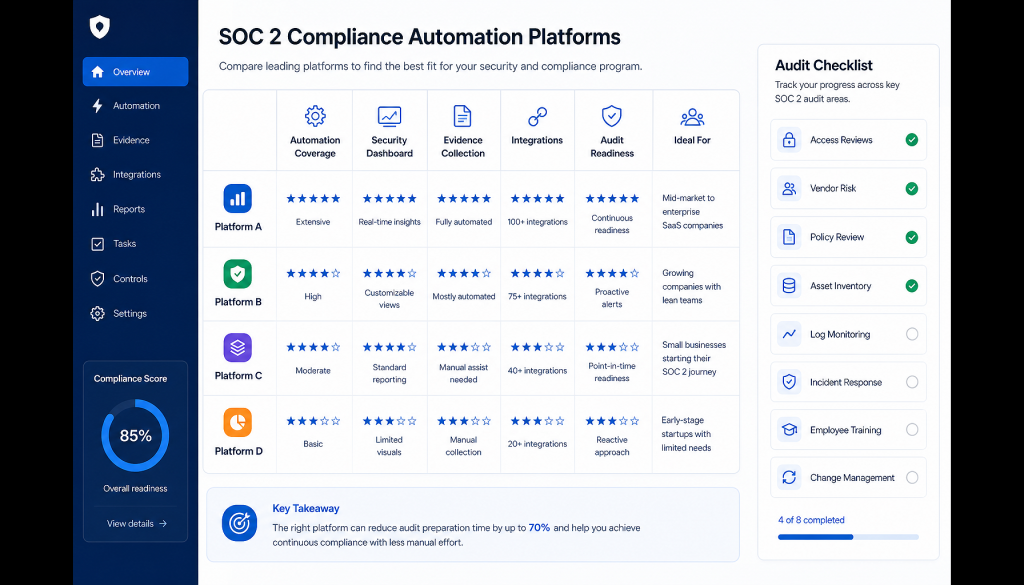
Here’s the short version: Vanta is the safe default for most SaaS companies getting SOC 2 for the first time. Drata wins on UI and developer experience. Secureframe makes sense if you don’t have a compliance person and want hand-holding built into the platform.
Now let’s get into why.
SOC 2 Isn’t Optional Anymore
If you’re selling B2B SaaS in 2026, SOC 2 Type II is table stakes. Not a differentiator. Not a “nice to have.” It’s the thing that gets you past procurement.
Enterprise buyers now ask for your SOC 2 report before scheduling a demo. No report, no POC, no deal. The compliance automation market has responded — it’s projected to hit $4.7 billion by 2028, and Vanta, Drata, and Secureframe are the three names that come up in every conversation.
The problem? Their marketing pages look almost identical. “Automated evidence collection.” “300+ integrations.” “Get audit-ready in weeks.” Every vendor says the same things.
The real differences show up in day-to-day operations, auditor ecosystems, and how much pain you’ll feel during implementation. That’s what this comparison is about.
What These Platforms Actually Do (and Don’t Do)
Let’s kill the biggest misconception first: compliance automation platforms don’t make you compliant.
They’re evidence collection and continuous monitoring tools. They connect to your cloud infrastructure (AWS, GCP, Azure), identity providers (Okta, Google Workspace), endpoint management (Jamf, Kandji), HR systems (Rippling, Gusto), and pull data automatically. They map that data against SOC 2 Trust Services Criteria and show you what’s passing and what’s failing.
What they won’t do:
- Turn on CloudTrail for you
- Enforce MFA across your org
- Write your incident response plan
- Configure your backup policies
- Train your employees on security awareness
The platform is a dashboard. Implementation is a separate project. Teams that confuse “buying a platform” with “doing compliance” end up six months in with a screen full of red indicators and nothing to show for their subscription.
Vanta: The Market Leader With the Deepest Ecosystem
Pricing: ~$10,000–$12,000/year for teams under 50 people on a single framework. Multi-framework or larger orgs pay $20,000–$30,000+. YC and Techstars portfolio companies get first-year discounts.
Founded: 2018. Over 7,000 customers. Raised $203M at a $2.45B valuation.
Where Vanta Wins
Integration depth is the real moat. 300+ native integrations covering pretty much every tool in a modern SaaS stack. In practice, 80–90% of your controls get monitored automatically once you connect your services. Manual evidence collection is minimal.
Auditor network is unmatched. Most SOC 2 audit firms already know Vanta. Auditors pull evidence directly from the platform, which cuts audit duration and communication overhead. Vanta-partnered auditors typically charge $2,500–$7,500 for Type I (compared to $10,000–$20,000 going direct). That auditor discount alone can offset a chunk of your platform cost.
Policy templates save real time. Vanta’s policy library is comprehensive and regularly updated. You’ll still need to customize them, but you’re not starting from scratch.
Where Vanta Falls Short
The UI is functional but dense. First-time users describe the initial setup as overwhelming — there’s a lot of surface area. Once configured, it’s fine. Getting there takes patience.
Pricing isn’t transparent. You’ll need to talk to sales, and the sticker price depends on headcount, frameworks, and how hard you negotiate.
Best For
Most SMB SaaS companies doing SOC 2 for the first time. The auditor ecosystem and integration coverage minimize risk. If you don’t have a strong reason to pick something else, Vanta is the safe bet.
Drata: Best UX, Built for Engineering Teams
Pricing: Comparable to Vanta — roughly $10,000–$12,000/year for small teams. Contract terms tend to be more flexible.
Founded: 2020. Over 5,000 customers. Raised $328M total.
Where Drata Wins
The interface is genuinely good. This sounds like a minor thing until you’re the person logging into a compliance dashboard every week. Drata’s UI is cleaner, more intuitive, and less cluttered than Vanta’s. The guided onboarding flow actually works — you don’t feel lost on day one.
Developer-friendly features matter. CI/CD integrations, custom API access, and flexible control configurations make Drata popular with engineering-led teams. If your CTO is the one driving compliance, they’ll probably prefer Drata.
Trust Center is a standout feature. Drata’s public-facing Trust Center lets you share your compliance status with prospects without sending PDFs back and forth. It’s polished and saves time during sales cycles.
Where Drata Falls Short
Integration coverage is slightly narrower than Vanta’s (~200+ vs 300+). For mainstream tools, you won’t notice the difference. But if you’re running niche infrastructure, check compatibility before committing.
The auditor network is growing but still smaller than Vanta’s. If you have a specific audit firm in mind, confirm they support Drata before signing.
Best For
Teams that value developer experience and clean tooling. If the people managing compliance day-to-day are engineers (not dedicated GRC staff), Drata will feel more natural. Also a strong pick for companies that want a polished Trust Center out of the box.
Secureframe: The “Done With You” Option
Pricing: Typically higher — $12,000–$20,000/year for small teams. But the price includes compliance guidance and implementation support that other platforms charge separately for.
Founded: 2020. Over 1,000 customers. Raised $79M.
Where Secureframe Wins
Built-in advisory services fill a real gap. If you don’t have a compliance lead and can’t afford a $200/hr GRC consultant, Secureframe’s included guidance is valuable. They help you understand what controls mean, how to implement them, and what auditors expect.
Multi-framework coverage is the broadest. 35+ frameworks including SOC 2, ISO 27001, HIPAA, PCI DSS, GDPR, CCPA, and more. If you need to satisfy multiple standards simultaneously, Secureframe’s cross-framework mapping reduces duplicate effort.
Auditor matchmaking simplifies logistics. Secureframe helps pair you with an appropriate audit firm based on your size, industry, and timeline. Useful if you don’t already have an auditor relationship.
Where Secureframe Falls Short
Pricing isn’t transparent — you have to go through a sales process. The depth of “advisory services” varies by plan tier, so don’t assume everything is included without asking.
Smaller customer base means fewer community resources, templates, and third-party guides compared to Vanta or Drata.
Best For
Companies without dedicated compliance staff who want more hand-holding during implementation. Also strong for multi-framework scenarios (SOC 2 + ISO 27001 + HIPAA simultaneously) where Secureframe’s broader framework library pays off.
Head-to-Head Comparison
| Feature | Vanta | Drata | Secureframe |
|---|---|---|---|
| Starting price (annual) | $10K–$12K | $10K–$12K | $12K–$20K |
| Native integrations | 300+ | 200+ | 200+ |
| Auditor network size | Largest | Mid-large | Mid |
| UI / onboarding quality | Functional, dense | Best in class | Guided, service-oriented |
| Frameworks supported | 20+ | 20+ | 35+ |
| Contract flexibility | Standard annual | More flexible | Negotiation required |
| Built-in advisory | Limited | Limited | Included (varies by tier) |
| Trust Center | Available | Best implementation | Available |
| Auditor cost savings | Highest (partner discounts) | Moderate | Moderate |
| Best for | Default SMB choice | Engineering teams | Teams needing guidance |
When to Choose What: Decision Framework
Choose Vanta if:
- You’re a SaaS company under 200 employees doing SOC 2 for the first time
- You want the largest auditor network and lowest audit fees
- Integration coverage is your top priority
- You don’t mind a learning curve on the UI
Choose Drata if:
- Your engineering team is driving the compliance effort
- UI quality and daily workflow matter to you
- You want a strong public Trust Center
- You prefer flexible contract terms over rigid annual commitments
Choose Secureframe if:
- You don’t have a dedicated compliance person
- You need multiple frameworks (SOC 2 + ISO + HIPAA) from day one
- You’d rather pay more for built-in guidance than hire a consultant
- You want help finding and managing your auditor relationship
Consider Sprinto if:
- Budget is your primary constraint
- You’re an early-stage startup or international company
- You can accept fewer integrations in exchange for a lower price point ($5K–$8K/year)
Five Mistakes That Actually Cost You Money
1. Treating the platform purchase as the finish line
Buying Vanta doesn’t make you SOC 2 compliant any more than buying a gym membership makes you fit. You still need to implement controls, write policies, configure services, and train your team. Budget 4–8 weeks of actual implementation work after platform setup.
2. Ignoring auditor compatibility
Your platform and your auditor need to work together. If your auditor doesn’t integrate with your chosen platform, you’ll manually export evidence — which defeats half the purpose of automation. Ask your auditor which platforms they support before you sign anything.
3. Underestimating the timeline
Every platform markets “get audit-ready in weeks.” Reality for most teams: 6–12 weeks from first login to all controls green, assuming you’re actively working on it. Don’t start one month before your enterprise prospect needs to see a report.
4. Forgetting about renewal pricing
First-year discounts of 20–40% are common. Year-two renewal might jump significantly. Ask about renewal terms before signing. Get multi-year pricing in writing if you can.
5. Buying more frameworks than you need right now
Multi-framework bundles look attractive, but if your customers only ask for SOC 2 today, start there. You can add ISO 27001 or HIPAA later. Paying for frameworks you’re not using is waste.
The Real Cost of SOC 2 (Platform + Everything Else)
The platform is one piece. Here’s what the full picture looks like for a 30-person SaaS company:
| Cost Component | Estimated Range |
|---|---|
| Compliance platform (annual) | $10,000–$20,000 |
| Audit firm (Type II) | $7,500–$20,000 |
| Penetration test | $5,000–$15,000 |
| Policy writing / consultant (optional) | $3,000–$10,000 |
| Security tools gap-fill | $2,000–$8,000 |
| Internal time (opportunity cost) | 80–160 hours |
| Total first-year cost | $27,500–$73,000 |
Year two is cheaper — you skip setup costs, and Type II renewals are often less expensive than initial audits. But budget $15,000–$35,000 annually for ongoing compliance operations.
FAQ
Can these platforms guarantee I’ll pass my SOC 2 audit?
No. They help you prepare and maintain evidence, but the audit itself is conducted by an independent CPA firm. That said, teams using any of these three platforms have very high pass rates because the continuous monitoring catches issues before the auditor arrives.
How long does SOC 2 Type II take from zero?
Type I can be done in 4–8 weeks with focused effort. Type II requires a minimum 3-month observation window (6–12 months is more common). Start-to-report timeline: typically 6–9 months for Type II.
Can I switch platforms later?
Yes, but it’s disruptive. Historical evidence doesn’t migrate. You’ll re-integrate all your services, reconfigure controls, and rebuild your evidence trail. Plan switches around your audit cycle — ideally right after a completed audit.
Is there a free tier or trial?
Vanta offers guided demos but no self-serve free tier. Drata has a similar sales-led process. None of the three offer meaningful free trials — you’ll see a demo, get a quote, and sign an annual contract.
What about SOC 2 for teams under 10 people?
If customers are asking for it, you need it regardless of team size. The manual alternative (spreadsheets + folder of screenshots) costs more in labor than a platform subscription. If budget is very tight, look at Sprinto or Tugboat Logic as lower-cost alternatives.
Do I need both SOC 2 and ISO 27001?
Depends on your market. US enterprise buyers primarily ask for SOC 2. European and multinational companies often prefer ISO 27001. If you sell to both, you’ll eventually need both — but start with whatever your current pipeline demands.
Bottom Line
For most SaaS companies in 2026, the choice comes down to Vanta or Drata. Vanta if you want the safest path with the most auditor support. Drata if you care about the daily experience of using the tool. Secureframe earns its spot when you need built-in advisory services or heavy multi-framework coverage.
All three are mature, well-funded products that will get you through a SOC 2 audit. The differences are real but not dramatic. Pick the one that matches how your team actually works, negotiate hard on price, and remember: the platform is the easy part. Implementation is where the real work lives.
Stay updated with our latest AI insights