Software development in 2026 is undergoing a quiet revolution. Not because of a new framework or language, but because AI-native development platforms are fundamentally changing how we build software.
This goes beyond AI-assisted coding. Traditional tools like GitHub Copilot or Cursor make you code faster. AI-native platforms let you build complex systems without writing code—or rather, they make AI your development team.
What Are AI-Native Development Platforms?
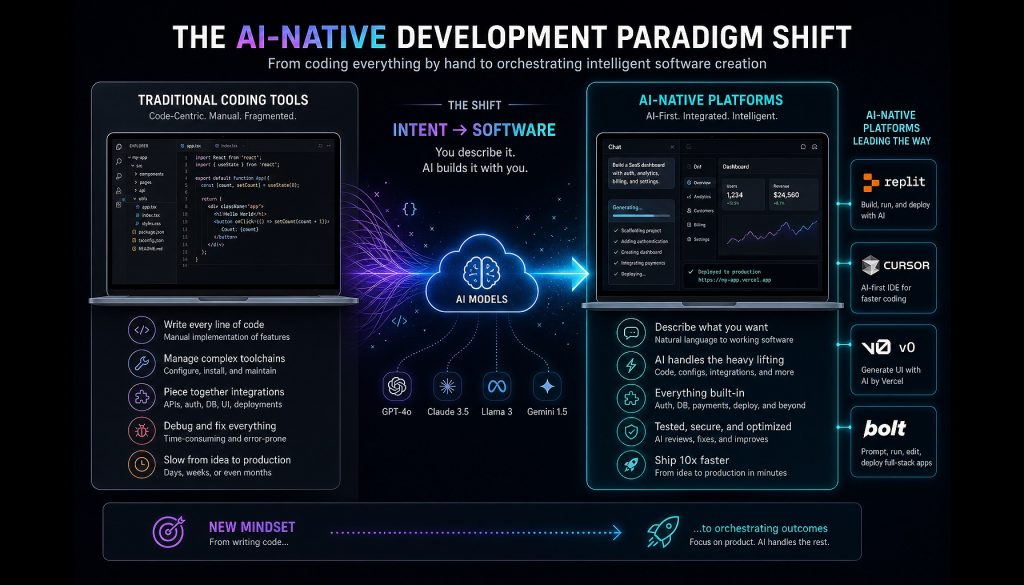
AI-native platforms aren’t just low-code plus AI. They’re a new paradigm for building software. Traditional workflow: product manager writes requirements, developers write code, testers write tests, ops deploys. AI-native workflow: you describe requirements in natural language, AI generates code, tests, deployment configs, AI monitors and optimizes continuously—you review and adjust.
The key difference: AI isn’t an assistant. It’s the primary executor.
2026’s AI-Native Development Platforms
1. Replit Agent: Closest Thing to an AI Programmer
Core capabilities: generates complete apps from natural language requirements, supports multiple languages and frameworks, built-in deployment and hosting, real-time collaboration and debugging. One founder used Replit Agent to build a complete SaaS prototype in 2 hours—user auth, database, payment integration included. Traditional development: at least 2 weeks.
2. v0.dev: Vercel’s AI UI Generator
Generates React components from text descriptions, supports Tailwind CSS and shadcn/ui, deploys directly to Vercel, supports iterative refinement. Best for rapid prototyping, frontend development, design system building.
3. Cursor: AI-Native Code Editor
Built on VS Code but deeply AI-integrated. Understands entire codebase context, AI can refactor across files, supports natural language programming. Best for professional developers, large projects, complex refactoring.
4. Bolt.new: StackBlitz’s Full-Stack AI Dev Environment
Runs complete dev environment in browser, AI generates full-stack apps (frontend + backend + database), supports real-time preview and debugging, exports code to GitHub. Best for rapid prototyping, teaching demos, no-local-environment development.
5. GitHub Copilot Workspace: AI-Driven Development Workflow
Auto-generates PRs from Issues, AI understands entire codebase context, supports multi-file collaborative editing, integrated GitHub ecosystem. Best for team collaboration, open-source projects, enterprise development.
Paradigm Shift: From Writing Code to Managing AI
AI-native platforms bring more than efficiency gains—they transform the developer role.
Traditional developer skills: master programming languages, understand algorithms and data structures, know frameworks and toolchains, debugging and optimization.
AI-native developer skills: prompt engineering (how to clearly describe requirements), architecture design (AI generates code, you design systems), code review (quickly spot issues in AI-generated code), AI collaboration (how to work efficiently with AI).
This doesn’t mean traditional skills are unimportant—the center of gravity has shifted. Like the move from assembly to high-level languages, developers no longer need to manage every detail but focus on higher-level design and decisions.
Real Cases: AI-Native Development Power
Case 1: AI Resume Optimizer
One founder used Replit Agent to build an AI resume optimization tool. Users upload PDF resumes, AI analyzes and suggests improvements, generates optimized resumes, supports user registration and payment. Traditional dev time: 2-3 weeks. AI-native dev time: 2 hours. AI generated 3000+ lines of code, developer modified only 50 lines.
Case 2: Social Media Content Calendar
One marketer with zero coding background used v0.dev plus Cursor to build a social media content calendar tool. Through natural language requirement descriptions, AI generated frontend UI and backend logic. Launched in 1 week, acquired first paying users. Key point: she didn’t need to learn React, Node.js, or databases—just clearly express product requirements.
Case 3: Legacy System Refactor
One enterprise used Cursor to refactor a 100,000-line legacy system—migrated jQuery to React, REST API to GraphQL, refactored database architecture. Traditional refactor time: 6 months (3 full-time devs). AI-assisted refactor time: 2 months (1 dev + AI). AI-generated code passed all unit tests, bug rate lower than manual refactoring.
Limitations of AI-Native Development
AI-native development isn’t a silver bullet.
Complex business logic still needs human design. AI can generate code but can’t understand complex business rules—financial system risk control logic, healthcare compliance requirements, intricate permission management. These require deep human involvement.
Performance optimization needs expertise. AI-generated code is usually functional but not necessarily optimal. For high-concurrency, low-latency scenarios, professional developers still need to optimize.
Security needs human review. AI may generate code with vulnerabilities (SQL injection, XSS, etc.). Before production use, security audits are mandatory.
Depends on AI service stability. If AI services go down or throttle, development workflow is affected. Backup plans needed.
How to Start AI-Native Development?
Step 1: Choose the right platform.
Rapid prototyping: Replit Agent or Bolt.new. Frontend dev: v0.dev. Professional dev: Cursor or GitHub Copilot Workspace.
Step 2: Learn prompt engineering.
Good prompts are the core skill of AI-native development. A clear requirement description lets AI generate high-quality code.
Step 3: Establish code review workflows.
AI-generated code needs review: does functionality meet requirements? Any security vulnerabilities? Acceptable performance? Follows team conventions?
Step 4: Iterate continuously.
AI-native development is iterative. First version may not be perfect, but can be adjusted quickly.
What Will Software Development Look Like in 2027?
If AI-native development continues this trend, 2027 may see:
10x developers become the norm. One developer plus AI can complete the workload of a traditional 10-person team.
Non-technical founders build products independently. Marketers, designers, product managers can directly build products without depending on dev teams.
Software development costs drop dramatically. SaaS product development costs may fall 80%, leading to more startup formation.
Developer role differentiation:
- AI collaborators (focus on working with AI, rapid product delivery)
- System architects (design complex systems, AI handles implementation)
- AI trainers (optimize AI models, improve code generation quality)
Conclusion: Embrace Change, Don’t Resist It
AI-native development doesn’t replace developers. It frees developers from repetitive labor to focus on higher-value work. Like the shifts from assembly to high-level languages, from hand-written HTML to frontend frameworks, each paradigm shift lets developers do more. AI-native development is the next shift.
In 2026, we’re standing at this inflection point. Developers who embrace change will become the new era’s 10x developers. Those who resist may be left behind. Are you ready?
Related Reading
- AI-Native Development Platforms Are Replacing Your Engineering Team
- AI-Native Dev Platforms in 2026: From Code Assistants to AI as Your Engineering Team
Stay updated with our latest AI insights