The AI customer service space just got a lot more interesting. In March 2026, Zendesk acquired Forethought in its largest deal in nearly two decades, sending a clear signal: standalone AI support agents are being absorbed by the platforms they once served.
If you’re evaluating AI agents for your support team right now, you’re facing a different landscape than even six months ago. The independent options are shrinking, platform-native tools are getting better, and pricing models range from $0.99 per resolution to $590K+ per year.
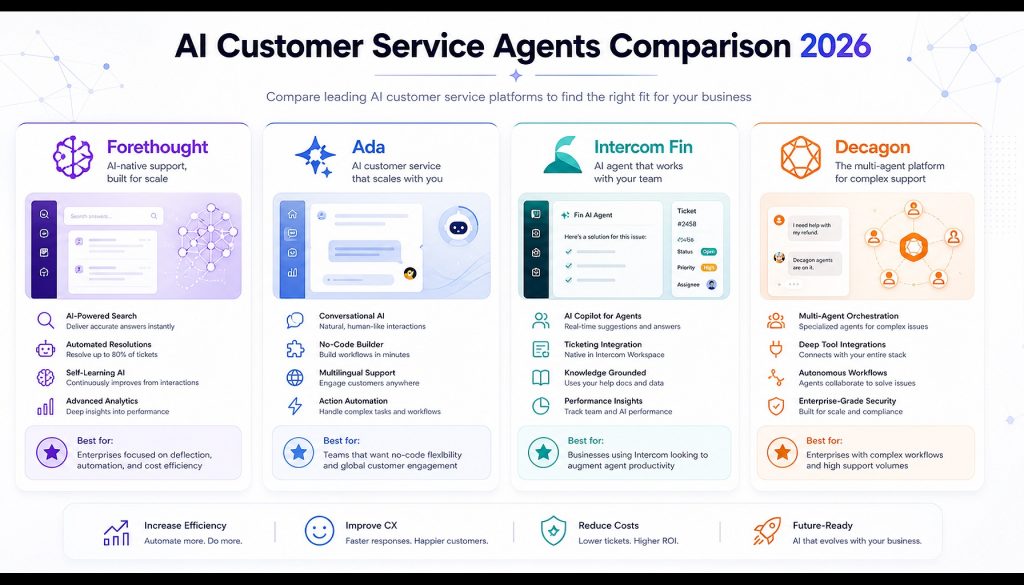
This guide breaks down the four most talked-about AI customer service agents — Forethought, Ada, Intercom Fin, and Decagon — so you can make a decision based on what actually matters: your ticket volume, budget, tech stack, and how much implementation pain you’re willing to tolerate.
The short version: Intercom Fin wins on speed and simplicity. Ada wins on enterprise depth and voice support. Forethought is in limbo post-acquisition. Decagon is the expensive wildcard with cutting-edge features.
Why This Comparison Matters Right Now
The Zendesk-Forethought acquisition isn’t just news for Forethought customers. It marks a turning point in how AI support tools are distributed.
The market is splitting into two layers:
- Platform-native AI: Zendesk AI, Intercom Fin, Salesforce Einstein, Freshdesk Freddy — built into your existing helpdesk, deeply integrated, but locked to that ecosystem.
- Independent AI agents: Ada, Decagon, and (formerly) Forethought — they sit on top of any helpdesk, offering cross-platform flexibility at a premium price.
Zendesk pulling Forethought into the platform layer means one fewer independent option. If platform independence matters to your long-term strategy, your choices just got narrower.
Head-to-Head Comparison
| Feature | Forethought | Ada | Intercom Fin | Decagon |
|---|---|---|---|---|
| Starting price (annual) | ~$59.5K | ~$30K | $0.99/resolution | ~$95K |
| Self-serve signup | ❌ | ❌ | ✅ | ❌ |
| Time to deploy | 30–90 days | 8–16 weeks | Minutes to hours | ~6 weeks |
| Voice support | ❌ | ✅ | ❌ | ❌ |
| Helpdesk integrations | 70+ | 12+ | Intercom-native | 4 |
| Security/compliance | SOC 2 Type II | SOC 2 + HIPAA + PCI | SOC 2 Type II | SOC 2 Type II |
| Independence risk | High (Zendesk-owned) | Low | Low (but Intercom-locked) | Low |
| Best for | Zendesk shops, high volume | Enterprise, multi-channel | SaaS teams on Intercom | Teams paying for cutting-edge |
Forethought: The Acquired Veteran
Forethought has been doing AI-powered ticket automation longer than most. Its core strengths are automatic ticket triage, Tier-1 auto-resolution, and agent assist (surfacing relevant answers to human agents in real time).
What it does well:
- Broad integration library (70+ tools including Zendesk, Salesforce, Intercom, Freshdesk, HubSpot, ServiceNow)
- Proven at high ticket volumes (requires 20,000+ historical tickets to train)
- Mature ticket classification and routing engine
The elephant in the room:
Zendesk says Forethought will continue supporting non-Zendesk customers. But let’s be realistic — a product owned by Zendesk will inevitably prioritize the Zendesk ecosystem. If you’re on Freshdesk or Intercom today, how confident are you that Forethought’s integrations with those platforms will get the same investment in 2027?
Pricing: Starts around $59,500/year. No self-serve. No free trial. Sales-led only.
Deployment: 30–90 days with a dedicated onboarding team.
Best fit: Enterprise teams already on Zendesk with 10,000+ monthly tickets and budget for a long implementation cycle.
Ada: The Enterprise Benchmark
Founded in 2016, Ada is the most mature independent player in this space. With 350+ enterprise customers and a $1.2B valuation, it’s built for organizations that need serious customization and compliance.
What sets it apart:
- Voice support — Ada can handle phone calls, not just chat. Very few competitors offer this.
- Multi-channel coverage — Chat, email, social, voice, all from one platform.
- Enterprise compliance — SOC 2 Type II, HIPAA, GDPR, PCI DSS. If you’re in healthcare or fintech, Ada checks the boxes.
- Deep customization — Complex workflow builders, API actions, conditional logic.
The trade-offs:
- Expensive ($30K–$300K+/year depending on scope)
- Long implementation (8–16 weeks, sales-led)
- Overkill for small teams or simple use cases
Best fit: Organizations with 50,000+ monthly tickets, multi-channel needs (especially voice), and the budget to match.
Intercom Fin: The Fastest Path to AI Support
Fin is Intercom’s native AI agent, built directly into the Intercom platform. If you’re already an Intercom customer, activating Fin is almost frictionless — import your knowledge base, flip the switch, and it’s live.
What makes it compelling:
- Resolution-based pricing ($0.99/resolution) — You only pay when Fin actually solves a ticket. No annual commitment minimum.
- Minutes to deploy — Self-serve activation, no sales calls, no implementation team.
- Seamless Intercom integration — Proactive messaging, conversation routing, and AI handoff all work natively.
- Transparent pricing — Rare in this category where most vendors hide behind “contact sales.”
Where it falls short:
- Almost useless if you’re not on Intercom as your helpdesk
- No voice channel support
- Per-resolution pricing gets expensive fast at high volumes (5,000+ resolutions/month = $4,950+/month)
- Limited cross-platform flexibility
Best fit: SaaS companies already on Intercom with 1,000–10,000 monthly tickets who want AI support running today, not in 90 days.
Decagon: The Expensive Dark Horse
Decagon launched in 2023 and already sits at a $4.5B valuation with 100+ enterprise customers. The product iterates fast, and its feature set is genuinely differentiated — but the price tag reflects that ambition.
What’s genuinely different:
- Knowledge Suggestions — Automatically identifies gaps in your knowledge base based on tickets the AI couldn’t resolve. This turns your AI from a static responder into an active knowledge management tool.
- Watchtower — Real-time monitoring of AI response quality with alerting. You know immediately when the AI is struggling with a new topic.
- Built-in A/B testing — Test different AI response strategies and measure resolution rates.
The concerns:
- Most expensive option ($95K–$590K+/year)
- Young company (founded 2023) — long-term stability unproven
- Only 4 helpdesk integrations (Zendesk, Salesforce, Intercom, Kustomer)
- Small integration ecosystem means less flexibility
Best fit: Enterprise teams willing to pay a premium for cutting-edge AI quality management features, especially if response accuracy is a top priority.
Decision Framework: How to Choose
Rather than a generic “it depends,” here’s a practical decision tree:
Already on Intercom?
→ Start with Fin. Zero-friction activation, pay-per-resolution, turn it off anytime. No reason not to try it.
Need AI handling both chat AND phone calls?
→ Ada is your only real option among these four. Voice support is its unique moat.
On Zendesk with high ticket volume?
→ Watch how the Forethought integration plays out. It still works fine today, but build a Plan B. Consider evaluating Ada or Zendesk’s own AI agent as alternatives.
Want the most advanced AI quality features?
→ Decagon, if budget allows. Knowledge Suggestions and Watchtower are genuinely ahead of the market.
Budget under $30K/year?
→ None of these four (except Fin at low volumes). Look at alternatives like My AskAI ($199/month + $0.10/ticket) or eesel AI ($239/month) for more affordable entry points.
What About Resolution Rates?
Every vendor claims 80%+ automated resolution rates. The reality is more nuanced:
- Industry average: 40–70% automated resolution
- Vendor claims: 80%+ (best-case scenarios with mature knowledge bases)
- What determines your actual rate: Knowledge base quality, ticket complexity, customer demographics, and how strictly you define “resolved”
The tools themselves matter less than your knowledge base. A well-structured, comprehensive help center will perform well with any of these agents. A thin knowledge base will struggle regardless of which $100K platform you buy.
Can AI Agents Replace Human Support?
No. And no vendor honestly claims otherwise.
AI agents excel at repetitive Tier-1 work: password resets, order status checks, feature explanations, billing questions with clear answers. They free up human agents to handle complex escalations, emotional situations, and edge cases that require judgment.
The goal isn’t fewer support staff — it’s support staff spending time on conversations that actually need a human.
The Platform Independence Question
Here’s the strategic question most buyers skip: do you want your AI agent tied to your helpdesk, or independent of it?
Platform-native (Fin, Zendesk AI):
- Deeper integration, less setup friction
- You’re locked in. Switch helpdesks and you lose your AI layer.
- Vendor controls the roadmap entirely.
Independent (Ada, Decagon):
- Works across helpdesks. Switch from Zendesk to Freshdesk and your AI layer survives.
- More expensive, longer setup.
- You retain flexibility.
If you’re confident in your helpdesk choice for the next 3–5 years, platform-native is the path of least resistance. If you’re uncertain or multi-platform, independent agents give you optionality — at a cost.
Bottom Line
The AI customer service agent market in 2026 rewards clarity about what you actually need:
- Speed and simplicity → Intercom Fin
- Enterprise depth with voice → Ada
- Cutting-edge AI quality tools → Decagon
- Already on Zendesk, high volume → Forethought (with caveats)
Don’t buy the most expensive tool hoping it’ll compensate for a thin knowledge base. Start with your documentation, then pick the agent that matches your scale, budget, and platform reality.
Related Reading
- AI Customer Support Chatbot Builders in 2026: Chatbase vs Voiceflow vs Intercom Fin vs Tidio vs Botpress
- Forethought Is Too Expensive: 6 AI Customer Service Alternatives That Cost Less and Deploy Faster
Stay updated with our latest AI insights