Contentful is the incumbent in headless CMS. Stable API, mature ecosystem, enterprise pedigree. It earned its position—reliable infrastructure, strong CDN performance, and a well-documented content delivery API that backend teams trust.
But three friction points are pushing teams to look elsewhere in 2026.
Pricing scales fast. The free tier caps at 5 users and 25K records. The Team plan starts at $489/month. A mid-size content operation easily spends $12K–$24K/year before touching enterprise features like SSO or custom roles. For a 15-person marketing team producing 200+ pieces of content monthly, the bill can reach $30K/year. That’s a meaningful line item that forces hard conversations at budget review time.
Content modeling has a steep learning curve. Content types, fields, references, validations, environments, locales—new team members need a week minimum to internalize the system. The content model editor is powerful but abstract. Non-technical editors struggle to understand why a “reference field” behaves differently from a “link.” That’s fine for a dedicated CMS team at a large org; it’s a blocker for lean startups shipping fast.
Real-time collaboration is stuck in 2018. Multiple editors working on the same entry still hit conflicts. There’s no Google Docs-style live co-editing. No presence indicators showing who’s working on what. For content teams used to Notion or Figma-style multiplayer, it feels like a generation behind.
None of these are dealbreakers in isolation. But combined, they explain why teams with 5–50 people are actively evaluating alternatives. Here are five worth your time—each with a different philosophy and sweet spot.
Sanity: Best for Content Team Collaboration
Core strength: Real-time multiplayer editing + fully customizable studio
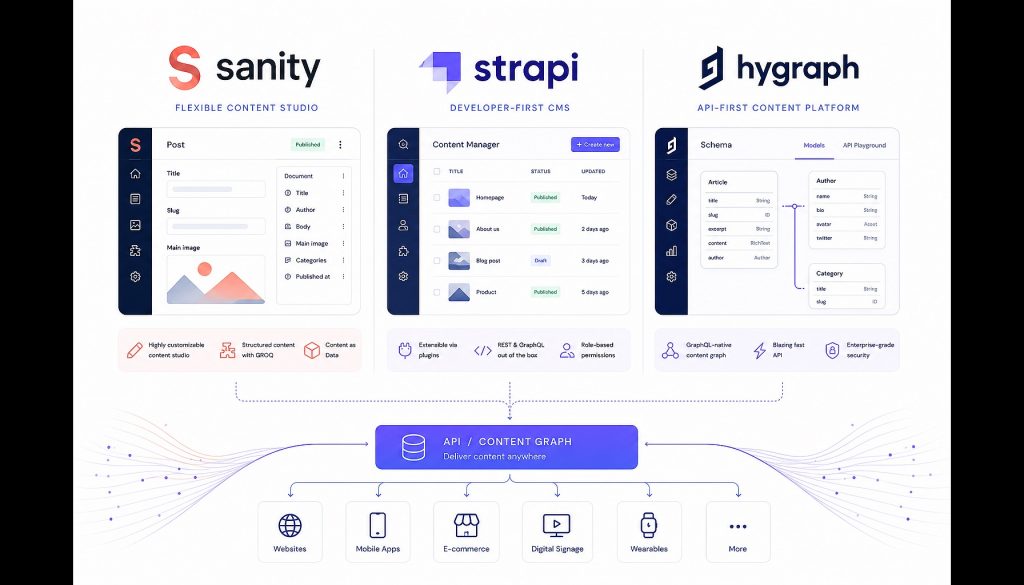
Sanity is the fastest-growing headless CMS in 2026, and the reason is collaboration. Multiple editors can work on the same document simultaneously with changes syncing in real time—no merge conflicts, no “someone else is editing” locks. You can see cursors, selections, and edits from other team members as they happen. It’s the closest any CMS gets to the Figma multiplayer experience.
The content layer uses Portable Text, a structured format that’s more flexible than Contentful’s rich text JSON. Where Contentful gives you a fixed set of rich text node types, Portable Text lets you define arbitrary block types. Developers build custom field components in React: comparison tables, embedded charts, interactive media blocks, code snippets with live preview—whatever the content team needs.
Sanity’s query language, GROQ, is purpose-built for content retrieval. It’s more expressive than REST filtering and lighter-weight than GraphQL for common content operations. The learning curve is about a day for developers comfortable with JSON.
Pricing: Free tier includes 3 users + 10K documents + 500K API requests/month. Paid plans start at $99/month—roughly half of Contentful’s equivalent tier. Overage charges are transparent and predictable.
Best fit: Media sites, marketing teams, multi-author blogs, documentation sites—anywhere content people outnumber developers and need to collaborate daily. Also strong for agencies managing multiple client projects through Sanity’s project-based architecture.
Skip it if: You’re building a pure API backend for a mobile app. Sanity’s editing experience is its differentiator; if nobody opens the studio, you’re paying for value you won’t use. Also consider that GROQ is Sanity-specific—switching away later means rewriting all your queries.
Integrations: Official plugins for Next.js, Gatsby, Nuxt, SvelteKit, and Astro. One-click deploy on Vercel. Native integration with Shopify for headless commerce.
Strapi: Best Open-Source Self-Hosted Option
Core strength: Fully open-source + self-hosted + plugin ecosystem
Strapi is the most mature open-source headless CMS. MIT-licensed, self-deployable to any VPS or Docker environment, with full data ownership. No vendor lock-in, no surprise pricing changes, no “we’re sunsetting your plan” emails.
The admin panel is built in React with a drag-and-drop content type builder that non-technical editors can use immediately. The plugin marketplace has 100+ options covering SEO metadata, i18n with locale fallbacks, advanced RBAC, GraphQL playground, and media optimization—most of what Contentful charges enterprise pricing for.
Strapi v5 (current stable) introduced a document-based content architecture, better TypeScript support, and a redesigned plugin API. The migration from v4 was non-trivial for some teams, but the result is a more modern codebase.
Pricing: Open-source edition is free with no feature gates. Strapi Cloud (managed hosting) starts at $99/month with automatic updates and backups. Self-hosted on a $20–$50/month VPS gives you the identical feature set. For a team of 20, self-hosting saves $1,000+/month versus Contentful.
Best fit: Teams with DevOps capability who want data sovereignty. Common in SaaS products, government projects, healthcare, financial services, and enterprise internal tools where data residency regulations (GDPR, HIPAA adjacency) make cloud-only CMS platforms a compliance headache.
Skip it if: Your team can’t handle database backups, version upgrades, and server maintenance. Self-hosting means you own the uptime. Strapi Cloud mitigates this, but at that price point you’re competing with Sanity and Contentful again.
Integrations: REST API and GraphQL out of the box. Framework-agnostic—works with React, Vue, Svelte, or any frontend. Docker Compose templates available for quick local setup.
Hygraph: Best for GraphQL-Native Projects
Core strength: GraphQL-first architecture + content federation + edge caching
Hygraph (formerly GraphCMS) was purpose-built for GraphQL. Your content model auto-generates a fully typed GraphQL schema with queries, mutations, and filters—no manual resolvers, no schema stitching. If your frontend team already thinks in queries and fragments, Hygraph feels native.
The standout feature is content federation: aggregate multiple data sources (Hygraph + Shopify + Stripe + your custom microservices) into a single GraphQL endpoint. Your frontend makes one query to get product data, pricing tiers, and editorial content together. For e-commerce teams managing 10+ integrations, this eliminates an entire BFF (backend-for-frontend) layer.
Edge caching is built-in and automatic. Content distributes across global CDN nodes with query latency consistently under 50ms. Cache invalidation happens on publish—no manual purging or TTL guessing.
The content editing UI is clean but less customizable than Sanity’s studio. You get a solid structured editor, but don’t expect to build custom React components inside it.
Pricing: Free tier includes 2 users + 1M API calls/month + 100K content entries. Paid plans start at $299/month—more expensive than Sanity or Strapi, but federation and edge delivery are included without add-ons.
Best fit: Teams already committed to GraphQL (Next.js + Apollo, Gatsby, Remix). E-commerce sites that need to combine product catalogs, pricing engines, and editorial content from multiple backends into one API layer.
Skip it if: Your team isn’t comfortable with GraphQL, or your frontend still uses REST. You’d be adopting a new query paradigm and a new CMS simultaneously—that’s two learning curves and double the risk on a single migration.
Integrations: One-click deploys on Vercel, Netlify, and Gatsby Cloud. Native webhooks for CI/CD pipelines.
Payload CMS: Best for Full-Stack TypeScript Teams
Core strength: TypeScript-native + code-first config + built-in auth
Payload emerged post-2023 as the developer-first CMS. Everything is configured in TypeScript—content models are code, not UI clicks. You get full type inference across frontend and backend with zero code generation step.
It ships with user authentication, role-based access control, file uploads, and webhooks out of the box. No plugin hunting for basics that Strapi requires extras for.
Local dev experience is fast: hot reload, complete TypeScript inference, and auto-synced types between API and frontend.
Pricing: Open-source and free. Payload Cloud (managed hosting) starts at $30/month—significantly cheaper than any competitor’s hosted tier.
Best fit: Full-stack developers building MVPs, startup engineering teams, and technical content sites where the dev team owns the CMS.
Skip it if: Your content team expects a polished admin UI rivaling Contentful or Sanity. Payload’s admin panel is functional but less refined for non-technical users.
Integrations: Official Next.js App Router template. Vercel deployment supported.
Directus: Best for Wrapping Existing Databases
Core strength: Instant API layer on any SQL database + raw SQL access
Directus takes a fundamentally different approach. It’s not a standalone CMS—it’s a management layer you put on top of an existing MySQL or PostgreSQL database.
Got a production database that’s been running for two years? Point Directus at it. You instantly get a REST API, a GraphQL API, and an admin dashboard—no data migration required.
Complex multi-table joins, aggregations, and custom queries? Write native SQL. You’re never limited by CMS abstraction layers.
Pricing: Open-source and free. Directus Cloud starts at $15/month—the cheapest managed option in this list.
Best fit: Projects with existing databases, complex relational data, or internal tools. Also strong for teams that need both a CMS interface for editors and raw database access for developers.
Skip it if: You’re starting from scratch with no existing data. For greenfield projects, Strapi or Payload give you a more guided setup experience.
Integrations: Standard REST and GraphQL APIs. Works with any frontend framework.
Comparison Table
| Feature | Sanity | Strapi | Hygraph | Payload CMS | Directus |
|---|---|---|---|---|---|
| Hosting | Cloud | Self-hosted or Cloud | Cloud | Self-hosted or Cloud | Self-hosted or Cloud |
| Open Source | Partially (Studio) | Yes (MIT) | No | Yes (MIT) | Yes (GPL) |
| API Type | GROQ + GraphQL | REST + GraphQL | GraphQL | REST + GraphQL | REST + GraphQL |
| Real-time Collab | Yes | No | No | No | No |
| TypeScript Native | Partial | Partial | No | Yes | No |
| Free Tier | 3 users, 10K docs | Unlimited (self-host) | 2 users, 1M calls | Unlimited (self-host) | Unlimited (self-host) |
| Paid Starting Price | $99/mo | $99/mo | $299/mo | $30/mo | $15/mo |
| Best For | Content teams | Data sovereignty | GraphQL projects | Dev-first MVPs | Existing databases |
How to Choose
The decision depends on your team composition and existing stack:
Budget-constrained with DevOps capability → Strapi. Free, open-source, full control.
Content team collaborates daily → Sanity. Real-time editing is genuinely better than anything else on this list.
Frontend already uses GraphQL → Hygraph. Native GraphQL with content federation saves significant integration work.
Full-stack TypeScript team shipping fast → Payload CMS. Code-first config with the cheapest cloud tier available.
Existing database you can’t migrate → Directus. Wrap what you have, get an API in minutes.
Need enterprise compliance (SOC 2, RBAC audit logs, SSO)? Contentful still has the edge here. If your procurement team requires these checkboxes, staying with Contentful is defensible.
For everyone else—mid-size teams, developer-led projects, startups watching burn rate—the alternatives above deliver better developer experience at lower cost. The headless CMS market in 2026 has moved past feature parity. The differentiator now is how fast your team can go from idea to production.
Stay updated with our latest AI insights