Kevin O’Leary wanted to build a $100 billion data center complex in Utah. Forty thousand acres — roughly two Manhattans worth of desert turned into server farms.
The locals showed up to planning meetings in numbers that overwhelmed the venue. Lawsuits followed. The state scrambled to rewrite its approval process. O’Leary accused opponents of being “professional protesters” and hinted at Chinese government funding behind the opposition. Two local women responded with a satirical video that went viral.
This is not an isolated incident. In 2025, $156 billion worth of data center projects were blocked or delayed by community opposition. Through the first half of 2026 alone, another $98 billion in projects have stalled.
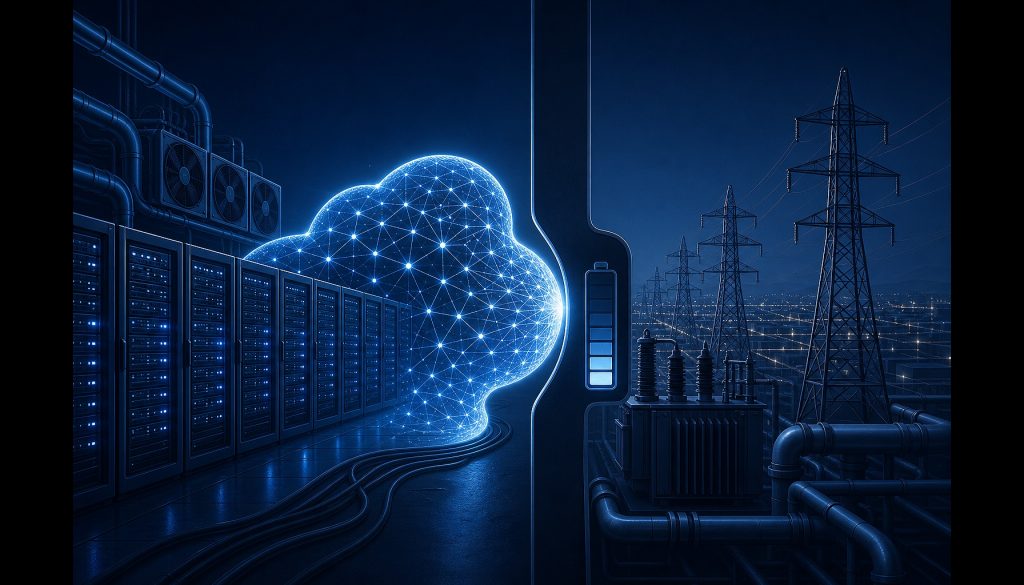
While the tech industry talks about AI transforming everything, the actual expansion is running into constraints that no amount of venture capital can solve: land, water, and electricity.
Physical Constraints Are Harder Than Code
A recent UN research report projects that AI data center power and water consumption will double by 2030.
The specific numbers are stark. A mid-sized data center uses as much water daily as a small town. Large facilities require 5 million gallons per day — enough to supply 50,000 people. AI-driven rack power density has jumped from 8 kilowatts in 2021 to over 50 kilowatts in 2026.
Software optimization cannot fix this.
Howell, Michigan rejected a Fortune 100 company’s data center proposal for a blunt reason: so many residents showed up to oppose it that the meeting room couldn’t hold them. A Virginia-based writer admitted in a Washington Post column: “I’ll be honest — on data centers, I’m a NIMBY.”
Florida has sued OpenAI. Regulation is shifting from “should we govern this?” to “how do we cap it?”
The fundamental mismatch: tech companies expand at software speed, but physical infrastructure moves at construction speed. Grid upgrades take 3-5 years. Nuclear plants need 10-20 years from planning to operation. AI companies want answers by next quarter.
BYOP: The Absurdity of Bring Your Own Power
Electricity has become the binding constraint.
The industry’s response is “BYOP” — Bring Your Own Power. Data center developers now scout locations with available generation capacity, build their own power plants and substations, then construct the actual computing facilities.
O’Leary’s other project, Wonder Valley in Alberta, Canada, plans to self-supply with 7.5 gigawatts of natural gas generation. That’s enough electricity for 7.5 million homes.
The obvious question: if tech companies are building their own power infrastructure, what’s the grid even for?
Nuclear is the more dramatic version of this trend. Eighteen “nuclear-powered AI data center” projects are currently in development, totaling 31.2 gigawatts of planned capacity. Microsoft is restarting Three Mile Island — the same facility that nearly melted down in 1979.
Engineers on Hacker News and Twitter have been blunt about the timeline problem: “Nuclear permitting starts at 10 years minimum. Insurance companies won’t touch these projects. By the time you’re operational, AI architectures may have iterated three generations.”
One data center investor put it more directly: “Our strategy right now is simple — control land that has power, regardless of where it is. You can run fiber, you can grade land, but you cannot buy electricity that doesn’t exist.”
Power is shifting — literally — toward whoever controls physical resources.
Who’s Pushing, Who’s Blocking
This conflict isn’t technology versus Luddites. The reality is messier.
The push side is straightforward: tech giants (Alphabet announced an $80 billion AI infrastructure plan), data center developers, and local governments hungry for tax revenue and jobs.
The opposition is more complex. Utah’s resisters aren’t environmental organizations — they’re regular residents worried about water (Utah is already arid), disappearing farmland, and the character of their communities changing overnight.
Writing in The Guardian, Astra Taylor and Saul Levin noted: “The $156 billion blocked in 2025 will be a smaller number than 2026’s total. This isn’t just a tech issue — it’s a democracy issue.”
The structural tension: the federal government pushes AI competitiveness (the Trump administration issued executive orders streamlining data center approvals), but land use, zoning, and utility regulation sit at the state and local level. Washington says “national strategy.” Utah residents say “my well is going dry.”
The interest map breaks down clearly:
- Tech companies need expansion to maintain valuations and market position
- Investors need AI infrastructure returns (Anthropic’s IPO filing is a signal)
- Local residents need to protect existing quality of life
- State governments are caught between tax revenue and voter backlash
Fortune reported that in some Republican strongholds, opposing data centers has become a viable campaign position. One organizer said: “This was never red versus blue. It’s people who live here versus people who want to industrialize it.”
With 2026 midterms approaching, the political weight of this issue is still growing.
History Rhymes: New Technology Meets Old Constraints
This pattern isn’t new.
Nineteenth-century railroad expansion triggered land acquisition battles that filled courthouses for decades. Early twentieth-century grid buildout took 30 years to reach rural areas. 1990s fiber optic deployment hit “last mile” community resistance at every turn.
The script is always the same: proponents invoke national interest and economic inevitability; locals ask why they should bear the cost.
But there’s a critical difference: AI’s resource consumption curve is exponential.
A railroad, once built, is a fixed asset. Fiber, once laid, serves for decades. But AI models demanding double the compute every 18 months means today’s data center may need expansion or replacement within three years.
This isn’t a one-time infrastructure investment. It’s continuously accelerating resource consumption.
The Atlantic reported on a case in Chile where a Google data center consumed 1,000 times the water of the entire neighboring town’s population. Residents only discovered what was happening when their water pressure dropped — they hadn’t been told an “algorithm factory” was being built next door.
The UN report made a point that investors are starting to internalize: AI is not merely digital technology. It is “a material system with measurable environmental costs.” Power, carbon emissions, water, and land occupation should be treated as “material risks in any AI infrastructure investment portfolio.”
Wall Street is beginning to listen.
The Contrarian Take: AI Hits Its Ceiling at the Grid, Not the Algorithm
The mainstream narrative says AI’s bottlenecks are algorithmic breakthroughs, data quality, and regulatory policy.
I think the real ceiling is grid capacity.
Ropes & Gray’s 2026 investment report stated it plainly: the competitive advantage in data center investment is not technology — it’s “BYOP strategy and early site control.” Translation: whoever secures power wins.
The implications cascade:
Geographic redistribution is forced, not chosen. O’Leary picked Utah not for Silicon Valley talent proximity, but because it has land, sun (for solar), and low population density (meaning relatively fewer opponents). Expect more AI infrastructure in energy-rich, population-sparse regions — West Texas, Northern Canada, Scandinavia, the Middle East.
Tech companies become energy companies. Microsoft restarting a nuclear plant is the beginning. Next comes acquisitions of power utilities, direct investment in generation projects, and lobbying to rewrite energy regulation. The line between Big Tech and Big Energy is dissolving.
The most aggressive prediction: by 2028-2030, electricity will surpass chips as the dominant cost in AI training. GPUs are expensive but they’re a capital expenditure — you buy them once. Electricity bills accumulate by the hour. When that crossover happens, AI competition shifts from “whose model is smartest” to “whose power is cheapest.”
Gartner’s VP analyst warned: “Disruptions in energy availability will constrain new data center growth for generative AI and other uses.”
Put simply: the most advanced algorithm in the world is worthless without electricity to run it.
What This Means in Practice
For investors: Stop fixating exclusively on model companies. Look at who’s solving the power problem. Data center REITs, power infrastructure plays, and small modular reactor (SMR) projects may offer more durable returns than the next foundation model startup.
For tech workers: Your company may scale back AI projects not because of budget cuts, but because it can’t secure power. “We don’t have the money” becomes “we don’t have the megawatts.” This isn’t speculative — it’s already happening at mid-tier cloud providers.
For founders: Edge AI and local models deserve serious attention. As cloud compute prices rise due to power constraints, small models that run on user devices gain a structural cost advantage. The open-source shift toward compact multimodal reasoning systems isn’t purely a technical preference — it’s a resource reality.
For everyone else: Pay attention to data center proposals in your region. This isn’t an abstract tech topic. It directly affects your water bill, electricity rates, and property taxes. Utah residents pushing back aren’t anti-technology — they’re exercising basic democratic agency over local resource allocation.
The broader point: stop believing the “infinite AI scaling” narrative. Physical systems have hard limits, and those limits don’t bend for funding announcements or stock price momentum.
Where This Lands
In June 2026, O’Leary finally conceded, agreeing to cut the Utah project’s footprint by 75%. His words: “I screwed up.”
That admission may preview what the broader AI industry faces in the next few years.
The past five years demonstrated AI’s exponential growth in digital space. The next five will show that growth curve hitting physical walls: insufficient grid capacity, strained water supplies, escalating community opposition, and tightening regulation.
AI development won’t stop. But it will be forced to change shape. More efficient models, smaller inference systems, distributed rather than centralized architectures — these aren’t idealistic technical choices. They’re the inevitable response to resource constraints.
Three predictions for 2027-2030:
- At least one major tech company delays a flagship AI product launch due to power availability
- “Energy efficiency” displaces “parameter count” as the primary competitive metric for AI models
- Data center siting logic flips from “proximity to users” to “proximity to power”
AI expansion hasn’t ended. But the era of unconstrained scaling is over.
The physical world is applying the brakes — and it’s a harder stop than any regulator could impose.
Related Reading
- The Grid Won't Keep Up: How Physical Reality Is Throttling AI's Expansion
- From Pixels to Physics: NVIDIA Cosmos 3 and the End of AI Reality Gap
Stay updated with our latest AI insights