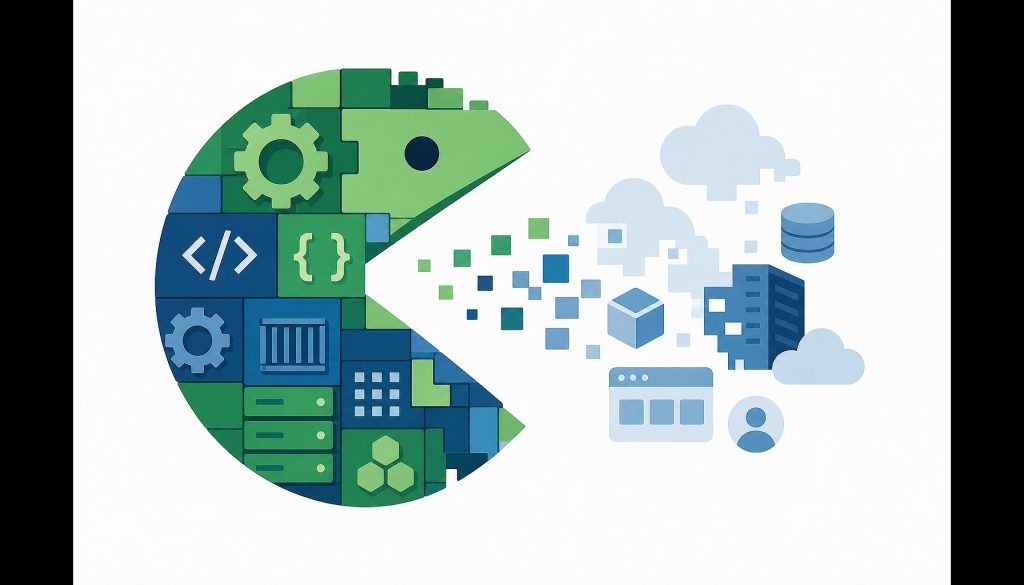
In March 2026, Spotify announced the full migration of its infrastructure codebase from Terraform to OpenTofu, cutting annual licensing costs by over $1.8 million. The same month, Meituan completed a data pipeline migration from Fivetran to Airbyte, reducing operational spend by 63%. These aren’t isolated incidents. A quiet but decisive shift is underway at the infrastructure layer — and it’s rewriting the economics of cloud computing.
One License Change, One Mass Exodus
When HashiCorp switched Terraform’s license from MPL 2.0 to BSL (Business Source License) in August 2023, few predicted it would become a watershed moment for the entire cloud industry. Three years later, that decision didn’t just ignite open-source community anger — it detonated a decade of accumulated corporate frustration with vendor lock-in.
OpenTofu’s birth was almost immediate. By September 2023, the Linux Foundation had taken stewardship of the project, with IBM, Oracle, and Spacelift joining as backers. The project hit 18,000 GitHub stars in its first month. Community contributors surpassed Terraform’s five-year contributor total within six months.
The real inflection point came in late 2024. OpenTofu 1.8 achieved full compatibility with Terraform 1.5 while introducing state encryption, dynamic provider registration, and other enterprise-grade features that Terraform itself lacked. Datadog, GitLab, and Cloudflare all announced migration plans. By early 2026, OpenTofu held 47% market share in new deployment scenarios — the first time Terraform lost its absolute dominance.
The migration path turned out to be surprisingly smooth. OpenTofu’s automated conversion tooling handles 90% of Terraform code with zero modifications. More critically, the Linux Foundation’s governance model eliminated license risk concerns for enterprise legal teams — historically the hardest barrier in technology selection decisions.
The Data Pipeline Reckoning
Airbyte’s trajectory illustrates the deeper logic at work. Founded in 2020, the company now handles 23% of enterprise data integration workloads globally. Its competitors — Fivetran (valued at $5.6 billion) and Stitch (a Talend subsidiary) — represent the classic closed-source SaaS model at its most entrenched.
The pricing gap alone gets CFOs’ attention: Fivetran’s per-row billing model puts the cost of processing 100 million rows per month somewhere between $25,000 and $40,000. Airbyte’s self-hosted open-source version costs essentially nothing to run; the managed cloud version comes in at 30-40% of Fivetran’s price.
But price isn’t the primary migration driver. Control is.
ByteDance’s case is instructive. In mid-2025, their engineering team discovered that Fivetran imposed undisclosed rate limits and data sampling policies on certain API connectors, causing real-time analytics delays. After migrating to Airbyte, the team built a custom connector in three weeks, cutting data freshness from 15 minutes to 90 seconds. That kind of customization is structurally impossible in closed-source tooling.
The deeper current is data sovereignty. As GDPR, China’s Data Security Law, and US state privacy regulations tighten, enterprises are recognizing that routing sensitive data through third-party SaaS by default is itself a compliance liability. Airbyte’s self-hosted model keeps sensitive data inside the network perimeter — now a baseline requirement in financial services and healthcare.
Vendor Lock-in: The Elephant That Won’t Leave
This open-source wave isn’t fundamentally about technology. It’s about a collapse in trust.
AWS optimized Lambda cold-start times from 200ms to 50ms in 2024 — but only for functions running on Graviton processors with specific memory configurations. GCP’s BigQuery introduced “intelligent pricing” in 2025, which in practice means a black-box algorithm tied to query complexity that produces 40% monthly bill variance. Azure adjusted virtual network pricing three times in 2026, each time with documentation updates lagging weeks behind.
Cloud vendors seem to have forgotten that their customers are CTOs and architects — people whose daily job is calculating risk and cost. When pricing rules become complex functions that require ML models to predict, when core APIs ship breaking changes annually, “cloud convenience” starts looking a lot like “convenience-as-hostage.”
MongoDB’s 2018 license change to SSPL remains a cautionary tale. The intent was to block cloud vendors from free-riding. The result: AWS launched DocumentDB (MongoDB API-compatible but not MongoDB), Azure shipped Cosmos DB, the community fractured, and MongoDB’s market cap dropped 40%. The lesson was clear to everyone watching — in the cloud era, open source isn’t a moral stance. It’s a survival strategy.
The Rise of the Hybrid Model
Here’s the 2026 reality: pure open source doesn’t generate revenue; pure closed source doesn’t generate trust. A new equilibrium has emerged.
OpenTofu runs on a “core open source + enterprise add-on” model. Base functionality is fully free. The enterprise tier provides policy engines, audit logging, and SAML integration at $50,000-$200,000 per year scaled to infrastructure size. The key detail: all enterprise code is also open source — the license only restricts commercial redistribution. Customers can audit security while OpenTofu maintains sustainable revenue.
Airbyte is more aggressive. Their model combines managed services with expert consulting. The open-source version is feature-complete, but the cloud-managed version adds auto-scaling, multi-region deployment, and 24/7 support. 2025 revenue hit $42 million — 70% from cloud hosting, 25% from implementation consulting. Founder Michel Tricot’s logic is straightforward: “We don’t monetize by restricting features. We monetize by saving customers time.”
This pattern is now standard. Grafana, Temporal, and Materialize all run similar playbooks. The result: open-source projects get commercial-grade R&D investment (Airbyte has 120 employees) while preserving community innovation velocity (600+ external contributors).
The contrast with traditional closed-source SaaS is stark. Terraform Cloud’s renewal rate dropped 18% in 2025. Fivetran’s new customer growth rate fell from 85% in 2023 to 23% in 2026. The products aren’t worse — the trust is gone.
What Migration Actually Costs
Romanticizing open source is dangerous. Real-world migration data tells a more complicated story.
| Factor | Managed SaaS (Terraform Cloud / Fivetran) | Self-hosted OSS (OpenTofu / Airbyte) |
|---|---|---|
| Software license cost | $200K-$800K/yr | $0 (core) or $50K-$200K (enterprise) |
| Migration timeline | N/A | 2 weeks (code) + 2-4 months (toolchain) |
| Ongoing headcount | 0 additional | 1-3 SREs dedicated |
| Support SLA | 4-hour response | Community (days) or paid enterprise |
| Compliance liability | Shared with vendor | Fully internal |
| Customization | Limited / impossible | Full control |
| Total 3-year TCO (mid-market) | $600K-$2.4M | $300K-$900K |
A multinational retailer that migrated from Terraform Cloud to self-hosted OpenTofu completed infrastructure code migration in two weeks — but toolchain integration (CI/CD pipelines, security scanning, cost analysis) took four months. They saved $600,000 in annual fees but invested three full-time engineers and $150,000 in external consulting upfront.
Operational burden is the hidden cost. SaaS value isn’t just the software — it’s “someone else worries about it.” Self-hosting Airbyte means managing databases, monitoring, backups, upgrades, and security patches yourself. One mid-stage SaaS company’s DevOps lead put it bluntly: “We saved on Fivetran’s bill but hired 1.5 additional SREs. The first two years were actually more expensive.”
Compliance responsibility also shifts. When Fivetran has a data breach, there’s a vendor to hold accountable. When your self-hosted Airbyte instance leaks data, the board is looking at you. A financial services CISO was direct: “I don’t mind paying more. I mind explaining to the board why we didn’t use the established solution.”
Looking Ahead: What 2028 Probably Looks Like
From mid-2026, the two-year outlook is coming into focus:
Open-source infrastructure will account for 60-70% of new deployments. But not “pure” open source — hybrid models with open cores and commercial wrappers. Most enterprises will opt for managed versions. Only top-tier tech companies will have the capacity to fully self-host.
Vendor lock-in will return in subtler forms. Cloud vendors have adapted. They won’t lock APIs — they’ll lock data gravity. AWS will happily let you move your Lambda functions elsewhere. But migrating petabytes out of S3? The egress costs and transfer time alone will deter most organizations. The next generation of lock-in targets data lakes, feature platforms, and vector databases.
Open-source licensing will keep fragmenting. BSL, SSPL, and Elastic License 2.0 — these “almost open” licenses are becoming standard. Pure MIT/Apache 2.0 is increasingly rare as project maintainers learn to protect their commercial interests. We may see “delayed open source” models emerge — code released under restrictive licenses that automatically convert to MIT after 12 months.
Regulators will step in. The EU is already drafting “infrastructure portability” rules requiring standardized migration interfaces from cloud vendors. The US FTC is examining anti-competitive behavior in cloud computing markets. China’s domestic technology policies structurally favor open-source adoption. Within five years, open source may shift from technology preference to compliance requirement.
The biggest wildcard is AI. As infrastructure embeds large models — intelligent scheduling, automatic optimization, predictive scaling — can open-source communities keep pace? Training GPT-5 required 200,000 GPUs, a scale of compute that open-source projects will never match independently. The next wave of lock-in may not be in code at all. It may be in model weights.
The Bottom Line
The 2026 open-source infrastructure wave is, at its core, a redistribution of power.
For the past decade, cloud vendors and SaaS giants turned “convenience” into a taxation right — use our services, accept our pricing, our constraints, our timeline. OpenTofu and Airbyte aren’t a technology revolution. They’re a simple declaration: infrastructure should be a public good, not a rented black box.
But this isn’t a binary war. Spotify migrated to OpenTofu while still running on AWS EKS. ByteDance self-hosts Airbyte while their data warehouse runs on Alibaba Cloud. Real-world architecture is a mosaic, not a manifesto.
What has genuinely changed is mindset. In 2020, a CTO would ask: “Why would we build this ourselves?” In 2026, the question is: “Why can’t we?” That shift in framing is more powerful than any single line of code.
Open-source infrastructure won’t “devour” the cloud. The two will coexist, compete, and converge. But from here forward, vendors need to remember: lock-in carries a price, and code has a long memory. The moment you change a license from MPL to BSL, you’re not protecting a business model — you’re casting a vote for the fork.
The question that will persist: Who controls the tools we use to build the future?
The answer is being written in code, one commit at a time.
Related Reading
- The Post-Vendor Lock-In Playbook: OpenTofu, Airbyte, Open Source Infrastructure 2026
- Open Source Infrastructure in 2026: Post-Vendor Lock-in Era
Stay updated with our latest AI insights