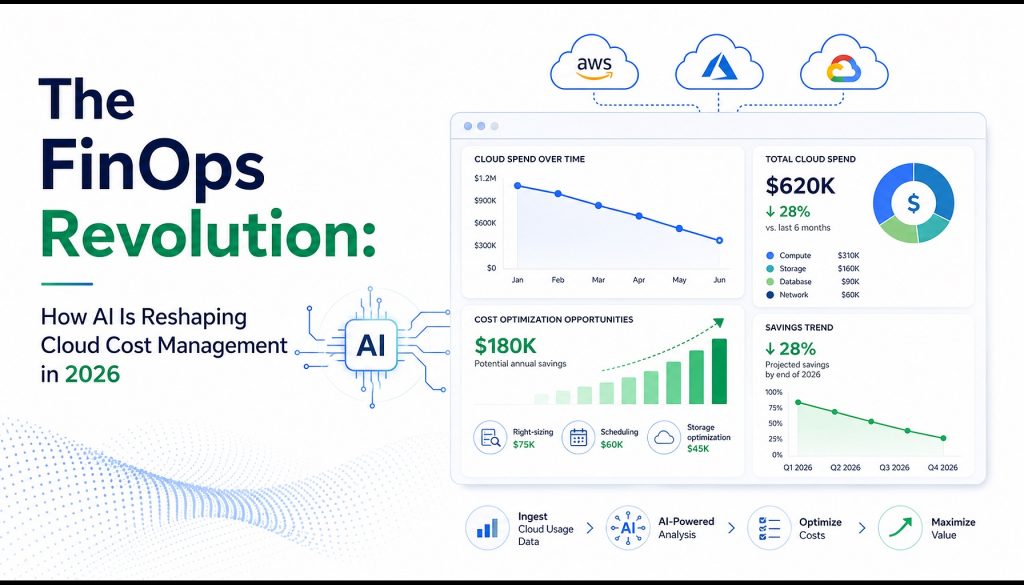
Cloud bills in 2026 aren’t just getting bigger — they’re getting unpredictable.
Spendark’s latest report puts global cloud waste at over $100 billion, with compute resources accounting for 35% of that figure. AWS started charging $3.65/month for every public IPv4 address in February. Sounds trivial until you’re running hundreds of load balancers and EC2 instances, and your bill jumps by tens of thousands overnight. Azure followed suit in July 2025. Worse, AI workloads have made cost forecasting nearly impossible. A single inference call can trigger a dozen downstream requests, and GPU instance pricing fluctuates at multiples of traditional compute.
Here’s the inflection point: the FinOps Foundation’s 2026 report shows that 98% of organizations now include AI spending in their FinOps practice — up from 31% just two years ago. That’s not incremental growth. That’s a paradigm shift. AI isn’t just the source of the cost problem anymore; it’s becoming the core of the solution.
Three Directions for AI-Driven FinOps
1. Automated Optimization: From Recommendations to Execution
Legacy FinOps tools tell you “this instance could be smaller” and wait for you to act. AI-native tools act for you.
Rightsizing: Vantage’s FinOps Agent monitors actual utilization and automatically flags over-provisioned resources. Kubecost does the same at the Kubernetes layer, delivering container-level cost visibility and pod rightsizing recommendations.
Spot Instance Management: Spot.io (now part of NetApp) and Cast AI use ML algorithms to shift workloads between spot, on-demand, and reserved instances automatically. Spot instances save 60–80%, but the cloud provider can terminate them at any moment. AI finds the balance between risk and reward.
Reserved Instances and Savings Plans: ProsperOps and Usage.ai specialize in automating commitment purchases. They analyze historical usage, predict future demand, and buy Reserved Instances (1–3 year commitments, 30–70% savings) or Savings Plans without human intervention.
Cloudchipr operates across multi-cloud environments, covering AWS, Azure, and GCP under a single optimization engine. Its AI identifies unused resources — unattached disks, stale snapshots, zombie load balancers — and recommends cleanup actions.
2. Predictive Analytics: Seeing Tomorrow’s Bill Today
Cost anomaly detection is table stakes for 2026 FinOps platforms. Oracle Cloud shipped its Cost Anomaly Detection feature in January, continuously monitoring daily spend and alerting on abnormal patterns. Simple in concept, but the implementation combines time-series forecasting, clustering, and deep learning — the model has to learn the “seasonal rhythm” of your business operations before it can accurately flag deviations.
Vantage pushes real-time anomaly alerts through Slack, Teams, or email, paired with root cause analysis. Finout and Amnic go further with AI-agent-driven RCA that doesn’t just tell you costs spiked — it pinpoints which Kubernetes namespace, which AWS service, even which specific API call caused the spike.
Forecasting: CloudZero and Ternary use machine learning to project future cloud spend. This matters for budget planning — no CFO wants to discover at quarter-end that cloud costs ran 40% over forecast. Predicting AI workload costs is particularly difficult because agent architectures introduce non-deterministic execution paths.
3. Policy Enforcement: Letting Machines Make Decisions
The most aggressive direction is fully autonomous cost management.
Auto-shutdown: Sedai and Cast AI detect idle resources and shut them down automatically. Dev environments go dark from 8 PM to 8 AM and on weekends. This sounds obvious, but most companies don’t do it because manual management is tedious at scale.
Dynamic Scaling: Zesty Disk auto-adjusts EBS volume sizes to match actual usage. Kompass (also from Zesty) handles Kubernetes pod rightsizing and spot management.
Autopilot Mode: Vantage’s Autopilot handles Savings Plan purchases with zero human input. nOps offers similar ML-driven optimization integrated into DevOps workflows. This is the endgame vision: engineers focus on building products while AI handles cost efficiency.
The New Challengers: Who’s Disrupting Legacy FinOps
Enterprise incumbents — IBM Cloudability, VMware CloudHealth, Flexera — face pressure from a wave of AI-native startups.
| Tool | Focus Area | Key Strength |
|---|---|---|
| Cloudchipr | Multi-cloud waste elimination | Scans AWS, Azure, GCP; identifies unused resources across providers |
| Vantage | Full-stack cost visibility | 20+ native integrations (cloud, K8s, Snowflake, Databricks, OpenAI, Anthropic); virtual tagging; unit cost tracking |
| Kubecost | Kubernetes cost management | Namespace/deployment/pod-level visibility; Prometheus integration; IBM’s Kubecost 3.0 adds AI workload visibility |
| Usage.ai | Commitment optimization | Continuous Savings Plan/RI adjustment to match actual consumption |
| Finout | Unified FinOps platform | Positions as “FinOps OS” — cloud, K8s, AI, SaaS, shared costs under one roof |
| ProsperOps | Automated commitment buying | Autonomous RI/Savings Plan purchasing based on ML demand forecasts |
What these tools share: they don’t just produce dashboards. They execute. The gap between “insight” and “action” that plagued first-generation FinOps is closing.
Challenges and Risks: AI Is Not a Silver Bullet
At FinOps X 2026, every major vendor had some flavor of AI story. But AI-driven cost management comes with real problems.
AI Recommendations Aren’t Always Right
ML models need time to learn your business patterns. If your traffic has strong seasonality — think e-commerce Black Friday peaks — the model needs at least a year of data to learn that cycle. Before then, it may incorrectly flag normal seasonal surges as “anomalies.”
Research presented at ICLR 2026 identified five core challenges with AI agent architectures in production: latency from sequential API calls, token costs, error cascades, brittle topologies, and poor observability. Gartner predicts that by end of 2027, more than 40% of agentic AI projects will be shelved or canceled due to rising costs, unclear business value, or insufficient risk controls.
The Over-Automation Trap
Fully autonomous cost optimization sounds great until it shuts down something you need.
Picture this: an automation tool detects that a dev environment has zero weekend activity, so it powers down. An engineer working Saturday to fix a production incident finds the dev environment unavailable. Or worse: the system decides to move production workloads from on-demand to spot instances for savings, and those spot instances get terminated during a traffic spike.
This is why most organizations still take a cautious approach to full autonomy. The dominant pattern remains “AI recommends, human approves” — AI generates optimization suggestions, but execution requires human sign-off.
Tool Sprawl
The FinOps tool market is a jungle. Usage.ai’s guide identifies four categories of cloud cost problems, each with different tool classes: commitment overspend, idle and over-provisioned resources, Kubernetes cost allocation, and visibility/governance. Most teams run two to three tools in combination.
This creates its own complexity: separate dashboards for different environments, reconciliation work that consumes weeks of analyst time, and allocation models that lag behind organizational reality. Finout positions itself as the unifying layer, but a single pane of glass remains the exception, not the norm.
The Road Ahead: Will FinOps Become an AI Agent’s Job?
The 2026 trajectory is clear: FinOps is shifting from manual processes to systems and automation. As nOps puts it: “2026 rewards teams that scale FinOps through systems and automation, because manual cost management can’t keep pace with the new shapes and velocity of cloud spend.”
But fully autonomous FinOps remains a few years out. Today’s reality is hybrid: AI handles data-intensive work (scanning thousands of resources, analyzing usage patterns, detecting anomalies), humans handle judgment-intensive work (defining risk tolerance, approving major changes, setting business priorities).
The FinOps Foundation report shows AI cost management as the most in-demand skill set across organizations of every size — reflecting both the rapid growth of AI-related spending and the complexity of understanding and allocating those costs. Even at the highest spend levels, FinOps teams remain lean. Automation isn’t optional; it’s survival.
What to Do Now: A Practical Playbook
If you’re a CFO or engineering leader, here’s the 2026 FinOps strategy that makes sense:
- Establish visibility first. Before optimizing, know where money goes. Pick a platform with multi-cloud and Kubernetes coverage. Vantage, Finout, and Cloudchipr are solid starting points.
- Start with low-risk automation. Let AI handle obvious waste — unattached disks, expired snapshots, zombie load balancers. These are reversible, low-risk operations with immediate ROI.
- Build dedicated AI workload cost tracking. AI spending is growing faster than traditional cloud spend. Use tools that integrate with AI services (OpenAI, Anthropic, Databricks) and establish unit cost metrics — cost per inference, cost per agent invocation.
- Invest in skill development. AI cost management is the most demanded FinOps skill in 2026. Train your team on AI workload cost dynamics or hire people with that experience.
- Keep humans in the loop for critical decisions. Full autonomy works for low-risk scenarios. Anything that could impact production or involves significant financial commitments still needs human approval.
The future of FinOps isn’t “AI or humans.” It’s “AI plus humans.” Machines handle scale; people provide judgment. Organizations that find this balance will win the cloud cost war in 2026 and beyond.
Cloud spend won’t stop growing. But as AI-driven FinOps tooling matures, growth can finally become predictable and controllable.
Stay updated with our latest AI insights